
PHOTOGRAPHS & PARAGRAPHS


Journal: 2022
[Dates reflect days on which entries are posted.]
∼ July 25, 2022 ∼ “Little Calumet River Trail in Summer”
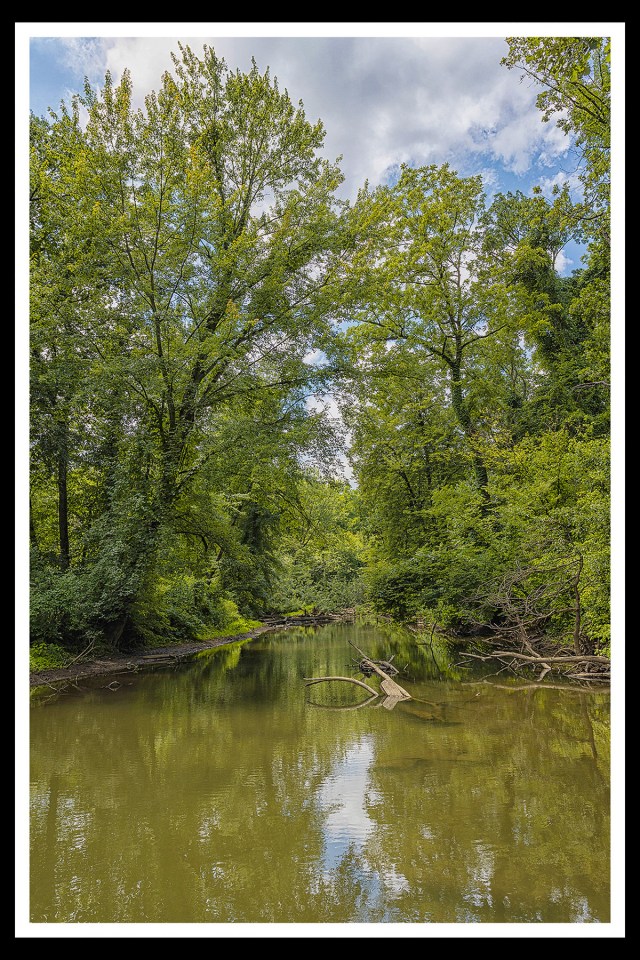
While hiking, I reach the slowly flowing water of this nearly still tributary, yet fairly full from recent strong rainstorms that have passed through the region and since dissipated. I stop a while to watch a lone hawk quietly glide on by, gracefully riding high streams of unperceived air drafts at that altitude and sliding against the bright light of a clearing sky extended above a ragged green tree line stretched beside the far bank. The patiently advancing river, frequently in literature a metaphor for the passage of time, leads me forward today but seems to curb its current purposely, as if it, too, wishes to linger, relish the present and exist outside the steady progress of chronology toward the future, even as its presence represents the past.
∼ July 18, 2022 ∼ “Summer Banners”

I am pleased that summer season banners appearing at prominent locations throughout Indiana Dunes State Park, including hanging at the main entrance and outside the front door of the Nature Center, have been created from my photographs. They are products of the Indiana Department of Natural Resources with support from Friends of Indiana Dunes. If you are visiting the park, don’t miss them!
∼ May 14, 2022 ∼ “Accessibility for All”
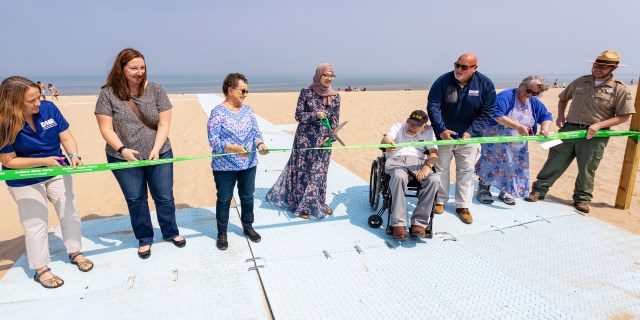
Earlier this week I attended a ceremony at Indiana Dunes State Park celebrating the installment of a specialized beach mat allowing persons with mobility difficulties to cross the sandy landscape and to view Lake Michigan from the edge of the surf, experiencing the lake waves from close range. I was pleased to take photographs of the event for the park, including the ribbon-cutting moment seen in the accompanying image, and I was emotionally moved during the occasion, both by the joy witnessed in those who had previously been prevented from approaching the water and by the generosity of individuals or groups whose contributions made the purchase possible, such as Friends of Indiana Dunes, Make-a-Wish Foundation (Indiana), and the Lake Michigan Coastal Program. In addition, this represents another advancement in the ongoing process of expanding the accessibility of the Indiana Dunes for everyone by the Indiana Department of Natural Resources and Indiana Dunes State Park. Indeed, the park also offers two types of all-terrain chairs that make possible traveling some of the trails or touring the beach for more visitors.
∼ April 24, 2022 ∼ “April Abstract at Lake Michigan”

I am currently reading a new book, More Than a Rock: Essays on Art, Creativity, Nature, and Life by photographer and author Guy Tal. He is an excellent photographer and one of the best writers at presenting especially thoughtful personal reflections or critical commentary on photography’s position in relation to other arts and various issues. One of the book’s chapters insightfully examines the concept of abstraction in art, particularly its “contentious” connection to photography, a topic I have covered at times as well. Tal explores how abstract artwork “can be a tantalizing puzzle for the mind, forcing it to contemplate an image, try to decipher it, and decide how to respond to it…. This prompting of a viewer’s mind to study an image more closely is what artists refer to as visual tension.” In the past I have displayed examples of my more abstract landscape photographs produced through manipulating settings when capturing an image, such as softening the focus, intentional camera movement, slight adjustments in exposure compensation, and emphasizing complementary color combinations. As noted previously, I create photo abstracts out of the natural scenery I perceive, images which might allow for a notebook entry likewise expressing a somewhat subjective notion with a little bit of contemplative or speculative meditation. I also try to exhibit the primacy or purity of light and color. I regard these imaginative images as “mirage photographs.”
∼ April 9, 2022 ∼ “A Little Bit But Often”

This week I was watching an episode of the late Anthony Bourdain’s A Cook’s Tour show from more than twenty years ago in which he spotlighted the northern Spanish coast city of San Sebastian and sampled the wonderful Basque foods found there. Although I knew of San Sebastian from teaching Ernest Hemingway’s The Sun Also Rises to my students, and I remembered it as one of the author’s favorite locations, this video visit to savory places—local restaurants and tapas bars—seemed even more vivid than I remembered in my readings. During Bourdain’s travels from one spot to another along the old streets, briefly but frequently stopping for culinary offerings of delicious dishes accompanied by teasing sips of fine wines, he repeated a theme of the experience, an attitude that could be summarized in a popular saying by the Basque people in the region: “A little bit but often!” I was reminded that this approach is what attracts me to the form of these short prose pieces I have produced at a steady pace in my journal the past five years. In my writing I sometimes feel as if I am presenting isolated images together with a condensed text intended to create a cumulative effect that might sate an appetite for interesting native scenery.
∼ March 26, 2022 ∼ “Marsh Sounds in Late March”

I am hiking the recently renovated boardwalk over the Great Marsh in Indiana Dunes State Park during late March along three-mile long Trail Two that connects to the longer Trail Ten. Nobody else is here. At first, moving through a forested section, I listen to the distant rhythmic tapping of a lone woodpecker somewhere among the upper limbs of these empty trees but out of sight and the gentle grating of those bare branches scraping against one another in a strengthening wind. However, when I cross the dark marsh water, nearly ink black in this time of year, I suddenly hear the loud trill arising from a chorus of spring peepers creaking all around me, yet still hidden from my view, as if speaking in a secret language to enthusiastically welcome the new season. The only other sounds are the steady cadence of my boot steps and the slight squeak of each tan plank bending, giving way a bit beneath my feet.
∼ March 14, 2022 ∼ “Trees at End of Winter”

Each year, starting in the middle of March I walk familiar trails of the nearby state and national parks to inspect damage done by nature during the harsh weather of recent months. Accompanied by an increase in birdsong among the still-bare upper boughs, I hike these routes to view vulnerable trees I have been monitoring from year to year, some for almost a decade. Many have been kept from my sight for a while, camouflaged by snowfall or made inaccessible because of icy inclines and narrow paths along slim, slippery dune ridges. I always discover previously tilting trunks that have been toppled by winds or their roots exposed by land erosion and numerous weakened branches that have snapped, fallen beneath the weight of snow. Although temperatures have gradually warmed lately and sunlight now extends deeper into the evening, as the official beginning of spring is about seven days away, the surviving trees exhibiting these leafless limbs throughout the region will remain as reminders of winter for at least a few weeks longer but also serve more importantly as sources for admiration much beyond that time.
∼ March 7, 2022 ∼ “Blowout Ridge in Late Winter”
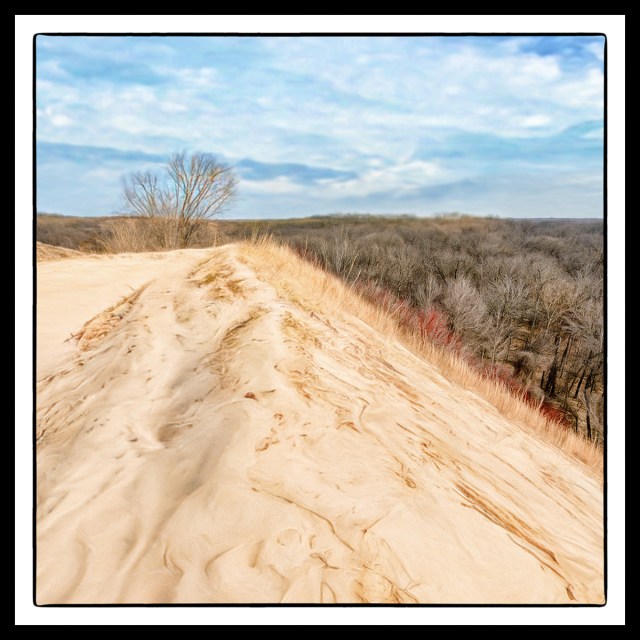
As winter’s accumulation of snow and ice slowly melted away during recent days due to a stretch of warming weather with temperatures eventually rising toward seventy degrees by Saturday, I climbed high ridges surrounding large blowouts at Indiana Dunes created over time by erosion from inland northern winds sweeping across Lake Michigan. Each year upon the initial thawing of the landscape evident in the start of March, I return to these narrow and steeply elevated trails that I have avoided for months as more difficult to scale in slippery wintry situations, especially when carrying camera gear and a tripod. Crossing a slim sandy summit curving around the rim of the Beach House Blowout and overlooking treetops of a forest farther east, I felt a great sense of invigoration and an anticipation of upcoming spring conditions.
∼ March 5, 2022 ∼ “Final Strip of Shelf Ice”

As temperatures rose into the fifties and sixties throughout the region during this first week of March, I watched the final strip of shelf ice hugging the shoreline slowly dissipate, thinning as it was melting away into Lake Michigan. At times, slim streaks of clouds swiftly sweeping low overhead from the southwest, pale against their blue backdrop, resembled these remnants of white clinging to the tan sand of beach at the water’s edge. With winter less than three weeks from being over, the spreading sunshine already held a spring-like warmth within it, and a transition seemed already underway, though I know from experience that another sudden snowfall could easily still occur in the meantime.
∼ February 26, 2022 ∼ “Shelf Ice Beneath Blue Sky”

At the end of February, the winter accumulation of shelf ice along the Indiana Dunes shoreline usually deteriorates quickly under strengthening sunshine until it ultimately disappears. Though fascinating and often beautiful to observe, this annual feature is always hazardous and becomes even more dangerous during times of rapid melting. Seemingly, each year individuals ignoring repeated warnings sadly find themselves in treacherous circumstances, slipping into the frigid lake water. Indeed, just this past week we witnessed another tragic example with a loss of life. As I viewed the accompanying scene in my photograph with its white mass of ice dissipating under a clear blue and sun-brightened sky, I tried to capture the artistic beauty that can appear so seductive. By taking this image of rich tints with motion blur due to intentional camera movement, I hoped to imitate the color field paintings for which abstract expressionist Mark Rothko is well known.
∼ February 19, 2022 ∼ “Snow and Haze on a Late-February Day”
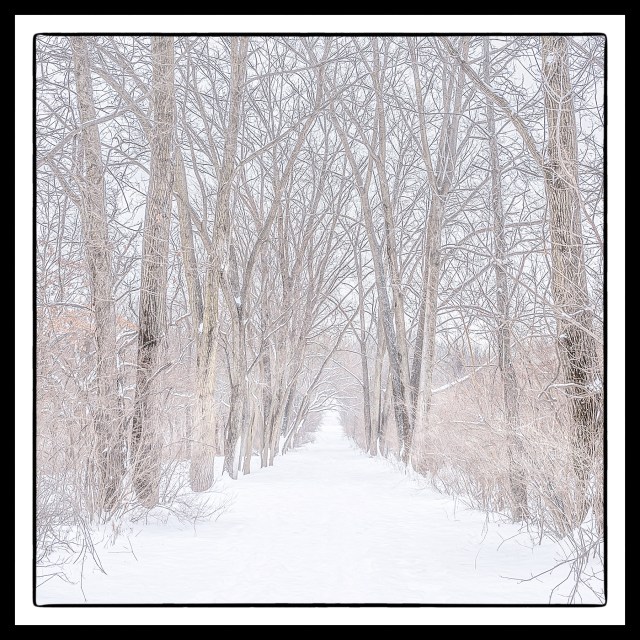
Often in late February, even as the oncoming spring might be in sight, Canadian clippers slip through the region creating a very cold and snowy weather pattern. Sometimes files of squall lines quickly shift over the area, leading to whiteout conditions with sudden bursts of snowfall amid strong wind gusts. On such days when details of the landscape seem half-hidden by pale haze at times approaching an almost ash gray and the background sky behind bare branches looking like loose latticework lightens to white, the scenery begins to resemble a monochrome print, devoid of all color or vibrancy but perhaps made even more dramatic by their absence. Yet, the setting feels appealing for what might be a final winter hike through these transformed woods, since meteorological spring starts March 1, particularly as this forest path nearly fades away up ahead and then disappears into the distance, appearing to hint at an unforeseen transition soon to be experienced.
∼ February 15, 2022 ∼ “Sun and Shadows After Snow”

After last night’s storm, blue skies again appear in the distance as sunshine streams through these empty branches beside the frozen creek and this frigid afternoon begins its creep toward evening. The bright white of the illuminated snow seems to absorb the daylight, offering a false sense of warming. In some places the shapes of little drifts around trunks or fallen deadwood shift with each sudden rush of an increasing wind, and a few upper limbs grate, rasping as they scrape against one another. I hike a trail frosted and crisp with a smooth surface of thin ice atop the snowfall, partly darkened by shadows though not yet blemished by footprints. Remaining warm within my winter wear, I have been walking well more than an hour and passed no one along the way, but I did witness a pair of deer darting sharply among a tangle of trees deep in nearby dune woods, briefly creating a momentary commotion and clamoring amid this serene setting before quickly disappearing beyond the shallow slope of a small hill.
∼ February 12, 2022 ∼ “Wintry River with Toppled Trees”

After the arrival of a snowstorm accompanied by a Canadian cold front during the night, the sun remained hidden behind a milk-white sky most of the day. In the morning, while the northern breezes began to whistle even more between those thin limbs of little trees enduring on banks beside the river, and at times large snowflakes slowly fell in intermittent spells like floating white feathers along the waterway, I traveled a winding trail. Hiking this slim path through dune woods now camouflaged by deep drifts, I listened as occasional gusts sliced the forest’s silence with their whispered whoosh. However, by mid-afternoon conditions calmed quite a bit, winds quieted and the water current, narrowed in places by masses of ice and clogged by a logjam of toppled trunks or broken branches beyond the bend, seemed almost still.
∼ February 7, 2022 ∼ “A Winter Moment”

Pausing along a winding trail on a cold but windless winter day, those slow-moving remnants of storm clouds—afloat overhead, though almost motionless, and appearing at times as clean as white linen—seem trapped among bare branches beyond the bend in this section of the river. A network of twisting trees marks my way ahead, silhouettes of thin limbs in some places crisscrossing, reflected in the calm current below like a dark web. Amid the stillness, I listen to note an absence of birdsong and the loss of rustling leaves recalled from previous seasons, memories carried as consolation. In spring, when new windblown movement of warmer weather returns above me and a chatter begins to fill the treetops again with the sharp pitch of chirping, I will think back to this frigid walk through quiet snow-covered woods bordering the waterway now narrowed by ice. Despite the unremitting filter of forgetfulness, I know I will clearly remember this moment.
∼ February 5, 2022 ∼ “Morning Following Snowstorm”
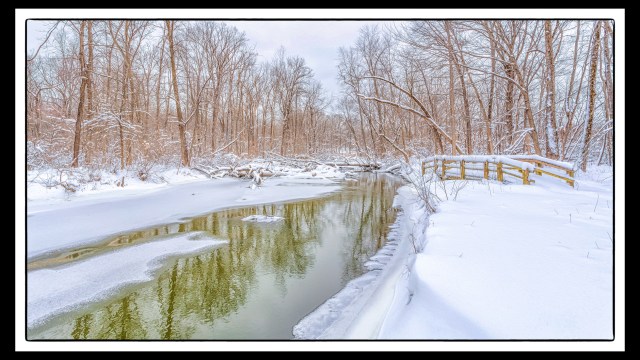
Throughout the year I always anticipate a couple of days as particularly ideal for photography. I eagerly await the slanting late afternoon light upon arrival of peak leaf color in autumn, and I look forward to the stark unspoiled scenery beneath a lingering gray sky on that morning following the biggest winter snowstorm. Even if I were not interested in capturing images with my camera, these occasions seem inviting for simply taking a hike through nature when the landscape appears the way it does under such unique conditions. Therefore, this week I walked a few paths covered with more than a foot of fresh snow and mostly unmarked yet by others’ footprints, including this trail along the Little Calumet River in the Indiana Dunes National Park.
∼ January 29, 2022 ∼ “Cold Glow”
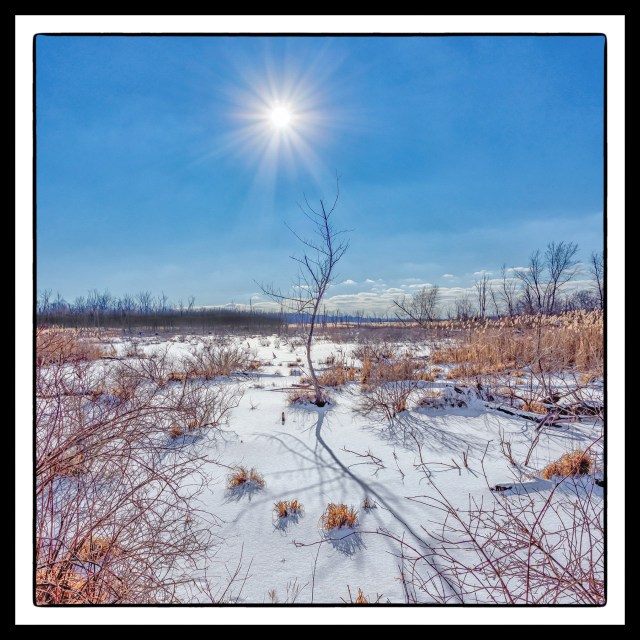
(“About the light, the way it glows”—Mark Strand, “Two de Chiricos”) When the weather at the end of January and beginning of February becomes frigid enough to register below-zero temperatures, although the sun seems so bright in such a clear sky, I find myself drawn to walks on trails through the Great Marsh at Indiana Dunes National Park. Amid the thin silhouettes created by midwinter’s low lines of sunlight angling from the south between thin limbs of empty trees, the now frozen and snow-covered waters, white and windblown smooth, establish a stark contrast that emphasizes dark extended shadows of bare branches and stunted trunks. I appreciate the clean appearance of this natural landscape’s cold scenery that at times resembles the surfaces of settings seen in those Giorgio de Chirico artworks to which I was first introduced as an undergraduate student in a Mark Strand creative writing class many years ago.
∼ January 23, 2022 ∼ “Dead Swamp Forest Following Snowfall”

The shallow waters of this dead swamp forest in Indiana Dunes National Park have frozen and been covered in white by a light overnight snowfall disturbed only by occasional paw prints of small animals. The morning is now cloudless and without wind as sunlight and stillness fill the landscape. My pedometer indicates I have already hiked at least three miles of wintry trails trying to find scenes that seem to signify the season. During summer this section of the Great Marsh is frequently difficult to visit due to flooding in the area and the nuisance of insects, but today the setting appears to me to be nearly inviting. Though the calm air is cold, the sunshine warming my layers of clothing keeps me comfortable, and these conditions create the placid atmosphere I had been seeking.
∼ January 14, 2022 ∼ “Brightening Skies Above Blue Water”
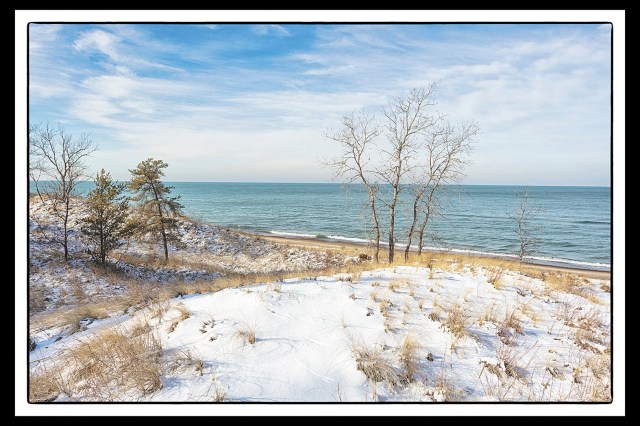
A cold and inconsistent current of air folds through distant treetops in thin woods on the hills above Lake Michigan, lakeside ridges and foredunes of wilted grass filled with just a dusting of overnight snow, as the landscape has reassembled itself once again. I stand at the edge of a ledge yet slick with ice, leaning into an increasing onshore breeze to photograph the moment, my tripod weighted by a dangling camera bag to stay steadily in place, its three-legged shadow starting to darken in arriving sunlight. When the wind settles a bit, I still the scenery in this wintry image to which I will return in other seasons, brightening skies clearing over the blue water and slim white surf seen behind a cluster of bare trees bunched beside the beach.
∼ January 9, 2022 ∼ “Looking Ahead”

The spring semester begins this week at Valparaiso University; yet, as each year’s curriculum schedule is planned far in advance, I was given an opportunity to design a new class for instruction in spring 2023 with a deadline for the proposal set at last month before Christmas break. I am pleased to report my suggestion of a topic called “American Landscape in Images and Literature” has been approved. This course will examine depictions of the American landscape through views presented in visual imagery and literary works. Beginning with the Romantic paintings of the Hudson Valley School in the nineteenth century and moving through to the billions of photos of natural locations posted nowadays on Instagram or elsewhere, students will compare and contrast the ways the United States has been displayed in different eras and their impact on society. Additionally, written profiles of various regions in the country, from Walden Pond to Tinker Creek, will offer examples of American authors’ perceptions of their surroundings over time and the evolution of environmental philosophies. Course requirements will include personal chronicles of the local landscape through a series of photographs and electronic journals by each member of the class, formal research papers focused on specific environmental issues, and field trips with lab events conducted nearby at a state or national park. I am looking forward to teaching this course.
Journal: 2021
∼ December 19, 2021 ∼ “Final Day of Autumn”

As we enter the final full day of autumn on Monday and look forward to the arrival of winter, the landscape appears to be lagging quite a bit this year. Local meteorologists have noted the absence of any measurable snow during the entire season, a first for most locations in the region. Consequently, scenery throughout the area, normally covered by at least a light layer of white in mid-December, seems to still resemble the imagery one would find in a John Constable late-autumn landscape painting. Although the trees are leafless and the more vivid foliage has given way to mostly duller red, rust, or orange coloring among the undergrowth while the green grasses have faded to yellow and tan, an expectancy of change yet lingers in the atmosphere like those clouds slowly crossing overhead, leisurely drifting from the north but perhaps indicating an eventual change is on the way.
∼ December 5, 2021 ∼ “Historical Marker”

Near the entrance to a trail that winds alongside Dunes Creek, seen in this image, stands a sign marking an historic event that took place in 1780. According to the notice posted by Daughters of the American Revolution, a minor battle took place on December 5 of that year between combatants associated with the American forces and a unit under the command of the British. The incident appears to have been the only military conflict in this region during the Revolutionary War. The historical marker indicates that a structure, known as Le Petit Fort, established not far from this position and just hundreds of yards from Lake Michigan, served as center for the hostilities. However, the label of “fort” might be misleading and actually refer merely to a cabin surrounded by a palisade fence enclosing a garden area, perhaps an outpost usually used for accommodating hunters or merchants traveling along the southern tip of Lake Michigan. During the skirmish, the British triumphed, as losses for the Americans included four killed, while two were wounded and seven were captured, held as prisoners. A few others escaped through the woods depicted in the accompanying picture. The British suffered no casualties.
∼ November 28, 2021 ∼ “Horse Crossing in Autumn Light”
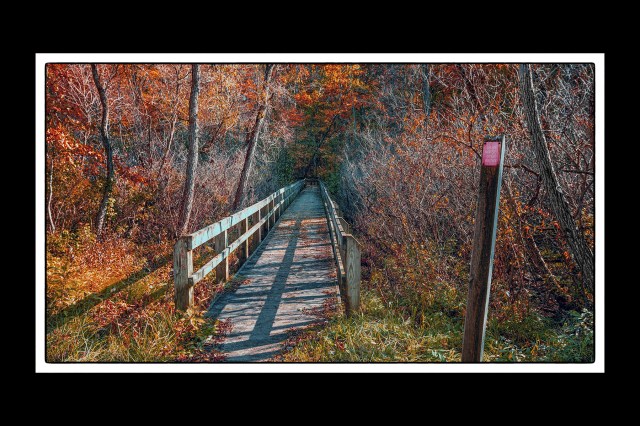
Capturing the final flourish of diminishing fall foliage, I visited a path in Indiana Dunes National Park that additionally serves as a primary trail for horseback riders. The route moves more than three miles through dense dune woods atop land that at one time during glacial ages represented the southern shore of prehistoric Lake Chicago (a precursor to current day Lake Michigan, whose edges retreated about thirteen centuries ago). Along the way the passage also crosses a couple shallow creeks, a few slim ravines, and a brief patch of marshland over which a narrow wooden bridge extends. I never walk this course in summer warmth when the thick forest is all a solid deep green, insects often swarm, and horses frequently pass; however, the colorful leaves of these hardwood trees in autumn and their thin limbs covered in snow or sleeved with ice clicking in shifting winter winds are always inviting.
∼ November 23, 2021 ∼ “A Richer Display”
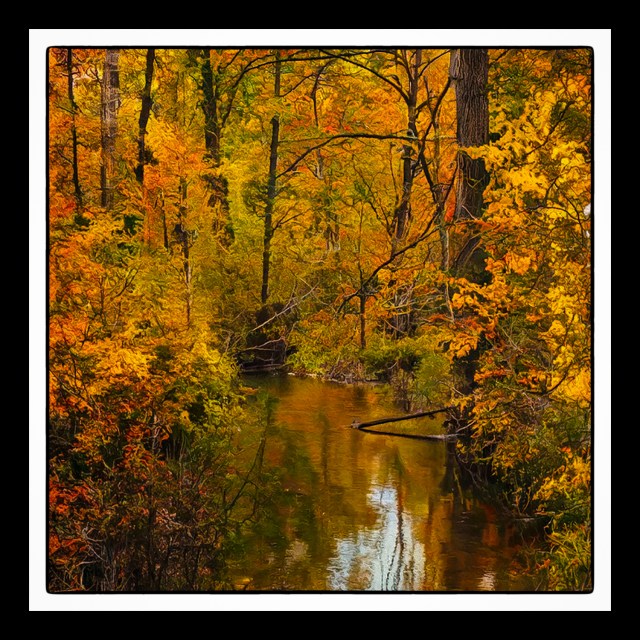
In my previous post I noted a favorite location where I photographed a path in Indiana Dunes National Park at the peak of autumn leaf color. At the same time, I visited another setting where I had captured colorful fall foliage in past years, and I discovered scenery that seemed to exemplify the beauty of the season. This image of the creek winding along Trail Two at Indiana Dunes State Park appeared particularly appealing, captured on that calm and cloudy afternoon following a couple days of rain, and its characteristics reminded me of elements one might find in an artwork by the great Indiana landscape painter, T.C. Steele, whose biography, The House of the Singing Winds, I had recently reread, and who always prized as subject matter the arrival of a distinct Hoosier autumn with its “richer display of tints in fresh foliage.”
∼ November 21, 2021 ∼ “A Favorite Fall Walk”

On the day the peak of fall foliage finally arrived, I tried to hike familiar trails where I believed the leaves would be the most vivid. Having witnessed enough autumn seasons in this region and walked these paths in previous years, I knew some spots in routes through nearby woods that might prove more promising, including the scene in my accompanying photo. Fortunately, I was not disappointed. Like many of my fellow landscape photographers, I annually anticipate days displaying the change of colors among trees and shrubs with the eagerness I once reserved for Christmas morning when a child, and I am especially excited if the correct conditions—cool, calm, and cloudy—for capturing such images coincide with the exhibition of nature’s transition.
∼ November 16, 2021 ∼ “Still River Scenery”

Much of the first half of November has been blustery, strong winds accompanying passing storms. Regular bands of rainfall have swelled waters in the region streams and narrow creeks a little above normal fall levels. But just as the peak autumn season for vivid foliage arrived accompanied by calm and quiet conditions, I was fortunate to visit a muddy trail winding along a motionless river reflecting those colorful trees exhibited upon its bank like paintings placed on display. Indeed, the silence of my surroundings was only momentarily broken by the subtle crunch of crisp leaves already shuffling underfoot, and each time I paused to photograph the still scenery, I appreciated nature’s artwork even more.
∼ November 14, 2021 ∼ “Footbridge in Fall”

Walking among woods during early November following a night of showers, the lush scenery seemed so inviting. Each trail through the transitioning trees offered an array of colors, some on upper limbs illuminated by a slant of sunlight, that enhanced the landscape. Even those leaves—red, green, yellow, orange—already fallen to the mud-blackened ground contributed to the splendor all around me. As I approached a small footbridge in a forested gulley worn over time by the flowing water of a seasonal creek, now surrounded by vivid fall foliage at this peak moment, I imagined the location could almost serve as a dream-like setting in a fantasy film. Additionally, I believed this short span traversing a lingering stream of rain runoff perhaps represented an apt metaphor for a transient passage from one part of the calendar to another.
∼ November 10, 2021 ∼ “Autumn Morning After Rain”

On damp autumn mornings following precipitation, especially along already soggy trails like that beside Dunes Creek, the array of wet leaves seems to display even more intense colors. The richness caused by moisture creates greater saturation and diminishes reflective sheen from ambient sunlight that otherwise might lessen its vivid nature. This situation eliminates any need for a polarizing filter that cuts glare, and such humid conditions even appear to imitate the common act of dialing down highlights in post-processing a photograph to elevate vibrancy by reducing distracting elements caused by brighter facets shining in the image. Indeed, the best time to capture fall foliage occurs during a dewy morning or on a hazy day close after rainfall under the filtered soft light of thin continuing clouds covering the sky like translucent gauze.
∼ November 8, 2021 ∼ “The Time of Falling Leaves”
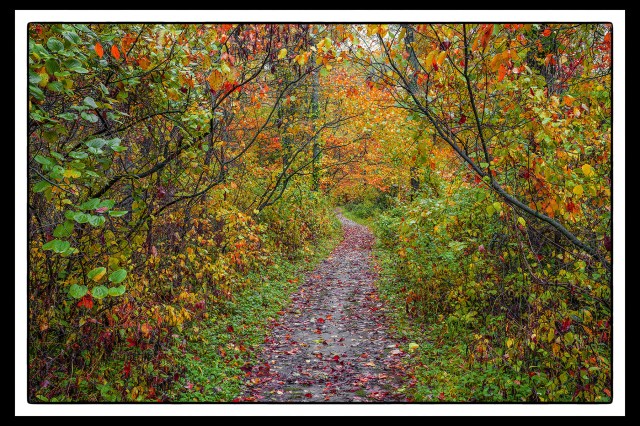
When asked about their favorite seasonal scenery, most landscape photographers readily acknowledge a personal preference for fall foliage, particularly in this region of the country. The three or four weeks spanning peak autumn color in nearby woods provide impressive imagery found around every turn along the forested trails. Indeed, the end of October and start of November are marked in my calendar as the best time of year for hiking through the wooded terrain I frequently visit. I might even confide that I have a special fondness for pictures capturing those moments when a sense of transition is evident with many of the trees or shrubs yet exhibiting smatterings of leaves still a rich green amid an array of yellow, orange, red, rust, and tan, some spatters of color also already scattered underfoot. As naturalist John Burroughs once wrote: “The time of the falling leaves has come again. Once more in our morning walk we tread upon carpets of gold and crimson, of brown and bronze, woven by the winds or the rains out of these delicate textures while we slept.”
∼ November 1, 2021 ∼ “Seasonal Transition”

When I visited the Little Calumet River this weekend following a few days of steady rain, I found the water level had risen considerably. Additionally, since the latest storm had gradually drifted toward the east and this location is sheltered from continuing northern winds, though they’d diminished quite a bit, the flow of the current had slowed, exhibiting a mirror-like presence that reflected emerging fall foliage seen on branches of overhanging trees along the banks, a few leaves even as red as remnant embers following a campfire. However, much of the autumn color coming into view appeared slightly delayed this season, and peak leaf peeping still seemed at least one more week away. Nevertheless, as I stood beside my tripod, my boots sinking in thick clumps of mud on a riverside trail, the vivid scenery appearing in my camera’s digital screen already displayed a great deal of seasonal transition.
∼ October 30, 2021 ∼ “Stormy Weather”
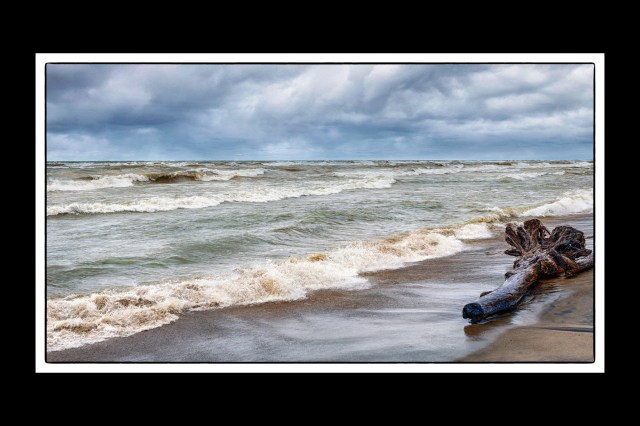
After yesterday’s all-day rain saturated the landscape, and this morning’s torrential downpours muddied even more those narrow trails extending toward darkened sand along the shore, I find waves of lake water yet tossed by continuing gusts. Following summer months mostly marked by above normal temperatures and very dry conditions, early autumn has been characterized by wet and blustery weather with a steady series of storm systems moving through the region recently. The latter portion of October has been particularly tempestuous. In fact, rainfall the past three weeks has easily exceeded that received in the previous ten weeks. Also, accompanying winds from the north have repeatedly whipped around the low-pressure centers and created greatly turbulent currents along the Indiana Dunes shoreline, as the high water has washed over local beaches and further contributed to coastal erosion.
∼ October 23, 2021 ∼ “A Touch of Fall Color”
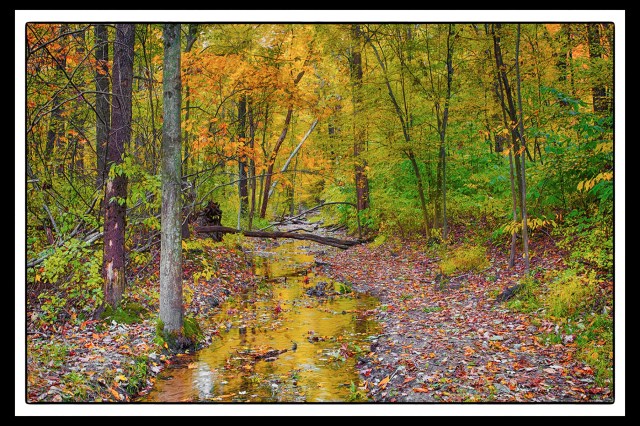
Although it’s only October, the daily midday sunshine seems to have weakened quite a bit—as if filtered, even on cloudless afternoons—and already somewhat resembles the soft white of winter light one might see on a cold and snowy day. Moving through a cool nook of woods amid a dense earthy scent, I notice evidence of nature’s transition signaled by this season’s initial leaves relinquished from creekside trees, a scattered few nearby already appearing colorful and crisp. These fallen leaves, autumn’s adornment, scuttle beneath my feet due to brisk lingering winds following last night’s strong autumn storm that had swept ashore from the north bringing a distinct morning chill. The remaining foliage filling branches bending above, awaiting its eventual surrender to the seasonal change, also flutters fitfully with each erratic breeze brought by an onshore gust.
∼ October 16, 2021 ∼ “Lone Gull After Autumn Storm”

A thick layer of clouds weighted by rain had accumulated overnight with arrival of a cool front and by noon eventually gave way to a slow parting of the overcast, narrow patches of blue poking through here and there. Shells and pebbles sound at times like street gravel underfoot as I hike down a steep dune slope toward the beach, an indented section of shoreline suddenly slimmed by Lake Michigan’s high-water level. I am amazed at the isolation felt along such a slender stretch of sand yet untouched by the footprints of others. Nearby, knee-deep waves wash ashore, forcefully churning the surf and jostling scattered bits of driftwood, while in the distance crests break into whitewater with a fine spray lifting at least ten feet high then swept by gusts under today’s late-afternoon sky. I walk the length of this strand, alone except for that lone gull I watch lingering at the lake’s edge, stepping gingerly, warily aware of my movement, seemingly pleased as well by the changing conditions.
∼ October 11, 2021 ∼ “Early Autumn Evening”

∼ October 3, 2021 ∼ “The Invention of Nature”
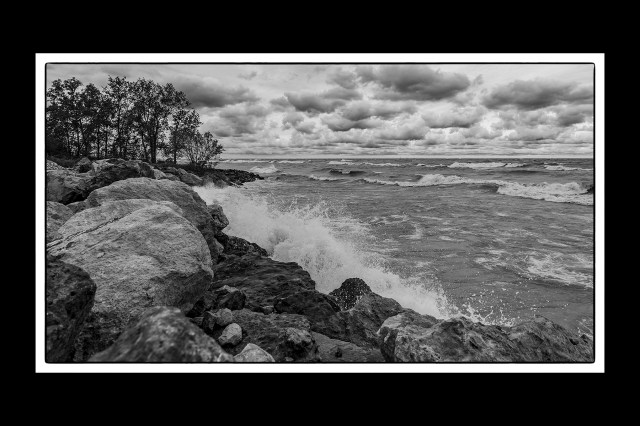
I have been reading an engaging biography of Alexander von Humboldt. Andrea Wulf’s magnificent study, The Invention of Nature, chronicles the impressive life of a man who shaped learned views of the environment among all who followed him with perceptions still held by current ecologists. Born into a wealthy Prussian family in 1769, Humboldt was perhaps the premier adventurer, scientist, naturalist, and thinker of his time. As Wulf notes, Humboldt was “described by his contemporaries as the most famous man in the world after Napoleon.” However, I was also struck by numerous splendid black-and-white illustrations contained within the pages of this book, depictions of the various landscapes explored by Humboldt, and I decided to revisit my interest in monochrome photography, which I have mentioned in the past. Consequently, I produced the accompanying image captured along the northern Indiana coast, a picture exhibiting the tone and atmosphere of nature during an oncoming autumn storm that seems to me more suitably presented, maybe even invented, in this format.
∼ September 27, 2021 ∼ “Beach Following Early Autumn Storm”
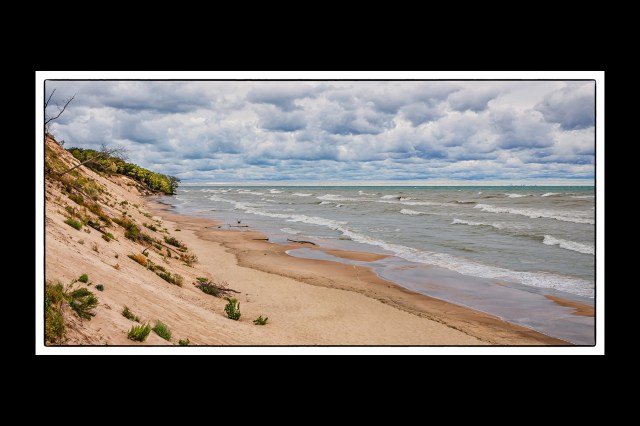
I descend a shallow slope from a dune ridge to a scene that shows wet sand empty of others’ footprints, a sign I am apparently the first to arrive at this stretch of shoreline following an early autumn storm. Before eventually edging toward the east, a gray sky with remaining sporadic rain showers moved through the area much of the morning. I decided to hike along the coast after the overnight front brought black clouds weighted by heavy rain that eventually gave way to a slow parting of the overcast with a continuing increase in shifting afternoon winds now blowing from the northwest, flowing over the water while the high level of Lake Michigan takes away large portions of the beach in some places. As I step beside the surf and walk toward a tree line at the flooded point ahead, following days of unabated gusts from the north, I watch the lake waves swell well above ten feet at times, somewhat like those remembered ocean crests where I was raised.
∼ September 25, 2021 ∼ “First Day of Fall”

The first day of fall this year also brought a storm front with strong northern winds. As heavy rains drifted east, leaving behind only brief periods of mist or drizzle, I walked the shoreline of Indiana Dunes to observe the whitecaps of turbulent waves breaking on the surface of Lake Michigan. Although temperatures had dropped significantly—plummeting to the fifties from a high of nearly ninety the day before—as if a switch had been flipped clearly delineating the seasonal transition, the blustery weather felt invigorating, each refreshing gust seemingly reinforcing nature’s message of change and foreshadowing upcoming autumnal conditions. While hiking through elevated mounds of blowing sand in foredunes just above a flooded beach, I paused to capture the obligatory photograph of a distant Chicago skyline showing beneath the departing clouds and rising behind the windswept lake.
∼ September 21, 2021 ∼ “Late-September Sunlight”
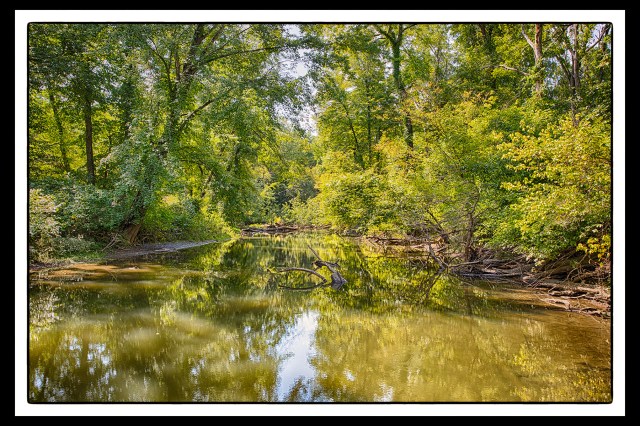
I pass two boys bathed in late-September sunlight fishing at a bend in the Little Calumet River, each sitting on his own thin flat stone near the edge of the water, both flicking their wrists slightly to give an impression of life to the bait dangling at the end of their lines, while a pair of white floats bob like tiny boats on the glistening surface. They offer subtle waves that I return as I try to keep quiet so as not to disturb their efforts, and I move through an opening between trees toward where the trail closely follows the shallow slope of a small hill to a slim ridge path hidden in the thicker woods ahead. On this morning after a night of light rain, the damp shaded lower branches still heavy with leaves yet sag, though sunshine slips through skylights of narrow gaps among the upper limbs where a few birds continue to trill their tunes.
∼ September 19, 2021 ∼ “Late Summer Afterglow”

September’s late summer days this year have seemed unusually warm with temperatures at times nearing ninety degrees. Each evening’s arrival is just as tranquil, often bringing at best only a lazy lake breeze to the beach, not even enough to shake these slender leaves of marram grass seen rising in silhouette among the foredunes. Tonight, the smooth surface of the water also remains still at sundown. While waiting to photograph the scenery, I watched a widening light along the horizon until the snuff of sunset and a gathering cloud cover swiped bright daylight away for good. The gradual darkness of nightfall, routinely progressing steadily under growing overcast skies from blue to moonless and starless emptiness, now begins to unfold over everything, and only a golden glow with some reddish tints shows through those narrow bands of clouds, natural banners extending above the far shore.
∼ September 14, 2021 ∼ “Great Marsh at End of Summer”
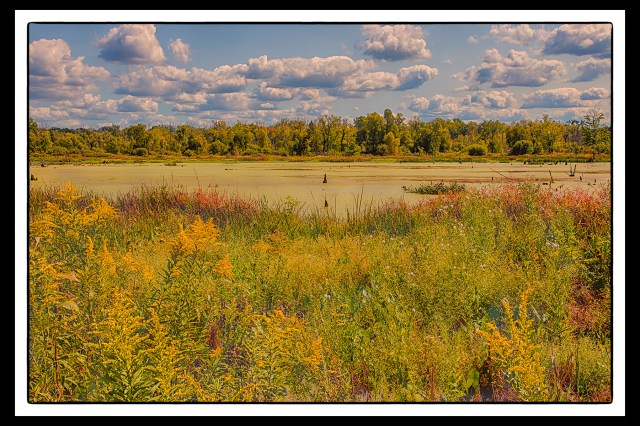
Throughout much of summer the Great Marsh at Indiana Dunes National Park usually seems to be a study in greens. The trees filled with foliage, the long thin reeds of grass, the sedges at the edges of trails, and even the algae covered surface of the water offer various shades of the color. Yet, as the season nears its end persistent small patches of wildflowers and tall weeds already displaying hints of different autumn tints dot the landscape with splotches—yellow, orange, rust—looking like touches of rough brushstrokes, perhaps paint dabbed on an impressionist artwork. The clouds crossing above today also appear to bear an assortment of shapes splashed in place on a light blue background. Additionally, on this day I pause to watch the graceful movements of a great blue heron and a great egret whiter than any of the clouds overhead. However, since I have not brought my long lens to capture a close-up image, viewers will need to see if they can locate those birds in the accompanying wide-angle photograph or use their imaginations.
∼ September 11, 2021 ∼ “A Chance Meeting”
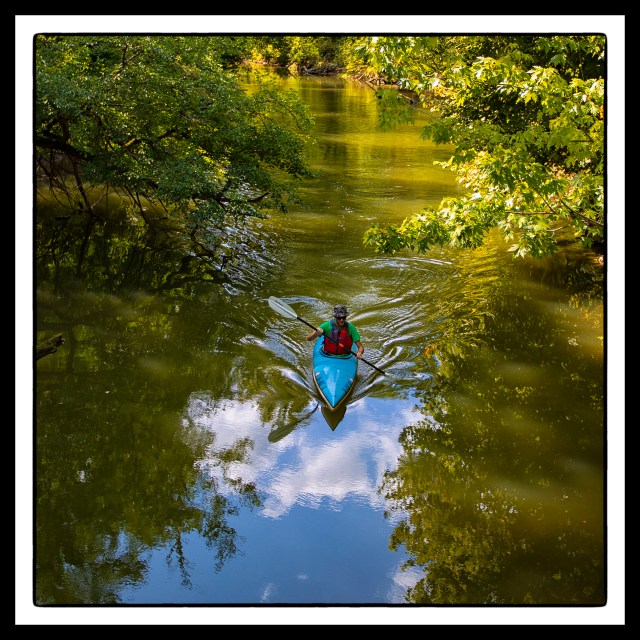
I rarely encounter many people when hiking and photographing locations along the Little Calumet River in the Indiana Dunes National Park, but yesterday I was pleased to meet and speak with Samuel Love, a fellow chronicler of the region’s landscape. I was capturing some images from a favorite spot on the kayak launch near the historic Bailly Homestead when I first noticed Sam arriving with a kayak and planning to record his journey up part of the east branch. We had a fine conversation on the nearby bridge before Sam started his travels upon the river, and I snapped the accompanying photo of him as he rowed toward where I had positioned my tripod on the span. You can follow Sam’s trip by viewing his video, “The Calumet Wilderness,” at the following link: https://youtu.be/DdzYOf0_lu8
∼ September 7, 2021 ∼ “Raised Swim Risk”
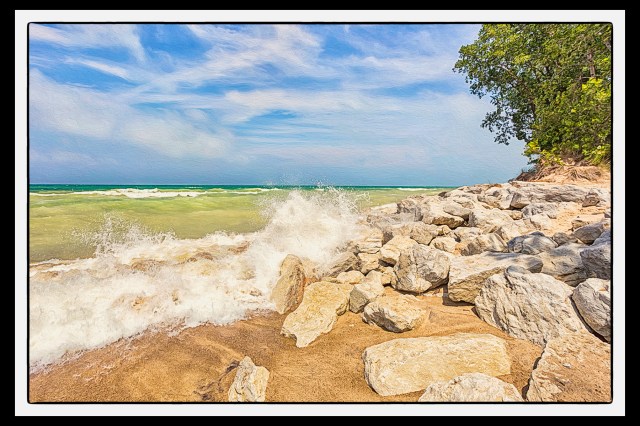
Labor Day weekend, which some regard as the unofficial end of summer despite more than two weeks remaining until the autumnal equinox, arrived with comfortably warm temperatures reaching into the upper-seventies and low-eighties in various nearby locations, certainly a suitable situation for final vacation days. In fact, meteorology records indicate this week is the last of the year to have average high temperatures in the region at 80-degrees. Such delightful daily measurements will not return until sometime next June. However, with the persistence of northerly winds, following a low front that had passed through the area late Friday and into Saturday, steadily pushing lake waves toward the shore and creating dangerous currents accompanied by riptide conditions raising risk levels, both the state park and the national park along the Indiana Dunes had to close their beaches for swimming at times. Unfortunately, the forecast predicts a similar situation through much of the upcoming week.
∼ August 27, 2021 ∼ “Golden Hour”

Every evening, as the seasons cycle through the year, each with its distinctive features, I look forward to that golden hour when angled sunshine begins to loosen its grip on the landscape. Sometimes the anticipation merely leads to disappointment. For instance, yesterday’s late daylight slid behind a clutter of black clouds, apparently weighted with rain. The dark cluster lazily crossed the lake, blocking just enough of the view to eliminate any idea of a sundown photograph. Today, however, I wait by my tripod at this same site for the arrival of vivid transitioning to a night sky as the sun sets above a long border of clouds over that western crease of coastline. Its rich orange and red colors slip slowly but steadily into the distance as if the day were simply draining away. Although a bit of northern wind persists, it lifts only little waves turned toward the shadowy shore, which provides a fine line for leading my eye across the image.
∼ August 23, 2021 ∼ “Still Summer Afternoon”

I am surprised by a late haze of daylight as a stray white cloud is nudged momentarily in front of the sun like a translucent window curtain drawn by slight southerly winds in the upper atmosphere. Nearby, without even a ripple the lake stays nearly still below a tint of clear sky looking like a lustrous blue jewel, yet the kind of canopy photographers usually despise for an absence of interest. With its glinting surface, the waveless water appears almost motionless, as smooth as polished glass. The deep green leaves, decorating branches on a line of beach trees that seem to have sidled beside the shore behind me, lie limp from lack of a breeze, as if lazy, maybe too weary from yesterday’s blustery weather to give a quiver, and their cumulative shadows collect in black pools among the surrounding pale tan sand beneath them that today shows signs of being bleached a bit by the bright summer sunshine.
∼ August 17, 2021 ∼ “Summer Sunset Through Beach Trees”
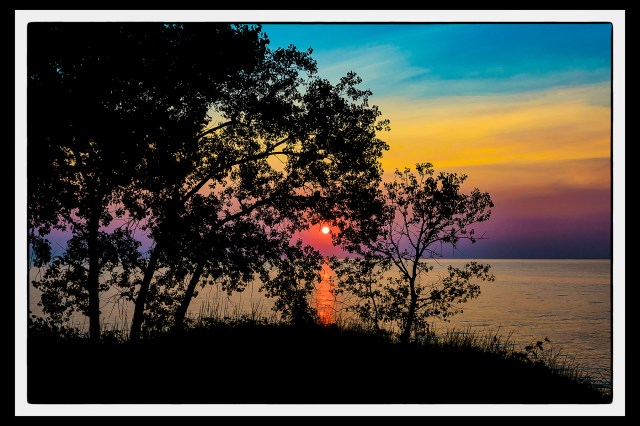
Between silhouetted leaves among black branches of shoreline trees, sunshine blossoms just above the horizon on the other side of Lake Michigan, and its extended influence of illumination glows behind that filter of faint haze brought by migrating smoke from widespread western wildfires. In recent weeks, each evening we’ve seen certain hues in the summer sunset enhanced by a diffusion of light moving through a dense layer of minuscule particles spread against the transitioning sky. The sun itself sometimes appears nearly orange, yet in other instances even hints at red, and all the tints in the distinct pastel sheets of atmosphere shaped around it seem to be set in place as precise swaths applied by a painter’s brush.
∼ July 26, 2021 ∼ “Listening to Didion”
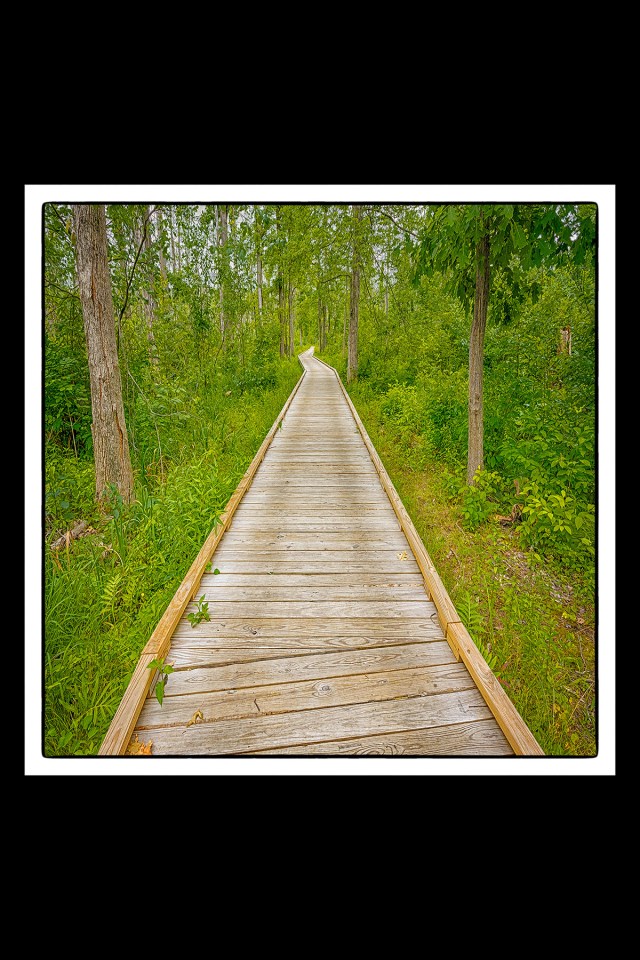
In Joan Didion’s well-known essay titled “Why I Write,” which she acknowledges as inspired by George Orwell, the author states: “I write entirely to find out what I’m thinking, what I’m looking at, what I see and what it means.” Later in the same piece, Didion connects word and image: “The arrangement of the words matters, and the arrangement you want can be found in the picture in your mind. The picture dictates the arrangement.” When composing prose, I instinctively listen to Didion’s description of her method. Indeed, I have commented in the past that my approach to composition comes from the desire for a process of discovery amid curiosity about an unknown, and choices made in my writings arrive from an attempt to meld language with landscape. Like the boardwalk trail disappearing into a distance still to be explored in my accompanying photo, I try for my constructed sentences to move forward in an orderly way that clarifies through contemplation yet allows for some mystery of destination and an appreciation, even a celebration, of the bordering contrast or delightful disorder inherent in nature.
∼ July 22, 2021 ∼ “Footbridge to Trailhead in Summer”
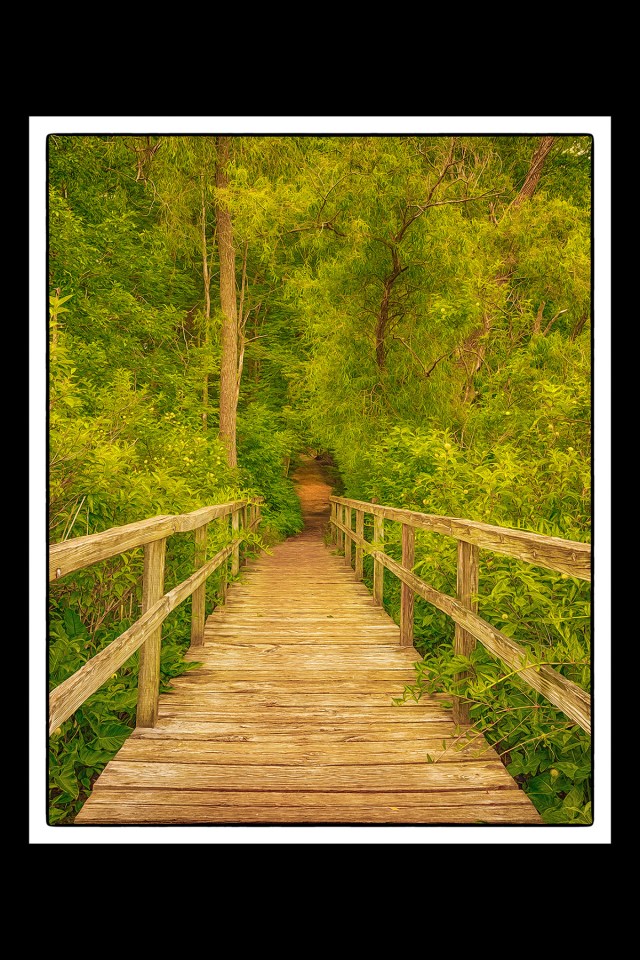
I cross this short wooden footbridge over marsh water and enter a tunnel opening in the tree line where a trailhead to three routes allows for various ways to walk through the cooler dune woods. Much among the landscape seems asleep on these lazy days of summer. Even those birds occupying higher branches of trailside trees that I have heard so often since the beginning of spring and within recent weeks now appear nearly silent. Only the mosquitoes have awoken; although so far, they have left me alone. During my midday hike in this heat, I meet fewer people along the trails—perhaps a pair of lovers strolling slowly up Trail Eight, a tougher passage steeply climbing three peaks but ending by descending at the beach, and some family campers accompanied by a dog exploring the old growth forest through which Trail Nine folds before arriving at the shore, plus a few lone joggers quickly passing me here and there on the flatter but longer path of Trail Ten.
∼ July 18, 2021 ∼ “Printed Images”

Earlier this week, my wife Pam requested that I print the accompanying Lake Michigan sunset picture for her to frame and display on one of our walls. It may seem odd, but we rarely show my own photos at home, despite the tens of thousands I may have taken over the years. In fact, although I have dozens of photographs framed for formal gallery exhibitions stored away in bins in my study, only one of my images is available for viewing anywhere in the house, a farm landscape captured about eight years ago that Pam had transferred to a canvas backing in our family room. Since I insist on personally printing my own photos, I am always amazed at the ease of the digital process compared to those times during my chemical film developing in a darkroom a few decades ago. However, as I attempted to calibrate and recreate in the printed image the brilliant luminosity of the backlit version appearing on my computer, I was also reminded why even in those old days I often preferred to share my film images as illuminated slides projected on a screen.
∼ July 15, 2021 ∼ “Give It Grace”
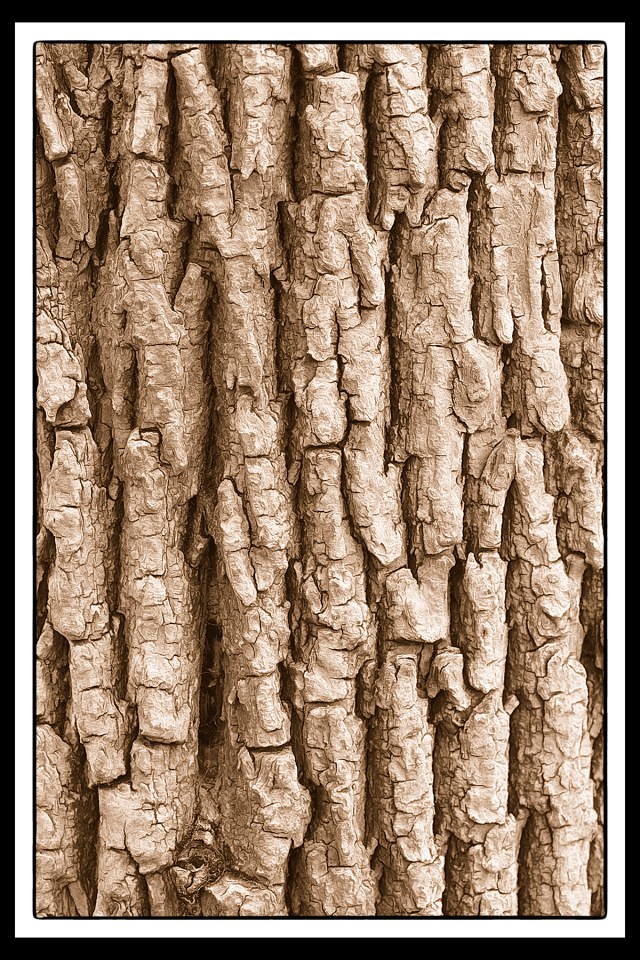
In the fading light of this late-day haze, as the faint shadows of trailside trees lengthen and a slight breeze seeps through overhead leaves, some aspects of the scenery seem to soften or slip within themselves. Once, when writing a couple lines about viewing the landscape, a brief meditation on nature, the way he so frequently does in his poems, Charles Wright commented: “To look hard at something, to look through it, is to transform it, / Convert it into something beyond itself, give it grace” (“Looking Around III”). These words also might define my approach to photography when walking in woods, transforming the setting I see through use of a camera, even altering its impression a bit by capturing a craggy trunk with a macro lens. I confine the observer’s eye to a selected slice of time and space received within the frame of a printed image, isolated now as a distinct object existing on its own, perhaps displaying a separate state and thus inheriting an almost abstract artistic sense of grace.
∼ July 13, 2021 ∼ “North Winds in Summer”
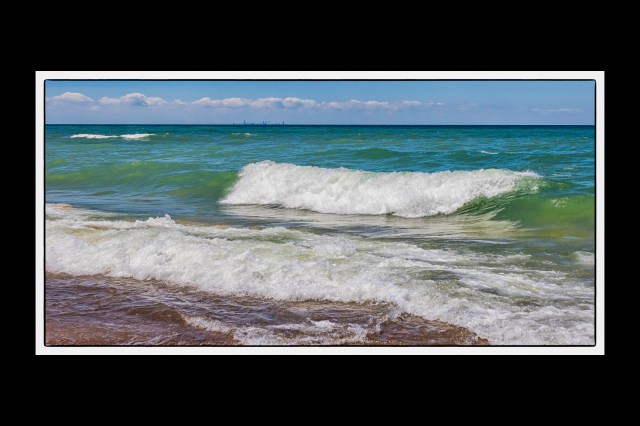
A formation of faint clouds moves through the far blue sky above an outline of Chicago still visible on the horizon. The thin line of white extends beyond Lake Michigan, its shape looking a bit like the fading wake of a small motorboat in otherwise calm waters. Close to shore, this morning’s breakers flash their creamy foam amid a building surf, emerging under summer sunshine. The scenery seems familiar, almost as if this were the shoreline where I was raised. Indeed, I am reminded of my childhood days wading among rolling waves in shallow bays along the Atlantic Ocean coast. Behind me, I hear a raspy voice of the cooling northern breeze wheezing between leaves filling branches of beach trees. Four birds circle just above the ridge of a wooded hill shading the foredunes, ring-billed gulls appearing high overhead with silhouetted wings resembling those sheet-metal blades cut like scales on an Andrew Calder mobile sculpture.
∼ July 11, 2021 ∼ “Trail Through Dune Woods in July”

Most landscape photographers find this season’s woodland scenery difficult to capture in an interesting fashion because of the chaos usually inherent in the composition. The busyness of the setting doesn’t allow a viewer’s eyes to focus on any one spot within the frame, and the jumble of limbs filled with so many lush leaves can be jarring upon observation. In winter jagged bare branches with dark bark often provide greater contrast and seem to be more expressive, as do clusters of different colored foliage in autumn; but in late spring or much of summer, settings underneath a canopy of trees in a full forest with green undergrowth frequently result in frustrating images. However, I often try to resolve this issue by including a trail extending through the center of the picture, a leading line that guides one’s eyes from the bottom of the frame toward the top and offers a feeling for the dynamic experience of traveling along a controlled and determined path neatly placed amid a random and confusing clutter of natural surroundings. This route through the woods also could be perceived as exhibiting a classic Romantic juxtaposition that might be witnessed in numerous works of literature or paintings, a feature depicting a symbol of civilization wending its way among elements of wilderness to some mysterious distant place positioned in the midpoint of the photo.
∼ July 9, 2021 ∼ “Extreme Greens”
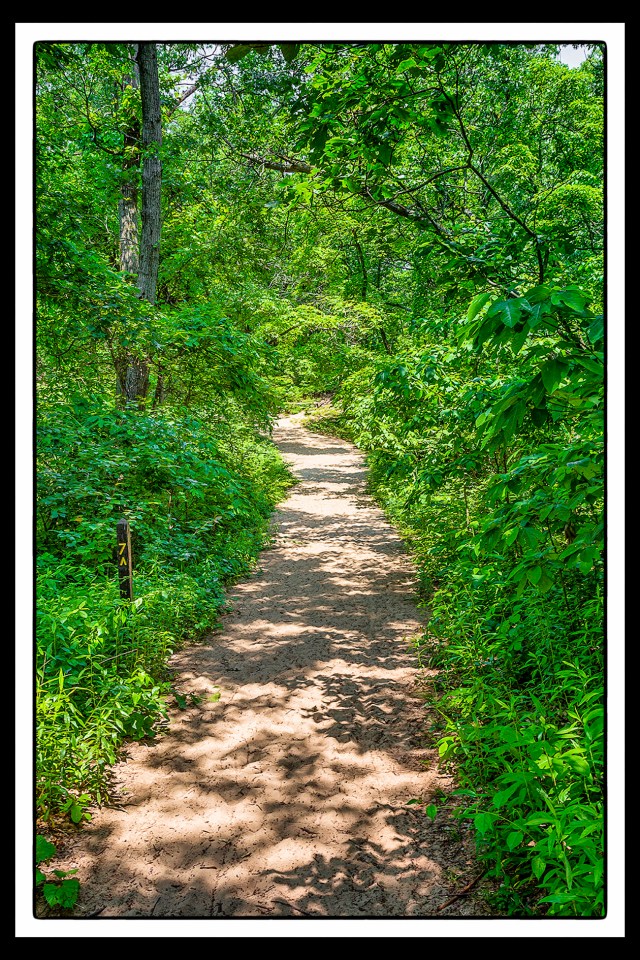
I recently cited artist David Hockney in one of my entries, and I’d like to again reference his paintings here. In 2020, Hockney premiered his magnificent and mammoth exhibition titled The Arrival of Spring, filling London’s Royal Academy of Arts with large canvases and iPad artworks depicting rural areas in Normandy. Describing this landscape project, Hockney repeatedly commented in interviews about the inspiration of the seasonal shift moving from winter through summer, and how in peak spring he would encounter enticing scenery of “extreme greens,” colors he believes difficult to accurately recreate in paintings or photographs. Similarly, I am always drawn to the lush green foliage of trees, shrubbery, and other undergrowth covering the ground in late spring or early summer—especially following a spell of spring showers or patterns of more powerful rainstorms during late June or at the start of July—as seen in my accompanying photo depicting a part of Trail Seven at Indiana Dunes State Park.
∼ July 6, 2021 ∼ “Night Shift”
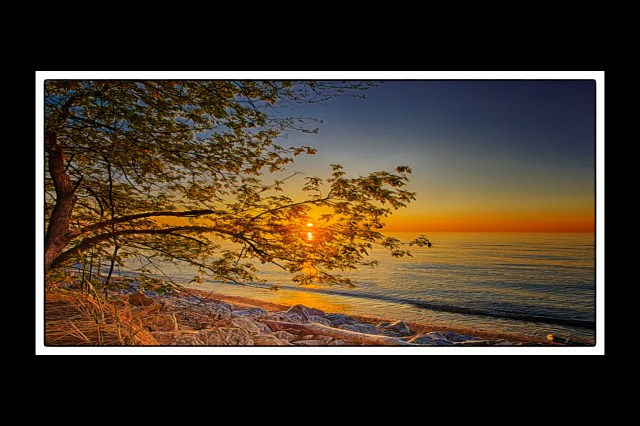
On a recent early-summer evening when the weather was unseasonably cool with nighttime temperatures dipping into the mid-fifties, a lake breeze was shaking the thin top branches of beach trees and the sand appeared nearly bronze, the way it frequently does in late light as sunshine drains away over the horizon. I listened to the steady stutter of surf slipping up and down the sloping shoreline. A couple gulls swooped toward the water before rising high above as if weightless, repeating their pattern over and over again. At a distance, in a little hollow among the foredunes someone had started a small fire with sticks of driftwood for warmth, though such an act is prohibited in this part of the national park properties. I awaited the tide of darkness to slide through with a shift to nightfall, also now anticipating arrival of the first stars to mark the far eastern edge of a cloudless sky with their flickering pinpricks, knowing that soon a crescent moon would begin to move overhead as well.
∼ June 29, 2021 ∼ “Beach Beneath Clearing Skies”

When I receive a reminder of an anniversary of some posted photo that appeared in my timeline on Facebook during a previous year, I enjoy reminiscing about the occasion depicted in the picture. Indeed, I frequently appreciate this feature. Therefore, when the accompanying image from eight years ago popped on my screen over the weekend, I recalled the situation captured with my camera. As in this past week, which has been marked by thunderstorms with heavy rain and strong gusts, the weather then had been mostly overcast and stormy. When Pam, Alex, and I arrived at the Indiana Dunes beneath an emerging sun, we observed evidence that the lake had been swept by winds until completely covering the beach sands in recent days. Some of the spots near the base of dune bluffs were still spotted with pools of water, and much of the sandy stretch along the shore yet showed dark marks stained by waves rushing over the sandbars. In the photograph Alex and Pam are seen sitting on a section of the beach that only hours before had been under water, and the remnants of storm clouds can be witnessed as they continue to blow across the lake to be replaced by sunlight. Although I am usually careful to avoid including people in my landscape photos, and both Pam and Alex are normally camera shy, I wanted the contrast presented by individuals in such elements, even if minimal in the scenery, and I must confess this shot has always been a favorite of mine, particularly made memorable because of the presence of Alex and Pam caught unaware amid their surroundings.
∼ June 27, 2021 ∼ “Perceptions of Reality”

Viewing an interview with artist David Hockney recently, I noted his comment that all figure paintings and landscape photographs, perhaps even abstract works, may merely be perceptions of reality. Hockney has been prolific in producing various genres of paintings plus sometimes incorporating photography into his artwork. (Indeed, I believe his iPad landscape pieces are fascinating.) Indiana Dunes State Park posted on Friday the accompanying summer solstice sunset photo I had captured. I am always delighted when my contributions are displayed on that page, mostly to aid in promotion of the area but also because of reactions by the large audience of nearly 70,000 followers. As I reviewed some responses, I was surprised to find differing replies suggested the image must be mislabeled since it is clearly “a sunrise” or that the print was “flipped” backwards because of the position of the sun in relation to the skyline of Chicago. I realized my perception that dictated an ambiguous composition of the scenery likely inadvertently invited such interpretations. Since the photograph was taken at the solstice, a midpoint between seasons, I had purposely positioned the horizon at the center of the frame (normally frowned upon by landscape photographers). Additionally, I had snapped the shutter at a moment in the limbo lighting following full sunshine and before the beginning of blackening skies over Lake Michigan. Moreover, because the sunset appears at its northernmost location at this time of year, and the sun’s path moves over the righthand landscape beside Chicago only about two weeks either side of the solstice, observers understandably could be confused by the uncommon place where it is situated in this image. Finally, I had added a bit of texture in post-processing to blend a feeling of photography and painting. Consequently, I concluded that Hockney’s statement about paintings and photographs as products of artists’ perceptions also applies to the active impressions involved in viewing, perhaps similar to reader-response theory, which I teach in my literature courses.
∼ June 23, 2021 ∼ “Not Dark Yet”

Each evening beside the beach, as I stand by my tripod watching the sun setting in front of me, I try to anticipate the late display nature might deliver. To pass time, I sometimes think of old song lyrics, words to pair with the scenery in front of me, such as “Summer Breeze” by Seals & Croft or a favorite Bob Dylan tune with an apt line, “It’s not dark yet but it’s getting there.” Tonight, daylight finally disappears into a full flush of color, the slipknot of sunset, followed by an orange afterglow above the horizon in a sky emptying of clouds, all now exiled amid a daily rhythm of transition. I fill my backpack preparing for a return walk to my car waiting in the dark parking lot, the quiet setting broken only by a distant hiss of heard but unseen surf softly tossed on the sand and rocks, an easy onshore breeze rustling bristly leaves of grass or isolated trees among the foredunes. I resign myself again to a lack of language, mere words paired with scenery, effective enough to eloquently, or perhaps even adequately, capture the experience. I also hope when I review my photograph at home, its image will suffice as a surrogate, at least a somewhat satisfactory substitute, for the actual event.
∼ June 15, 2021 ∼ “Mid-June Dune Scene”

Beyond a ridge not much more than fifty yards from me, while hiking here I passed a boy sitting on a fallen tree trunk turned driftwood and washed upon the beach, his hands clasped onto one another as if in prayer, fingers overlapping like the folded wings of a nearby ring-billed gull standing farther along the shore on tan sand now wet and darkened by a recent surge of surf. Earlier, in the distance a sleek sailboat was floating over the lake with one white sheet unfurled and billowing. I am photographing a few dunes brightened by streaming sunlight under a cloudless sky, stubs of bushes and blades of marram grass with their leaves displaying the deep greens of late spring, plus small and slim trees bent a bit with thin limbs, perhaps twisted over the past decade by winter winds. When I was as young as that boy, I’d often rest during afternoons in this warm month on a harbor pier withered by weather and weakened by persistent ocean waves, where a fleet of old fishing boats returned each evening, their decks loaded with the day’s catch, dozens of seagulls hovering in the leisurely breeze blowing overhead. Today, as I freeze this moment with my camera, try to still the windblown setting with my shutter, I am also again reminded of movement, about the inevitable passage of time, as well as the final line from my favorite passage of prose at the close of The Great Gatsby: “So we beat on, boats against the current, borne back ceaselessly into the past.”
∼ June 13, 2021 ∼ “A Note About My Writing Process”

In his New York Times bestselling volume of very brief essays, The Book of Delights, Ross Gay includes a vignette (he calls them “essayettes”) titled “Writing by Hand,” which extols the virtue of composition by pen in a small notebook, the process he followed in creating his journal collection. Gay reports: “first, the pen, the hand behind the pen, is a digressive beast. It craves, in my experience anyway, the wending thought, and crafts/imagines/conjures a syntax to contain it.” Similarly, the more than 600 journal entries I have offered the past five years also have been initiated with my writing by hand in small lined notebooks, the current one provided by my wife as a gift. I have discovered this deliberate manual mechanical process displays an evolution of thought and language through scratched out phrases, arrows connecting sentences or fragments, and editing balloons with inserted words plus alternative synonyms. Each quickly conceived piece requires little more than fifteen or twenty minutes to produce and preserves procedures of inspiration, imagination, or correlation of details, while developing a permanent record of scribbled ramblings, better than the computer screen, which continuously tempts fingers to press the delete key.
∼ June 10, 2021 ∼ “Sunset Near End of Spring”
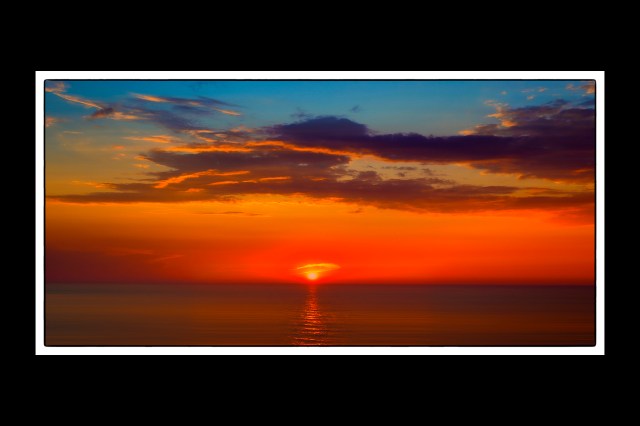
I set my tripod legs into the sand on a narrow path among clusters of high marram grass in the foredunes on an almost windless evening. Spring is turning into summer, now less than two weeks away. The number of bugs by the beach increases at dusk but thus far are not much of a nuisance. Sunset photos seem to easily please me, perhaps each possessing its own personality, displaying singular shades of color combinations, some more lush than others, as in an artistic arrangement. Tonight, a rogue cloud even seems to halo the setting sun. Often, I find the contrasting fringes of sky around the central glow most dramatic, as when violet and charcoal tinges begin to fill in the overcast spaces, creating a complement to those vivid tints still lingering on the horizon, and the lake water largely fades into darkness as well in a way that eventually completes the circle, like rounded or softened edges making a frame for me with this natural vignette. It suddenly seems so simple: I only have to snap my shutter button to snatch an image worth preserving.
∼ June 8, 2021 ∼ “Walking the Beach in Spring”
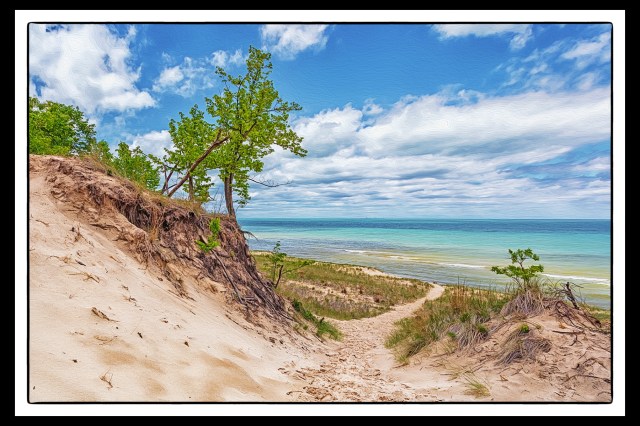
Since those frigid northern winds were exiled with the winter weather, each onshore breeze in this season now seems refreshing. Dune woods newly full of foliage ride the ridges of little hills shouldering an eroded coastline. Where I walk through the foredunes on this late spring morning, I watch one gull float beside the beach, twitching its wings and shifting position with each small surge of surf. The early forecast calls for thunderstorms bringing sudden downpours this evening. Yesterday, the still lake water resembled a glass table top reflecting an afternoon’s blue sky ruined only by a few far-off splotches of cumulus clouds, distant specks lying like hung laundry along the horizon. Every day we live with the conditions we’re given. Like life, the landscape appears ever changing, adjusts and alters its profile with any visit. I just try to photograph the scenery and find the right language to describe precisely what I see.
∼ June 6, 2021 ∼ “Abstract Expressions: Surf in Spring”

“Journal and landscape / —discredited form, discredited subject matter— / I tried to resuscitate both, breath and blood, / making them whole again…” (“Apologia Pro Vita Sua,” Charles Wright). Occasionally, I create photo abstracts out of the natural scenery I perceive, images which allow for a notebook entry likewise expressing a somewhat abstract notion with a little bit of contemplative or speculative meditation. As I view the accompanying spring shoreline setting captured with motion blur due to intentional camera movement and texturized in post-process, I am reminded of a concern I frequently entertain. Sometimes I think I have written more than I should or anyone would care to hear. In the end, is everything I produce simply an attempt at superficial description or is evidence presented to readers of any greater significance? I have accumulated almost two-hundred thousand words in my journals inspired by Thoreau; yet, I wonder where is the focused narrative and what is the overarching story. Are words written after an experience merely the vague scent of drifting smoke following the dousing of a breakfast campfire, an aroma that has shifted a few football fields’ distance in a persistent late-morning wind and now lingers along a trail in the nearby woods for visitors to sense, though not knowing the source, not tasting the slightly seared sausage or sipping the hot coffee? Is it enough just to offer these short pieces, prose vignettes that, perhaps like Charles Wright’s poems, record an observation or report an emotion in language momentarily inspired by landscape? I guess I’d like to believe Wright was correct in a statement also from his work cited at the start of this entry: “Landscape’s a lever of transcendence….”
∼ June 3, 2021 ∼ “Late Spring Trail”

The days have lengthened, bright sunlight tightening its grip on the landscape, gnawing away at the nighttime. Last week, a strong southern storm disintegrated as it drifted north, its clouds fragmenting as they approached, its rain dissipating. Due to recent short-term drought conditions, despite yesterday’s brief light rain shower, the creek water level is lower this month, its current running slower and receding in those places already almost dry, revealing a golden bed of sand. Earlier, I heard birds glibly conversing close by my path in the slim upper limbs of trailside trees. Now, in the distance one lone woodpecker keeps its beat. A mess of ephemeral insects thickens the air near me, some seemingly flickering as they flit in and out of narrow rays of late sunshine seeping between deep green leaves at times throwing their web of shadows about the ground around my feet.
∼ May 30, 2021 ∼ “Spring River”
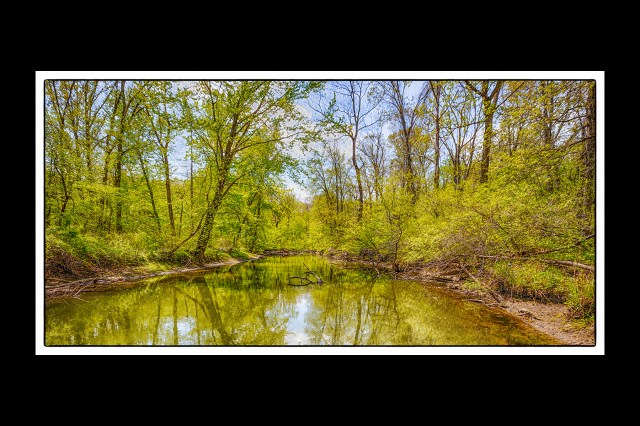
In mid-spring sunshine, lush green leaves appear nearby, filling limbs on these riverside trees. Birds repeatedly sing above as they slip easily from one branch to another. I listen to their rhythmic lilt drifting in this morning’s leisurely breeze. Yesterday’s steady procession of black clouds and bouts of heavy rain have slowly floated away, retreated to the east. Following April’s annual flooding, the worn path of this trail seems to have shifted a bit. Now realigned a little, it twists and turns beside the river, passing closer to the eroded bank than in the past. Dark pools of shadow have returned and again offer cool pockets of air amid the gradually warming weather of late May. Reflections settle on the surface of slow-moving water, as if the reverse images are intentionally meant aesthetically to double the impact of such wonderful scenery.
∼ May 23, 2021 ∼ “After a Passing Storm”

When most of the clouds cleared last night following a quickly passing spring storm, starlight brightened portions of the sky. In the morning, sunshine dried the countryside. Though the strongest gusts disappeared during the day, the lake continued to display a turbulent surface all afternoon as windy conditions washing over the water still stirred nature’s wave machine. I like to see how each season this landscape re-shapes itself. Yesterday, I noticed dramatic coastal erosion at the eastern end of the beach, sections of dune slopes that had been ruined by wintry weather. During my walk today, I could see three trees torn from a ridge had slid to the tan sand on the shore below. The lake level had decreased about ten feet, and this narrow strand now appeared to be feathered white by a scalloped line of surf, its swells pushed onshore before that persistent movement of air from the north.
∼ May 18, 2021 ∼ “Lake View in May”
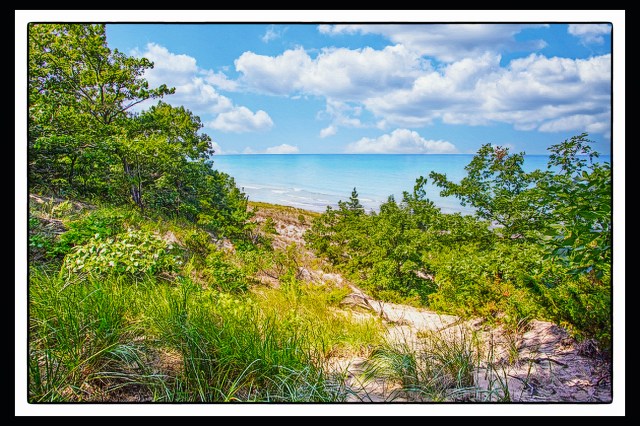
Like torn sheets of old note paper, scattered remnants of last year’s brown leaves now still blow about the ground, spun slightly by even the lightest breeze around slim trunks of trees beginning to blossom, some already filled with foliage. The afternoon’s strengthening sunshine is sifted by budding branches also shifting a little in the fresh air yet becoming warmed by those southern winds of spring. The setting appears silent except for this season’s revival of sporadic birdsong in limbs high overhead and sometimes also overarching the trail. A few isolated clouds float by like white sandy islands surrounded by a tint of blue sky seemingly the color of seawater. Earlier, walking by bristly underbrush amid thin ridge woods looming above the coast, I peered down, watching beyond the brow of a dune mound toward where small waves folded into themselves and splashed softly upon the shore, drops glistening in the glow of sunlight as if bits emitted by a sparkler lit in celebration, perhaps at last pleased to reach the beach.
∼ May 15, 2021 ∼ “A Gesture of Respect”
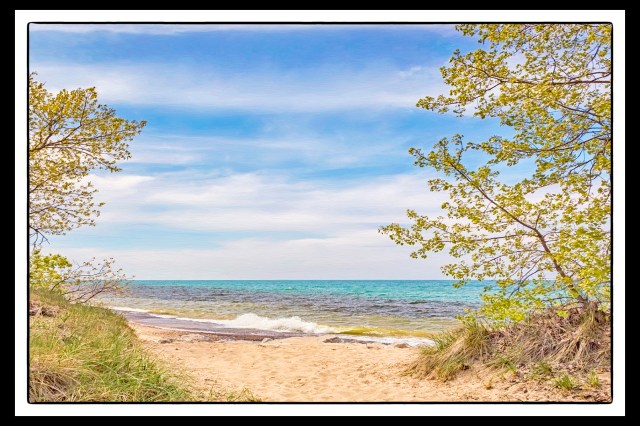
This afternoon I feel little wind and observe only a slow movement of thin stratified clouds crossing toward the southwest sky as if escorting a late-day sun. I walk quietly along a dune path through high leaves of marram grass beside the beach, every slender leaf greener than a week before. Lazy waves of lake water arrive, at times like lines resembling those bowed stripes inside the frame of a minimalist painting by Morris Louis. Moments ago, I observed an older man standing with a deaf adolescent by his side. The boy appeared maybe eleven or twelve years old. Both figures stood just beyond the reach of pulsing surf, each shading his eyes from a harsh glare of bright sunlight with one hand. The old man’s other hand was pointing toward the thin strip of Chicago skyline barely visible amid haze on the horizon beyond the blue lake. Then he bent to face the juvenile and communicated a comment by signing with a flutter of fingertips. In reply, the youngster simply nodded and smiled, his eyes still protected from the sun with an open palm touched to his forehead, as if in a fixed salute, offering a gesture of respect.
∼ May 12, 2021 ∼ “Marram Grass in Early May”

Following an afternoon of uninterrupted sunshine, I waited by the shoreline. Just before darkness arrived tonight, a collection of clouds again scraped the far sky above Lake Michigan. A little bit of wind picked up, and a repeated sequence of small waves washed ashore. Last night I watched zigzags of lightning igniting over the horizon; however, rain stayed away. Although most of the coastal trees have yet to fill with leaves, a sure sign of spring’s presence along the beach begins with the greening of marram grass, which during the humid morning was dripping with dew. Those swaying shapes, many that had been nearly gray or beige for the past six months, now offer vivid color, some narrow blades seeming like lines of handwritten script. Farther inland, evidence of May blossoms and blooms have already begun to replace those starker images inflicted by winter. The landscape continually sorts and resettles itself, and I know so much of my perception frequently seems connected to the metaphor of weather. Each day, I read the clever language of nature in its distinct signature.
∼ May 3, 2021 ∼ “A Simple Setting”
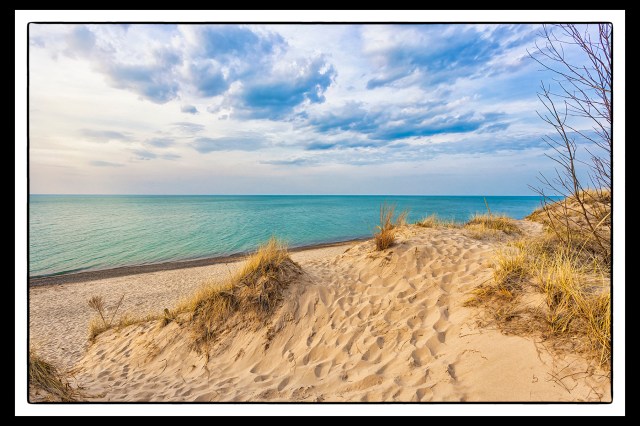
A few birds turn circles above beach trees as a last cluster of clouds drifts past in late-day light. Leaves of marram grass bend a bit among the dunes in a leisurely breeze, and the soft sand shifts easily beneath my feet. The lake water seems to transition between green and blue, and it now looks even smoother than earlier in the day when a weak weather front moved through the region. Although this location appears empty now, I have followed the footprints of others, perhaps previous visitors also walking toward the shoreline for brief relief from an active afternoon. When the sun slides lower over the horizon, all the edges of darker shadows will lengthen and sharpen until absorbed by nightfall. The tiny spots of stars will then flicker, and a chaos of bright dots will collect again against the backdrop of a black sky. Thoreau once wrote: “I am struck by the simplicity of light in the atmosphere.” I too prefer the predictability and simplicity inherent in just such a luminous setting.
∼ April 27, 2021 ∼ “Dune Tree Above Beach in Early Spring”
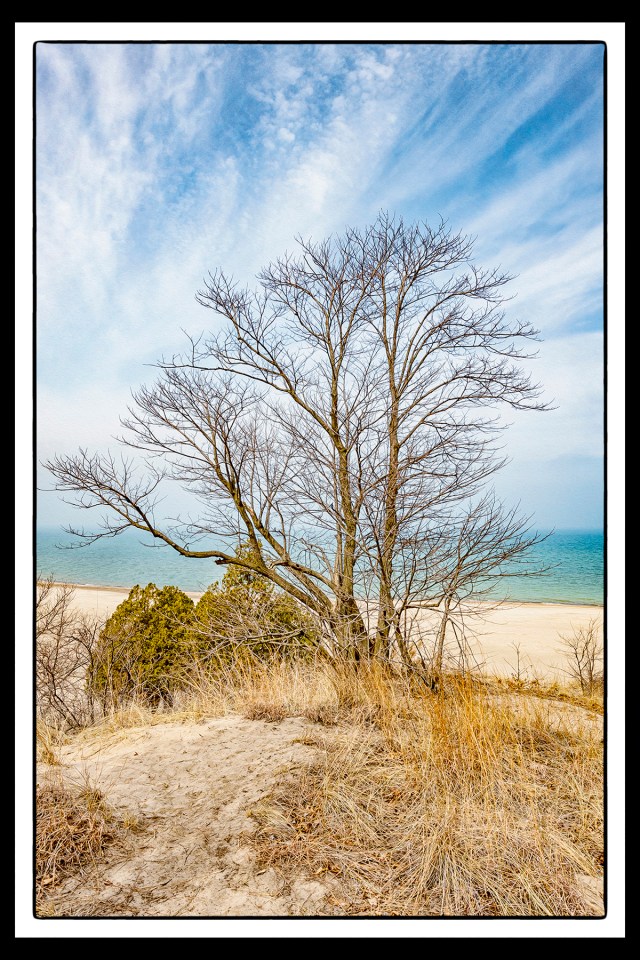
In this season, empty lakeside trees still seem to draw my eyes to the blue and white slotted sky beyond. The same light breeze that creates an easy cloud drift toward the north hardly shifts these thin limbs, while the surf along this subtle curve of shoreline appears nearly calm and smooth beneath dissipating lake haze. In a month or two the beach below this mound will feature crowds gathered in small groups, all feeling the heat brought by radiant sunshine, and I will find myself exploring elsewhere. Today, I make my way down a path through dunes now washed by the weaker sunlight of early spring among marram grass, especially dense in some places. Their blades gently waver, looking untidy, even tousled by a momentary increase in wind, and at times flow over those small broken branches that had fallen during winter-kill just a month or so ago.
∼ April 25, 2021 ∼ “Full Moon in April: A Memory”
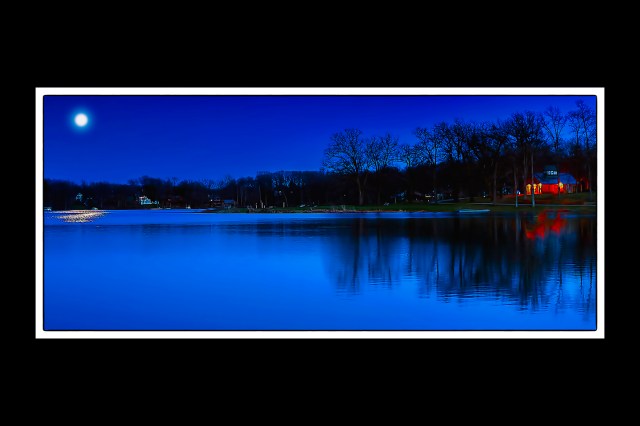
Earlier this week a reminder on my timeline at Facebook posted an old photo from a past April. In an article I also wrote a while back, I posed the notion that taking photos contributes to an enhanced sense of memory, and I quoted a study that found memories were improved in those folks focusing on freezing moments with their cameras. Although I hadn’t viewed this image in years and had simply stored it away in my archives hard drive, I immediately remembered the day I captured the scenery seen within the picture’s frame. I recalled not having a tripod with me, and I recollected the trouble maintaining a steady hold on my camera to avoid shaky blurring due to the necessary long shutter opening in such a darkening setting. I felt again the satisfaction of achieving clarity despite this difficulty. I also thought about how still the water seemed in an almost breezeless and unusually warm spring at late evening. I relived the silence around me, even the chirping sound of the season’s returning birds had halted while I stood by the side of this small lake in a county park. I reviewed the cloudless sky and the reflection of moonlight on the surface of the water, as well as the isolated glare of houselights blazing along the shore, knowing I was alone when I witnessed it all, observing an occurrence nobody else will ever share. Examining details in this image returned me to a location and transported my mind to a specific instance in time, as I had once proposed photographs so often do.
∼ April 22, 2021 ∼ “Solitary Tree in Early Spring”

In early spring season the beaches still remain steeped in silence under slanting sunlight, large summer crowds now a couple months away. Bleached by wintry conditions and fading into the tan backdrop of foredunes sand, blades of marram grass yet exhibit their pallor. A single gull above continues to be blown about by colder onshore winds still chilling the coastline. Although later in April, this week’s forecast called for more snowy weather to come through the region. Again, I walk the lakeshore on my own; however, if anyone were here with me, I’d show how a lone tree among the dunes after winter’s end seems to be steadfast, resolute and unwavering. I would explain why I find such a common image of isolation so interesting and admirable, something from which we may learn appreciation for our solitary experiences. As Thoreau wrote about solitude and nature: “I am no more lonely than a single mullein or dandelion in a pasture, or a bean leaf, or a sorrel, or a horse-fly, or a bumblebee. I am no more lonely than the Mill Brook, or a weathercock, or the north star, or the south wind, or an April shower, or a January thaw, or the first spider in a new house.”
∼ April 20, 2021 ∼ “Spring Sunset at Dunbar Beach”
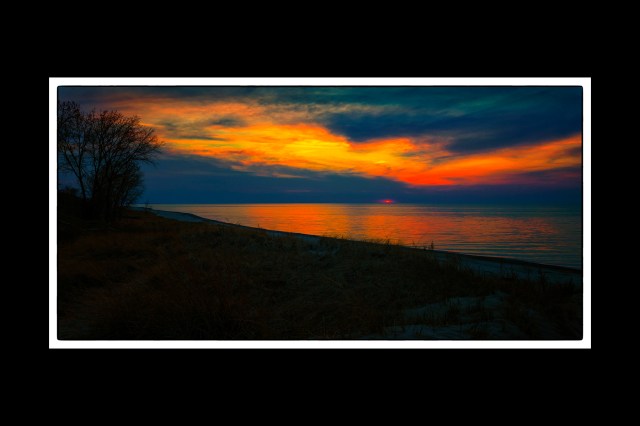
In previous posts I have frequently spoken about the need to develop patience when engaged in landscape photography, especially when capturing a sunset image. Waiting for the precise moment of ideal light requires a degree of resolve. I might stand beside my tripod for an hour or more—checking and measuring luminosity on the camera’s histogram, hoping for bright and colorful conditions in the distance evident on the digital display—before discovering an acceptable exposure or finally quitting the scene upon deciding the night’s not right. On a recent evening, I arrived at a ridge above Dunbar Beach long ahead of a scheduled sundown. All afternoon an impressive scattering of cumulous clouds had passed overhead, and I was enthusiastic to capture a panorama since weather apps promised a similar situation through to nightfall. However, I found the horizon beyond Lake Michigan fitted with a thick wall of pasty gray, a combination of haze and low overcast across the water. Fifteen minutes ahead of setting, the sun disappeared completely and any expectation of a splendid picture seemed lost. Nevertheless, at the last minute, as if peeking beneath a stage curtain, a red circle showed itself a bit at the western edge of the skyline, and suddenly upper levels of the skies were richly illuminated once more, ignited by an array of oranges or yellows spread against a dark and almost Prussian blue cloud cover, all reflected on the lake’s surface, which appeared smooth in this unusually warm and windless spring setting.
∼ April 18, 2021 ∼ “Sensory Elements and Experiences”

This morning’s cold temperatures and brisk winds seemed borrowed from another season, but now the weak onshore breeze, although still a bit chilly, feels no more than a gentle breath on my neck as I hike beside the lake. I know the words I choose to use in my descriptions sometimes appear to serve only one purpose—prose composed to offer context about a photo for those who wish to picture themselves on the scene. However, every passage also allows me to preserve sensory elements of my memory as an initial step to fully maintain and measure a moment in time, maybe even to gauge its significance. For instance, today’s cool coastal air, despite the afternoon’s brightening sunshine, and the rattle of colorful beach pebbles or hollow shells jostling beneath my feet contribute to the visual image captured by my camera to define or determine the importance of an incident. As Ralph Waldo Emerson explained the process: “The senses collect the surface facts of matter. The intellect acts on these brute reports, and obtains from them results which are the essence or intellectual form of the experiences.”
∼ April 14, 2021 ∼ “Return to Normality”

Last week as I walked the shoreline along Lake Michigan on an unseasonably warm evening for early spring, I noticed groups of visitors gathering to watch a forthcoming sunset. By the time the sky above the horizon had been lit with an array of vivid colors, a small crowd had collected by the water’s edge. I had to set my tripod among dune mounds on a ridge to omit from my camera frame those figures strolling the beach below. That same night I viewed an episode of the Ken Burns documentary about Ernest Hemingway, the author whose works I’d studied for my Ph.D. and who serves as subject for senior seminars I teach. Although the program offered little new information, I found myself fascinated by a number of photographs exhibiting Hemingway and his Parisian circle that I had previously not seen. However, almost as interesting were images of the masses at crowded street cafes in Paris during 1921 and 1922, captured not long after the end of World War I in November of 1918 and the Spanish Flu pandemic that extended from 1918-1920. These scenes reminded me of the possible return to normality, including full beaches on hot summer days, one would like to believe will soon occur again as surely as the next sunset.
∼ April 12, 2021 ∼ “Trail Toward Beach in Mid-April”
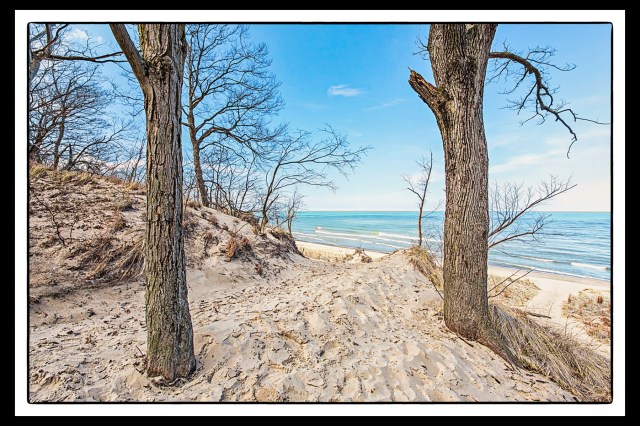
During April hikes I notice shortened stubs of shrubbery or stunted tree limbs that have been damaged by wintry weather. These seem to serve as lessons to be learned about ruin or the hope for restoration in spring, elements of nature’s authentic language meant to make a point, perhaps the authoritative field guide more instructive than pages in any book. Along this ridge trail with tan sand underfoot, I hear a murmur of surf in the distance, where I see persistent waves move onshore in rhythm with a continually quickening wind. Splotches of strengthening sunlight fill slopes of dune hills like bright patches of paint placed on a canvas by a Luminist artist. As always, I carry my camera and tripod, awaiting a break from the harsh sunshine evident all morning. The last time I came this way, the landscape had been buried beneath knee-deep snowfall, smooth white drifts glinted under a weaker winter sun during brief openings in cloud cover, and cold northern gusts whipped across a frozen lake.
∼ April 10, 2021 ∼ “Sunset at Start of Spring”
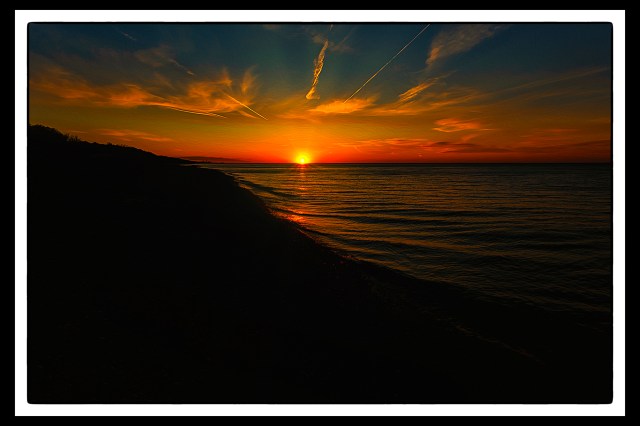
Every evening, as the seasons cycle through the year, each with its distinctive features, I look forward to that golden hour when angled sunshine begins to loosen its grip on the landscape. Sometimes the anticipation is disappointing when late daylight slides again behind a clutter of black clouds, perhaps weighted with rain. The dark cluster lazily crosses the lake, blocking just enough of the view to eliminate any idea of a sundown photograph. On this occasion, however, I waited by my tripod for the arrival of a vivid horizon transitioning to a night sky as the sun set over that western crease of coastline, its rich colors slipping slowly and steadily into the distance as if the day were simply draining away. Although a bit of wind persisted, it lifted only little waves and turned them toward the shoreline edge, providing a fine point of interest for leading the observer’s eye.
∼ April 7, 2021 ∼ “Trail Two Boardwalk Restoration”

I have often heard photographs mentioned as forms of memory, visual reminders of past experiences or recovered moments recognized from a scene lost in time. Even in images of the landscape, I find some truth to these perceptions. Reviewing old photos, I will notice a beach tree that has since been toppled by winds or a storm surge of winter waves. Sometimes I discover other images containing evidence preserved of settings impacted by previous conditions and exhibiting damage or destruction that now have been reconstructed and restored. Recently, the 2020 Indiana State Park’s Property Achievement Award was given to the Indiana Dunes State Park’s staff for restoration of the wooden walkway through wetlands along Trail Two, which included demolition, then installation of 2,561 feet of new boardwalk. Here is my before and after view at a segment of the path that had been posted on the park page. I enter this with appreciation to the park staff, volunteers, Ken and Mary Hill Family, and the Friends of Indiana Dunes, Inc. for their efforts and support of the renovation.
∼ April 5, 2021 ∼ “Trail Two Woods in Early Spring”
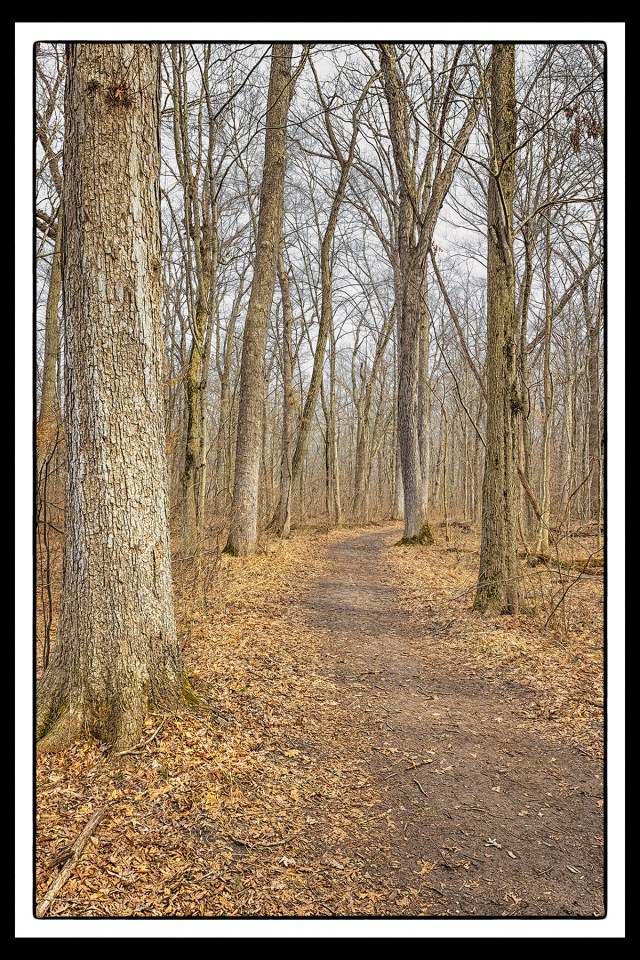
As I walk through these dune woods once more, light from a low sun flickers ahead of me between bare limbs still anticipating spring growth. In some places along the way, the ground around me remains chaotic, yet cluttered with a collection of branches broken by winter’s heavy weather. Clear skies, newly blue following two days of rain, returned at dawn for a while, perhaps like an image in a memory, though momentarily lost, suddenly remembered. Sifted scraps of weak morning sunshine seeped through these empty trees for a few hours. However, a mostly cloudy overcast now covers everything again. At times, the click of my camera shutter seems the only sound in this silent setting. Early April and already the narrow creek, twisting not farther than a few yards from my feet and only a month ago swollen by snowmelt, seems partially re-stocked by seasonal showers, its current running steadily behind where I have set my tripod.
∼ April 3, 2021 ∼ “Blowout Dune in Early Spring”

A steady progression of weather systems drifted past northwest Indiana during the last three weeks. Nature’s changes never end. Although spring seems to be attempting to settle in the region like those legions of migrating birds alighting on the limbs of leafless trees, only days ago snowflakes fell, powdering slopes facing north toward the water and slickening steep trails twisting inland. Today, wind speeds are gradually increasing once more across the area, though some gusts are already bending slim branches of treetops. Earlier the lake horizon line had been lost to morning fog, but now only a faint haze remains. Hoping to photograph scenes along the shore before a forecast rainstorm arrives, I hike a path among sand mounds and between clusters of still winter-worn marram grass at a blowout dune above the beach.
∼ April 1, 2021 ∼ “Sunset Through Empty Trees”
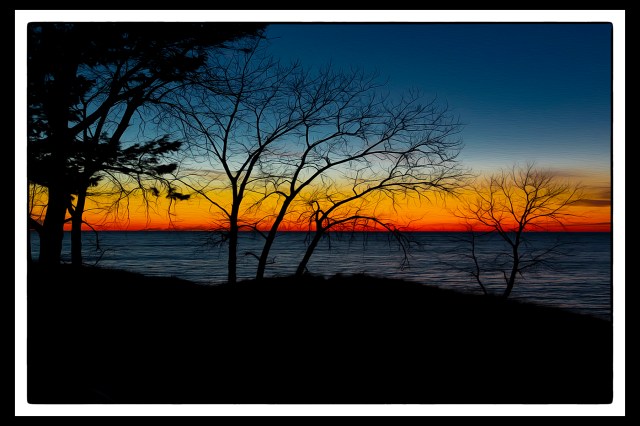
The weather warms a bit as southern winds increase and a spring storm spins in this direction from the west. Each week, with the path of a strengthening sun drifting farther north and daylight hours growing longer, the gradual shift to sunset now seems intended to be seen more like the threshold of a door toward a darker interior able to offer relief from the harsh sunshine. Perhaps this vivid sundown merely represents the landscape’s lively way of saying goodbye, one more day acquitted and allowed to go away, the simple replacement of one calendar page with another. Behind a line of yet empty lakeshore trees, a brilliant belt of vibrant color brightens the horizon. Soon, like a black bolt of fabric, nightfall finally will unroll. All of this exists as a sequence of scenery to be repeated every evening throughout the season until thick foliage completely fills these trees.
∼ March 30, 2021 ∼ “Big Blowout at Start of Spring”
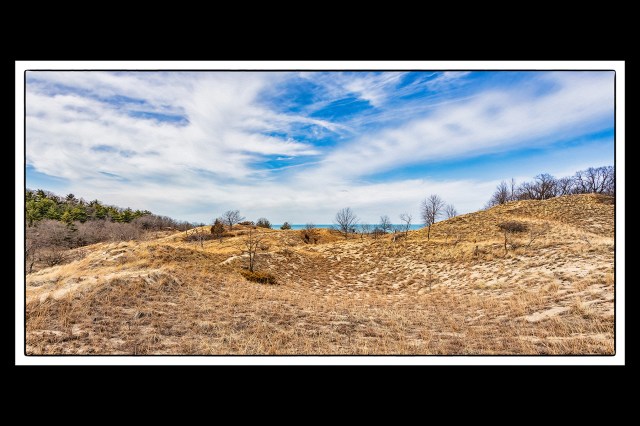
When spring begins to bring better weather, I like to hike the Big Blowout, traveling deeper inland from the beach, now out of sight as I position my tripod for the sweep of a panorama photograph. A thin strip of sandy trail winds through this countryside often too difficult to walk in thick winter snow. A blue sliver of lake remains visible beyond a dune ridge. Much of the ground appears yet brown with tangled wisps of marram grass, and a scattered presence of empty trees awaits the eventual influence of color from this new season. However, some evergreens populate a distant slope as though showing off for the benefit of my camera. Early afternoon sunshine partially blocked by intermittent cloud cover, I wait for a moment when the entire landscape is softened by bright light fading to diffused shade, to release my shutter and avoid any harsh contrast caused by sharp dark lines of hard shadows.
∼ March 28, 2021 ∼ “Shoreline Trees in Late March”

Driving earlier toward the site of my hike, I observed flags outside shops and gas stations normally flying outstretched high beside the highway during recent windy days were now lying nearly limp, though an increasing onshore breeze seemed to arrive by the time I reached the beach. When the clouds finally cleared to a thin and patchy overcast, the sky began to renew its rich blue hue. As the weather had warmed during this midmorning in early spring and temperatures approached seventy degrees, I removed the waterproof pullover I had been wearing and started my planned three-mile walk. Making my way on a narrow trail through groupings of thorny thickets gathered together not far from the shore on a dune rise beside the lake, I noticed a file of empty trees extending toward the east as if they were sentinels keeping watch, arranged in a single-line formation for guarding the calm water along the coast seen easing into this scene.
∼ March 25, 2021 ∼ “Lazy Day”
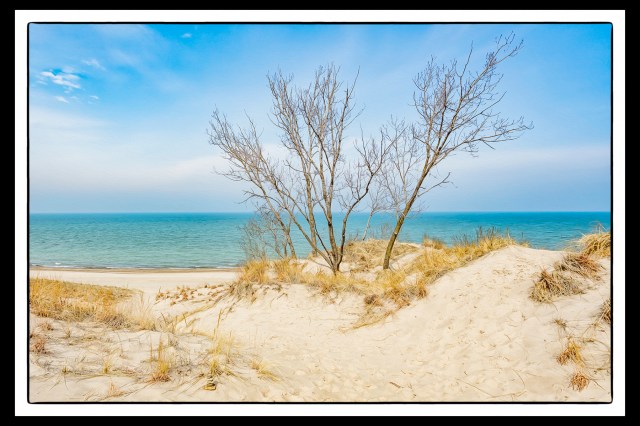
Mid-afternoon, a single small sailboat drifts maybe six hundred feet offshore, a couple ring-billed gulls lifted by a light breeze circle effortlessly above a softly breaking surf, each seemingly flying a slack but repeated pattern. Only an hour and a half into my hike, I stand tired and alone along the beach on a foredune among these trees, yet leafless, that have once again survived winter’s severe weather to extend their lengthy shadows in spring. Today, I know there will be few photos taken. Instead, I will lazily step toward the shore, one footprint following another through the loose sand, carrying my camera without its tripod, for once appreciating the lighter weight, this time more witness of the present scenery than photographer, living in the present rather than preserving the past stilled in a picture to be printed and someday perhaps positioned on a gallery wall. Nevertheless, I will sit beside the water’s edge on a large branch of dried driftwood a while to rest, and later I will write lines in my notebook with a brief description of the images I’ve observed.
∼ March 23, 2021 ∼ “Trail Toward Shore in March”
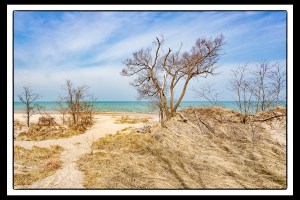 Last night’s passing showers have left beaded raindrops on top of those fallen rust-colored leaves yet layering the soft wet soil. In this still chilly morning at the beginning of spring some cool pools of water collecting in low places along the dark wooded trail continue to display their thin skin of ice. I listen to an insistent whisper of easy surf heard ahead in the distance. By the time I reach the beach near noon, bright sunshine spreads from an opening of trees in front of me, lighting the shoreline and almost igniting the whitecaps of little breaking waves now in sight. Dune ridge shadows drift with the shifting movement of the southern sun. Breeze-bent blades of marram grass fill the foredunes, each leaf wavering in this gentle wind, although occasionally all are bowled over for a moment by the arrival of a sudden gust, onshore air current in which ring-billed gulls ride alongside the lake edge. At times they glide above where I notice a woman wearing a colorful cardigan stooping to the damp sand repeatedly with her young child, a small girl with an apparently matching sweater, both seemingly pleased to be gathering unusual shells and smooth stones that had been shuffled ashore during the recent storm.
∼ March 21, 2021 ∼ “Dune Hill Trail in Mid-March”
 Following a day of drizzle as well as a lingering morning mist, today I hiked a less traveled and unmarked trail through dune hills laced with bright afternoon sunlight peeking between bare branches of tall trees rising on either side. There are favorite places in the landscape during late winter and early spring where I feel most comfortable, isolated spots with minimal accents to their stark scenery that seem to be maybe more interesting to me than when filled with the green of midsummer leaves or even the flourish of orange and rust colors seen in full fall foliage. Although others might not know these simple locations or never think of them as desirable settings for photography, I find myself drawn to long and twisting silhouetted limbs, their thin figures framing the way ahead, an increasing number of migrating birds busily chirping overhead, and that narrowing path disappearing in the distance toward an unknown that lies beyond its next bend.
∼ March 18, 2021 ∼ “Outtakes”
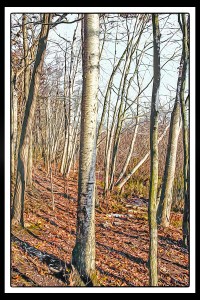 In my previous post I noted that my photographs are often designed to complement narrative phrases conceived as I hike. In this entry, I include a half dozen random observations, brief pieces (maybe a verbal version of film outtakes) from a recent walk that I have not yet collected into a cohesive composition. Perhaps this can offer an idea of how my thought process progresses from scattered fragments before becoming a final draft. 1) “The slender lines in dried trailside leaves left on the brown ground since autumn months appear as thin as the tiniest veins viewed in a human wrist.” 2) “The clear cold water of Dunes Creek flows slowly past me and feels like ice to my touch, enough to numb a finger in minutes.” 3) “Rich with a scent of dampness, black, thick and sticky mud from snowmelt runoff or recent rainfall seeping across my path squishes uncomfortably under my feet with each step forward.” 4) “A deer displaying the season’s coat of darker guard hair, nearly a football field away, gazes at me through a deep screen of trees, its figure faintly visible between bare branches of this dune forest.” 5) “‘Time Has Come Today’: distant clicking by an unseen woodpecker seems to echo in these empty woods like the tempo of those cow bell tick-tocks or rhythmic drum beats in an old Chambers Brothers song remembered from high school.” 6) “A dreary gray start to this day at end of winter finally gives way to bright afternoon sunlight sifted by silhouettes of interwoven upper limbs.”
∼ March 16, 2021 ∼ “Word and Image”
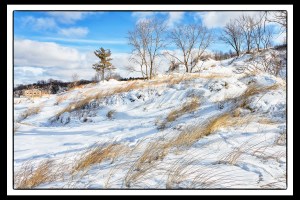 For five years I have kept my Indiana Dunes journal, perhaps seemingly nothing more than afterthoughts collected in paragraphs for a photographic almanac of images. Yet, I’ve never explained the way I arrive at my commentaries. Although most would assume I compose captions after gathering the photos, I can confide that the initial step in my writing method usually coincides with the arrangement of a setting within the rectangle of my camera viewfinder. Often, the framing and focus evident in a picture is actually dictated by what I already know I want to say about the scenery, narrative phrases conceived on location that I’m confident will be contained in any formal description. Consequently, my process from start to finish is an interwoven mixture of elements, part verbal and part visual, as I try to integrate word and image. For instance, as I stood by my tripod last month for the accompanying shot, I had devised a sentence likely to be included in any ensuing entry: “As afternoon skies were cleared by an onshore breeze, some narrow shadows of empty trees appeared, dark lines thrown by angled winter sunlight onto this snow-filled dune hill not far from the park’s iconic pavilion, currently vacated for extensive renovation scheduled to be complete in spring.” This on-site observation at the time shaped the taking of my photo as much as anything.
∼ March 14, 2021 ∼ “Swamp Forest at End of Winter”
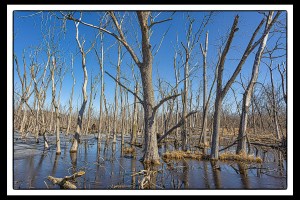 I walk past snags and deadfall caused by winter winds on this windless and warming sun-filled morning. As early spring approaches, with seemingly more contributors to the normal chorus of birdsong lately now among the rickrack pattern of bare branches above me, I pause to photograph a portion of swamp forest that has recently thawed after weeks of a February deep freeze. Nearby, on the other side of the trail, nearly a dozen sandhill cranes squawk loudly to express their displeasure at my presence, some slapping sharply and powerfully at the dark surface of water with their large wings, before they decide to fly about fifty yards away and settle beneath empty twisted limbs amid another collection of stark trees, the bottoms of their thin trunks disappearing into a surrounding surface of black liquid, mostly composed of old snowmelt mixed with mud, beginning to ripple in little waves due to this sudden disturbance.
∼ March 10, 2021 ∼ “Path to Beach in Early March”
 Driving north along the bypass for a midweek hike at the Indiana Dunes on a warm March afternoon, I observed a suddenly strong sun seemed to dangle high in the distant southern sky appearing in my rearview mirror. Though still offering more illumination than heat, its light brightened each feature of the landscape I passed along my way, particularly silhouetting those thin upper limbs of empty trees lining the highway. However, when I finally reached a narrow beach path through a tangle of yet bare shrubs leading toward the shore, the same location I’d photographed hidden deep beneath two feet of snow just a couple weeks ago, I noticed scattered cloud cover over the mostly still lake water had increased and now overwhelmed what had been a rich blue hue of clear skies. Nevertheless, this low ceiling of cumulus formations contributed a sense of texture to the scenery and added to my interest in capturing the image.
∼ March 9, 2021 ∼ “Dune Path on Mild March Day”
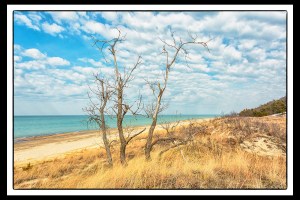 As I drove toward the Lake Michigan coast yesterday, the exterior temperature reading on my car dashboard stalled just short of seventy degrees. Only one week into the month and the weather seemed involved in a dress rehearsal for spring’s imminent arrival. Although swift southern winds briefly warmed the region somewhat, I noticed bright white remnants of snow lingering among wooded north-facing slopes of dune hills that had not yet been exposed to direct sunlight due to the continuing low angle of the sun’s passing. Nevertheless, hiking a shoreline trail winding among foredunes, I observed a pair of multi-colored butterflies already fluttering back and forth between the long-yellowed leaves of marram grass and still leafless clutches of undergrowth beside this path just above the beach. A trio of empty trees, their bare branches reaching expressively toward clusters of clouds overhead, completed the scenery, and I felt the presence of those butterflies floating in unusually mild March air along my way appeared to indicate a clear transition in seasonal conditions had happened on this late winter day.
∼ March 8, 2021 ∼ “My Selection Process”
 I was pleased to receive a kind comment from a best friend all the way back in high school days as a response to one of my photos posted last week. In his complimentary note, he asked a general question I’ve received frequently in differing forms from others about my process of selecting locations for daily photography, and I have decided to answer a bit more completely here. I check weather apps regularly to determine not only whether the upcoming day will contain precipitation (rain, sleet, or snow), but also for expected percent of overcast, types of clouds, wind speed and direction, angle of sunshine, sunrise and sunset times, as well as possibilities of haze, fog, or mist. Certain conditions favor hiking wooded trails while others dictate a walk along the lakeshore or wandering into marshland and swamp forests. Additionally, I revisit specific areas repeatedly until I finally find the right lighting and to capture images with dramatic effects, such as spring growth, fall foliage, or wintry scenery. It helps that I live nearby a state park and a national park (totaling nearly 17,000 acres of natural landscape with a variety of terrain), both of which I regard almost as my personal backyard. In the accompanying recently taken photo I chose to hike beside a newly thawed river that had been frozen for a while. On this mild day following a spell of snowfall, I knew the water, outlined in white and with current wavering in a slight breeze, would be clear due to snowmelt and the setting would be protected by a partly cloudy sky from harsh shadows of overhanging branches.
∼ March 7, 2021 ∼ “Discovery and Didion”
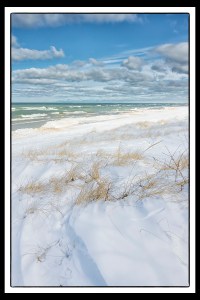 I have taught creative writing for forty years, and every semester I begin the initial class session by informing my students about how the attraction of imaginative composition for me involves a process of discovery. Setting pen to paper or placing letters on a digital screen leads me to fresh revelations or adjusted understandings of various matters—even when examining familiar frequently explored subjects—I hadn’t yet realized I possessed. Similarly, when photographing landscape scenery, my greatest pleasure comes from originating a distinctive impression of what appears before me, perhaps like the accompanying recent picture of a coastline after snowfall. My main motivation is similar in both art forms. As I was reading a just published anthology of some previously uncollected Joan Didion essays this week, I observed her explanation for why she wrote: “I write entirely to find out what I’m thinking, what I’m looking at, what I see and what it means.” The essay reveals that her work focuses on conceived images and that she hoped to uncover what was going on in those pictures envisioned in her mind. Didion even compares the written word with photography: “To shift the structure of a sentence alters the meaning of that sentence, as definitely and as inflexibly as the position of a camera alters the meaning of the object photographed.”
∼ March 4, 2021 ∼ “Pure Landscape Photography”
 In late winter the once-iced creek water becomes unfrozen and still moves slowly through these dune woods. Weak sunlight filtered by thin cloud cover slips between the bare branches of trailside trees. Small knots of snow gather at the base of brown trunks now wet with melt. When I peer at the vertical rectangular image appearing in my viewfinder, the setting seems oddly calm, soothing, transient, and fragile. I no longer feel the chilly breeze yet sweeping easily onshore from Lake Michigan. Each time I freeze an instant with the thousandth-of-a-second quickness from my camera shutter, I experience the nature of “no-Time” about which Robert Penn Warren often spoke in his poetry—the perceived effect of timelessness when a moment seems separated from all others and beyond the control of chronology. Perhaps this represents the essence of pure landscape photography, distinct scenery isolated in time.
∼ March 2, 2021 ∼ “Beach Trees Near End of Winter”
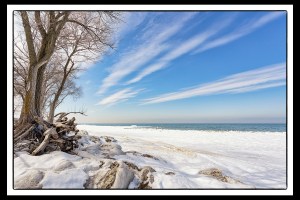 Near the end of each winter I take inventory of beach trees lost because of waves due to storm surges, burdensome weight of snow and ice, or strong northern wind gusts. I hike miles along the Indiana Dunes shore to inspect the condition of those I had known to be endangered, and I am surprised when I find they have withstood another harsh season. I have visited many of these trees repeatedly for photographing over the past decade, and I have grown to regard some as landmarks or admired them for their ability to survive severe weather almost as steadfast sentinels standing watch at the water’s edge. Last week as I walked the coastline again during thawing of the shelf ice, I noticed at least four more of my favorite trees had recently been destroyed by wintry weather, their toppled trunks and broken branches lying twisted in a mixture of sand and snow. However, like the trees seen in my accompanying image, others still managed to remain upright and will continue to grace the lakefront, perhaps with an elegant and enduring presence.
∼ February 25, 2021 ∼ “Rural Road Under Snowfall”
 When the snowfall finally ended, a number of rural lanes remained impassable, a few maybe two feet deep with the week’s total accumulation; so, I found a recently plowed parking lot at the state park and carefully hiked this rarely traveled route through dune woods to Trail Two. Although the sky stayed overcast and gray until late day, and a flat light filled the backdrop behind thin limbs bending in bare trees, some stuck with blowing snow adhering to their tilted trunks, the scenery seemed somewhat appealing. As I stood by my tripod to capture this image, the white way ahead looked like an empty page, perhaps that blank flyleaf flipped at the start of a highly anticipated new book. The storm’s strong winds had gradually diminished, and a calm collected across the quiet landscape except when a pair of long-legged cross-country skiers appeared nearby but respectably apart, sliding along a narrow path through an old-growth forest. The young couple called out a brief greeting to me before quickly disappearing, gliding gracefully into the distance, and then the silence returned.
∼ February 23, 2021 ∼ “Dune Hill in Winter”
 All week now, snow drifts built along those slopes facing the lake beneath a nearby hill where the wind sweeps ashore from the north after each passing storm. Finding myself hiking knee deep in fresh snowfall, strenuously stepping toward an upper ledge overlooking the lakeshore, I pause a moment to rest. Listening to an absence of sound, the stillness feels soothing at first; however, this quiet is soon broken by the persistent tapping of a woodpecker coming from dune woods just beyond the ridge above me. Its steady ticking seems similar to a metronome’s rhythmic pace, and each strike against the hard bark quickly brings memories of recurring summer scenery. Today, camouflaged by winter white and faint haze, the setting’s features are almost unrecognizable. Nevertheless, warmer days only months away, soon songbirds too will again fill the tops of these trees, also yet empty of leaves, and walking steep sandy trails will be a little bit easier.
∼ February 21, 2021 ∼ “Dune Hill After Winter Storm: A Panorama”
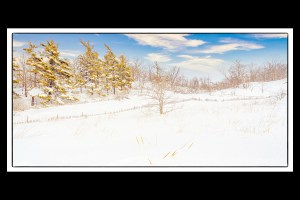 When I arrived at Indiana Dunes State Park, I found myself alone. The strongest portion of a winter storm had faded away, and even the brief spells of flurries witnessed while driving had ended. Skies soon cleared enough to brighten the whitened landscape. I walked toward the shallow slope of a sand dune now covered in a couple feet of unblemished snow, a location where no one else had yet stepped. One portion of the hill before me featured trees whose leaves still lingered some, though long gone to gold in autumn, and they gathered snowfall among branches laboring beneath the sudden weight. In the distance a ridge line of empty trees seemed to cradle a few clouds amid an increasingly rich hue of blue above. Although I rarely capture images in a panorama format, this scene appeared appropriate for such an elongated aspect ratio, presenting an extremely wide perspective that studies suggest is nearer to the usual field of view naturally seen by the human eye.
∼ February 17, 2021 ∼ “Beach Beneath Snowfall”
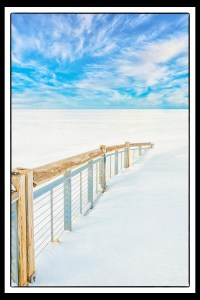 Early morning began with frigid temperatures, readings dipping below zero, and a bit of light snow continuing to build atop two feet of previous accumulation. But by the time I drove north and reached the lakeshore, the thermometer level had raised a number of notches to eight degrees. Eventually, a solid gray overcast gave way to developing blue skies showing from behind thin lines of wispy clouds above ice-covered Lake Michigan. I trudged along a walkway railing that frequently leads visitors toward the sandy beach at Indiana Dunes State Park for summer sunbathing or swimming; however, today in this wintry weather, the slim wooden handrail simply disappeared into a field of deep snow, at times drifting waist high. It had become impossible for me to distinguish between the normal shoreline and the white expanse of shelf ice buried beneath days of snowfall, now extending as far as the eye can see toward the horizon.
∼ February 16, 2021 ∼ “Devil’s Slide After Snowfall”
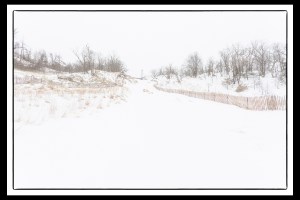 I have always enjoyed photographing in snowy conditions, especially when I am able to capture images of settings during fresh snow cover that normally are occupied by multitudes of people. The absence of footprints and clean, smooth contours of wind drifts create a sense of solitude and serenity unusual for a location commonly seen teeming with hikers. The accompanying photo shows Devil’s Slide at Indiana Dunes State Park, a distinctive spot recognized by all who spend time there—frequently the initial hike taken by visitors and the lone official site designated for sledding in winter. Since I had arrived while light snowfall was still filling the landscape and the heavily overcast skies were as white as the steep slope, I was delighted with my opportunity. I snapped pictures in black-and-white format as well as in color, but I share the latter here because I feel the faint touch of tint in the fencing and some of the blades of undergrowth showing through the snow added an attractive accent.
∼ February 14, 2021 ∼ “Sandy Slope Toward Dune Hill in Winter”
 I appreciated the positive feedback received for a recently posted black-and-white photograph. As I noted in my commentary accompanying that picture, I find certain scenes in frigid wintry conditions seem more suitable for this basic format. Because these snowy images already contain mostly white scenery offering a fair amount of blank space often broken only by silhouettes of bare branches as contrast, the straightforward approach of a simple black-and-white photo appears an appropriate choice. Consequently, hiking the other day along the beach at Indiana Dunes State Park during a passing snowstorm at times in near whiteout circumstances, I decided this landscape displaying a sandy slope now hidden beneath snowdrifts with its thin line of empty trees stretching along the crest of a dune hill would work well if captured as a monochrome setting.
∼ February 12, 2021 ∼ “Beach Tree Beside Frozen Lake Michigan”
 With recent nighttime temperatures falling into negative territory on the thermometer and wind chills some days well into double-digits below zero, an accumulation of snowfall along the coast has blended well with the quickly developing shoreline shelf ice now thickening and stretching as far as the eye can see toward the horizon. Even each bare beach tree extending its thin and twisted limbs suddenly seems like a delicate work of sketched art with the vast expanse of frozen Lake Michigan almost serving as a pale canvas backdrop. Although severely cold and so stark in its wintry appearance, the air increasingly frigid with brisk onshore gusts, the magnificence of the scenery still serves as an invigorating feature to me while I hike a couple miles beside this sweep of vast white covering the lake’s hardened surface.
∼ February 9, 2021 ∼ “Morning Snowfall on Sand Dunes”
 In the morning snowflakes slowly floated down outside my window from a low ceiling of thick clouds in windless air like the atmosphere inside a child’s snow globe or pale confetti drifting in an old black-and-white film. Radar screens showed a minor weather disturbance shaped like a tight fist shifting through the area. I decided to hike the hidden sand dunes in increasing shoreline fog, shelf ice on the lake beyond. I wanted to be the first to walk among the fresh powder. This new tier of snowfall appeared to soften the icy crust of those frosted layers left from last week’s storm and several nights of below zero temperatures, perhaps covering everything from the past “in forgetful snow,” as T.S. Eliot once wrote. By noon, though no sunshine arrived and the sky remained a light gray, the short snowstorm had gradually eased, diminishing remnants slipping farther to the east—although another low pressure system was forecast for later in the day. Its presence tapered the way sleep seems to recede easily with each day’s waking, the attractive aftermath of delicate snowy scenery lingering like the pleasure of a remembered dream.
∼ February 7, 2021 ∼ “Fallen Trees in Winter River”
 As I hiked a trail beside this river on a winter morning following snowfall, I noticed a section where the slow-flowing current was interrupted by a cluster of recently fallen trees clogging the passage of water. Small patches of blue from clearing skies, in some spots looking like sample swatches of paint applied in thin brushstrokes to a canvas, reflected amid the many thick trunks and big branches, light brown now covered with white. All were collected together near a sharp bend and created a blockage obstructing the winding waterway. Colorful little ripples occasionally speckled the river’s surface, not yet frozen and so gently disturbed by a soft intermittent breeze. When I had arrived, my presence disrupted four mallard ducks that rose sharply from the water, vivid with the distinctive green gloss on their heads, and quickly flew out of sight through woods downstream. Afterward, I stood at my tripod in a strange silence, setting the scene within the frame of my camera viewfinder, suddenly aware of a certain sense of calm, an apparent stillness developing in the nearly motionless air after the strong wailing winds that had characterized the previous night’s passing storm.
∼ February 5, 2021 ∼ “Dunes Creek Bend in Winter”
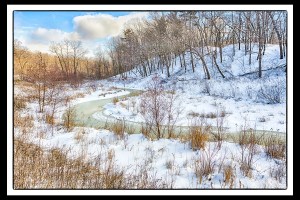 With the recent arrival of additional snowfall and a late first freeze of waterways in the region, the distinctive bend winding between two wooded dune hills at the west end of Dunes Creek, along the short Beach Trail from the Pavilion parking lot at Indiana Dunes State Park, appeared particularly wintry and especially appealing this past week. Just a few hundred yards from where the east-to-west current’s slow pace finally flows into Lake Michigan, the curved course of the creek, gracefully placed in an inland valley (that until a “daylighting project” in 2006 also had been covered for decades by a parking lot), seems to lend a sense of elegance to its surroundings in each of the seasons—and I have photographed the scenery in all four—but it especially attracts attention to itself when frozen during the winter months.
∼ February 3, 2021 ∼ “Coastal Snow Following Overnight Storm”
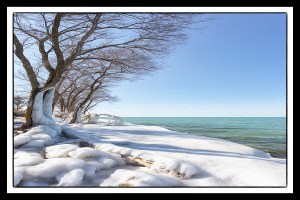 A quickly moving snowstorm swept across the area overnight. In the morning light, large flakes still swirled in a twist of winds outside my window. Although seemingly colder than temperatures in recent weeks, the brightening sky displaying patches of blue in breaks between thick clouds brought forth a false sense of warmth and comfort. But by the time I reached the beach, now dressed in its winter white, the last evidence of overcast had disappeared and the unhindered sunlight illuminated an ample showing of snow topped with a shallow layer of shiny ice, almost glowing along the lakeshore. Calm yet chilly conditions created a smooth surface of pretty much motionless lake water tinted by the rich blue hue extending overhead. Even the bare branches of coastal trees—some weighted and bent by this latest snowfall—seemed to lean expressively toward the shoreline, their thin limbs caught firmly in winter’s grip. As I checked the settings visible on the back of my camera, I liked the crisp image of clean scenery arrayed in front of me and now captured within the frame of my digital screen.
∼ February 1, 2021 ∼ “Welcome to February”
 The month of February often offers excellent opportunities for winter hiking and photography around the area. Weather conditions continue to allow landscape scenery to be seen through new perspectives as snow cover frequently softens or smooths a number of natural features and increases contrast in details, creating opportunities for great images. Empty tree limbs even allow viewing through woods to locations along trails usually hidden in other seasons by full foliage. Moreover, during February local daylight lengthens more than an hour and ten minutes, changing sunrise from 7:00 a.m. to 6:23 a.m. and sunset from 5:04 p.m. to 5:38 p.m. Plus, average daily temperatures rise: highs climb from 33 degrees to 41 degrees and lows ascend from 18 degrees to 24 degrees. Still, chances of a significant snowfall or two remain likely. In fact, although extended meteorological records show January normally witnesses a couple more days of snow accumulation in the region, February has proven snowier during the past decade.
∼ January 29, 2021 ∼ “End of Trail Seven Following Snowfall”
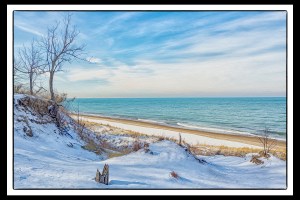 Thickening clouds rolled over the area overnight and earlier this morning, bringing increasing winds and leaving another thin layer of snowfall. However, skies nearly cleared by noon, and the day’s weather calmed considerably quickly. I walked through dune woods once again, hiking the short one-mile course of Trail Seven up a sandy inland incline of coastal hillside toward its crest, where one eventually emerges from the forest edge onto a narrow ridge overlooking Lake Michigan. Moderately easy compared to the steep ascent of neighboring Trail Eight that traverses the three highest peaks of the state park and requires greater labor, this route opens at its top to a shallow path descending gently through foredunes, where wind-smoothed slopes of drifting snow appear yet undisturbed by footsteps, and it ends at that steady pulse of small waves breaking in the surf now showing not far below.
∼ January 26, 2021 ∼ “Beach Reopening”
 Yesterday, Indiana Dunes National Park officially reopened remote Central Avenue Beach, a favorite location for me to photograph, after a long period of closure due to destruction caused by strong gusts and wave erosion to the beach as well as dune slopes. Reports note that 56,000 tons of restoration sand were added to the site by the Army Corps of Engineers. I last visited it following a brief summer storm. Shadows of stray fragments from a few late clouds, remnants amid blue skies, slowly floated across the lake untroubled by much of a lessening breeze, at times temporarily darkening its water’s greenish-yellow hue. In the distance yet not very far from shore, ring-billed gulls still circled, silhouetted in sharp afternoon sunlight. An empty beach extended ahead of me, unmarred by footprints. Its access had been limited by damage to an entryway dune that had once tilted easily toward the shore, slanting at a shallow angle. But cut abruptly by the high waves and winter gale winds, it now existed merely as a sheer cliff of nearly twenty-five feet, down which I carefully climbed, stepping carefully into solid footholds of packed sand or onto small boulders and carrying my camera bag strapped over my shoulder. (The beach apparently remains difficult to access, but an easier path is promised when warmer weather returns.) At the time, I noticed a stillness all around me except for the sound from that steady whisper of soothing surf washing ashore and interrupting the silence in rhythmic intervals almost as regular as a metronome.
∼ January 24, 2021 ∼ “Sacred Space in Winter”
 These north facing slopes of foredunes along Lake Michigan will always hold their snow cover a little longer, even when winter weather sometimes lingers into late March, although today faded yellowing patches of marram grass already show through a diminishing layer of white. Walking a fair distance east on a chilly beach, I reach the location where painter Frank Dudley once lived on an isolated sandy ledge below Mt. Holden in a lakeside cabin he’d named Duneland Studio, consisting of four rooms filled with his artworks, a big brown-brick fireplace, six picture windows overlooking the coast and open to strong onshore winds, plus an old grand piano for his wife Maida. In the past I have written fondly of this location as almost a sacred space, my favorite place along the shore, now returned to its natural state as seen in the accompanying image, yet transcendent, containing a somewhat spiritual significance. Here is where Frank and Maida hosted politicians and other prominent citizens in the early 1920s for displaying his scenic paintings, hoping to persuade support for legal status designating this landscape as public parkland, an official designation that finally occurred in 1923 with establishment of Indiana Dunes State Park.
∼ January 22, 2021 ∼ “Trail Two Bridge in Winter”
 Although the bulk of an overnight storm front had at last passed toward the north, its distant southern fringes yet extended over our area. When I went walking in the morning, a bit of snow still fell intermittently, sifting between the bare upper branches of trees along Trail Two, filling the landscape with a thin white layer suddenly so bright even in the gray daylight, seemingly cleaning the disheveled scenery left by the autumn season around Dunes Creek. Only the beginning of winter, the slow-flowing stream had not frozen, and remnants of resilient leaves remained in a few of those lower overhanging limbs, some looking almost like the color of rust flakes on a lower body panel of an old automobile. A couple toppled trunks traversed sections of the water, various others lay scattered about the path but mostly hidden now by the fresh snowfall. Apparently, I had been the first to arrive, since the footbridge continued to be free of footprints, and I was hesitant to mar its purity, so I lingered a little, pausing long enough to capture this photograph of the setting.
∼ January 18, 2021 ∼ “Coastal Erosion”
 Recent news reports with updates on continuing efforts to reverse losses from local coastal erosion reminded me of this image I’d taken in early September but never shared. Already, the late-summer day displays more evidence of steady decay: a pair of dead trees, soon to topple to the disappearing beach submerged below, still lean precariously from a thin ridge above a slight curve of shoreline. My afternoon walk beside the surf is halted due to the lake’s raised water level and insistent waves lifted by gusts yet stiffened by this back flow of northern wind current following a short storm that passed throughout the overnight hours. In some places, smooth grooves of sand seem planed down the steep slopes of dunes, and in other spots the sharp pitch of this incline appears rougher, a little like a surface littered with pared shavings. In the distance, green tops of trees in thick woods extending to a point just beyond my sight might eventually become endangered as well. As in this scene, almost the entire length of the Indiana Dunes has experienced damage in recent years, destruction from deterioration of the coastline due to natural patterns of periodic shifts in weather conditions, and latest assessments suggest possible gradual progress in recovery efforts likely won’t be apparent until sometime in spring.
∼ January 15, 2021 ∼ “Mild Start to January”
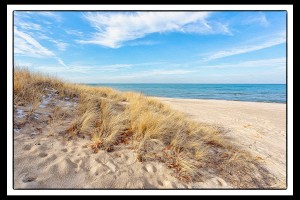 The first two weeks of this month have continually exhibited temperatures above normal. On mild winter mornings when almost all the snowfall along the shore has melted, the natural beauty of specific features beside the beach emerges into view once again, such as the scattering of crisp autumn leaves still strewn about the dunes, some caught among resilient tufts of marram grass, and the calm blue lake water adjacent to a lighter hue of brightening sky on the horizon. As though meant as a metaphor, the tan sand in this scenery smoothed by recent breezes but interrupted by a few strings of footprints disappearing into the distance—perhaps from other solitary strollers like myself—seems soothing. Even the final remnants of snow, tiny pockets caught in shadowy spots, appear like those dabs of flake white paint once touched to an impressionist’s canvas. I feel as if I’d like to stay here all day, await more of the afternoon warming brought by a slow yet steady flow of southern air current that arrived last night, but I know I must be going soon.
∼ January 13, 2021 ∼ “Small Pond on Warm Winter Day”
 Thus far, the deep freeze witnessed in past winter seasons has not arrived. This morning the region was filled with mist and the sporadic spit of brief rain showers, but I am awaiting true wintry weather, the frigid cold with heavy snowfall stored in my memory and evident in past photographs. Today I notice the dune woods look almost as they have since the end of autumn, and a lack of snow in the swamp forest during mid-January seems so apparent this year, just as the absence of shelf ice along the shoreline appears odd. Black bare branches yet bend overhead, stark and sharply defined in their darkness. Last week, walking this trail at the bottom of a small gully along weak creek current bordered with little pools of still water like the tiny pond in my image, normally frozen over by now, the sandy path still gave way easily, soft and soggy beneath my feet. I even heard the faint sound of a distant birdsong, as if in spring, from somewhere between those twisting limbs of empty trees rising on either side of me.
∼ January 12, 2021 ∼ “Dunes Pavilion Renovation Update”
 The historic pavilion at the public beach in Indiana Dunes State Park has been undergoing renovation the past five years and, following a number of delays, is now scheduled for reopening in May. An amended construction contract, revised and released on December 2, notes a ribbon-cutting ceremony has been set for May 7. The pavilion was originally constructed during 1929 and first opened for use in 1930. I recently examined progress on the structure, observing the exterior alterations appear attractive and are nearly complete, plus the building—which apparently will include a restaurant and ice cream shop—already displays a new entryway façade with a retro style, as seen in my accompanying image. Plans describe that an “open-air first floor will be available for public picnicking, shade from the hot sun of the beach, and interpretive programs and exhibits related to the history of the state park and the dunes region.” Notably, revisions to the pavilion that will be premiered in May do not include possible conceptual additions yet being developed of a glass-walled rooftop bar and an attached banquet center with 14-foot window walls, which have been sources of controversy and contention, especially with environmentalist constituencies who advise such features would be harmful to migrating birds and spoil the art deco design of the original construction. However, experts are being consulted with consideration for classic architecture, weather impact, danger to birds, influence of ambient lighting, etc. An emphasis on alcohol sales among refreshment options also concerns many who wonder about the possible influence on social atmosphere at the adjacent beach, where the Indiana Department of Natural Resources assures alcohol will remain prohibited. The DNR further informs all that a future banquet center “will provide indoor space on the second floor for wedding receptions, meetings, and other events. It will also be used for a variety of public programs throughout the year.”
∼ January 11, 2021 ∼ “Trail Beneath Bent Tree”
 When the sun’s path tracks toward the south, drifting during the seasonal meteorological shift in winter, its sharpening angles of light often emphasize aspects of sunshine and shade, creating points of greater contrast in attractive images. Frank V. Dudley, “the Painter of the Dunes” from whom I have learned some tactics about how to capture images, frequently featured this polarity of illumination and darkness in parts of his artwork to increase a distinct awareness of distance for observers. Conversely, on gray days with sky now clouded by thickening overcast, natural daylight flattens and all sense of depth is altered. Indeed, late this morning when I walked the beach, Lake Michigan was still mostly hidden behind a white gauze of haze collecting along the coast, limiting any vision or effective photography. However, moving inland during emerging sunlight that had dissipated a lingering thin mist, I was reminded that long limbs, once burdened by the heavy weight of rain from spring storms and snow in colder months, or branches broken by strong winds, sometimes might bend so low above a narrow trail almost as if to deliberately hinder further movement through the woods, at other times merely casting a lone shadow in front of me.
∼ January 9, 2021 ∼ “Journal Update”
 Each January, as the sun sets on one year and another starts, I archive the cumulative record of journal entries in my ongoing Indiana Dunes photography and commentary project, begun in January 2017 as part of proposals for a couple grants. While I was saving the posts from 2020 last week, I noted having written a total of over 160,000 words in more than 650 pieces, each accompanied by a photograph, during the past four years. The initial entry on New Year’s Day 2017 mentioned my indebtedness to Henry David Thoreau, whose body of journal composition contains about 2-million words, as a model for my process. Thoreau advised that one should “write often…rather than long at a time, not trying too many feeble somersaults in the air.” He also believed brief and simple observations or informal contemplations were frequently more effective because otherwise one might be tempted to prioritize style: “It is surprising how much, from the habit of regarding writing as an accomplishment, is wasted in form.” As always, I thank all for reading my words, which I hope have been rewarding, and I invite everyone to review my collection of commentaries.
∼ January 7, 2021 ∼ “Beach Overlook After Overnight Snow”
 During warm summer days when a refreshing onshore breeze begins to lift leaves of trees beside the beach or shifts loose sand along winding paths I often follow through the dunes toward the shoreline, I like to hike this upper ridge trail just a bit inland, where a few cooler routes ideal for casual walking rise above the scenery and allow better observation. However, even in this morning’s wintry conditions, when snowfall conceals much of the foredunes’ marram grass—shaded yellow or made gray by the colder weather, some seemingly frigid with a white fringe—and other areas display a scattering of hillside shrubs, their lower branches and twigs becoming hidden in little drifts, I prefer an elevated perspective. By the time I capture this image, I notice a cluster of clouds that had collected at dawn in the distance above the horizon—I thought perhaps indicating another storm front might be approaching—has now mostly faded from view and given way to nearly clear blue skies.
∼ January 5, 2021 ∼ “Steady and Stable”
 In a recent post about photographing a scene under overcast skies, I mentioned my use of a tripod, as I have occasionally done in the past. Despite sometimes reading comments where one wonders about its necessity, I have found the practice of including a tripod in my process valuable for physical stability of the camera and for imposing a steadying sense of patience in my routine. Obviously, on bright sunny days in open areas acceptably sharp pictures can be taken handheld, since the intense light allows for a fast shutter speed. However, much of landscape photography occurs during times of decreased illumination—such as at sunset, under cloud cover, or beneath the canopy of foliage in a forest—which compels longer shutter speeds for proper exposure and adds more likelihood of camera shake when held in the hand. Nevertheless, at times my ability with handheld shooting may be tested. For instance, the accompanying image was taken on a whim. I was driving along the lakeshore when I noticed a sudden sunset afterglow appear briefly on the horizon behind a line of trees. Fortunately, I was able to park my car fairly quickly, but I didn’t have the luxury of retrieving my tripod from the trunk and setting it up. I hurried to a proper spot, and I snapped the shot while leaning against a tree as an anchor. Because of the dim conditions, I wasn’t sure how clear the capture until I returned to my car, reviewed the playback on the preview screen, and happily determined it displayed crisp features.
∼ January 3, 2021 ∼ “Resolution: Fine Art Photography”
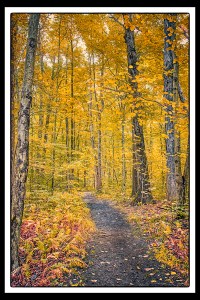 In photography’s infancy, “pictorialism” photographers tried to rival artists by adopting various techniques associated with painting. Later, the Photographic Fine Art Association, founded in England by Sultan Jouhar in 1961, was established in an effort to extend to photography the respect and elevated regard given to other visual arts, most notably painting. Its definition of “fine art photography” included an emphasis on evoking emotion with pictures designed to express an individual vision of a scene through the use of photographic skills in composing, capturing, and processing the final image. In the past I have noted how Ansel Adams considered photography an art with its photos as “made” images. Adams stated: “The photographer in every step envisions and constructs an image almost in the manner a painter might. Although the photograph sometimes might appear to be a mere documentation of whatever vista an individual has witnessed during a hike, the captured image has its own identity.” Similarly, beside documentation, I regard some of my work to be a form of fine art landscape photography–as seen in the accompanying picture captured in November on Trail Eight at the Indiana Dunes State Park—chronicling particular identifiable spots with a somewhat subjective interpretation that highlights specific aspects of the scenery, sometimes in an almost painterly perspective. With this in mind, as a resolution for the new year I intend to focus closely on creating more fine art photos accompanied by an impressionistic commentary.
Journal: 2020
[Dates reflect days on which entries are posted.]
∼ December 28, 2020 ∼ “Shoreline Vista in Early Winter”
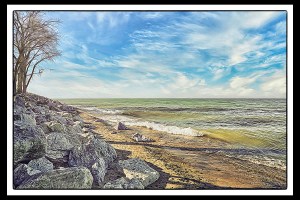 Though many years may display colder conditions during December days in this northwest corner of the state, and all can change quickly, temperatures thus far at the close of 2020 have generally remained fairly mild and weather has mainly stayed dry enough to prevent any significant snow accumulations or build-up of shelf ice frequently seen along the shore at Indiana Dunes beginning in early winter. Consequently, long walks along this thin strip of sand during sunny midday hours still occasionally offer visitors beautiful views of a mostly untroubled surf. In fact, I captured the accompanying image recently under comfortable circumstances, even despite a slightly increasing onshore breeze as the afternoon proceeded, while casually hiking along the Lake Michigan coast to examine evidence of sand restoration and to inspect a collection of precautionary boulders placed in various locations, clusters positioned as buffers to help in protecting some beach dunes and shoreline trees from when those strong surges with large waves often brought by mid-winter storms make their appearance.
∼ December 26, 2020 ∼ “Remembering Barry Lopez”
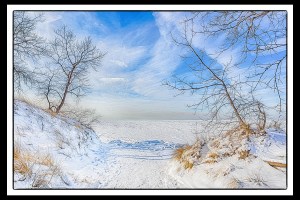 I received word from a friend this morning about the death of Barry Lopez on Christmas Day. Perhaps best known for Arctic Dreams, a National Book Award winner, he was an author who began as a landscape photographer and whose works on nature or wildlife have impacted and influenced numerous writers. Indeed, I acknowledge a debt to him whenever I comment on nature, especially winter scenes like the one in my accompanying photo. I have written about him within past journal entries and in a dedicated article titled “Seeing to Learn.” However, nearly 25 years ago, I was privileged to have work included alongside Lopez in The Sacred Place, an anthology of environmental writing. His contribution to the book, “Pearyland,” an essay about death in nature, chronicled a scientist named Edward Bowman, originally from Indiana, who was briefly in northern Greenland to study “what happened when large animals die” and “they’re taken apart by other animals…funneled back into the ecological community”; yet, Bowman eventually spoke about the separation of their “bodies and the souls,” their spirits leaving the land after death. In a paragraph seemingly appropriate today, describing Bowman’s evolving state of mind at the close of his visit, Lopez reports: “During his last days, he said, he tried to sketch the land. I saw the drawings—all pastels, watercolors, with some small, brilliant patches of red, purple, and yellow: flowers, dwarf willow, bearberry. The land was immense. It seemed to run up against the horizon like a wave. And yet it appeared weightless, as if it could have been canted sideways by air soft as birds breathing.”
∼ December 23, 2020 ∼ “Lone Tree with Leaves in Beginning of Winter”
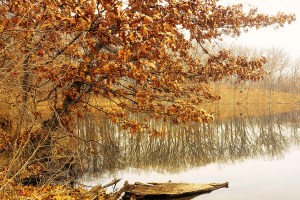 Walking through lakeside woods in the beginning of winter, I notice a lone tree, seemingly defiant, still clinging to most of its leaves—now crisp, and tinted a golden brown since mid-autumn—while the small hill rising up a bank beyond exhibits a section of nearby forest filled with the bare limbs of empty trees. This overcast day displays scattered patches of light fog along edges of the lake, and though calm conditions exist, I sense a forecasted rain seems imminent, soon to move through the area. I know I must start to head home before the storm arrives. Nevertheless, pausing to take a photograph at an odd and awkward angle, I need to slowly and carefully place one of my tripod legs in a shallow depth of motionless water, patiently trying to avoid creating little ripples that might upset the mirror reflection of treetops spread on the surface of the lake in front of me.
∼ December 21, 2020 ∼ “Great Marsh in Beginning of Winter”
 Although often frozen over and covered with an accumulation of snowfall at the start of winter, thus far only a thin skin of ice still layers the surface of water at the Great Marsh. On the opening day of the season, the shortest in terms of daylight, thick clouds came early then cleared, allowing some glimpses of sunshine between those lines of overcast, but ominous skies would reappear again, arriving with a storm front later in the afternoon. After briefly visiting Kemil Beach and hiking the eastern end of Indiana Dunes State Park coastline to examine evidence of sand erosion and to watch a pattern of small waves, brought by light western winds, break easily along the Lake Michigan shore, I traveled to these nearby wetlands and walked a short trail through irregular clusters of empty trees unevenly interspersed among a landscape once lush and bright in summer, but now stark and darkening.
∼ December 9, 2020 ∼ “The Democratic Lens”
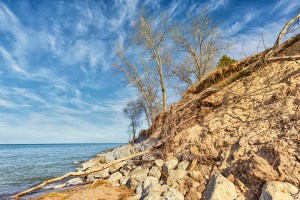 With the arrival of winter break at the university, I have been rereading Peter Gay’s historical text titled Modernism: The Lure of Heresy, which I initially encountered a decade ago upon its 2010 publication. In his account of Vincent van Gogh, the author indicates the painter’s dislike for photography: “The democratic lens, an invention that van Gogh despised, was to his mind doomed to register mere surfaces.” The obligation of the artist, van Gogh insisted, involved suggestion of something beyond the superficial. Since I have frequently acknowledged Frank V. Dudley, the Painter of the Dunes, as a main influence on my work, I usually attempt to present the landscape with a painter’s intimation of depth, perhaps an implied narrative or an arresting singular view that engages the observer in an aspect of the original experience, elevating the photo above mere equivalency of an image interchangeable with others and produced by “the democratic lens.” For example, I offer my accompanying picture of lakefront erosion that captures a scene representing the essence of an incident—what French photographer Henri Cartier-Bresson described as “the decisive moment”—shot before the eventual destruction of a half dozen trees soon to topple into Lake Michigan.
∼ December 1, 2020 ∼ “December Weather”
 Although the 2020 November around here had been among the warmest on record, complementing a much milder than normal year at area locations, December in this region has begun with typical wintry weather. Gale force wind gusts, sometimes surpassing 50 miles per hour hurrying from the north, brought large waves—at times exceeding 20 feet—across Lake Michigan toward the shorelines of northern Indiana on Monday. Local meteorologists reported lake-effect snowfall, usually associated with early winter conditions as cold air travels over warmer waters toward the Indiana Dunes, had already covered some coastal counties with a few inches of accumulation and were expected to continue through Tuesday’s beginning of the new month. Indeed, daily temperatures will drop during December from an average high of 41 degrees and low of 27 degrees at the start of the month to the more frigid levels of 32 and 18 by the final day of the year, freezing nearby creeks and streams, as seen in the accompanying calendar image.
∼ November 16, 2020 ∼ “Words on Nature by Walt Whitman”
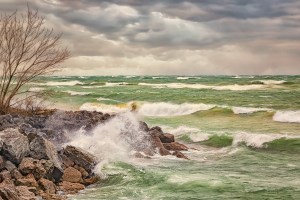 Early this past weekend I read a brief article (“Walt Whitman on What Makes Life Worth Living” by Maria Popova) about how Whitman speaks to the necessity of nature for physical or emotional human health in Specimen Days, his book of prose pieces. Late in his life, following a stroke that left him with partial paralysis, Whitman testified to the healing impact of nature: “After you have exhausted what there is in business, politics, conviviality, love, and so on—have found that none of these finally satisfy, or permanently wear—what remains? Nature remains; to bring out from their torpid recesses, the affinities of a man or woman with the open air, the trees, fields, the changes of seasons—the sun by day and the stars of heaven by night.” Consequently, on Sunday as steady winds exceeding 50 mph and reaching near hurricane gusts of 65 mph swiftly swept over the open water of Lake Michigan from the west, I decided to follow Whitman’s advice and explore outside by photographing scenes along the shoreline.
∼ November 8, 2020 ∼ “Image and Text”
 As many who view my photos already know, I teach literature and creative writing at Valparaiso University. Frequently, art students enroll in my writing courses as electives to become better at narrative or description, hoping to create accompanying notes to artworks displayed in gallery shows or brochures. Some artists seem reluctant to accept a connection between the visual and the verbal, preferring or sometimes insisting that pictures be seen and evaluated on their own. In the past, I have published an essay (“Captions and Captured Images”) discussing this subject. However, integrating word and image has historically been appreciated as a tactic to communicate. Brooks Jensen—photographer, author, and editor—states in his book, The Creative Life in Photography, that there exists an “inevitable marriage between image and text.” He observes that the blending comes naturally to some, such as novelist and photographer Wright Morris, but Jensen also cites various other classic photographers who sought to collaborate with writers: “Dorothea Lange and Paul Taylor, Walker Evans and James Agee, Margaret Bourke-White and Erskine Caldwell.” I’m aware most folks who encounter my photos on social media focus on the visual; however, I hope my captions provide an added layer of understanding, complementing or augmenting the scene captured within my camera’s frame, even when briefly describing as simple an image as these leaves—crisp and brown, wavy and striated, clinging to a thin limb—that have transitioned into a different kind of attractiveness.
∼ November 4, 2020 ∼ “Autumn Trail”
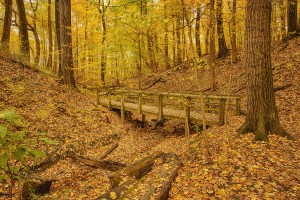 When northwest winds moved swiftly through these mid-season woods of Indiana Dunes National Park last week, fallen leaves of tall trees along winding trails littered the way ahead, and all seemed even more pleasing to my eye. The series of footbridges crossing a dry creek appeared like magical locations from some unknown place with distinctive scenery, perhaps cinematic settings from the imaginary landscape in a fantasy film. I walked the path during an afternoon lull in wind conditions, appreciating a still and silent atmosphere each time I stopped to position my tripod for photographing the surroundings. This lower level of my route, twisting and turning between slopes of small hills, seemed filled with decorative shapes of festive paper designed by craft scissors and tinted different shades of autumnal colors suitable for a celebration.
∼ November 1, 2020 ∼ “Welcome to November”
 This year the time change to Central Standard Time occurs in the morning hours of November 1, a transition that resets the local sunset to 4:43 pm. This switch of the clock creates a greater block of evening darkness, and by the end of November, nightfall will happen at 4:19 pm. Additionally, average daily temperatures during the month will gradually slip from a high of 57 and a low of 39 at the start of November to an average high of 40 and a low of 27 by the first of December. This tumble in degrees will be matched by the dropping leaves, which reached their peak in autumn color during the past week and, assisted by high winds or rainstorms, already have begun to cover the ground around all their tree trunks. Indeed, trails throughout woods in the region also are becoming more decorated with those rich tints of leaf fall.
∼ October 28, 2020 ∼ “Country Lane in Autumn”
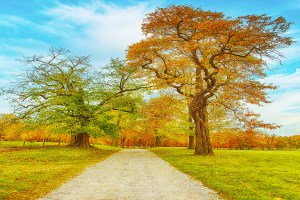 When I was walking from my car in a trailhead parking lot and moving toward a forested region in the Indiana Dunes National Park the other afternoon following a morning of rain showers, I appreciated the crisp atmosphere of cooler autumn weather and the suddenly brightening landscape under clear skies. I had been anticipating capturing images of colorful foliage among clusters of tall trees hidden in a ravine along a thickly wooded route. However, just before I arrived at the location where my path would bend into the first gathering of undergrowth and disappear in the darker interior, carrying my camera on a tripod over my shoulder, I turned for a moment to look back at the country lane I had just passed. I was surprised to find an appealing scene I hadn’t previously noticed now revealed from an interesting angle, and I decided to pause for a photograph.
∼ October 24, 2020 ∼ “Chellberg Farm in Fall”
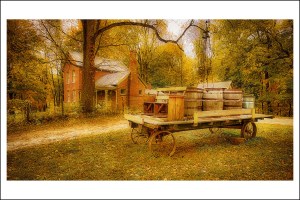 In the past I have mentioned how I often return to specific spots in the Indiana Dunes state or national parks to capture images during different months. Photos of historic Chellberg Farm, site of a nineteenth-century farmhouse located in the Indiana Dunes National Park and a favorite place I have repeatedly photographed, always seem suitable to any season. In a post from 2017 I noted: “in late fall—as the last leaves linger in surrounding trees…the farmhouse exists almost as a mere complement to that natural setting.” When I visited again this week, diffused light filtered through gray overcast skies appeared to soften the atmosphere and tint the landscape in a tone almost reminiscent of old-fashioned photographs. A chill in the air and the transitioning of leaves in trees around the home to autumnal color offered evidence of the seasonal change occurring throughout this region.
∼ October 20, 2020 ∼ “River in October”
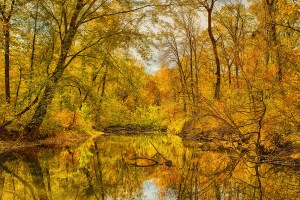 During the break in a sustained pattern of rain showers and windy conditions yesterday, I decided to take a short hike, traveling about a mile on a trail along the Little Calumet River in the Indiana Dunes National Park. Following a few days during which overnight temperatures had dipped toward frost level, those colors of foliage on trees lining the river appeared enhanced. Additionally, remaining leaves on branches overhanging the stream of water seemed even more vivid because of lingering moisture from a morning storm, and diffused soft light filtered by slightly overcast skies brought richly vibrant tints in a scenery not bleached by bright sunlight. Even the afternoon breezes that had been blowing onshore from nearby Lake Michigan suddenly diminished, allowing a nearly calm current to flow slowly by my side and reflect a variety of features yet decorating the landscape on both banks.
∼ October 18, 2020 ∼ “Autumnal Art”
 As local foliage offers evidence that the peak of leaf season has arrived in this region, I am reminded again of an excerpt from Henry David Thoreau’s posthumous collection of essays, Excursions, a favorite of mine. I especially appreciate “Autumnal Tint,” in which Thoreau contrasts artists’ supply of colors with nature’s great array: “Our paint box is very imperfectly filled. Instead of, or beside, supplying such paint-boxes as we do, we might supply these natural colors to the young. Where else will they study color under greater advantages? What School of Design can vie with this? Think how much the eyes of painters of all kinds, and of manufacturers of cloth and paper, and paper-stainers, and countless others, are to be educated by these autumnal colors. The stationer’s envelopes may be of various tints, yet, not so various those of the leaves of a single tree. If you want a different shade or tint of a particular color, you have only to look farther within or without the tree or the wood. These leaves are not dipped in one dye, as at the dye-house, but they are dyed in light of infinitely various degrees of strength, and left to set and dry there.”
∼ October 1, 2020 ∼ “October Sunset”
 Many of the evident changes to the landscape that occur in October are easily visible in the richness and variety of color in its setting and seen among foliage remaining on trees, still twisting in onshore breezes, or observed on those fallen leaves already layering the ground. Indeed, in many ways the environment in northwest Indiana becomes an expansive canvas painted by the transitioning climate, a natural artwork designed by the season’s increasing chilliness, and the scenery achieves an added level of beauty. October’s temperatures dip quickly throughout the month, as average daytime highs slip from nearly 70 to the mid-50s, and normal overnight lows drop into the 30s. Additionally, the length of daily sunlight, now angled from a position farther south, diminishes to just a little more than eleven hours by the close of October, introducing stunningly vivid sunsets over Lake Michigan earlier in the evening.
∼ September 21, 2020 ∼ “Weather and Landscape Photography”
 The final days of summer and start of autumn have seen cool and cloudless weather in northwest Indiana. As I have written previously in my journal entries, the influence and interaction of weather systems across the United States regularly impact our local meteorological circumstances. Whenever strong fronts or hurricane-level disturbances appear in the southern states and eastern half of the country, high-pressure zones moving across the Midwest frequently stall; consequently, cloudless skies will often linger for a longer period over Lake Michigan in mid-September. Consequently, many in the region enjoy the clear and comfortable weather at this time each year, but the opportunities for dramatic photographs are diminished. Indeed, as Ansel Adams observed: “Bad weather makes for good photography.” Nevertheless, fragments of these atmospheric low-pressure systems occasionally slip farther north and spread scattered splotches of clouds, such as in my accompanying photo taken when remnants of Hurricane Irma once drifted over the area. Currently, a weakening tropical storm, Beta, is shifting along the Gulf Coast, poised to pass onshore, and the path of its impact bears watching.
∼ September 14, 2020 ∼ “Path to Lake at End of Summer”
 Today, on my mother’s birthday, I remember her for the wise advice she often offered me as a boy, including sharing the old adage about making lemonade out of lemons. Checking my calendar this week, I thought fondly of her as I noticed various cancelled activities still listed on pages in late September and into October, including mounting a photography gallery display for a two-month “autumn photos” show and leading a planned fall foliage hike for nature photographers. However, as is the case with most other folks, situations have changed in 2020. In response to conditions occurring due to the coronavirus pandemic, many photography events that I originally had scheduled for this year—exhibitions, lectures, seminars, workshops, photo hikes, photography club talks, etc.—were called off. Fortunately, with the assistance of the Interpretive Naturalist at the Indiana Dunes State Park, where I have always enjoyed engaging with the staff and visitors, I was invited to continue my participation there by posting a photograph and a brief caption of commentary each week at the park’s Facebook page. Since I prefer combining words with images, I welcomed this chance to promote appealing locations in the state park like the path toward Lake Michigan in the accompanying picture, and I have appreciated the experience, especially given the numerous enthusiastic and encouraging responses received from readers of the page, which lists nearly 65,000 followers.
∼ September 8, 2020 ∼ “Knowing One’s Home”
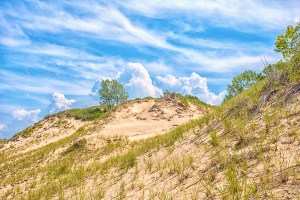 Decades ago when I was earning my Ph.D. at the University of Utah, I was amazed by the rugged Wasatch Range and various sections of the Rocky Mountains elsewhere throughout the region. Indeed, those surroundings served as a prime reason for my selecting to study in Salt Lake City despite attractive offers by other universities. From the snowcapped peaks, frequently lasting deep into spring, to the vast expanses of desert toward the south and west, I greatly admired that grand landscape. Consequently, at times I now wonder about my fondness for the Indiana Dunes and my insistence on repeatedly relating details about this nearby terrain where sandy peaks like the one in the accompanying image don’t even reach 200 feet. The local topography exhibits admittedly limited vistas in contrast with more dramatic sites evident in western states, even though the dunes stretch through a state park and a national park. However, I chose a book by David Gessner, All the Wild That Remains, for my holiday reading over the Labor Day weekend, and I received reassurance for my familiar focus through observations quoted within its pages by a pair of eminent environmental writers, Wallace Stegner and Wendell Berry, each emphasizing the importance of examining and comprehending the place one calls home. Stegner, a fellow Utah alum associated with the West, writes in a 1962 autobiography: “I may not know who I am, but I know where I am from.” Berry, a Kentuckian, responds in a 1963 letter to Stegner: “I would like to do as well, sometime, with the facts of my own little neck of the woods.”
∼ September 1, 2020 ∼ “Sunset at Start of September”
 A look back at summer as September starts reveals a season of unusual warmth, perhaps at a record level. According to recent local meteorology reports, the months of June, July, and August have brought many more days with top temperatures reaching into the 90-degree range than normally witnessed. Nevertheless, as we find ourselves three weeks from autumn, conditions throughout the region will transition during the next thirty days, as the warm weather will soon begin to chill significantly. By the close of the month, average high daytime temperatures will decrease from 79 to 69, and the average nighttime low will drop from 60 to 48. Additionally, the path of the sun swill slowly drift farther south, creating more dramatic angles of light at sunset.
∼ August 24, 2020 ∼ “Calm Lake in Late Summer”
 Lately, we have been witnessing a few late summer days with much warmer weather and blue skies visited only by light winds bringing wispy clouds, causing mostly calm lake water along the Indiana Dunes. In a recent journal note I wrote about how Ansel Adams regarded products of well-designed landscape photography as artifacts, made objects, art in their own right. I have written on this perspective frequently over the past couple years. Indeed, though I have sometimes described my photographs of nature scenery as documentary art, usually realistically chronicling a precise location during a specific season under defined climate conditions or weather disturbances, in the past I have also shared more abstract and consciously artistic compositions created by manipulation of my camera, maybe through deliberate movement or hand shake during an exposure to blur or accentuate shapes in a scene—perhaps the way an artist might apply brushstrokes to add texture or even drip paint drop-by-drop onto a canvas to exaggerate energy and visual expression—such as in my accompanying image, which depicts an experience of viewing the Lake Michigan shore in its state of stillness seen this week.
∼ August 19, 2020 ∼ “National Photography Day”
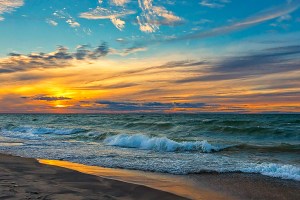 Since today has been designated National Photography Day, I share this excerpt from one of my past articles written about the process of photographic art and following a statement by the most renowned American landscape photographer: “Ansel Adams famously remarked: ‘You don’t take a photograph, you make it.’ When selecting a lens or arranging the camera settings, choosing to use a polarizing filter or graduated density filter, electing a time of day, arriving during weather with sunny or cloudy skies, situating the tripod and adjusting its height, committing to cropping, dodging and burning, and finalizing the print size or paper quality, the photographer in every step envisions and constructs an image almost in the manner a painter might. Although the photograph sometimes might appear to be a mere documentation of whatever vista an individual has witnessed during a hike, the captured image has its own identity. The photographer takes possession of this specific interpretation of his or her surroundings.”
∼ August 17, 2020 ∼ “Way Leads on to Way”
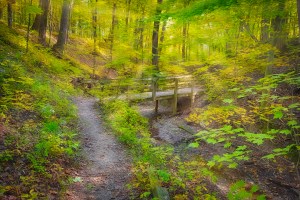 I have begun teaching literature and writing classes for the fall semester this week, all online through Zoom meetings. Conducting the initial sessions (including the use of visual presentation with sharing of syllabus files, links to required texts, and chat interaction), I recall the past the way my zoom lens draws distant objects closer. I am reminded of the first classes I taught more than forty years ago, which took place before personal computers or mass access to the Internet and that merely relied upon manual distribution of a mimeographed syllabus. Obviously, much has changed since then, but mostly through degrees of gradual transition over time. My general education class has been tasked with writing a personal narrative essay and my Modern Poetry group is beginning with reading a selection of Robert Frost poems, including “The Road Not Taken.” Consequently, I pulled from my bookshelf a memoir collection by Sydney Lea, A North Country Life, which illustrates the importance of memory in personal journals and cites the Frost work: “‘knowing how way leads on to way.’ I know a lot about that too: once my mind gets started in retrospective mode, this path seems to branch onto that one, that onto another, on and on until only sleep, and at times not even that, stops my rambling.” I believe aspects of these thoughts contribute to my longstanding and continuous fascination with photographs of trails disappearing into the landscape ahead, perhaps “bent in the undergrowth,” a natural image signifying the uncertainty of a future filled with surprises that can only be reached by traveling one trail at a time while possessing faith in the possibility of rewarding discoveries somewhere down the path.
∼ August 11, 2020 ∼ “Beach Clean Up”
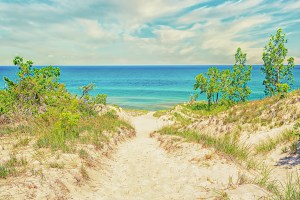 Since opportunities for numerous activities have been canceled or severely limited this summer, national parks and state parks, especially those with public beaches or other open waterfront access, have seen increased attendance during July and August. Consequently, much of the landscape has been negatively impacted under the stress of unusually high traffic patterns. As mentioned in past posts, I am a member of Nature First, a nonprofit and nonpartisan organization of photographers who advocate for conservancy of the environment we capture in images. As its current newsletter explains: “Nature First promotes the protection and preservation of the world’s natural and wild places through inspiring, educating, and uniting everyone making photographs and videos in nature; empowering them to be ambassadors of the natural world.” Therefore, I’d like to encourage those local folks able to engage in the Indiana Dunes State Park Beach Clean Up scheduled for this Sunday, August 16, beginning 8 a.m. at the park pavilion and moving east along the beach to bring the sand dunes back to their pristine condition. Trash bags and gloves will be provided, while participants are asked to wear masks and social distance.
∼ August 4, 2020 ∼ “Summer Surf at Sunset”
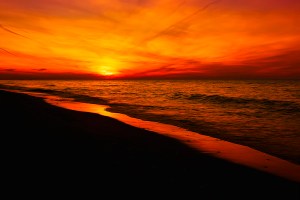 During midday in midsummer the dunes often appear pale, whitened by a bright sunlight shining from directly above through the opening and closing of gaps in high cloud cover occasionally crossing overhead. A sharp bleaching of the landscape by harsh light with an accompanying emergence of distracting shapes of dark shadows creates a great contrast lessening an opportunity for optimum photography. Following a winding walk through the foredunes—in summer conditions often almost chalk colored between tufts of green marram grass swaying in a late afternoon lake breeze—hoping I might find an appropriate location to photograph sundown, I know that before nightfall I will be rewarded by sight of a thin strip of surf and damp reflective sand extending along the beach, which suddenly seems to be painted in place, absorbing the low-angled rays and exhibiting vivid colors brought by a glorious sunset now caught by my camera.
∼ August 1, 2020 ∼ “Sunset Through Beach Trees”
 Since August represents the final full month of summer, many visiting Indiana Dunes at this time of year wish to preserve the season’s fleeting sense of comfort and contentment often witnessed in tranquil settings along the shore of Lake Michigan. Even though the daily length of daylight gradually shortens with the earlier arrival of sunset each evening, accumulating to a loss of seventy-five minutes by the onset of September, perhaps this slow erosion of sunshine seems to emphasize even more a need to seek a scene highlighting the season’s beauty once again and capture an image displaying nature in its best dress, maybe saving a memory exhibiting green leaves on slim branches of beach trees framing the distant blue lake water suddenly brightening with red and gold, illuminated in this late hour under another vivid sunset.
∼ July 27, 2020 ∼ “Persistent Presence”
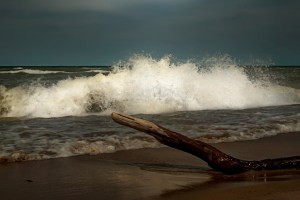 The Outermost House: A Year of Life on the Great Beach of Cape Cod (1928), Henry Beston’s classic memoir chronicling time spent in a small cottage among the dunes of Cape Cod during 1926-1927, devotes a total chapter (of the ten included in the book) to a fascinating meditation about the nature of waves breaking on shore. Living in his little home only thirty feet from the beach and just twenty feet above sea level, a constant companionship of the waves’ steady cadence created an acute consciousness of the surf’s sounds, which changed noticeably in different seasons and under various weather patterns. Beston notes becoming even more aware of the persistent presence of the ocean’s pulse at night while lying in bed amid otherwise quiet conditions with an absence of all those distractions of daytime activities. I also find my favorite time for standing beside Lake Michigan occurs after dark under moonlight, perhaps following photographing sunset and when most visitors have departed, listening to turbulence of the surf brought by prevalent northwest winds, as I am reminded fondly of my own history as a boy growing up beside the Atlantic Ocean.
∼ July 21, 2020 ∼ “Tenuous Coexistence”
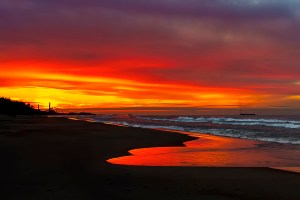 The current issue of Outdoor Indiana (July/August 2020) contains an extended feature article written by Scott Roberts about the initial year of the recently designated Indiana Dunes National Park (after officially serving as a national lakeshore since 1966), as well as its ongoing relationship with Indiana Dunes State Park, which was established in 1925 and shares the coastline. Within the magazine’s profile of the region, the piece discusses the longstanding conflict and uneasy state of survival between the natural landscape and industrial development along the waters of Lake Michigan. Roberts explains the situation as it developed during the early twentieth century, especially following important ecological discoveries: “Environmentalists viewed this area as the most undisturbed portion of Indiana’s dunes shoreline, but industrialists saw other uses for its sand.” Although there has been increasing cooperation and compromise between corporate interests and conservation champions throughout later decades, a tenuous coexistence continues today, which I tried to capture in my accompanying image of a park beach as the sun sets behind distant smokestacks and a cargo ship slides across the horizon.
∼ July 14, 2020 ∼ “An Easy Evening Breeze”
 As an extended heat wave, more than a week long with temperatures in the nineties, ended this weekend when strong thunderstorms accompanied by cooler conditions finally arrived, many began to breathe a little easier with an evident sense of relief. The whole local landscape seemed to respond as well. Even those trees throughout the region appearing weary with leaves that had started to droop a bit under the strong and unforgiving sunshine, some limbs dropping dried leaves due to the persistent heat I had mentioned already in place during my July 1 entry, were suddenly reinvigorated. Nevertheless, all during the hot spell each sunset that introduced a moderate evening became a welcomed section of the day, especially if paired with the slightest onshore lake breeze. Indeed, lakeside in this month I’m often reminded of the first line of lyrics from “Summer Wind,” my father’s favorite song sung by Frank Sinatra: “The summer wind came blowin’ in from across the sea….”
∼ July 7, 2020 ∼ “Description Expresses Love”
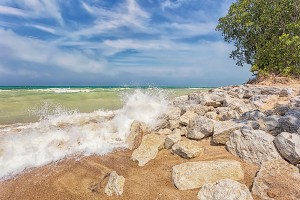 During the past week I have been reading a biography of John Updike by Adam Begley and, since Updike published about 70 books (including 26 novels), catching up on some of his works I hadn’t read before. When I teach Updike’s better-known fiction in my classes, I often focus on his extraordinary ability with description. Perhaps this skill links a bit with Updike’s hint of interest in photography, as exhibited in a story titled “The Day of the Dying Rabbit,” which emphasizes the main character’s occupation as a professional photographer and how that influences his perceptions of details evident in everyday events. Additionally, Updike is quoted in the biography as believing that “description expresses love.” I tend to agree, since I find my own combination of writing with photos attempts to convey a fondness for nature, specifically the Indiana Dunes, by displaying settings in such a way as to draw readers or viewers into elements of scenery, perhaps the white spray of a lake wave breaking under bright sunlight. I appreciate the often-unnoticed offerings in an image that evoke or suggest the various senses—sight, sound, touch, taste, and smell—allowing one to feel present within the captured moment.
∼ July 1, 2020 ∼ “Late Light in July”
 In an 1852 journal entry, Henry David Thoreau wrote the following rhetorical question: “Is not all the summer akin to a paradise?” Certainly, those idyllic surroundings filled with numerous elements of a rich and vivid landscape seen during this season in the local region, especially during July, seem to suggest such a comment is warranted. Indeed, as the calendar page for the new month now opens in the midst of a typical Midwest heat wave hovering over the area and forecast to continue perhaps for the next two weeks, bringing temperatures in the 90s and humidity levels almost as high, the slightly cooler conditions experienced when walking among trees with leaves waving in a lake breeze at the Indiana Dunes—especially in early evening as a sunset illuminates the skies and late light reflects on the surface of the water—offer a scene exhibiting imagery one more likely might expect to find in a tropical paradise.
∼ June 29, 2020 ∼ “Diana of the Dunes”
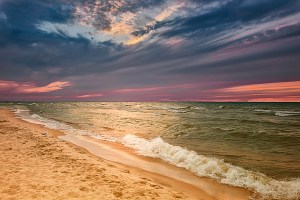 This weekend, I completed another book on my summer reading list, Diana of the Dunes: The True Story of Alice Gray, a biography by Janet Zenke Edwards nicely chronicling the unique and tragic trajectory of a woman who abandoned her comfortable life in Chicago on October 31, 1915, at the age of 34, perhaps determined to commit suicide due to loss of a love relationship. However, beginning with an observation of her first sunset from the Indiana Dunes shoreline, she found instead a passion for her austere existence in an abandoned shack along Lake Michigan. Any resident in the region may be aware of exaggerated or imaginative legends about this figure, who died in 1925; nevertheless, the accurate account is even more compelling. Alice Gray was a scholarly individual—a Phi Beta Kappa at the top of her class at the University of Chicago, where she also pursued graduate work—whose views on such issues as life, love, literature, landscape, and loss are evident in a few eloquent excerpts preserved from commentaries she apparently produced during her decade at the dunes. I especially appreciate her diary’s succinct descriptions, such as the following: “…the lake is seen in a wide sweep and the horizon is banked with blue clouds, with an intense pink above them….” Unfortunately, a greater accumulation of her fine writings has since disappeared.
∼ June 24, 2020 ∼ “Marsh in Early Summer”
 At the start of summer when weather has warmed to the 90s and the air turns humid, each of the nearby beaches along Lake Michigan will frequently fill with visitors by late morning, even in this time of pandemic concerns. Especially recently, since the waterfront in neighboring Chicago and other Illinois spots remained closed to sunbathers or swimmers due to restrictions meant to counter spread of the virus, the Indiana Dunes shoreline has drawn larger gatherings. Consequently, attempting to avoid crowded conditions, I often try to find alternative locations to photograph, places with paths less traveled (to borrow language from Robert Frost) during such heat. This week, after watching an archived video interview with David Foster Wallace explaining “a hunger for silence and quiet” away from the constant clamor in contemporary society, I chose again to hike a loop through the Great Marsh, which I managed to travel in a relaxed pace without encountering anyone else, and I was moved once more by the calm surroundings. Indeed, I was also reminded of a journal entry posted almost exactly a year ago (6-30-19) about a similar walk, when I noted how “the serenity of its distinct stillness—broken only by a far-off bird call or a bull frog’s croak, maybe the flapping of a nearby Great Blue Heron’s large wings—fills my thoughts with contemplation.”
∼ June 22, 2020 ∼ “Summer Solstice Season”
 The official transition from spring to summer occurred this weekend with arrival of summer solstice. Although I appreciate all times of the year for photographing the region’s natural scenery, I must acknowledge a particular fondness for comfortable hikes within the lush landscape in northwest Indiana parks during this portion of the calendar, a segment stretching about three weeks before July 4 that I regard almost as if separated into its own season. Overhanging tree limbs are alive with sweet song from unseen birds and the leaves of grass extending like sheets of deep green all around, each blade blowing gently in a light breeze, yet exhibit a rich tint unblemished by the patches of brown an extended summer heat will create. Irregular sprays of spring wildflowers still fill the forest floor bordering trails, though their paths are now mostly thinned by rising overgrowth lining the way, offering a greater sense of seclusion from the outside world. Especially this year, those narrow waterways wending through wooded terrain flow slowly, their lazy current remaining at a high level because of record rainfall witnessed in recent months.
∼ June 17, 2020 ∼ “Solitary Tree”
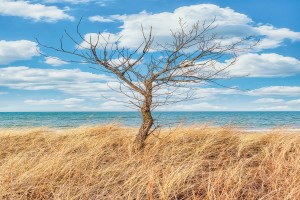 Due to conditions created by the pandemic virus, everyone has had to adjust everyday living in recent months. Certainly, a serious impact has been felt by multitudes whose health or livelihood has been affected, and I am grateful that my situation has allowed for merely altering behavior a bit and more minor modifications to planning, including cancelling or postponing a series of various public appearances—a photography workshop, a multimedia presentation, a photo exhibit, etc.—scheduled for this time of year. Nevertheless, since my regular routine for capturing images in the landscape usually involves solo hikes to somewhat isolated locations of the state and national parks where I am unlikely to encounter others, and the photographs sometimes display secluded scenes in less visited settings, my focus of attention has not changed. Indeed, many of my works, such as this individual leafless tree standing in lakeshore foredunes, complement current concerns and appropriately offer symbols of solitude or present patches of the natural habitat separated from much human traffic.
∼ June 15, 2020 ∼ “Nature Photography Day”
 Today has been designated Nature Photography Day, and I celebrate the occasion by reminding myself about one of the lessons I have learned from nature, patience, which I find helpful in everyday life, but especially in times of personal crisis or when difficult situations seemingly exist in the world all around us. I have been rewarded by participating in this practice of photography, about which I have written before in an article, “Adopting the Pace of Nature,” and from which I excerpt a segment here: “I have found the photographic process, particularly when I’m engaged in landscape photography, additionally exists as one aspect that has contributed to my more patient behavior. I have learned from nature the benefit to a calm acceptance of delay or deliberation. Capturing images in natural settings requires preparation and pausing in place until the correct conditions present themselves. As I stand beside my tripod and watch the movement of clouds and shifting angle of sunlight, or I halt as a pair of passersby amble past my field of vision to clear the otherwise empty beach I am photographing, I am reminded of the advice once offered by Ralph Waldo Emerson: ‘…adopt the pace of Nature. Her secret is patience.’”
∼ June 9, 2020 ∼ “That Familiar Conviction”
 As the weather warms considerably at the end of spring and conditions concerning the viral pandemic seem to have ameliorated a bit, especially in some sections of the country, many appear to be anticipating the upcoming bridge to summer’s heat and lush scenery even more than in past years. Particularly in settings of nature as mid-June approaches, flowers blooming under bright sunlight and unseen birdsong filling full branches offer visitors’ senses healthy signs of a new season’s arrival, perhaps to be accompanied by needed hope and optimism. Indeed, this week I have been reading another volume on my summer book list, a fresh and specifically focused perspective on the biography of F. Scott Fitzgerald—whose works I frequently teach in a senior modern literature seminar course alongside novels by Hemingway and Faulkner—and I was reminded of a passage from one of my favorite texts, The Great Gatsby, whose narrative takes place nearly 100 years ago and spans the summer of 1922: “And so with the sunshine and the great bursts of leaves growing on the trees, just as things grow in fast movies, I had that familiar conviction that life was beginning over again with the summer.”
∼ June 1, 2020 ∼ “June Mood”
 As the calendar pages turn to June, which will officially introduce summer, my mood always shifts toward more cheerful thoughts with the warmer weather, which I’m sure is common. No matter the circumstances elsewhere in the world, those local places in nature I visit provide images that revive my spirit. During this month, when daylight hours expand to their greatest extent, everything appears brighter and more colorful. Each brilliant afternoon brought by sunlight now only slightly angled toward the southern sky, often accompanied by a refreshing light breeze along the Lake Michigan shoreline, seems to invite exploration of our flourishing landscape. In a journal entry Henry David Thoreau wrote on June 6, 1857, he noted: “This is June, the month of grass and leaves. The deciduous trees are investing the evergreens and revealing how dark they are. Already the aspens are trembling again, and a new summer is offered me. I feel a little fluttered in my thoughts, as if I might be too late. Each season is but an infinitesimal point. It no sooner comes than it is gone. It has no duration. It simply gives a tone and hue to my thought.”
∼ May 28, 2020 ∼ “Words About Walking”
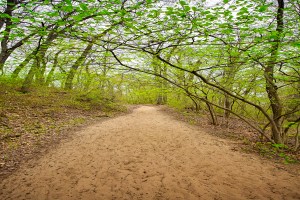 This week as I was beginning another book in my already accumulating summer reading list, The Most Beautiful Walk in the World: A Pedestrian in Paris by John Baxter, I realized I often enjoy accounts of journeys by foot, long and short. Many times, I have appreciated the reports of authors hiking established trails or backpacking paths through wilderness, whether domestic routes such as the Appalachian Trail or more exotic locations, including frozen lands in the Arctic Circle. Some of my personal library represents lesser-known volumes by chroniclers of nature, but additionally displays best-selling books by Bill Bryson, Jon Krakauer, Barry Lopez, Cheryl Strayed, and others. I also find interest in narratives about wandering urban areas noted for their influence upon artists and writers, such as streets of various New York City neighborhoods, perhaps Greenwich Village and Soho, or strolling past spots known for historic cafés and art galleries of Paris noted in numerous biographies of the nineteenth- and twentieth-century painters or mentioned in novels by folks like Ernest Hemingway. Of course, much of my introduction to literature about walking arose early in college when I first encountered Henry David Thoreau’s numerous journal entries and essays involving excursions in the countryside, which I frequently quote. Not surprisingly, a quick word search of the entries collected in my Indiana Dunes journal page during the past three and a half years reveals “walking” or “hiking” appears nearly 700 times, usually accompanied by photographs of passages I have traveled, such as Trail Nine at the Indiana Dunes State Park, pictured in the accompanying image.
∼ May 24, 2020 ∼ “The Drama of Sunset”
 Despite an uncertainty evidenced every day in news reports during the past few months—while much of the world’s intended entertainment and sporting events or other already arranged gatherings, large and small, have been placed on temporary hold, postponed to a later date, or canceled altogether—daily elements of the environment continue on nature’s normal schedule. Additionally, those folks noticing common meteorological features have acquired an enhanced appreciation for their regular occurrences, such as cloudless afternoons and vivid sunsets. As I mentioned in a previous entry (“Blue Skies” on May 6), “in recent weeks many have commented upon an apparent greater richness when viewing clear distant skies, most likely because of an absence of pollution due to fewer cars on roads and lessening activity in nearby industries.” Furthermore, we are reminded that clean air contributes to brighter and more colorful sunrises and sunsets, unhindered spectacles that can be witnessed by everyone eyeing skies everywhere. Indeed, Henry David Thoreau once noted: “We never tire of the drama of sunset. I go forth each afternoon and look into the west a quarter of an hour before sunset, with fresh curiosity, to see what new picture will be painted there, what new panorama exhibited….”
∼ May 14, 2020 ∼ “Telling a Book by Its Cover”
 Initiating my Indiana Dunes project conducted during the past four years, I noted an intention to blend my experiences as an author and a photographer to promote the natural landscape. My history as a writer and editor, as well as a professor of modern and contemporary literature, has included an interest in the aesthetics of cover art for numerous publications. Additionally, my photographs have served as magazine article illustrations and artwork for various book or journal covers. Moreover, when discussing the great novels of the twentieth century in classroom conversations with my students, we sometimes engage in debates about whether or not one can “tell a book by its cover,” and we examine the impact various dust jackets may have contributed to commercial publicity or shaped readers’ expectations. For example, in my Hemingway and Fitzgerald course we consider the iconic first edition cover for The Great Gatsby. Consequently, I am always intrigued by the introduction to a literary work or a periodical one receives from the visual imagery viewed before opening the volume to its first page. Even as an editor of electronic journals for more than twenty years, I have attempted to preserve the traditional format of cover art. Therefore, I was delighted to have my photograph captured at sunset from atop Mt. Baldy in the Indiana Dunes National Park with the Chicago skyline also visible in the distance across Lake Michigan as the cover for the new issue of Valparaiso Fiction Review, especially since the scenery seems so representative of the region from which the journal originates.
∼ May 6, 2020 ∼ “Blue Skies”
 In the 1920s Irving Berlin composed a song titled “Blue Skies” for a Rodgers and Hart musical named Betsy when he was urged to contribute to the production at the last minute. The work gained more fame when included in the movie The Jazz Singer, which opened the industry to “talking” films. Later, this song supplied the title for a film headed by Bing Crosby and Fred Astaire. Throughout the decades, this classic tune achieved acclaim with different audiences when covered by a range of various artists, such as Benny Goodman, Thelonious Monk, Frank Sinatra, Ella Fitzgerald, Doris Day, Willie Nelson, and Rod Stewart, among others. However, for landscape photographers, afternoons with blue-sky conditions are almost always deemed as undesirable and often referenced negatively as a “bluebird” day. A lack of clouds diminishes possibility of any interest, depth, or definition in an image, presenting a bland and blank field instead. Nevertheless, in recent weeks many have commented upon an apparent greater richness when viewing clear distant skies, most likely because of an absence of pollution due to fewer cars on roads and lessening activity in nearby industries. Nowadays, what once seemed unremarkable has become a distinctive sign of the times, and the lyrics of a song nearly a century old obtain fresh relevance, though perhaps offering a needed mood of optimism as well: “Blue skies smiling at me / Nothing but blue skies do I see.”
∼ May 1, 2020 ∼ “The Gladness of May”
 The final week of April in northwest Indiana this year supplied substantial overcast, flat and blackening skies bringing large amounts of precipitation and localized flooding. Storms swept across the region in surges, raising water levels, and their winds increased the height of waves at Lake Michigan shorelines, which exacerbated the already existing erosion situation along beaches of the Indiana Dunes. Nevertheless, the great accumulation of rainfall in recent days has assured May likely will be marked soon by ample sunshine bringing rich green foliage and colorful floral displays. Such a transition will be welcomed during this season’s darkened mood thus far due to conditions caused by the coronavirus crisis and its accompanying intimations of mortality, to play on words by William Wordsworth, who advised: “Feel the gladness of the May!” Another author, Henry David Thoreau, also identified spring as a season that serves as “an experience in immortality.” Indeed, evidence of new and beautiful growth always appears to contribute a renewal of optimism needed at the end of winter, and nature’s annual boost to the spirit will be especially appreciated in 2020.
∼ April 25, 2020 ∼ “An Excellent Form of Safe Exercise”
 I was pleased to see this week that the Indiana Office on Tourism and Development featured my photo of Trail Nine at Indiana Dunes State Park, taken in June of last year while I helped lead a photo walk, as the visual for their “Visit Indiana” promotion to have state residents resume hiking at local sites as an excellent form of safe exercise. Visitors are reminded “social distancing is important to help prevent the spread of coronavirus.” However, all are advised: “If you need to get out of the house, areas where you can find seclusion are ideal, like Indiana Dunes State Park.” In a journal entry posted at the time I captured the image, I wrote about Trail Nine: “the hike begins beside marshland, moves through dune woods, rises a sand hill to an elevated path curving around the impressive Beach House Blowout, and then extends along a narrow ridge with vistas of Lake Michigan. In a report rating this 3.6-mile loop as the number one trail in Indiana, The Hiking Project observes: ‘This is the definitive trail in the dunes. It combines hiking through mature forests and along the top of a dune ridge overlooking Lake Michigan. The views are incredible.’”
∼ April 22, 2020 ∼ “Preserve and Protect the Purity of Nature”
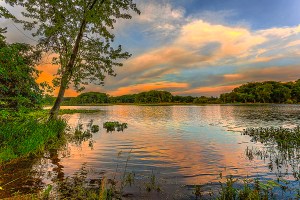 Many photographers will celebrate Earth Day this year by reminding everyone of a need to preserve and protect the purity of the landscape, especially those locations in our state and national parks that might be more vulnerable due to staffing or supply shortages during current conditions. As I noted last year when announcing my participation with a new coalition of concerned individuals, Nature First: An Alliance for Responsible Nature Photography, all are accountable for safeguarding the natural beauty we encounter and capture in images. The organization requests that photographers practice themselves and advance with others a set of seven guidelines: 1. Prioritize the well-being of nature over photography. 2. Educate yourself about the places you photograph. 3. Reflect on the possible impact of your actions. 4. Use discretion if sharing locations. 5. Know and follow rules and regulations. 6. Always follow “Leave No Trace” principles and strive to leave places better than you found them. 7. Actively promote and educate others about these principles. Landscape photographers have a practical vested interest in maintaining the scenery they need as subject matter. However, as avid devotees to natural settings, we also appreciate the precarious position of nature, particularly for me in higher traffic sites like the Indiana Dunes state and national parks.
∼ April 20, 2020 ∼ “Colors of the Spirit”
 Although I prefer to take realistic photographs along the shore on days displaying a chaos of clouds, clear skies sometimes seem most suitable for capturing more abstract images, such as my accompanying photo, Surf in Spring. An absence of overcast allows for a light blue field filling the upper level of the frame and contrasting with the darker hue of lake water beneath, as well as the whiteness in the breaking waves or the tan sand of the beach at the bottom. As I have mentioned in previous posts, I am attracted to the simplicity in such a composition, emphasizing an interaction of intensity in illumination with the extent of tone in those tints included. Inspiration arises from an influence of color field paintings by abstract expressionist artists Mark Rothko and Helen Frankenthaler, with my choice of a vertical (or portrait) format—rather than the horizontal orientation I normally prefer for landscapes—appearing nearer to the mode closely associated with Rothko’s canvases exhibiting multiform layers of concentrated color piled upon one another. However, I am aware Rothko rejected any notions regarding his work as a link to a physical landscape, especially since he held a dislike of nature, declaring his representations merely to be spiritual illustrations. Nevertheless, as Ralph Waldo Emerson once wrote: “Nature always wears the colors of the spirit.” Consequently, with my abstract interpretations, I try to combine nature’s elegance with a sense of the human spirit.
∼ April 15, 2020 ∼ “Mid-April Snow on Pink Magnolia”
 Although the winter season in northwest Indiana seemed warmer than usual, including five degrees above normal in March (the fifteenth warmest on record), I have noticed that most spring flowers and ornamental or fruit trees seem slow to bloom this year. Perhaps one reason can be found in a meteorological review measuring overcast skies during the past month, which appears to have been the fourth cloudiest March in history statistics, dating back to the nineteenth century. Nevertheless, the beginning of this week witnessed a late start to vivid spring colors, presenting a promise of the much-awaited transition to spring imagery, including the brilliant pink magnolias that are always anticipated for their ability to brighten the atmosphere in mid-April days. However, Wednesday morning offered a surprise covering of adhesive snow that stuck to trees and shrubbery like a delightfully decorative white overlay but which just might stunt the growth of those first buds finally about to blossom.
∼ April 13, 2020 ∼ “An Awareness of Absence”
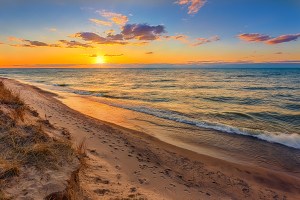 Yesterday, as everyone experienced Easter Sunday in a uniquely different fashion than in the past, I read an article in the current New Yorker, “Mortality and the Old Masters,” by poet and art critic Peter Schjeldahl, who has written about his own mortality since a recent diagnosis of lung cancer. Among the observations and speculations offered in this piece, the author conjectures the coronavirus pandemic—”unlike the 1917-1918 influenza pandemic, which killed as many as a hundred million people, largely young, and left so little cultural trace”—may create a longer lasting impact on how we perceive the world around us, including visual works of art. Schjeldahl suggests we will even reevaluate those classic artworks known so well by all: “Here’s a prediction of our experience when we are again free to wander museums: Everything in them will be other than what we remember.” With this in mind, I reviewed a number of my photographs from previous seasons, including the accompanying image from late last April, and details such as strings of footprints on an empty beach under a setting sun suddenly appeared to have an added significance, seemingly symbolic of an awareness of absence, calling to mind the disappearance of those who once stepped along the sandy shore. My photograph now exhibited to me a greater sense of isolation or solitude. Photographer James Balog once famously stated a truism, that “photography is a way to shape human perception.” However, the interpretation of content in photographs, as well as other art forms, clearly can just as easily be shaped through human perception influenced by changing contemporary conditions.
∼ April 6, 2020 ∼ “The Calmer Character of Nature”
 A remote route winding inland from Trail Ten through the foredunes at the eastern end of Indiana Dunes State Park rises toward thickening woods past a narrow ridge above the Big Blowout, offering a wide view beyond the beach. During early spring, the high sunlight at noon spills between silhouetted thin limbs of trees yet empty and awaiting the season’s promised gift of green leaves. When I travel this direction in April, an easy breeze often slips onshore—lightly lifting, shifting, and smoothing the loose sand. The air is still usually chilled by a colder Lake Michigan, its surface hue now more frequently colored by blue skies. Although the winter months this year passed without so much snow to weigh down and break weaker branches, damaging winds from strong northern storms toppled many trunks precariously balanced on dune hills at the edge of the lake, and all along the park’s shoreline the scenery has been altered dramatically by coastal erosion. Nevertheless, in times of uneasiness, I like to hike this isolated section of the landscape, visit its silent and solitary setting presenting a necessary sense of serenity, as a way to reconnect, especially during moments of human chaos, with the calmer character of nature.
∼ April 3, 2020 ∼ “Last Leaves Left After End of Winter”
During April the spring landscape truly begins to take shape. Before May arrives, colorful beauty will return in the form of this season’s first flowers and in the shape of vivid images exhibiting blossoming fruit trees. Nevertheless, I like to inventory the area at the start of this month, hike trails under mostly bare branches, walk paths through stark stretches of nearly empty shrubbery, or even check for examples on the hedges along fences at the edges of my backyard, as in the accompanying image, all the while perceiving places where scatterings of last year’s leaves remain, not yet fallen and fully intact. Surprised by how many leaves, though brown and crisp, have withstood winter’s harsh weather and continue to cling to thin limbs or decorate underbrush still rising from the dark soil, I find they have transitioned into a different kind of attractiveness, wavy and striated, at times almost appearing artificial in their artistic presence. They also seem to offer a certain type of symbolism, one which I admire as it seems to signal survival, a characteristic much appreciated anytime but maybe more so in this difficult year.
∼ April 1, 2020 ∼ “Mixing Memory and Desire”
 A well-known quote about April by T.S. Eliot in the opening of his groundbreaking poem, “The Waste Land,” notes uneasiness with the beginning of spring conditions. The poet writes: “April is the cruellest month, breeding / Lilacs out of the dead land, mixing / Memory and desire, stirring / Dull roots with spring rain. / Winter kept us warm, covering / Earth in forgetful snow….” The tone and content of this work perhaps seems even more appropriate this year. As the weather warms and vivid signs of spring start to dot the landscape, usually seen as symbols of hope or optimism for the new season, associated with celebrating a revival of life, these elements contrast with the presence of a disquieting mood reflecting apprehension and an awareness of mortality all around. Though maybe not exactly as Eliot intended, many nowadays are involved with “mixing memory and desire,” recalling the comfortable situation just months ago before the coronavirus pandemic arrived while also anticipating a future free of current worries, wishing for a return to safer and saner days.
∼ March 24, 2020 ∼ “Reversal of Fate and Fortune”
 The transition to spring-like weather has hesitated somewhat during the first week of the season. Yesterday morning we even woke to a light dusting of snowfall, although I managed to capture a sunset glow a few days ago. However, world events have shifted suddenly and stunningly during the same time period, and much of the nation has witnessed strict restrictions on travel or participation in everyday activities. Professional landscape photographers who normally rely upon great mobility to achieve dramatic images in international locations, many sold to the tourist industry, have been confined to their home areas and lost incomes because of shutdowns. Ironically, earlier this year various publications reported problems of overcrowding and complications caused by the popularity of tourism, partly due to enticements of compelling photographs posted on social media platforms like Instagram. Nevertheless, perhaps the most iconic picture this past winter—seen in newspapers, magazines, and online sites—displayed a long, stalled line of mountain climbers awaiting their turn to ascend a final ridge to the top of Mt. Everest, as reported in John Hammer’s article for GQ titled “Chaos at the Top of the World.” Bloomberg published a story called “Tourism Is Eating the World,” The Atlantic offered “Too Many People Want to Travel,” and Outside Magazine released a revealing piece declaring “Utah Wanted All the Tourists, Then It Got Them,” chronicling “the global phenomenon of over-tourism that has wreaked havoc from Phuket to Venice to Tulum….” When I stood alone by my tripod on an Indiana Dunes beach to take the accompanying sunset photograph, practicing social distancing, nobody could be seen in any direction, and I was aware that in a span of mere weeks citizens across our planet have observed a complete reversal of fate and fortune.
∼ March 19, 2020 ∼ “Emotional Encouragement”
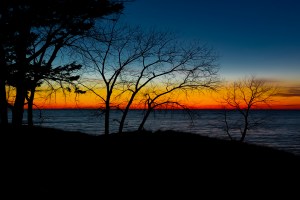 I always enjoy photographing sunsets, especially along the water’s edge. Nevertheless, I acknowledge that they represent a landscape photographer’s weakness and invite sentimentality, sometimes defined as a blending of tenderness and nostalgia. When asked about their appeal, I have nothing new to offer that hasn’t been expressed by others: the colorfully lush sky reminds me of those luminous and impressionist paintings of nature I admire. In addition, I never tire of capturing images of sundown since no single experience is ever quite the same as the previous occurrence. I’m engaged by the entertaining scenery as the horizon light show evolves over a certain extent of time, the so-called golden hour; therefore, there should be no surprise that I find the event inspiring and comforting. However, when asked for suggestions about taking pictures, I usually advise patience because the richest tints of an afterglow frequently follow the sun’s disappearance by twenty minutes or so. Indeed, one evening during this difficult week of dark news around the world, looking at Lake Michigan between trees still bare in a late-winter chill, I waited a while past my last sight of sunlight and was rewarded by an image spanning the screen in the viewfinder of my camera, a setting so soothing, seemingly full of affirmation and presenting emotional encouragement.
∼ March 15, 2020 ∼ “Almost at the End of Winter”
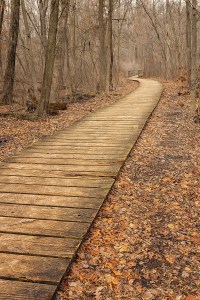 With spring arriving in a few days, I take my final winter hike at Indiana Dunes State Park. Like some others, including Henry David Thoreau, I have acquired a fondness for walks in this season. Although the vivid colors of spring and summer are absent and the trees lack green leaves or the sweet sounds of glorious birdsong, I find appealing the stark, often lonesome, and quiet character of the landscape, especially the expressiveness evident from bare branches twisting in empty trees above a layer of crisp leaves discarded last autumn but still covering the thawing ground. Something almost spiritual seems present for me whenever experiencing such solitude in nature. As Thoreau once stated in a journal entry during winter in early 1857: “There is nothing so sanative, so poetic, as a walk in the woods and fields even now, when I meet none abroad for pleasure…alone in distant woods or fields, I come to myself, I once more feel myself grandly related, and that cold and solitude are friends of mine. I suppose that this value, in my case, is equivalent to what others get by churchgoing and prayer. I thus dispose of the superfluous and see things as they are, grand and beautiful.”
∼ March 13, 2020 ∼ “Hiking as a Form of Social Distancing”
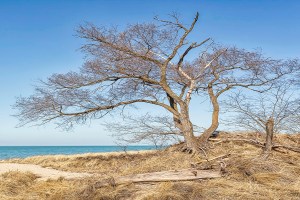 Like folks in many other countries throughout the world, Americans’ attention has been arrested by focus on every aspect of the coronavirus pandemic and its impact on all, so much so that a rare national emergency has been declared. Among the recommendations of advice by medical experts, people learned a new term as they have been advised to practice “social distancing,” which drastically limits the kinds of healthy activities available for individuals. Nevertheless, hiking through nature’s landscape—as I did yesterday when I captured the accompanying photograph—presents an ideal exercise that fits the description. In addition, various studies have verified the positive consequences for body and mind when one is alone in nature. As I noted in a November post titled “Influence of Blue Spaces” (11/26/19), walking “beside bodies of water is restorative physically and spiritually, producing positive results in one’s mood or emotional outlook.” Additionally, in a recent piece by Jill Suttie at Greater Good Magazine, “Five Ways Hiking Is Good for You,” the author outlines “benefits beyond what you receive from typical exercise.” Among the article’s conclusions, she suggests hiking can sharpen one’s thinking process, help increase a sense of calm, enhance personal satisfaction, inspire creativity, and improve one’s attitude through a firm connection with nature.
∼ March 12, 2020 ∼ “Winter Wreckage: Trail Two”
 Much attention recently has been devoted to examining damage along the coast of Lake Michigan due to a devastating degree of erosion to beaches and sand dunes in the state or national parks along the Indiana Dunes, as well as private properties in communities bordering the shoreline. Indeed, I have devoted a number of posts to chronicling details offering evidence of destruction, such as downed trees and sheared dune hills, results of those large waves and strong winds brought ashore by winter storms the past few months. Further, various civic groups and government organizations are currently seeking funding to find ways to preserve or restore sections wrecked by wintry weather. However, at the start of each spring I also hike other areas among the landscape looking for indications of deterioration. [For example, please check my entry from three years ago (6/16/17) when I photographed and reported the dismal situation of the wooden walkway spanning a half mile of marsh on Trail Two of Indiana Dunes State Park, which since then has been under reconstruction after the state budgeted $400,000.] Last week I visited a different stretch of the same trail farther east along Dunes Creek, and I found another location now in need of repair, its pathway battered and weathered by this winter’s harsh conditions.
∼ March 9, 2020 ∼ “First Sunset After Time Change”
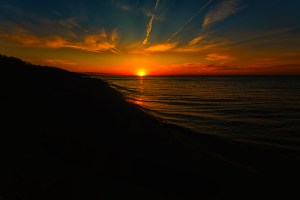 Following the adjustment ahead of our clocks for Daylight Savings Time, Sunday afternoon’s strong sunshine offered a situation that seemed somewhat like spring. Later, an extra hour of evening light combined with milder temperatures in the low sixties created comfortable conditions conducive to walking along the coast. Therefore, I decided to hike beside Lake Michigan and to photograph sunset from a significantly narrowed Kemil Beach at Indiana Dunes National Park. Although a number of other visitors were drawn to the shore, access from some locations near the water was difficult due to a dramatic reshaping of the dunes by this winter’s drastic extent of wave and wind erosion. In fact, in many places paths toward the surf that had been easy ways for one to step down shallow slopes through marram grass toward the water’s edge now led to minor cliffs, with sudden drops of ten feet or more, where most folks stopped and only a few ventured farther. By the time I slowly descended a steep trail to reach the dark and empty beach where I set up my tripod amid a thin layer of small stones, I discovered much of the once-wide swath of sand that had stretched beside the lakeshore has recently been relocated. Nevertheless, when nature presented its sundown show, I felt the effort worthwhile.
∼ March 7, 2020 ∼ “Damage Assessment”
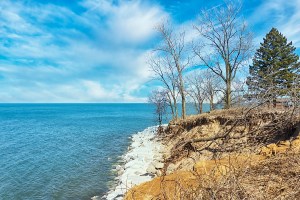 In the closing weeks of winter as March weather warms and the natural surroundings thaw, I like to hike areas in the Indiana Dunes to examine conditions and assess how much damage has been done to their appearance during these past few months. As I have noted in previous posts, most of the shoreline along Lake Michigan has experienced extensive erosion of sand dunes and noticeable loss of beachfront due to strong northern winds or large waves created by storms against a coast left vulnerable by an absence of shelf ice during this year’s fairly mild winter. Indeed, just yesterday as gale force winds swept waves onshore once again, I learned a section of Lake Front Road that runs by Lakeview in Beverly Shores and from which I captured the accompanying photograph on a calm day last weekend, is now closed to traffic because it is in danger of dropping into the water. All of this has taken place in a peak period of near record high-water levels, which fluctuate in multi-year patterns. For instance, we witnessed a time of low-water levels in Lake Michigan about seven years ago. Like many others, I have been struck by nature’s recent widespread destruction of the lakeshore landscape, including sections of dune hills that appear sheared and the loss of many trees lining ridges above the surf. In fact, I recommend everyone visit the YouTube channel of Timeless Aerial Photography at the following link to view drone footage of disappearing beaches along the Indiana Dunes: https://www.youtube.com/channel/UCi_Sz7b1dYEYpcm7ZsleMFA/videos
∼ March 3, 2020 ∼ “Seasonal Transition”
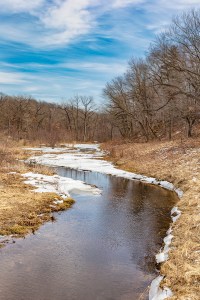 Each year at the start of March I photograph the same familiar locations in the Indiana Dunes to compare conditions and display initial signs of the approaching spring. Usually, the amount of snow accumulation in an image indicates how far along the seasonal transition has advanced. Indeed, snow quantity among elements of the landscape has varied dramatically in recent years, with the beginning of March 2019 exhibiting extensive coverage while hardly any existed in 2017 or 2018. The last leg of Dunes Creek winding through the state park just before it empties into Lake Michigan has become a common spot for me to picture the situation of natural surroundings at the opening of this month. As can be observed in the accompanying photo taken March 1, only a bit of snow and ice bordered the waterway, mostly hugging the north bank that remains shaded all day by a wooded dune hill keeping it from direct sunshine still angled from southern skies. If the current long-range forecast from local meteorologists suggesting a prolonged warming trend proves correct, this may be the last evidence of white from wintry weather we will see until sometime next autumn.
∼ March 1, 2020 ∼ “The Start of March”
 Perhaps more than any other month, March exhibits the most striking difference in seasonal transition at Indiana Dunes from start to finish. In its beginning, sunset occurs at about 5:40; but by the final days, sundown happens around 7:15. Due to the adoption of Daylight Savings Time in mid-month, sunlight eventually extends more than an hour and a half later into each evening. Further, the position of the sun’s track advances farther north, offering a stronger presence every day and allowing for more interesting photographs when its glow slowly disappears beyond the western edge of Lake Michigan. Meteorological spring begins March 1, the time period traditionally regarded as this area’s “cold season” ends on March 3, and the average low temperature rises above freezing in this month. Of course, three weeks in, one witnesses the official calendar introduction of spring as well, and each morning a noticeable increase of birdsong can be heard everywhere, as if announcing such a significant change has come and celebrating the warming days.
∼ February 24, 2020 ∼ “Snow and Ice Along Lake Coast in Late February”
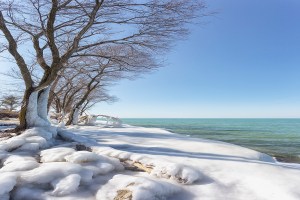 After last week’s brief spell of cold and snow that finally contributed to development of some level of ice shelf along the Indiana Dunes coast, the weather warmed a bit on Saturday and Sunday. Consequently, with calming winds and temperatures in the mid-fifties by the shore, I walked the lake’s edge under bright sunshine to witness the conditions. As I have noted in previous posts, this winter has seen an absence of usually extensive ice shelf buildup, which normally provides protection from an onslaught of large waves created by storms with stronger northern winds on the area’s beaches and dunes. As a result, much of the lakeshore has been damaged due to sand erosion and numerous fallen trees, including a number of my favorites often featured in past photographs. In fact, on Thursday Indiana’s governor issued an official statement ordering investigations into the deteriorating situation and initiations of actions offering assistance, including petitions to FEMA for funding and possible applications for federal disaster assistance. Nevertheless, on this visit most of the seasonal destruction of nature by the lake seemed camouflaged by an attractive covering.
∼ February 19, 2020 ∼ “Indiana Dunes National Park Marks One Year”
 Anyone who has followed my journal in the past few years knows the posts I have shared that chronicle the history of lobbying by nature lovers for a proposed Indiana Dunes National Park (see my 10/5/17 and 10/6/17 entries), my comments in favor of the designation included in an Indianapolis Star article (check the 12/21/17 entry), and my reports on both the law’s enactment—on February 15, 2019—and the subsequent dedication ceremonies for the new status of the park (posted on 2/19/19 and 3/13/19). In a number of other pieces, I have documented the growth of publicity and visitor population during the past year. As I noted in a 3/26/19 post, the initial press coverage alone resulted in the news reaching perhaps 76 million people for as much as $750,000 in free advertising. I mentioned in a six-month report (9/19/19) that the park had already accumulated in 2019 a record number of visitors for any annual count. By December (12/5/19), I observed travel guide publications for 2020 were listing Indiana Dunes National Park as a recommended place for tourists. Therefore, with the first anniversary of the park’s recognition taking place four days ago, I invite everyone to revisit “Congratulations, Indiana Dunes National Park!”—my essay at the “Articles” page on the Indiana Dunes project website—for a more complete overview of the efforts that were exerted by many to bring about this national park now marking its first year of existence.
∼ February 15, 2020 ∼ “Color Field Landscape Photography”
 In journal entries during the past few years I have posted a half-dozen abstract depictions of the Indiana Dunes coast and Lake Michigan. (Please see my 4/6/19, 12/27/18, 6/25/18, 5/29/18, 5/27/18, and 1/28/18 commentaries.) Those images emphasize a few elements I also discuss in one of my photo essays, which was published in May 2018, titled “Sunset, Sky, and Shoreline Abstracts.” As I note in the introduction to that piece, “I am often fascinated by the way that light and color interact in a natural setting.” I have acknowledged painters Mark Rothko and Helen Frankenthaler as prime influences for these photographs, and I reported critic Robert Hughes on Frankenthaler’s seascape art, Cape (Provincetown): “the view from the waterfront is translated into a piercing lemon-yellow strip of beach and a green horizon, with diaphanous veils of blue stacked up in the sky.” Like Frankenthaler, all my previous examples have been presented in the horizontal perspective I favor for most of my landscape photography. However, over time I have gathered a number of strictly vertical shots taken in a portrait mode clearly to be considered as separate from my usual content and more like the format preferred by Rothko for his color field works, what I have described as “blurred blocks of concentrated color floating across a canvas.” Consequently, I now have added a page labeled “Abstract Photo Art” to my website menu, where I display a gallery of similar images in different degrees of abstraction I have collected, and I invite everyone to examine it.
∼ February 8, 2020 ∼ “Lake Effect Snowfall in February”
 As I have noted a number of times in past journal entries, this winter has been much milder than those of recent years. Indeed, January and February in 2019 earned the label of Polar Vortex for all their deep freeze days with sub-zero temperatures plus an ample accumulation of snow or thick layers of shelf ice along the Lake Michigan shoreline. Consequently, in recent weeks whenever a quickly moving storm has shifted through the region and offered some opportunity for snowfall, many in the area have taken notice. Nevertheless, each prediction by local meteorologists calling for substantial snowstorms totaling six inches or more has inevitably turned into a mere dusting. On Thursday and Friday, a shallow sheet of white renewed interest in imagery normally associated with this time of year. In fact, by noon yesterday I heard from a friend at the Indiana Dunes who reported the state park’s paths—like Trail Nine, a favorite of mine—at last seemed a bit wintry due to a small wave of lake effect snowfall with a low level of visibility, and she urged me to photograph the scenery.
∼ February 3, 2020 ∼ “First Sunday in February”
 Despite the unusually mild winter weather thus far, with January’s average temperature more than 6 degrees above normal, this initial Sunday in February presented the first display of luminous sunshine in nearly a week, and all afternoon swiftly moving west-to-east breezes were sweeping waves along the Indiana Dunes coastline. Indeed, although much of the region even witnessed temperatures in the low sixties yesterday, colder conditions persisted by the lake, where the thermometer’s rise stalled in the middle forties. Moreover, with those quick gusts coming off the still-frigid water, the wind-chill factor created some sharp stinging for my face and hands when I walked a path through wavering blades of marram grass toward the shore. Seeking to examine an absence of accumulation in snow or ice one might expect at this time of year, I also checked for damaging consequences to the foredunes from this season’s dramatic beach erosion due to an almost record high surf. Eventually, I hiked about four miles along the state park’s eastern end and appreciated the day’s bright scenery every step of the way.
∼ February 1, 2020 ∼ “Forward in February”
 When I created my 2020 calendar pages, I selected images captured during the previous year to depict various Indiana Dunes locations in each season. Examining those photographs chosen for the winter months and considering them in contrast with conditions currently evident around the region, one can easily see detailed differences that display changes in weather patterns. Although ample snowfall and below-zero measurements on thermometers dominated during winter 2019, an absence of significant accumulations or frigid temperatures thus far characterizes this winter. Indeed, the closing days of January 2019 experienced overnight lows of -20 degrees. Instead of that past vista depicting a frozen-over surface of Lake Michigan, the shoreline along northern Indiana today doesn’t even exhibit any development of shelf ice. Nevertheless, as reported in recent journal entries, frequent rainstorms have raised lake water levels, and that lack of coastal protection from high waves usually offered by ice buildup has allowed significant lakefront erosion to occur.
∼ January 28, 2020 ∼ “Walking Winter Woods at Indiana Dunes”
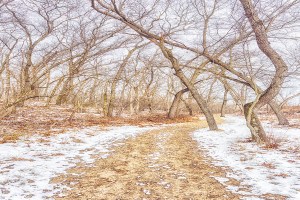 Walking deep through dune woods in winter, as I frequently do, I am sometimes reminded of Henry David Thoreau’s observation that forests or fields during this time of year represent a remarkable display exhibiting “the wonderful purity of nature at this season,” which he considered “a most pleasing fact.” Indeed, Thoreau writes with advice directing that everyone should, “in the bare fields and tinkling woods, see what virtue survives. In the coldest and bleakest places, the warmest charities still maintain a foothold.” Hiking a sandy Trail Nine and moving through fringes of snow in Indiana Dunes State Park this past week, I remembered how dark and intimate the path appears in midsummer months, enclosed by shade from a thick canopy of full foliage on branches bending overhead and occupied by chirping birds. As fond of those conditions as I may be, I must acknowledge that these trees, though now looking weathered and vulnerable, seem more dramatically expressive, perhaps even graceful, when empty of leaves, revealing their gnarled limbs twisting into a gray sky and creaking a bit in a weak breeze, but otherwise silenced by an absence of birdsong.
∼ January 25, 2020 ∼ “Dunes Creek After Light Snowfall”
 The opportunity to photograph snow-covered scenery has been severely limited this winter. Compared to past years, my portfolio for the season reveals an absence of such images. Due to much milder conditions than usual, the region has experienced only a few occasions during which accumulations of even a couple inches have occurred. Consequently, following flooding rains earlier in the week, when winds changed direction overnight and a squall line whitened trails among dune woods, I decided to hike Indiana Dunes State Park’s Trail Two, which parallels sections of Dunes Creek. However, I discovered walking to be treacherous since the thin layer of snow hid a sheet of slick ice beneath that had gathered after the flooded waterway overran its edges and became frozen. Nevertheless, a narrow stream of clear current invited my attention as it still flowed slowly and darkly between those pale banks yet clean of tracks by small animals, the entire setting softly lit in an afternoon illumination filtered by continuing cloud cover.
∼ January 21, 2020 ∼ “Respecting Resilience”
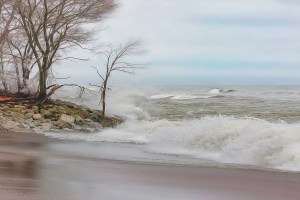 During those moments when I miss the luminosity of a summer sky at sunrise or perhaps that tight line of golden light along an autumn horizon just before nightfall, its glow still illuminating the colorful foliage of treetops beside the shore, I’m often reminded of the distinctly artistic elements subtly visible in a wintry image. Although Thoreau regarded January as the only month of “pure winter,” this year’s beginning—exhibiting the absence of any appreciable accumulation of snowfall, nothing other than a few isolated dustings—has established a deceptive setting. Even now, amidst a milder winter without much snow or the usual protective shelf ice edging the waters of Lake Michigan, I find the scenery inspiring, particularly on days when gales of a northern wind sweeping the length of the lake create large waves battering the breakfronts of beaches bordering the Indiana Dunes shore. Indeed, I respect the resilience evident in some of nature’s more vulnerable features weakened by the damaging winds, such as those thin and brittle trunks with slim windblown limbs at times weighted by ice, plus the partially exposed roots that clutch at sand to reach for the shallow layer of soil below. Yet, as I write this, I wonder whether another of my favorites has fallen.
∼ January 17, 2020 ∼ “Swamp Forest Following January Flooding”
 Following the flooding from last weekend’s strong storm that brought warmer southern wind currents and three inches of rain to the region, I revisited a favorite section of swamp woods found within Indiana Dunes National Park and situated in close proximity to the Little Calumet River. The swollen tributary had overflowed its banks, spreading waters at least a few feet deep far and wide into features of the surrounding landscape. Unlike during summer conditions when the surface of the swamp water becomes thickly filled with algae causing a greenish-yellow murkiness, in those winter months at times experiencing milder temperatures and without frost or snow filling the area, such as seen this week, the submerged ground between these trees usually appears visible beneath clear water. However, when surging runoff from the river during periods of flooding collects some sludge across muddy patches along the way, the watery forest floor often turns a rich and reflective shade of brown exhibiting an artistic image displaying exquisite elements of nature.
∼ January 14, 2020 ∼ “Lake Waves”
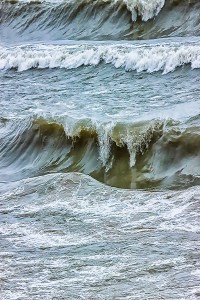 The shoreline of beaches along the Indiana Dunes during January in past years usually would be encased in a thick rim of shelf ice. In fact, sometimes the expanse of Lake Michigan’s surface would be solid white with snow accumulating over a frozen layer. [Check the photos from previous winters on the January link at the main page for examples.] However, due to this winter’s mild temperatures, the region remains free of such wintry images. Consequently, rainstorms followed by strong northern winds—such as this weekend’s blast that brought thunder, three inches of rain on Saturday, and caused waves at times reaching 20-feet high—have continued to sweep damaging swells ashore, further adding to the already dramatic coastal erosion recently witnessed because of the lake’s current record water level. [See my 12/13/19 journal entry for further information.] Even after the storm moved east on Sunday, as I walked paths through sand dunes to observe the extent of destruction created, I watched the persistent turbulence of lake waves where in the past there would have been pale sheets of ice extending into the distance.
∼ January 12, 2020 ∼ “Southern Storm Clouds Start to Arrive”
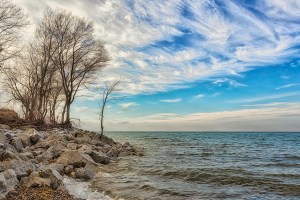 This second weekend in January started with calm conditions and a warming southern breeze raising temperatures into the upper fifties or lower sixties. Eventually on Friday, mostly bright blue skies broken only by white lines of a wispy overcast would begin to give way to a dull gray—perhaps the shade of dated and tainted whitewash paint or the subtly dismal look of old discarded newspaper that has faded away—as intensifying winds shifted ever more quickly toward the north. Shadows of cloud cover caused dramatic changes on Lake Michigan, its waves deepening to watery crevasses and the surface darkening nearly to the color of slate, looking a lot like dingy dishwater. By late Saturday afternoon, following a day of very heavy rain, the weather front had moved east, whipping strong northern winds carrying snow showers behind it and reportedly creating waves on occasion greater than 20-feet high, which would wash over breakwater boulders along the shore, flooding areas beside the coastline and endangering a number of vulnerable trees bordering the lake, even drawing daring surfers in wetsuits to ride those impressive swells onto the Indiana Dunes beaches while some daylight time remained.
∼ January 10, 2020 ∼ “Marsh Pond on Warmer Winter Day”
 On this mild midwinter morning, an unfrozen pool of marsh water still displays the previous season’s frail fallen leaves beneath as though in an attempt to preserve one colorful element of autumn, perhaps also offering further evidence of time’s inevitable transition. Usually, two weeks into the new year, this location may remain inaccessible during an onslaught of another severe northern storm, the ice glaze of solid pond even covered by feet-deep drifts of blowing snow. However, now I find myself hiking beside empty trees among scenery so silent and serene that the noticeable absence of birdsong seems only fitting. Although heavy cloud cover continues overhead, clear air yet prevails along this trail. Later, as a wave of lake haze at last shifts onshore and seeps into these dune woods, I will make my way home.
∼ January 5, 2020 ∼ “Beach Trail Beside Broken Tree”
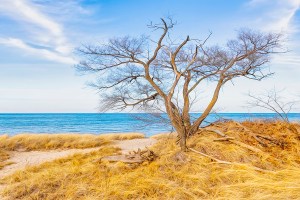 A couple of passing clouds cross before me, scuff against the bright blue above, and one farther away blurs that sunlight arriving from over the southern horizon. Empty limbs of beach trees in winter seem so much more delicate. Indeed, each tree appears vulnerable, perhaps like those sailboats moored until spring in a nearby harbor, whose thin masts rise starkly toward the sky without the colorful covering of their unfurled canvas sheets spread overhead throughout the summer months. Although already January, except for an occasional brief spell of overnight flurries, this year’s mostly mild weather thus far has kept away the season’s normal scenery of knee-deep snow blowing in northwest winds with layers of shelf ice thickening along the shoreline of Lake Michigan. Instead, walking a sandy path toward the water, I hike beside broken branches strewn among the marram grass, usually frozen by now but currently just yellow leaves flowing to the east, bending in an easy breeze, as I appreciate today’s continuing reprieve from a lot colder conditions.
∼ January 3, 2020 ∼ “Warm Start to the New Year”
 Visiting Indiana Dunes State Park for the first time in the new year, I stopped at the Nature Center to take down my exhibition of photographs that had been on display in the auditorium throughout November and December. This officially completed actions included in fulfilling my 2019 Arts in the Parks and Historic Sites grant. At the same time, I spoke with the park’s friendly staff members and discussed with the Interpretive Naturalist our plans for scheduling events proposed in my outline of the 2020 grant I recently have been awarded. Afterwards, enjoying bright sunshine and unusually warm weather for January, almost spring-like, I walked among foredunes along Lake Michigan, and I noticed elements of different seasons yet evident in the images I captured with my camera. Marram grasses, though mostly faded to yellow from the deep green during summer, were spotted at their base with rust-colored leaves, wind-blown remnants of autumn. Meanwhile, a few tiny spots of white, residue from the other night’s light snowfall, some pockets looking like pale scraps of linen, showed in those shadows still caused by a sharp angle of southern sunlight.
∼ January 1, 2020 ∼ “Happy New Year: 2020”
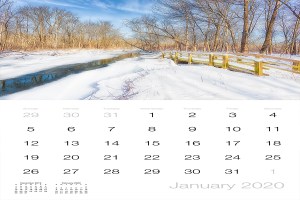 This first day of 2020 marks the start of my fourth year engaged in a continuing project chronicling the Indiana Dunes in photography and prose. During the experience, I have been pleased to have the support of grants awarded by the Indiana Arts Commission in conjunction with funding from the National Endowment for the Arts. Additionally, I am grateful for the cooperation and helpful assistance generously offered by staff members of the Indiana Dunes State Park and Indiana Dunes National Park. The personnel at both locations have been welcoming, encouraging, and enthusiastic about my work. I also appreciate the numerous individuals I have met while hiking trails, offering photography workshops, exhibiting photos, and presenting lectures on the environmental, political, or artistic history of the Indiana Dunes. Finally, I thank all who have followed and commented about this endeavor on an assortment of social media platforms, and I invite everyone to further engage with the collected materials by checking the various pages available at the official web site: https://edwardbyrneindianadunes.com/
Journal: 2019
[Dates reflect days on which entries are posted.]
∼ December 27, 2019 ∼ “Hiking Big Blowout During Warm December Day”
 With record setting temperatures in the mid-sixties, air drifting inland from over Lake Michigan cooled only a bit. I hiked a few miles and climbed to the top of the Big Blowout during early afternoon, observing broken overcast cradling late afternoon sunlight. This morning, the sun’s glow penetrated the day’s haze like a campsite lantern carried along a trail through dune woods to the waterfront on a foggy morning. At noon, although already almost one week into winter, a lone motorboat with engine switched off bobbed about a hundred yards offshore, the vessel’s yellow bow turned toward the north, while a sharp slant of sunshine still slipped between increasingly interesting patterns of clouds. An inconsistent wind shifted direction from the southwest, eventually blowing toward the east with a drift of intermittent billows slowly moving over the lake. Other visitors were walking along the beach, each seemingly in no hurry, apparently wanting to linger a bit and enjoy this brief reprieve, aware the weather would soon transition again to less pleasant conditions.
∼ December 23, 2019 ∼ “Winter Begins with Warmer Weather”
 As I have noticed in a quick examination of old journal entries and collected photographs from past years, local weather at the end of December, the ten days following solstice, tends to vary greatly. Similar to current conditions and reports from the extended forecast, the past couple years have witnessed mild temperatures in the fifties, but a few years ago the area was covered in snow with thermometers dipping to minus double-digit degrees as the 2016 calendar ended. On days following windy weather in early winter, like today, the disturbed surface of the lake settles once again and the littlest ripples become only minor white waves breaking late as they reach those shallow depths beside the beach. Hiking the dunes in this sidelight of a low sun sliding across the southern sky, I see the sheen of sunshine on such still water, and a clarity in the atmosphere allows me to view a beautiful background of blue hues in sky and water. Ahead, I find a few young trees with narrow trunks and slim limbs huddled by one another, appearing almost graceful this afternoon, perhaps even seemingly prepared and ready to be resilient against upcoming wintry gusts.
∼ December 20, 2019 ∼ “Walking the Shore on a Late Afternoon at End of Autumn”
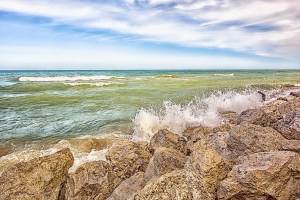 A distant glimmer of sunshine plays hide-and-seek between lowering clouds beginning to spread overhead. I walk along this beach, the gentle turbulence of waves steadily working the rocky breakwater nearby and a clatter of colorful pebbles scattering beneath my feet. Although this afternoon’s air was filled only with variable winds arriving from the southwest, primarily weak and slightly warming breezes following a recent cold spell, the shifting development of mostly overcast skies has introduced a tinge of chillier temperatures, as well as the suggestion of more storms to come. Occasionally, I notice a bit of activity far offshore, first a small black boat but then a large and dark cargo ship crossing Lake Michigan from a harbor to the west of here, moving in a direction away from the coast. I watch as each seemingly isolated vessel slips smoothly through the open water—past that distinctive Chicago skyline still illuminated by lingering daylight, shortened in this late autumn season, and barely visible on the other side of the lake—then it’s silhouette silently slides toward the northeast, where an increasingly leaden horizon looms ahead.
∼ December 13, 2019 ∼ “Erosion Closes Section of Lake View Beach”
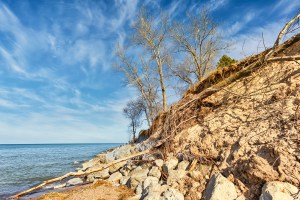 Yesterday, Indiana Dunes National Park announced closure of beach access and a section of the adjacent parking lot at popular Lake View until May or later as an effort at “maintenance of public health and safety.” For years, I’ve watched favorite trees along the border of sand dunes beside the beach survive high waters and windswept waves. Each time I captured their presence in a photo, I’ve wondered how much longer they’d be able to last. In spring I’d especially marvel at their resilience, making it through another difficult winter with such harsh weather conditions, even as the coastline around them has further deteriorated so significantly. However, one after another of these trees has fallen in recent weeks as erosion has erased beachfront and undercut dunes. Especially along Lake View, where up to one hundred feet of sandy collar has disappeared in places and a number of trunks have toppled despite boulders brought as a breakwater due to the current record high water levels and strong northern gusts in the Great Lakes, I’ve experienced a version of the medical phenomenon known as “phantom limb syndrome.” With every visit I make, I continue to envision the scenery as I previously had seen it and captured in images over time. In my mind, each tree I’d appreciated so much and that once stood almost defiantly along the water’s edge yet remains, perfectly pictured in my memory.
∼ December 8, 2019 ∼ “Marram Grass in Late Autumn”
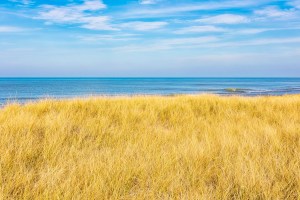 Only a few clouds in sight since the passing toward the east of a short-lived morning squall line that had sliced this coast with its thin formation and contributed a quick burst of rain shower, the day now remains fairly clear, a mostly blue sky covering everything from horizon to horizon. The nearly clean sheet of the lake’s surface has been made even bluer by lying beneath cerulean openings. Although I’d prefer a greater overcast giving a hint of depth for my photography, I nevertheless appreciate the way a flush of afternoon sunlight lends a sense of warmth to this shoreline, especially since I know a sharp cold front has been predicted for the week ahead. I watch small and slowly rolling waves approach the shore. An easy breeze that had been active and sweeping the beach all morning suddenly seems to be sleepy. I follow a sandy path twisting between tall leaves of marram grass, brilliantly yellow now and occasionally quivering among the foredunes.
∼ December 5, 2019 ∼ “Indiana Dunes National Park: Publicity, Promotion, and Popularity”
 Recent reports in local news outlets have hailed the fact that the naming of Indiana Dunes National Park during its re-designation through an act of Congress signed by President Trump in February has encouraged a greatly increased number of visitors with a still-accumulating total at a record attendance in 2019. Moreover, revelation that Frommer’s, a well-known and well-respected travel adviser, has included Indiana Dunes National Park among its “Best Places to Go in 2020,” the latest in a series of annual listings, should assure even more tourists will arrive in northwest Indiana during the upcoming year. As noted in an article by Visit Indiana, Andy Seifert, author of a piece written for Frommer’s, attractively describes that the new national park “encompasses a pleasant stretch of Lake Michigan beachfront, thick forest, and a bog brimming with unique plants.” Given this positive publicity, as well as the growth of promotion throughout the last ten months and toward 2020, one wonders whether popularity will be further enhanced and what kind of gatherings we will see in this national park’s first full calendar year of existence.
∼ November 30, 2019 ∼ “Fallen Trees in Swamp Forest During Fog”
 As much of America engaged in Black Friday activities yesterday, shopping at malls or seeking drastic discounts online, I again participated in Opt-Out Friday along with many others celebrating nature across the nation by hiking paths in state or national parks. In fact, I walked a little less than eight miles, photographing scenes along winding routes in Indiana Dunes National Park. Weather conditions were a bit chilly but not uncomfortably so: temperatures hovered in the upper thirties and an uneven fog wafted between the trees in nearly windless air. While traveling a trail through a swamp forest, I observed damage done recently by fierce windstorms, including one that passed over the region Wednesday night through Thanksgiving afternoon, bringing gales up to 66 miles per hour into our area according to local reports. In a small section of my wetland surroundings, I counted about two dozen of the dead trees, some quite tall, that have been toppled, their reddish root balls and brown boles showing above the waterline. Since their underground support lies submerged beneath feet of water in damp and sandy soil easily loosened, these trees seem more vulnerable to assaults from such strong gusts.
∼ November 26, 2019 ∼ “Influence of Blue Spaces”
 In some places along the shore, the fine grains of sand give way to colorful beach pebbles shuffled about the surf with the surge of each wave. I frequently meet very friendly people, often working in couples, seeking these small stones, as well as shells or various relics of the past, such as beach glass or crinoids, fossils of creatures similar to sea urchins found among the other objects. [Please see my post of 6/26/17 relating one such encounter.] Walking leisurely at the edge of the water, carefully picking up interesting bits of debris one at a time to examine their distinctive shape or tint, these beachcombers always seem to me to be excellent examples of patience and peacefulness. Indeed, I’m reminded of “Blue Spaces,” a recent article written by Elle Hunt advising “why time spent near water is the secret of happiness.” Following studies by experts, including a marine scientist and an environmental psychologist, Hunt suggests “the science is consistent” that “being by the water is good for body and mind.” This thoughtful piece explains being beside bodies of water is restorative physically and spiritually, producing positive results in one’s mood or emotional outlook.
∼ November 23, 2019 ∼ “Recalling Thoreau on Fallen Leaves”
 “The crisped and yellow leaves around / Are hue and texture of my mood….” Henry David Thoreau wrote those words in his poem titled “The Fall of the Leaf,” and I recall them today. November sunlight now low in the sky and shining between clouds, all along the way on my hike I find a littering of fallen leaves—orange, brown, bronze, copper, yellow, and a few already mostly gray—lying in the trail’s shallow covering of mud. Moving through those woodlands in windless conditions, I pause a while to listen as I hear in the distance the shrill whistle of a late-day train traveling an east-west track parallel to the northern Indiana shoreline. This sharp sound breaks a sustained silence I’ve been experiencing, taints that state of serenity I’d been appreciating so much during my autumn walk among nature’s seasonal decorations. When everything is quiet once again, I cross a footbridge farther into the forest, the branches in its trees lashed and thinned by last week’s storms that repeatedly brought bands of rain and snow over the region, contributing to the colorful scene I see before me.
∼ November 21, 2019 ∼ “Lake View Erosion”
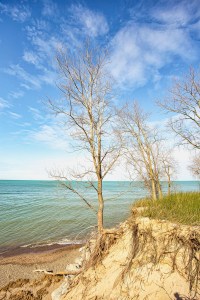 All day yesterday, a threatening sky loomed, although at times sunlight peeked through thick overcast, perhaps like a distant porch light enveloped in mist or a small firepit flame burning amid forest fog. Breaking waves washed onshore and undercut sand dunes. By evening, cold air from a northern front began to clear those low clouds yet covering the coastline, and this morning the horizon brightened, revealing a revision of the lakeside landscape due to recent erosion at a popular viewpoint. With lake levels near record highs and strong autumn storms, much of the beachfront has been diminished. Experts believe Lake Michigan has reached the peak stage in an extended and recurring pattern of fluctuation. Sadly, a few of my favorite trees whose exposed roots had been hanging onto steep sandy slopes—and that I’ve frequently photographed—have been lost. Their weathered trunks and bare branches that had long been leaning along bluffs above the surf have now tumbled over the edge and fallen into the water below. Unfortunately, others remain in imminent danger as well.
∼ November 19, 2019 ∼ “Central Beach After Autumn Storms”
 After weeks beneath feet of water swept ashore by autumn storms, this slim stretch of Central Beach has reappeared. Evidence of erosion from a repeated battering by breaking lake waves and powerful gusts in recent days can be seen all along the shore. Sand dunes that used to slope gently toward the beach have been shorn by strong northern winds, eliminating almost all access below, so the way ahead remains empty. Even the normally ever-present smattering of gulls, small groups so often gathered along the edge of the surf, have gone away and not yet returned. Dozens of trees lining bluffs high above this half-mile long narrow strip have fallen from their place. Though today displays cold afternoon scenery with little patches of ice that may yet be witnessed in some shaded spots, bright sunshine now illuminates this coastline setting opening in front of me as I lean from a bluff too steep for a tripod and resort to hand-holding my camera to capture an image.
∼ November 17, 2019 ∼ “Autumn Path”
As the slanting sunshine slides closer to the horizon, at times hides behind clusters of clouds on partially overcast afternoons, or the light lessens when I walk paths beneath overhanging tree limbs during mornings in autumn, these hues of fall foliage seem to deepen. Indeed, most of the lush landscape appears consumed by vibrant colors. Even the remaining greens in some leaves among the underbrush seem much more lustrous, and the way ahead often becomes swept with splashes or dabs from the season’s brushstrokes—red, rust, orange, yellow. This temporary state of nature may be the best reason for a photography hike despite suddenly colder temperatures, an apt excuse to wander a winding trail through rich dune woods yet protected in places from fierce northern winds by those steep slopes of sandy hills on either side. Although the transition of conditions in this setting may occur quickly, the scenery in my captured image will linger longer, well past next September when the process will begin once again.
∼ November 14, 2019 ∼ “Autumn Trail After Rain”
 Last week’s heavy rains accompanied by strong gusts caused trailside trees along some routes to lose more of their leaves. When I offer photography presentations at the state or national park, I frequently suggest visiting wooded scenery immediately following a storm, especially in autumn. As Henry David Thoreau states in “Autumnal Tints”: “it is after moist and rainy weather that we notice how great a fall of leaves there has been….” Normally, the inherent tints of fall foliage will seem even richer when saturated by moisture after a rainstorm. Additionally, I advise everyone that when brisk winds occur during this time of year, the forest floor on various paths becomes carpeted with colorful fallen leaves as far as one can see. Arriving early, photographers also might be more likely to capture images with fresh layers of leaf accumulation yet to be trampled by other hikers. Moreover, slanted sunshine peeking between remnants of cloud cover and streaming through overhead branches may allow for interesting illumination sometimes leading to filtered lighting or even an overall golden tone.
∼ November 12, 2019 ∼ “Communing with the Landscape”
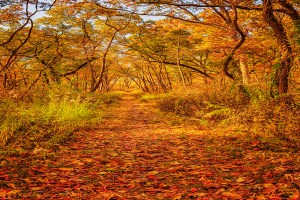 Viewing a recent lecture by well-known British photographer David Ward, who specializes in producing intimate landscape images, I was struck by a comment concerning one’s role in depicting nature. Ward suggests those of us who offer our visual perspectives of the environment ought to have a goal of communing with the landscape rather than consuming the landscape. His guidance appears to urge a more contemplative approach to photography in which the pictures are a part of some larger concept, perhaps in a manner that invites observers to delve beyond the surface of that two-dimensional representation within its frame. Origins of the word “commune” come from Middle English derived from Old French (“comun”), a root of the word “common,” and the definition declares a sharing of intimate thoughts or feelings, especially on a spiritual level. Ward follows this advice in his own presentations, contemplating aloud for audiences upon aspects of the objects he captures with his camera. Likewise, I take comfort in the content of my continuing project on the Indiana Dunes, which has always blended personal observations and brief prose meditations with the landscape pictures I have included.
∼ November 9, 2019 ∼ “Autumn’s Artistry”
 After last week’s peak of fall foliage, in some places among dune woods the trees now have shrugged off much of their leaves. However, a couple pockets of color remain in the forest along Dunes Creek, where some branches sheltered by nearby hills from nearly wintry winds bend amid other empty limbs above the flow of water below and yet appear to be almost ornamental, as if continuing in stubborn resistance to the recent spell of cold air. Even sporadic patches of grass beside the waterway seem to be holding onto those last hints of green left from summer months. At times I imagine this brilliant chaos, still mostly hidden inside the landscape a distance away from frequently traveled trails, has been offered by a personified nature displaying its creative design for viewing, each tinted leaf like a dab of paint on a canvas, or perhaps presenting a final flourish for me to photograph, today allowing one more way to remember autumn’s artistry.
∼ November 7, 2019 ∼ “Dunes Creek in Early November”
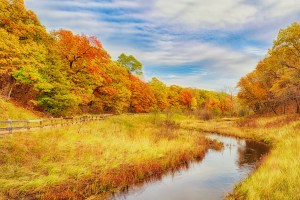 Earlier this week I witnessed the season’s color when it reached its peak. A cool brisk wind that had been active, raising waves and sweeping the shoreline sand all morning, at last seemed to be sleeping. Walking away from the beach and following along Dunes Creek, I could see fall foliage bordering the trail appeared painted in place. As the inescapable shift toward winter continued, and autumn offered its glorious farewell to warmer weather, the chill in the air clearly presented a sense of departure. Nevertheless, these slightly inland trees were yet mostly filled with stubborn leaves, suddenly stilled in a brief lull between breezes, and lines of white clouds scratched lightly against patches of pale blue sky. However, a few bare branches, signs of conditions soon to come, poked over the pathway ahead, and their limbs were now silent with an absence of summer’s birdsong. Tall and slender reeds swayed gently beside the curving waterway, full from an all-night rainfall that had briefly changed to snow before dawn and was now, like a reminder of time itself, flowing slowly before me.
∼ November 4, 2019 ∼ “After an Autumn Sunset”
 With the switch of time that resulted in moving clocks back an hour Sunday morning, sunset slipped to almost 4:30. This transition to earlier darkness also reminded me the arc of the sun’s track has drifted far enough south that its path at sundown now aligns closely with the shoreline of northern Indiana. In fact, as I mentioned to a gathering of photographers at my fall photography talk in the Indiana Dunes State Park on Saturday afternoon, although the best-known photos of sunset from the nearby beach occur in summer—particularly in July when I lead a hike to capture images of the sun as it slides behind the skyline of Chicago on the far side of Lake Michigan—fall photographs of sunset allow one to include the coastal features of Indiana within the frame of the viewfinder. Additionally, as the Weather Channel reports, during fall and winter the angled light “must pass through much more of our atmosphere”; consequently, “blue light gets scattered away, making the reds and oranges more pronounced.” Furthermore, “weather patterns allow for dry, clean Canadian air to sweep” above the lake, thus “more colors of the spectrum make it through to our eyes without getting scattered by particles in the air, producing brilliant sunsets and sunrises that can look red, orange, yellow or even pink.”
∼ October 30, 2019 ∼ “Fall Foliage at Bailly Bridge”
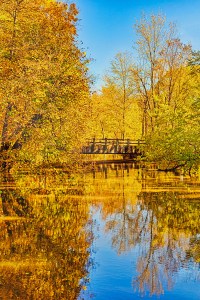 As mentioned in previous journal entries, the final week of October and first few days of November usually exhibit peak leaf color in the Indiana Dunes. Since the season for full fall foliage lasts only for this brief period, weather during the ten days or so that offer optimum autumn scenery can be crucial. Unfortunately, much of the time this year has witnessed chilly and windy conditions with days of rain, creating frustration when seeking opportunities for fall photography. However, during one of the breaks in this stormy pattern, I visited a stretch of the Little Calumet River in the national park that flows past the old Bailly Homestead, a historic location I have written about on numerous occasions. (For a sampling, please see some of my posts dated 8/17/19, 6/21/19, 6/5/17, and 2/26/17.) While there, I captured an image of the short bridge that crosses the waterway near where Joseph Bailly first established a fur trading post in 1822. Under the light blue field of a cloudless sky, the yellow leaves of surrounding trees lit by bright sunshine seemed even more luminous.
∼ October 28, 2019 ∼ “Trail Through Dune Hills in Late October”
 When I guide landscape photography walks in autumn at Indiana Dunes State Park, I remind participants that elements of weather cannot be controlled, so it is important to adapt to current circumstances, especially in this season. One can learn various techniques and tricks about taking photos, become knowledgeable of composition and camera settings, or learn processing skills. However, each trip into nature requires a certain amount of luck with the conditions. Particularly in fall, various features influence decisions in my selection of subject matter or image presentation. Too much sunshine usually introduces harsh contrasts and distracting shadows. Rain could create early leaf fall, as can wind, which also increases the problem of motion blur in leaves when focusing on trees. Therefore, yesterday I followed a familiar trail protected against the winds and shaded from direct sunlight by dune hills to find a spot of colorful foliage with tints enriched by moisture from the previous day’s deluge of rain.
∼ October 24, 2019 ∼ “Events During Peak Leaf Season”
 Next week I will once again be offering a presentation at the Indiana Dunes State Park Nature Center with tips about how to capture better landscape images when visiting the dunes. My talk is scheduled for Saturday, November 2, at 2 p.m. In addition, beginning on Friday, November 1, a two-month exhibition of my photographs will be displayed in the park’s auditorium. Considering these events will occur in the center of autumn, I will be including a number of timely photos with fall foliage. Indeed, that weekend should witness the height of leaf season, which usually peaks in the final few days of October and first week of November. (The current forecast calls for ideal conditions between Oct. 26 and Nov. 2.) Although, as I have mentioned in previous entries, the transition to vivid scenery seems a slight bit slower this year, delayed perhaps because September was significantly warmer than normal. Nevertheless, knowing a couple trails where the transformation of the setting often happens earliest, I did find locations the other day, such as in the accompanying image, that already are starting to show their vibrant colors.
∼ October 21, 2019 ∼ “October Sunset Along Indiana Dunes”
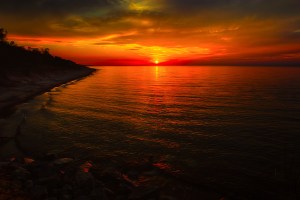 During summer months I sometimes lead a group of fellow photographers for a sunset photo hike at Indiana Dunes State Park. On various evenings in that season the sun lowers directly behind the skyline of Chicago on the opposite side of Lake Michigan. Consequently, the contrast between nature’s magnificently colorful light show and the outline of urban architecture profiled along the far shore often creates excellent photographs. However, each sundown beyond the lake in any season can result in outstanding images. In fact, although the path of the sun has drifted a fair distance to the south by the time autumn arrives and no cityscape appears before its descent, the impression displayed without the intrusion of human structures frequently seems even more dramatic. Indeed, in October the sun’s position sits at an angle to the Indiana coastline that permits capturing an image with features of the Indiana Dunes silhouetted within the frame.
∼ October 17, 2019 ∼ “Endangered Trees”
 This past week, weather patterns over the region transitioned, beginning to shift more quickly toward full fall conditions. Overnight temperatures dropped significantly, flirted with the freeze level, and for a few days we witnessed lake waves swelling beneath the influence of northern winds. Again, the vulnerability to sand attrition and coastal erosion along many beaches appears clear following each storm. Those trees with limbs leaning from low bluffs above the shoreline at some locations seemed to be teetering under the pressure of gusts, and now their precarious situation has become more obvious as networks of roots have been exposed. Indeed, despite desperate efforts at fortification with rows of boulders as breakwater, the trunks may soon topple into the surf below. Even on calm afternoons following every tempest, a dramatic tension is evident in the damaged setting, and I believe much of the magnificent scenery will be lost.
∼ October 15, 2019 ∼ “Crossing Paths”
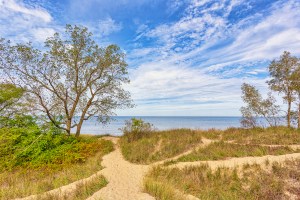 These crossing paths through the foredunes slope gently toward a curve of shoreline where earlier I explored the coast and watched a couple ring-billed gulls stand on a strip of beach narrowed by the lake’s high-water level, each bird poised amid wet sand that has now turned from tan to brown, almost a cocoa color. The pair slowly strayed away from me, ambling toward the west, and they appeared weary, perhaps having been battered a bit by that strong and chilly northwest wind rushing ashore during recent days, although the opening weeks of October had been mostly mild. Today, I decide to walk a different direction. Listening to the soft shuffle of surf, which diminishes as I move inland, I will climb a winding trail between long leaves of marram grass still swaying easily in this afternoon’s remaining breeze. Traveling toward a route that will enter the still-dark interior of dune woods, I look forward to examining what affect the first bit of chilly fall weather has had on the forest foliage.
∼ October 13, 2019 ∼ “Trail Two After a Day of Rain”
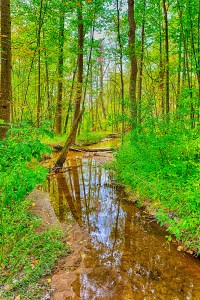 Following a day of stormy weather, the morning’s strong northern winds have eased to a light afternoon breeze on this stretch of trail sheltered by shoreline hills. Sunshine slices through new openings between the higher reaches of trees along this route among the dune woods, their upper limbs beginning to thin a little in mid-October. After a recent rainfall that totaled more than nine inches a week ago, Trail Two remains muddy though no longer flooded. The Dunes Creek path beneath my feet lies strewn with a scattering of some colorful leaves and a few signs of raccoon prints outlined in the soft soil. Nevertheless, perhaps due to warm and wet weather much of the summer and early autumn, more of the foliage thus far this fall seems to be green. I don’t often find crows this close to the coastline, but today one quiet figure, apparently undisturbed by my movement, appears to be watching me like a dark angel from its perch on a nearby branch, hanging low and partly hidden within the gray shade of that ragged, though ample, canopy yet looming overhead. I return the bird’s gaze, simply nod as if to acknowledge its presence, and carry on my walk toward the strip of beach bordering Lake Michigan.
∼ October 10, 2019 ∼ “An Observation on Photographic Imagery and Nature Writing”
 In a September report broadcast on CNBC about measurable movements in sales of books, a major bookstore representative commented how nature writing seemed to be one of the genres that have gained popularity with readers in recent years. An explanation offered that such works of literature provided settings with simplicity and beauty, scenery viewed as an escape from the chaotic and frequently troubling interaction in the lives of many in contemporary society, whether personally experienced or distantly encountered through news on television and commentary in social media. However, my observation of recent trends—including the documented proliferation of visitors swelling attendance figures at national parks—suggests the growth of online platforms, particularly Instagram, that constantly exhibit and regularly promote habitats of natural magnificence in millions of images always available, encourages curiosity about those locations. Consequently, a desire is engendered to comprehend in depth the environments represented by the seductive two-dimensional photographs of nature’s splendor witnessed daily on digital screens. Indeed, I have concluded similar pleasant elements in the natural surroundings have contributed to inspiring me, motivating my mixture of pictures and prose in this continuing Indiana Dunes project.
∼ October 8, 2019 ∼ “Autumn Sunset Through Dune Ridge Trees”
 I follow a narrow path up a sandy hill to the edge of this ledge overlooking Lake Michigan. Last year a shallow slope existed where this cliff now ends abruptly and drops sharply for almost thirty feet. A slope of loose sand once ran at a slight slant toward the shore where sunbathers would stretch their blankets and swimmers would wade among small waves. But today that wide beach lies submerged beneath an unusual high-water mark, and this location seems hidden, isolated above the coastline below. In fact, the lake level is currently 16 inches higher than last October, only 7 inches from the all-time record and nearly 6 feet beyond its low in 2013. Suddenly, an orange haze forms over the skyline. Some rust-colored leaves on dune ridge trees or settled among the marram grass lit by the sunset display evidence that the transformation of early autumn has begun. This evening, only a weak breeze moves through these branches, and the surface of the water below has calmed considerably since a late-morning thunderstorm passed, shifting swiftly toward the east. I aim my lens away from that glare of sun just dipping behind the horizon, changing the appearance of the scenery in front of me, and I capture this quick transition.
∼ October 6, 2019 ∼ “Seeking Initial Signs of Autumn on Early October Photo Hike”
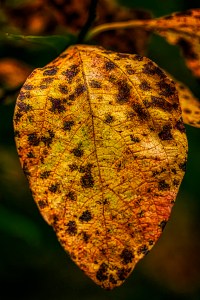 Yesterday afternoon I assisted Dan Barriball, an interpretive naturalist at Indiana Dunes State Park, in guiding a wonderful group of visitors on a photo walk along Trail Seven as part of the weekend’s Outdoor Adventure Festival. Dan provided valuable information about plants, trees, birds, and butterflies. I offered advice on certain elements of photography, such as composition and camera settings. I enjoyed speaking with the group in a preliminary introduction and then engaging in friendly conversations with a number of my fellow photographers as we traveled the short roundtrip route to Lake Michigan then back to the Nature Center, a bit more than a mile each way. I also spoke about Frank V. Dudley’s famously influential paintings created at the Indiana Dunes, and how my pictures sometimes attempt to imitate a few of the artworks by shooting the photos in locations or with perspectives similar to those Dudley chose. Indeed, one of his paintings bears a title identifying itself as The Seventh Trail (1953), an image we carried with us in order to identify the exact spot where Dudley might have stood while working on his canvas. We tried our best to find some initial signs of autumn for interesting examples of an intimate landscape photograph. Since the weather has been warm during late summer and into fall, not many leaves had yet changed color, but a few already displayed evidence of decay.
∼ October 3, 2019 ∼ “A Few Basic Beginner Tips on Landscape Photo Composition”
 This Saturday I will be leading a photo hike at 2 pm in the Indiana Dunes State Park as part of the annual Outdoor Adventure Festival. Whenever I meet people during my landscape photography treks in the Indiana Dunes, they frequently wonder what I’m seeking to capture with the camera. Initially, they usually guess I’m looking for birds. But upon my answer that I’m seeking engaging scenery, some ask for a few basic tips on composition. Guiding folks on photo walks, I give the following quick tidbits of broad and general advice for beginners. Quality of light might be my first concern when taking pictures, especially conscious of avoiding harsh shadows or distracting patches of bright sunshine in wooded areas. Additionally, I like to wait for days that display a scattering of clouds billowing overhead to contribute a sense of texture and perhaps supply a natural soft filter for the sunlight when hidden behind them, remembering that a strong sun tends to bleach color. Tall grass and small trees—whether full with foliage in summer or colorful in fall, even with their thin and twisting limbs bared in winter—often provide a fantastic foreground facet for focusing interest. Sometimes, I try to include a narrow trail weaving through thick woods or a winding path among the undulations of sand mounds, each feature offering a perception of distance in the setting. An extended stretch of beach emphasized by a white surf also can exhibit depth, an angling line leading the viewer’s eye into the image. Although I try not to talk too much about photo technique in my writings, I frequently receive e-mails requesting advice, and I thought these simple hints could be helpful to many.
∼ October 1, 2019 ∼ “Warm Weather at Start of October”
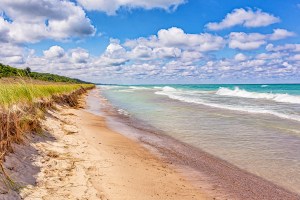 By late morning today’s sun had dissipated the faint early fog drifting in from Lake Michigan and dried those beads of dew on slender reeds of marram grass throughout the dunes. A few pillows of billowing clouds over me, that thin file extending above the horizon line now appears more like pale brush strokes lightly smudged across a canvas against a background painted blue. Although the calendar indicates autumn has begun and summer’s hold on the landscape should have loosened, nature’s sleight of hand seems to have deceived us once again. Warm weather nearing ninety degrees lingers at the start of October along the northern Indiana coastline brought by the breath from a southern front moving through. Angled sunshine streams onto the beach, brightening that tan stretch of sand ahead while whitening the surf. I decide I will walk west with the water to my right, watch the remaining leaves on shoreline trees quivering in whatever wind there is. Thinking about how quickly this scenery could soon change, I am reminded of words Henry David Thoreau once wrote in his journal: “The seasons do not revolve for us, we sing their lullaby.” [May 22, 1854]
∼ September 25, 2019 ∼ “Sunset After September Thunderstorm”
 Sometimes sunsets occurring beyond Lake Michigan after a quickly passing thunderstorm seem to exhibit even greater vibrancy, and the scenery becomes so much more stunning. The atmosphere appears clearer following such a sudden short-lived rainfall, and the remaining clouds create an increased sense of texture in the horizon sky. Today, a dull gray September afternoon has been replaced by this vivid evening setting with its distant imagery looking like a lit match, and I watch the calm water now settled before me, its surface reflecting that rich redness descending all around. Surprised when I arrived by the absence of others to witness this view, I walked the length of an empty beach to find an apt spot for my tripod, the camera lens now aimed at a slender trail of light extended toward its source. I waited nearly an hour until the persistent overcast broke, mostly rolled slowly away, drifting east as I hoped it would. Still too early for the moon or stars to slip into place and make their appearance, I know I will linger a bit longer.
∼ September 23, 2019 ∼ “End of Summer”
 The time has finally arrived for summer to unfasten itself from the landscape. In this morning’s weak breeze, leaves of marram grass filling the dunes seem to be gently waving goodbye to another season. Thin limbs of lakeside trees, still a bit green, lift a little with every puff of onshore breath, and their shadows extending under slanted sunlight slowly slide toward the water. The surf’s backwash following each breaking wave whitens the shoreline. Farther down the coast, most of the beach stretching ahead has been swept from sight by the height of the lake level. Last night’s sky, seeded with stars, seemed to indicate today would be clear as well, but now a cluster of clouds appears, crawling across the wide field of blue sky. Alongside a winding trail where I step through the foredunes, a few groups of wildflowers yet brighten briefly under the glance of sunshine. A pair of ring-billed gulls call above to one another and pass by my path, tipping their wings overhead slightly as they turn into the wind to become figures diminishing in the distance.
∼ September 20, 2019 ∼ “Washed Away Beach”
 I have been hiking narrow paths twisting through the foredunes this afternoon with little shelter from brisk onshore air currents. In the aftermath of a strong storm with northern gusts, I observe this sliced edge of fading shoreline, shaped by waves and wind, which continues outside the photograph’s frame. Each time I visit, I see the surf has sucked much more sand from the shore. Following three consecutive seasons with harsh weather patterns, this beach has been robbed of its depth—at least fifty feet in the past—and become impassable where I once walked its breadth with ease. The stretch of broken coast extends ahead of me, and overhead a congregation of clouds is assembling again before another storm forecast to arrive later today. On some evenings when hidden in thick fog or covered with a drifting mist, even before nightfall seals the deal, its length merely disappears from sight, vanishing in the near distance as if never there.
∼ September 19, 2019 ∼ “Indiana Dunes National Park: Six Month Report”
 In Tuesday’s newspaper, Chicago Tribune reporter Morgan Greene outlined the impact thus far from the re-designation of Indiana Dunes National Lakeshore to Indiana Dunes National Park just over six months ago. Greene cites Paul Labovitz, Superintendent of Indiana Dunes National Park, who observes the number of visitors this summer as “spectacular,” having increased substantially since March due to the renaming at the end of February. Indeed, the article declares the National Park Service estimates this year at Indiana Dunes as having seen “the highest visitor counts across decades.” Greene also reports that the Indiana Dunes Visitor Center “has clocked record traffic,” and it has already “broken its all-time annual record.” Conversations I have conducted with staff at the state park suggest an expected carry-over effect since it is surrounded by the national park territory. In fact, as my previous post noted, some traveling to the region in response to news about the national park have spent their time based at the Indiana Dunes State Park campgrounds and taken advantage of the state park’s popular beach or hiked its famous 3-Dune Challenge. A cooperative spirit between the two parks, such as during the Outdoor Adventure Festival upcoming in October, can only assist in further boosting attendance in the future at both locations.
∼ September 17, 2019 ∼ “Sunset Through Shoreline Trees”
 After a late-day lull in onshore winds, the surface of the water shimmers, and a stillness fills the evening air. Sunset spreads a palette of colors, dyeing the darkening horizon with its tints, a variety of shades seeping between thinning clouds and expanding across this end of summer sky. Already, a bit of cold accompanies the oncoming night and a few leaves on nearby trees with limbs framing my view have given up their green. Eventually, each season relinquishes its grip on the landscape. On my walk toward the shoreline tonight, I spoke with a man from Oklahoma who was touring the Midwest in a Winnebago with his wife, both retired. Heading east, they planned to travel to New Hampshire by the beginning of October to observe fall foliage in the White Mountains. He told me they’d been camping at the Indiana Dunes State Park and seen every sundown beyond Lake Michigan this past week, plus under clearer skies they stay later, sitting on a blanket stretched over the beach sand, lingering a little longer as they wait for the moon and great array of stars to show themselves.
∼ September 15, 2019 ∼ “Trail to Beach in September”
 Hiking a ridge trail high above the beach at least a half mile east of the state park pavilion, the end of summer only seven days away, I notice the sandy course ahead littered with rust colored leaves and pine needles. Although birds hidden in upper limbs still sing brightly and the tapping of a lone woodpecker announces its presence, those long blades of marram grass, some already fading to yellow among the foredunes, sway gently in accord with lake waves during each easy gust from a chilly onshore breeze. Though the calendar pages indicate we’re almost at autumn, there will likely be a while yet until the first hard frost or early snowfall. That luminous sunshine I’d witnessed most of the morning when I walked a winding route along Dunes Creek, splotches of light filtering through the thinning woods, has nearly disappeared this afternoon beneath dull skies from an increasing cloud cover settling overhead, introducing colder weather. I decide to descend a sloping path to the surf, where I will feel more fully the lifting wind bringing this touch of fall in the air.
∼ September 13, 2019 ∼ “Dune Hills Near Trail Nine”
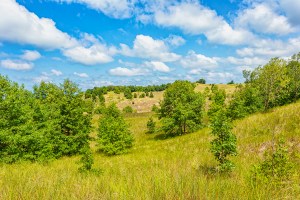 Calm conditions with an absence of lake waves, mid-September days like this signal a stillness between the busyness of summer and those autumn windstorms soon to shake leaves from these shoreline trees. I like the quiet and solitude so far along Trail Nine. Sometimes this silence seems like a gift, the scenery before me a secret shared with some hesitancy, an exclusive display, perhaps like a large painting in progress revealed, uncovered from a drop cloth draped over the canvas at an artist’s studio. At this stage of the season, the richness of those lingering greens yet enduring in the landscape seems to surprise me. In locations where fall colors—orange, red, yellow—have already begun to show among the undergrowth, I feel a sense of regret, an anticipation of loss. Already, this afternoon’s sun moves more quickly toward the horizon, the hours of daylight shortened significantly. Before long, I will position my tripod by the beach for a sunset shot over still waters, and nightfall will nearly be here.
∼ September 11, 2019 ∼ “Marram Grass Among Foredunes”
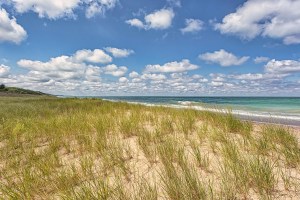 A mid-September spell of warmer weather with winds shifting to the southwest lifted temperatures into the upper eighties yesterday, and now nearly ninety degrees has been forecast for today and tomorrow. Features of the landscape along Lake Michigan seem almost summery once again, much of the marram grass still green and filling the foredunes, their long thin blades tilting slightly in the lightest breeze. Scatterings of small clouds, perhaps resembling shipped parcels whitened by bright sunshine, slowly float overhead and impose themselves on the scenery. The irregular shapes of shadows on their undersides slide across the coastline; dark and deliberate in their movement, they look like they are alive, even remind me of those crows sometimes seen passing aloft, drifting above taller treetops of the dune woods. Indeed, this week’s conditions have created an unexpected warmth that seems to suggest someone has reshuffled the calendar’s pages.
∼ September 9, 2019 ∼ “Sailing Under a Sunset Sky”
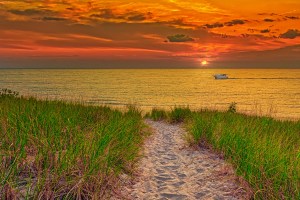 Since August closed and September opened during the Labor Day weekend, this stretch of shoreline already seems to be visited much less than during the past few months. Standing on a low mound among dunes just above the beach and sloping toward the surf, an easy breeze scattering the top layer of loose sand around my feet, I await another sunset in this diminishing season. A colorful glow blurs those distant clouds, slow moving and appearing smeared, almost as smudges or gauzy patches of gray among a late haze on the horizon. The reflective surface of lake water trembles a bit beneath the soft onshore wind. Though not yet autumn, already air along the coast cools quickly each evening. As summer nears its end, I notice a lone boat crossing toward the west, slipping before me in this glint of light and leaving a thin streak in its wake. Its stuttering engine interrupts the enticing spell of silence that had been sustained since I stumbled up the slanting path to arrive in this spot about an hour earlier.
∼ September 7, 2019 ∼ “Sentinel Tree in September”
 Standing on a sand dune and leaning lightly on my tripod, I watch as skies over Lake Michigan start to darken again with increasing cloud cover, yet the Chicago skyline is still visible in the distance. Gulls flutter along the shoreline the way they appear to do year-long, but today too far down the beach for me to hear their calls. This morning a small storm moved through northern Indiana, the low tone of muffled thunder rumbling for nearly an hour. Although temperatures still seem ideal in early September, nights contain a distinct chill, and soon these shortening days will also grow colder. Fall officially two weeks away, scattered patches of marram grass among the foredunes have already begun to fade, turning from green to yellow and tan. More coastline trees, like the sentinel in front of me, have started to thin, some even displaying completely empty limbs. The great variation of nature continues to exhibit evidence of change as I observe one season begin its shift into another.
∼ September 3, 2019 ∼ “Lake Viewed Through a Few Dune Trees at Start of September”
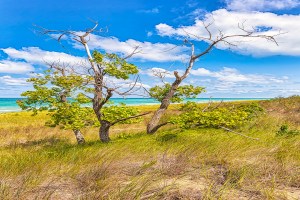 As I scuffle down a shallow dune slope toward the water, another flurry of fluttering wings, ring-billed gulls lifting aloft then flying loops, moving low enough to be by my right side, eventually drop to the lake’s surface, drifting not far from its edge. I pause to watch an intermittently turbulent surf whiten like chalk along that swatch of beach below. A staggered pattern of breaking waves, curved lines almost as pale as chalk, now decorate a distant bend in the shoreline, as do the clouds floating overhead. Those ripples close by appear to rasp in a rhythm, sometimes sounding like someone straining with exertion, as they scrape the sand with every rush onshore. Bare branches of coastal trees weakened by repeated bouts with stormy weather seem to creak with each brief gust of wind. Some already slouch, their thin limbs drooping as if from exhaustion. Today, I have a vague notion of what I want to capture with my camera. I stoop by my tripod, bow my head to look through the viewfinder, and press the shutter release button.
∼ August 29, 2019 ∼ “Eastern End of Trail Ten at End of August”
 Though still summer, when walking through shade trees along the dune ridge overlooking Lake Michigan I sometimes feel the sudden chill of autumn evident in an onshore breeze. Despite weakening a little lately as it moves farther south, the sun yet brightens streaks of surging surf below me with its angled light. The nights have already cooled quite a bit. Campers in the state park huddle closer to fire pits during a darkness that arrives earlier each evening. North winds bring a collection of fluffy clouds and continue to sweep the shoreline with insistent waves. Much of the beach sand has been washed away during this season’s storms. Recent high levels of the lake’s surface have created extensive erosion damage along stretches of the Indiana Dunes coastline. Today, I have been hiking deep into woods and along blowout rims again on the eastern ends of Trail Nine and Trail Ten, where a narrow tan path at last descends like an unraveled strip of ribbon toward the water’s edge.
∼ August 26, 2019 ∼ “Setting Sun Behind Horizon Clouds”
 Each evening as another summer sunset ends, before twilight starts its slide toward the blackness of nightfall, I like to watch the way vivid colors remain a while, lingering overhead perhaps paradoxically like a beautiful bruise from a minor injury that will eventually fade away, as has any pain already. Its display becomes nudged higher by angled light directed above that lake water shortly to be shadowed and disappear from sight. Though not totally overcast, the time is still too soon for stars to show themselves, and I know at first the moonless sky will wear its solid darkness like a buttonless coat. I appreciate a noticeable silence. Even those gulls that had been flying nearby, dipping their wings in cooling air along the beach, have quieted. I stand by my tripod in a flat patch of sand among the dunes, camera lens aimed toward the shore, as I sense the slightest drift in this light wind beginning to sift through a tangle of thin leaves, tall green blades of marram grass now shifting a bit all around me. Again, I’m aware no photo, even with the aid of these words, could fully capture the atmosphere.
∼ August 23, 2019 ∼ “Portage Breakwater: On Dangers to Nature, a Report”
 As I have noted in the past, the unique qualities of Indiana Dunes National Park include its proximity to industrial developments, which represent a constant reminder of the encroachment by humans upon the natural landscape and of the ever-present possible threat to the purity of nature. Last week, the constant concerns of many were realized when an excessive release of ammonia and cyanide occurred at the ArcelorMittal Burns Harbor steel plant along a portion of the East Arm of the Little Calumet River that flows into Lake Michigan near the Portage Waterfront, causing fish kill in the thousands. Disturbingly, a report of the spill, which may have occurred on August 16, apparently was delayed at least a few days. On Thursday, after three consecutive days of water testing clean, the National Park Service once again allowed swimming at the Portage Lakefront and Riverwalk Beach. It also reopened all of the Little Calumet River within the national park. This decision was made in consultation with the Indiana Department of Environmental Management and the United States Environmental Protection Agency. The National Park Service promises to continue monitoring testing.
∼ August 21, 2019 ∼ “Trail Above Lake Michigan in Late August”
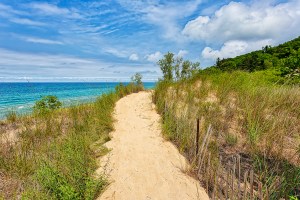 Late August and already the volume of summer visitors to the park has been trimmed a bit. This trail once again appears uncluttered, and its empty stretch slicing through the dunes ahead welcomes me forward. I slowly shuffle down a sandy slope toward the shore. In the distance, a thin scattering of overcast spots the horizon, and some fluffy clouds float overhead. Nearby, a few ring-billed gulls flutter above that stutter of small waves breaking on the beach. Beside the path, those wildflowers I have passed still nod easily with each gentle sweep of an afternoon breeze. The tall slim blades of marram grass shiver all around me, and the leaves of small trees on the ridge rustle in the occasional drift from an increase in northwest wind at their altitude. When I pause for a drink of water, I notice the whole scene seems designed for the kind of setting with a composition I’d hoped to find to take my photograph, waiting as though only hoping for me to do my work and snap the shutter.
∼ August 19, 2019 ∼ “Meeting a New Friend on Trail Ten”
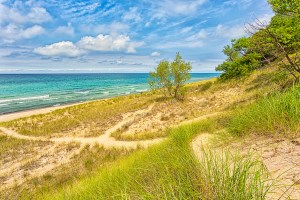 Earlier in the day, at the eastern end of Trail Ten in a section between Paradise Valley and the Pinery, where a narrow boardwalk built by local eagle scouts about five years ago crosses the Great Marsh deep in a forest among tall shade trees, amidst the relentless smell of dampness and decay at this time of year, I met a man from Mississippi named Mason who asked me for directions. The only individual I’d seen on my late-morning walk, Mason, a retired electrician, explained he’d been hiking a couple miles from the state park campsite. He wanted to know the closest and quickest way to Lake Michigan. I offered to guide him to where the route passes through dunes and comes upon the surf not far ahead. When we arrived at an opening in the woods and descended toward the shoreline, an increasing lake breeze was bringing with it a fresh scent. My new friend remarked admiringly in his wonderful accent that he’d been surprised to find in Indiana such tan sand and almost turquoise water, which fondly reminded him of those southern gulf beaches he knows so well.
∼ August 16, 2019 ∼ “Marsh Forest in Mid-August”
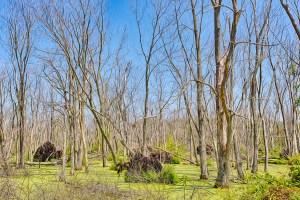 I stand beside my tripod to rest a while on the narrow trail and to watch the strong summer sun above briefly disappear under an isolated cluster of cloud cover suddenly arriving on this almost windless day. At first, I don’t notice a small yellow-and-black striped garter snake, just under two feet long, as it slithers past my left boot and slips quickly into the nearby marsh until lost among a forest of dead trees. The base of each trunk lies submerged beneath about fifteen inches of water coated by green seasonal algae. The trees seem arranged alongside one another in a pattern resembling controlled chaos, maybe like an array of symbolic features—perhaps meant to emphasize absence, loss, or longing—I have observed sometimes at abstract installations exhibited in an art gallery. I scan the surface of the water seeking to find a dark line—like those slim shadows of thin limbs—or even a little ripple, any bit of evidence to indicate the snake’s presence yet in such a still setting; however, I only witness this calm and undisturbed scenery in front of me.
∼ August 12, 2019 ∼ “Sunshine Peeking Between Riverside Trees”
 After about eight days without rain, those lower boughs of trees yet heavy with summer foliage beside this waterway seem to sag in deep shadows. As I hike by this site, where earlier I had seen a hawk glide gracefully in silhouette against the brightening background, the dry branches sigh high overhead in each increasing breeze. Those few I pass that are already empty of leaves creak a bit as they shift gently with even the slightest drift of southwest wind. Resting a while on this trail amidst a pool of cool shade, I sight the strong afternoon sun now free from this morning’s sporadic patches of fluffy clouds and peeking just above a tree line downstream. Its fine rays of yellow light probe an opening in the canopy, and they illuminate almost to overexposure a little cluster of limbs crossing their path beyond a distant bend in the river. I observe this sudden burst of sunshine as it ignites the far sky, perhaps like that first flame spurting sparks among dark kindling of twigs in a small circular firepit I’d witnessed last night at a nearby campsite.
∼ August 10, 2019 ∼ “Devil’s Slide at Johnson’s Hill”
 One of the iconic images in Indiana Dunes State Park, initially recognizable at the mouth of Dunes Creek near the popular public beach and historic pavilion, the Devil’s Slide down Johnson’s Hill often attracts visitors for a first hike. Climbing the steep dune, which reaches an elevation of about 100 feet at its summit, offers a panoramic vista of the shoreline along Lake Michigan, plus on clear days one can observe the distant skyline of Chicago, approximately 35 miles away. As I mentioned in a previous entry two years ago (8/21/17), this location “provides the only place in the park permitted for sledding in winter. However, viewing its current appearance and contrasting that with past photographs, particularly those taken decades ago, one discovers a transformation has occurred. In those old photos the entire hill looks to be bare of trees, grass, and underbrush.” Consequently, I return each summer to snap a photograph evidencing the continued growth of foliage on this terrain.
∼ August 7, 2019 ∼ “View from New Little Calumet River Kayak Launch”
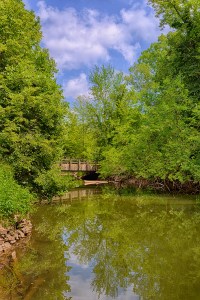 In a past post I wrote about construction of a new kayak launch along the Little Calumet River in Indiana Dunes National Park with assistance from a grant administered by Save the Dunes. (To read that entry and view my photograph of the structure, please visit my 6/21/19 entry.) As I mentioned, the kayak launch is situated near the historic Bailly Homestead, an appropriate location considering Joseph Bailly’s positioning of a trading post at that bend in the river during the 1820s because it “offered excellent opportunity to transport goods along the river and main east-west Indian trails that crossed nearby, as well as providing proximity to Lake Michigan, just a short distance north and convenient for shipping goods to a commercial hub in Mackinac. This riverside site proved ideal for delivery of animal pelts by canoe, and the local Potawatomi tribe served as favorite trading partners, supplying pelts from various game, including beaver, rabbit, and deer.” Yesterday, I stood on the newly-opened kayak launch facing east and captured this image of the bridge beside the Bailly Homestead. I also imagined how the scene might have appeared 200 years ago.
∼ August 6, 2019 ∼ “Cowles Bog Walkway Under Summer Sunshine”
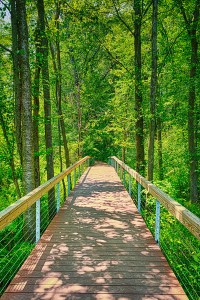 Hiking in the heat of early August, I travel an overgrown trail through Cowles Bog, famous as the location for pioneering studies conducted more than one hundred years ago of its unique ecological structure. Lines of vines crisscross a few feet overhead, their deep green leaves lush and still in this windless air. Beyond a bend, I spot that straight walkway extending over a stretch of wetland between spines of tall trees, the water level yet elevated somewhat by a series of rainstorms throughout spring plus much of June and July. In past years before this raised path was built, the way ahead would have been flooded, perhaps impassable during such conditions. (See my previous post of 11/22/17 about construction of the newly restored route.) This year’s pattern of wetter weather has also brought more pesky mosquitos or hovering deer flies; although, some of those unseen birds chirping cheerfully in filled limbs above me seem pleased to be able to feast on the season’s increased supply of insects.
∼ August 4, 2019 ∼ “Walking the Length of Central Beach”
 When wet weather dominated spring and the first half of summer, water levels of Lake Michigan reached near-record readings. Strong storms brought northern winds sweeping large waves toward shore, and many coastal locations along Indiana beaches were washed away. In fact, as I have reported in previous posts, Central Beach in the Indiana Dunes National Park seemed among the most vulnerable. (Please see my recent entries of 6/28/19 and 7/23/19.) However, since the past few weeks have seen an extended spell of calmer and drier weather, the surface of the lake seems to have receded a little. Consequently, I now find spots where previously submerged stretches of sand have begun to reappear. Visiting Central Beach the other day, I was able to walk its entire length for the first time this season, although much of the extent remains merely two or three feet wide, and I often had to measure my steps, moving quickly between the scalloped edging of a pulsing surf.
∼ August 2, 2019 ∼ “Photo Exhibition”
 Yesterday, before taking down my photography show that had been on display in the Nature Center at Indiana Dunes State Park during the months of June and July, perhaps the busiest stretch of the calendar for visitors, I spent a few minutes walking along the auditorium walls to review those fifteen prints I’d included. The variety of locations represented in the images captured at different times of the year reminded me how the local landscape constantly transforms throughout the seasons and seems continually visually appealing. I also spoke with a couple of the friendly staff members, both interpretive naturalists with whom I have helped lead photo hikes in the past, who informed me how much they appreciated the way my photographs brought indoors an array of impressive scenery from the surrounding settings. I was thankful again for the opportunity to share my perceptions of nature with so many people from near or far, and I already look forward to the next exhibition of my work—mostly autumn and winter images—that will be mounted at the Nature Center for viewing in November and December.
∼ July 30, 2019 ∼ “Sunday’s Sunset at Dunbar Beach”
 Walking toward the shoreline in late day at the end of July, I move along a sandy path through tall blades of marram grass and these few small trees scattered among the dunes with their leaves trembling slightly in a light onshore breeze. As I approach the coast, I pass a young couple speaking French and a group of four more visitors, apparently a family—parents with a pair of boys—conversing in German, all awaiting a view of sundown. I wonder if this is just a coincidence or perhaps evidence of a benefit from the recent re-designation of the Indiana Dunes lakeshore to a national park, which likely has brought more interest from international tourists. I am reminded once again how I sometimes take for granted this local gift of nature I frequently treat much like a large backyard and some near here regard as a weekend getaway, while others travel far from distant locations hoping to experience its beauty. This evening, I observe another wonderful sunset beyond Lake Michigan, and I am pleased these sightseers will not be disappointed.
∼ July 28, 2019 ∼ “Sunset Stroll”
 Friday evening, I was invited to help lead a “Sunset Stroll” hike at Indiana Dunes State Park. The interpretive naturalist, Ashley, enthusiastically guided a group of fifteen participants on a trail that extends along Dunes Creek toward where it flows into Lake Michigan. As Ashley provided entertaining and informative specifics about various features found along the way—types of trees and their uses, the history of the creek, or even why sunsets vividly display certain colors—I offered a few suggestions for photographing during sundown. The weather was ideal, windless with a temperature about 80 degrees plus little humidity, and all were engaged in friendly conversations. We had hoped to capture an image of the sun poised behind the center of the distant Chicago skyline, outlining some of the city’s famous buildings more than thirty miles away, as occurs at this time each year. However, due to persistent haze and pesky cloud cover obscuring details on the far side of the lake, conditions dictated we would merely witness a more subdued sunset that generally shaded the sky in warm hues, which were also reflected on the still water and brought out by lowering my camera’s exposure compensation. Nevertheless, as I mentioned in my remarks, every image of a sunset delivers some interest; plus, I felt the pleasant company of others on this night enhanced the enjoyment for everyone.
∼ July 26, 2019 ∼ “Walking Toward the Shore on a July Afternoon”
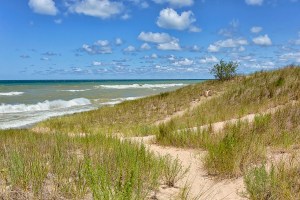 After hiking more than three miles, I have left a shaded trail winding through dune woods to walk toward the water. A few small mounds along the shoreline seem swollen recently with sections of sand skinned by swift northern winds and shifted inland. Tall reeds of marram grass sway lazily beside my path in today’s onshore breeze. Again, this thin reach of the dwindling beach below has been displaced by the rising water level of the lake. A late afternoon sunshine skims its surface and glints on the whitecaps of high waves approaching the coast. I pause to watch a large barge in the distance as its silhouette crosses before the Chicago skyline, which is still visible on the horizon. A couple gulls fly by my location and shriek in the mostly blue expanse overhead while another one thrashes its white wings in the turbulent surf glistening ahead as if offering an invitation for me to continue forward.
∼ July 23, 2019 ∼ “Northern Winds Sweep Waves Across Central Beach”
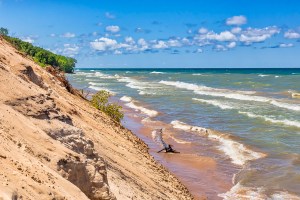 The region’s recent heat spell that brought the warmest days of this summer, with temperatures reaching into the upper-90s, ended Sunday evening when winds abruptly shifted from steady southern currents to strong northern gusts. In addition, as I noted in a previous post (please see my 6/28/19 entry), the water level at Lake Michigan already has approached a record elevation. As reported by Larry Mowry, meteorologist at Chicago’s ABC television news and an alumnus of Valparaiso University, the height of the lake’s surface is currently tied with the greatest measurement for any July during the documented history begun in 1918, and it now stands only 4 inches from an all-time record, which occurred in October 1986. Therefore, large lake waves washed away various beaches along the Indiana coast again on Monday morning, including the Indiana Dunes National Park’s Central Beach, a location I have referenced in past commentary as among the most vulnerable stretches of shoreline.
∼ July 19, 2019 ∼ “A Quick Look Back”
As I came across an interesting magazine article this week that explored an apparent difficulty in general of continuing the task of writing a journal, with most people abandoning the habit of regular composition pretty soon after beginning the process, I decided to review the accumulation of journal entries in this Indiana Dunes project. I started on January 1, 2017, noting the influence of Henry David Thoreau, since that year marked the 200th anniversary of Thoreau’s birth. The initial account acknowledged those repeated bits of inspiration I found in reading “his observations on nature or speculations about the human spirit.” I also admired his steadfastness, authoring pieces over a span of more than two decades in prose that added to about 2-million words. Consequently, I became curious about my own output thus far over the past two and a half years, and I discovered my contributions currently comprise more than 500 entries—each accompanied by a photograph—containing commentary in excess of 125,000 words. This represents a minimal total compared to Thoreau’s productivity, certainly; but the collection is expansive enough, and with fairly comprehensive content, that I can now confidently invite everyone to take a quick look back and to browse through my writing in past posts.
∼ July 14, 2019 ∼ “Dunes Creek at Midday in July”
 In this season’s heat, the gray shade from these trees along the creek beside Trail Two offers a little relief, and an easy breeze off the nearby lake yet blurs their upper leaves. Though I know I should not photograph during bright noon light that tends to lend such harsh sunshine or sharp contrast to images of the landscape, especially in summer months, I want to capture this vein of water—still filled due to so much spring rain—coursing like cursive writing through dune woods, perhaps written in the language of nature. It twists between a deep green camouflage of thick foliage also overgrowing the path ahead. A dappled bed of gold sand still shows, seen beneath splotchy reflections of sky in a slow-flowing but clear current. Today, I decide I will walk this way a while, aware that more strong storms are forecast, maybe before tomorrow morning, and in the upcoming week remnants of Hurricane Barry, now drifting through Louisiana, are expected to arrive.
∼ July 9, 2019 ∼ “Trailhead Beside Wilson Shelter”
 Moving through the dune woods just past noon on a windless day in early July, I notice scattered accents of colorful blooms yet decorate the landscape. The forest remains filled with deep green foliage after our rainy spring. Following a slightly curving boardwalk north, beginning over wetlands that will then turn east toward Trail Ten, I listen to wordless whispers of distant birdsong, their soft notes sounding graceful and establishing an almost mystical mood. Some slices of sunshine slide between leaves, illuminating splotches on the worn wood beneath my feet and brightening to yellow a bend in the path extending before me. But most of today’s cloudless and overly brilliant sky still hides behind this thickening canopy arching overhead, filtering a bit the harsh afternoon light. Last night, reading a biography of Claude Monet, I thought of his wish “to paint the way a bird sings,” and though those words seemed mysterious at first, now I think I know what he means.
∼ June 30, 2019 ∼ “Great Marsh at Start of Summer”
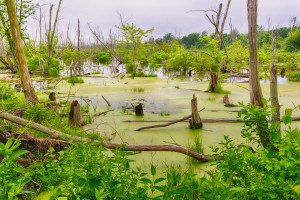 Hiking trails through the state and national parks at this time of year, I am not surprised to meet other visitors along the way. When I am seen standing with a camera poised atop my tripod, I frequently receive friendly comments and questions about photography. Folks occasionally ask directions or request recommendations of scenic places, and sometimes I strike up a pleasant extended conversation. Since summer months are commonly favored for vacations, many of the people I meet have traveled from distant locations. I have spoken with tourists from Spain, Germany, India, Japan, Mexico, Canada, and Norway, just to name some of the countries that come to mind, as well as many of the 50 states. Occasionally, I also speak with fellow Hoosiers from other counties who are visiting the Indiana Dunes for a first time. I enjoy these meetings. However, walking through the Great Marsh, I rarely come upon other hikers, even in summer. The serenity of its distinct stillness—broken only by a far-off bird call or a bull frog’s croak, maybe the flapping of a nearby Great Blue Heron’s large wings—fills my thoughts with contemplation and always reminds me of Henry David Thoreau’s observation in an 1853 journal entry that “the silence is something positive and to be heard.” When in nature, he would “stand still and listen with open ears” to “a fertile and eloquent silence.”
∼ June 28, 2019 ∼ “Early Summer Storm Washes Away Central Beach”
 As the record-setting wet weather and strong storms seen throughout spring have continued during this first week of summer, Indiana Dunes National Park has posted warnings online for visitors hoping to walk a number of trails that have been impacted by flooding. For instance, sections of the Glenwood Dunes Trail have been closed, and hikers have been cautioned about traveling in the Great Marsh, along the Portage Lakefront & Riverwalk, the Paul H. Douglas trails, and West Beach’s Long Lake Trail. The Portage Lakefront beach is also closed. However, as I have noted in past journal entries (please see my commentaries on 5/17/19, 8/22/18, 7/23/18, 4/10/18 and 3/15/18), Central Beach usually appears to be the location most noticeably affected by adverse conditions. With Lake Michigan’s current high-water level, gusting winds and large waves create a dramatic situation where the entire length of the beach is washed away, and damaging erosion of the sand dunes causes more trees to tumble down their steep slopes toward the surf.
∼ June 25, 2019 ∼ “Small Stream at Great Marsh”
 The first few days of summer have begun just as spring left off, much wetter than normal. With this year’s record levels of precipitation, waterways remain high and, in some cases, flooding has occurred. Even Lake Michigan is approaching a height not seen in recent times. When visiting the Great Marsh, located in Indiana Dunes National Park and less than a mile inland from Lake Michigan, for a hike as the new season started, I noticed an excess of rainfall has elevated the water table and unexpectedly created small temporary streams that suddenly thread through the scenery. As I captured the accompanying image, I remembered once more the original formation of the marsh happened thousands of years ago when strong waves overran the barrier sand bar and swamped the area before a recession of Lake Michigan’s level led to the development of growing dunes along the shore and isolated the inland section of wetland. Indeed, I appreciated once more how the mere year-to-year shifting of conditions allows for a fascinating ever-changing landscape.
∼ June 21, 2019 ∼ “Kayak Launch at Bailly Homestead”
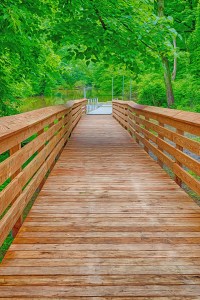 During a journal entry in 2017 (see 10/3/17), I wrote about efforts to clear the narrow Little Calumet River for easier passage by small boats. I noted that the river’s “course has recently been completely cleared of blockage from tumbled tree trunks or broken limbs for the first time in three decades after years of work from crews organized by the Northwest Indiana Paddling Association with assistance from other groups—reopened for navigating with kayaks or canoes.” To better accommodate river travelers, the Indiana Dunes National Park, with help from a grant administered by Save the Dunes, now has nearly completed construction of a kayak launch next to the historic Bailly Homestead, which appears to be an appropriate location. As I noted in another 2017 post (see 2/26/17): “…fur trader Joseph Bailly arrived in 1822 and established a trading post beside the Little Calumet River. This location offered excellent opportunity to transport goods along the river and main east-west Indian trails that crossed nearby, as well as providing proximity to Lake Michigan, just a short distance north and convenient for shipping goods to a commercial hub in Mackinac. This riverside site proved ideal for delivery of animal pelts by canoe, and the local Potawatomi tribe served as favorite trading partners, supplying pelts from various game, including beaver, rabbit, and deer.”
∼ June 20, 2019 ∼ “River Flooding After Late Spring Rain”
 As I have reported repeatedly during the past few months, this spring has been among the wettest on record in the region. Even as summer officially arrives tomorrow, the recurring rainfall has continued. Consequently, when traveling trails recently I have often found the routes impacted by flooding of marshland, swamp forests, or river waters bordering the way. For instance, in the accompanying image, the Little Calumet River has flowed over its banks, submerged the parallel path, and extended deep into nearby woods. Indeed, this week the Indiana Dunes National Park website advised hikers about rising waters overrunning trails: “WARNING: Please use caution when hiking various trails throughout the park. These trails include the Glenwood Dunes, Great Marsh, Portage Lakefront & Riverwalk, and Paul H Douglas Trails. If you still plan on hiking any other trails, we recommend wearing waterproof hiking boots and to have rubber wading or rain boots for backup. Happy trails!”
∼ June 13, 2019 ∼ “Breezy Afternoon Along East Rim Above Beach House Blowout”
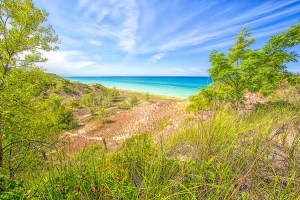 In my previous post I noted the widespread reputation of Trail 9 in the Indiana Dunes State Park, which moves through various types of landscape before rising up a steep sandy slope on the lee side of the dunes. The route includes a ridge path with magnificent views of Lake Michigan. Therefore, I thought I’d share this image photographed from a location where the trail narrows as it curves around the Beach House Blowout. Established by long-term exposure to northern winds arriving from the lake, big blowouts like this one eventually break through the dune hills. As I mentioned once before in my journal, much of the walk on Trail 9 takes place at a great height through an edge of woods lining the ridge, allowing hikers to experience cool lake breezes and offering some welcome shade on warmer days. Looking out from the eastern side, the bowl of open landscape leads toward a vast expanse of water and the distant skyline of Chicago barely visible on the horizon beyond.
∼ June 11, 2019 ∼ “Trees Along Trail Nine”
Arriving at the Nature Center in the Indiana Dunes State Park recently to mount an exhibition of my photographs for display in the auditorium, I met a group of visitors from out of state in the parking lot who asked for my advice about the various trails. During our conversation, I noted distinctions and highlights that could be discovered in a few of my favorite routes. However, my description of Trail 9 must have appeared most appealing, since the hike begins beside marshland, moves through dune woods, rises a sand hill to an elevated path curving around the impressive Beach House Blowout, and then extends along a narrow ridge with vistas of Lake Michigan. In a report rating this 3.6-mile loop as the number one trail in Indiana, The Hiking Project observes: “This is the definitive trail in the dunes. It combines hiking through mature forests and along the top of a dune ridge overlooking Lake Michigan. The views are incredible.” I snapped the accompanying image in the trail’s dune woods while helping lead a photo walk last week.
∼ June 7, 2019 ∼ “Late Morning in June at Indiana Dunes”
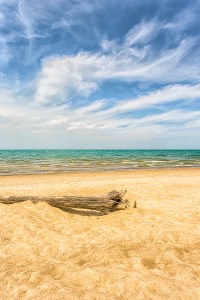 Yesterday’s heavy rain has ended, scattered by stars arriving at nightfall and then sent away. This late morning a bright sunshine illuminates the landscape extending beside Lake Michigan. I hike through an inland forest that has been transformed by new growth as spring nudges the calendar some more toward summer. Along a wooded ridge overlooking the lake, small birds are hidden by the thickening screen of leaves. Their sweet songs, subdued by distance and interrupted by an insistent hiss of surf, now sound like an intimate whisper of privileged counsel. I leave a linked pattern of footprints on the smooth slope of a sand dune, which shifts a bit with each sweep of westerly wind. Once again, I’m seeking scenery to photograph, perhaps something as simple as little waves leaving a scalloped pattern of water on the shore or one limb of darkened driftwood washed up the beach by high tide or a wispy cluster of quickly moving clouds, a few fluffy, whitening in the sunlight and hovering above a pale line of others looking like low hills filling the northern horizon.
∼ June 4, 2019 ∼ “Forest Flooding Following Spring Rain”
 During the photo hike I helped lead as a National Trails Day event at Indiana Dunes State Park on Saturday, mentioned in my previous post, those of us in the group who frequently travel along Trails 9 and 10 noticed a number of ponds unexpectedly appeared within woods lining the way. As I noted in my previous post, since last month had been the rainiest May in history throughout the region and this spring has been among the wettest ever, much of the local landscape has displayed signs of ground saturation and flooding in recent weeks. Consequently, many trees suddenly found themselves surrounded by water, their thick trunks and lower limbs mirrored amid a still pool visible between porous screens of rich green leaves. As I advised two of the children in our group with suggestions on how to snap pictures of these anomalies from nature’s normal state, I managed to capture a couple of photos as well, including this image, seemingly soothing to me and almost abstract in its impression on observers.
∼ June 1, 2019 ∼ “Start of Trail Eight in Beginning of June”
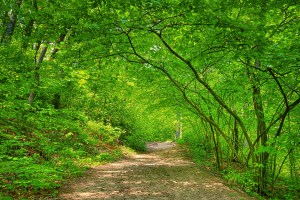 The American Hiking Society marks National Trails Day on the first Saturday of June by asking everyone to participate in an event recognizing the importance of nature trails. Consequently, national and state parks organize various activities for visitors. I was pleased to be invited to join Marie Laudeman, the knowledgeable Interpretive Naturalist at Indiana Dunes State Park, in leading a small group for a “photo stroll” on sections of Trails 8, 9, and 10. The advertised description of this activity as a “stroll” proved accurate, as those in this friendly gathering of adults and children enjoyed casually walking, talking, and observing items of interest among blossoming flowers or unique trees along the way. Since last month proved to be the wettest May in history throughout this region, I particularly appreciated the resulting lush green leaves all around us. Even vast sections of the forest that previously had been subject to prescribed burns now exhibited new growth, displaying the resilience and restorative ability of nature.
∼ May 31, 2019 ∼ “Celebrating Two Hundred Years Since Walt Whitman’s Birth”
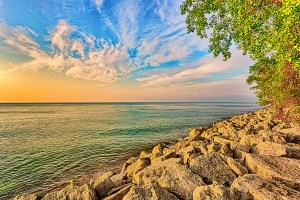 The final day of May always seems special as the birthdate of Walt Whitman, born 200 years ago (May 31, 1819). Words written by this “Father of American Poetry” have exerted great influence since the initial edition of Leaves of Grass was published in 1855. His literary example has helped guide writers toward an American Romantic philosophy that elevates to a spiritual level the natural world, parts of which he perceived in “Crossing Brooklyn Ferry” as “beautiful ministers” instructing humans. In his poem titled “Miracles,” appearing in the “Autumn Rivulets” section of Leaves of Grass, Whitman praises all aspects of nature. At one point he writes: “To me every hour of the light and dark is a miracle, / Every cubic inch of space is a miracle, / Every square yard of the surface of the earth is spread with the same….” Living on Long Island near where I was raised, Whitman regarded the sea as “a continual miracle,” and he often found beauty at “the edge of the water,” a thought I considered as I captured this late-day image of Lake Michigan in late May.
∼ May 29, 2019 ∼ “Indiana Dunes National Park Dedication Ceremony”
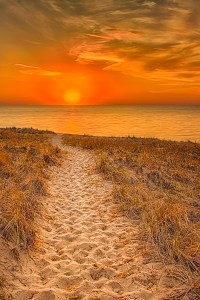 I have reported in numerous journal entries that a government resolution re-designating the Indiana Dunes National Lakeshore as the nation’s newest national park passed through Congress and was signed by President Trump in the middle of February (please see my previous posts on 3/26/19, 3/13/19, 2/25/19/ and 2/19/19). However, a dedication event celebrating renaming of the parkland was held yesterday along with a ribbon-cutting ceremony retitling the Miller Woods Trail after Paul H. Douglas, an Illinois Senator in the 1950s and 1960s who championed greater recognition for the Indiana Dunes. A number of speakers—including a few officials from the National Park Service and a handful of local, state, or federal elected politicians—recounted nearly a century of efforts by various individuals whose endeavors eventually led to this moment. Like a winding path through dune woods and marram grass onto a sandy beach along Lake Michigan, allowing at last a vivid view toward the bright circle of sun hovering above a vast expanse of water, that journey begun more than a century ago by figures with imagination and foresight has finally reached its brilliant goal.
∼ May 26, 2019 ∼ “Sun Setting Behind Approaching Storm Clouds”
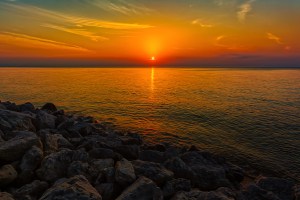 Recent weather reports have indicated that conditions between January and May of 2019 in the region have been among the wettest observed during the first five months of any year. In addition, May has broken the record for frequency of rain, since only seven days in this entire month have not experienced measurable rainfall. Consequently, my excursions hiking and photographing the spring landscape have been hampered or influenced in some ways by intermittent storms. For instance, the other evening I set my tripod beside Lake Michigan intending to capture an image of the sun setting behind the skyline of Chicago, which occurs at this stretch of the season. However, although temperatures hovered delightfully in the mid-70s with hardly a hint of onshore breeze, as the time for sunset arrived, so did a storm front with increasing winds and a low line of dark clouds visible on the opposite side of the lake, obliterating any view of the cityscape. Nevertheless, reminding myself no sunset is disappointing, I opted for this shot.
∼ May 22, 2019 ∼ “River Bend in Mid-May”
 I enjoy these bright spring days displaying suddenly stronger sunlight between a scattering of white clouds. Patches of blue skies embrace emerging green leaves filling riverside trees, riffling overhead slightly in just a whisper of wind, that insistent southern breeze bringing warmer weather. I know these river reflections will dull somewhat in summer months when the slow-flowing water darkens with muddy runoff or the greenish pigment of algae. Nowadays, I hike trails yet empty of those many tourists or vacationers who will begin arriving in a week or so, though I already notice an increase of chirping migrating birds perched in low overhanging limbs. In my mind I imagine, much the way I try to describe the transitioning landscape with precise words in my journal, these winged visitors are ardently greeting the new season in their own lyrical language. Along the way I am surprised at times by isolated splashes of yellow or red appearing like clusters of brushstrokes on an impressionist canvas, colorful flowers visible among the underbrush, some early blooms vividly acting as accents emphasizing this quick shift in scenery.
∼ May 17, 2019 ∼ “Storytelling in Word and Image”
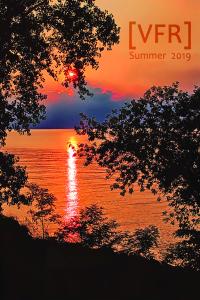 In a recent business discussion during which I explained some parameters of the Indiana Dunes project, I described my work as a photographer and a writer to be an ongoing narrative exploring the landscape of the region in a way that reveals its importance through various aspects: environmental, cultural, social, historical, political, or personal. I suggested a strength of my journal entries might lie in the blending of word and image to enable a sense of storytelling. The settings of photographs are positioned in a manner that prioritizes elements within the camera frame while also indicating what might be occurring outside the edges of the image. Likewise, the frozen scene can be viewed within a context of continuing action, perhaps as one witnesses in cinematic storytelling. Ideally, this visual evidence is enhanced by the language accompanying each picture, those composition skills developed during my lifetime as an author or as a professor of literature and creative writing. Combining the two means of storytelling also appears elsewhere, including the use of my photos as cover art for books and magazines. Therefore, I am pleased to offer this preview of the cover for the upcoming Summer issue of Valparaiso Fiction Review, scheduled to be released next week. I also invite all to view a compilation of my previous cover art for VFR at the following YouTube link: https://youtu.be/nEsFfRPlj6w
∼ May 16, 2019 ∼ “Signs of Spring”
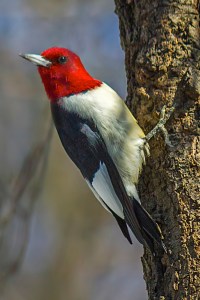 The annual Indiana Dunes Birding Festival occurs this weekend, which means I have been receiving numerous notifications from an Indiana Department of Natural Resources e-mail list to which I subscribe about sightings of more than 350 species of birds migrating through the region, certainly signs that spring is finally here. As I have noted in previous years, the alerts include various types of birds: a Golden-Winged Warbler, a Worm-Eating Warbler, a Little Blue Heron, a Least Bittern, a Nighthawk, a Willet, a Trumpeter Swan, an American Avocet, a Laughing Gull, a Clay-Colored Sparrow, a Snowy Egret, a Red-Throated Loon, a Mourning Warbler, a Lark Sparrow, a Connecticut Warbler, a Black-Throated Blue Warbler, a Western Tanager, an Olive-Sided Flycatcher, and many others. A rich diversity in the local terrain—marshland, swamp forests, woodland, dune hills, bogs, fens, prairie, rivers, sandy beach, and lake shore—provides perfect habitat for hosting winged visitors.
∼ May 14, 2019 ∼ “Spring Green on Trail Nine”
I like hiking wooded trails in the Indiana Dunes when those bare trees observed throughout winter finally begin to add a bit of green in spring but leaf cover is still thin enough that the skeletal structure of dark limbs remains visible. For a brief time, the seasonal transition becomes apparent, and any image viewed in the present seems also to capture glimpses of details suggesting lingering traces of the stark past as well as indications hinting at a future of flourishing color. As I have noted in other journal posts, the weather conditions thus far this year have been colder and rainier than normal, significantly delaying the arrival of full foliage sometimes seen by mid-May. In fact, as I walk Trail Nine in the Indiana Dunes State Park, I discover many of those trees deep within ravines between dune hills continue to be mostly leafless. However, as I pass where more sunlight usually strikes this path and it rises toward a ridge overlooking Lake Michigan, I witness a rich green fringe among limbs arching overhead, as if evidence of a gesture by nature to offer a welcome that brightens my way.
∼ May 9, 2019 ∼ “Fallen Tree Across River”
 As I hiked a slim trail along the Little Calumet River, I noticed a number of trees had toppled during winter months and deadfall of numerous fallen limbs littered the landscape. When I reached a bend in the narrow river where it turns from the south toward the west, I came upon a location where the current was impeded by a freshly fallen tree lying across the width of the river. The trunk already had been one of the many leaning toward the waterway on a steep southern bank, and I could see where the roots had loosened apparently due to overly saturated ground caused by repeated heavy rains or recent flooding. Although this mostly sunny day was calm and clear, and the flow of the river had slowed to a point that the surface seemed still, I knew more storms were forecast for later in the afternoon, and I imagined I would witness further damage to weaker trees in the riverside woods the next time I return.
∼ May 7, 2019 ∼ “Receding River”
 After last week’s steady stretch of storms offering repeated deluges of rain, much of the region’s landscape seemed saturated. Various tributaries experienced flooding, and the flow over river edges sometimes left inundated adjacent lands under feet of water. However, weather conditions finally dried during the weekend as skies cleared and temperatures moderated. Consequently, flood levels in local streams or rivers at last began receding, and I took advantage of the opportunity on Monday to hike a trail bordering the Little Calumet River that apparently had been submerged just days ago. Though some sections of the narrow path were still spotted by puddles or thick with mud, the depth of the river had lowered significantly and the current was contained within its banks, which were now displaying an array of trees and underbrush suddenly bright with the initial stages of spring growth, those rich greens of new leaves beginning to fringe upper limbs and fill shrubbery.
∼ May 4, 2019 ∼ “Nature First”
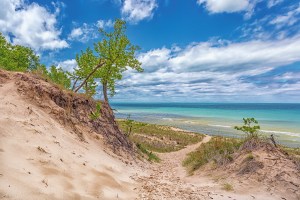 Marking the celebration of Earth Day two weeks ago, numerous photographers stated their support for seven principles of ethical behavior released by a coalition of concerned individuals under the title Nature First: An Alliance for Responsible Nature Photography. In the belief that some “nature photographers are increasingly becoming a liability for the beautiful environments they cherish and photograph,” the photographers committed to abide by the guidelines, which include the following: “1. Prioritize the well-being of nature over photography. 2. Educate yourself about the places you photograph. 3. Reflect on the possible impact of your actions. 4. Use discretion if sharing locations. 5. Know and follow rules and regulations. 6. Always follow Leave No Trace principles and strive to leave places better than you found them. 7. Actively promote and educate others about these principles.” This movement is an outgrowth from the rules of behavior recommended by Leave No Trace Center for Outdoor Ethics, which I already explored in my essay, “Landscape Photography: Ethical Engagement in the Environment,” released last June and available on my Articles page.
∼ April 28, 2019 ∼ “Footprints in the Sand”
By late April, each spring sunset beyond Lake Michigan seems to draw more attention, even the less dramatic ones. As the position of the sun steadily slides north toward the skyline of Chicago, its location becomes more prominent and its influence on the coloration of the lake appears greater. In addition, although the daylight weather gradually warms during this section of the calendar, many evenings may remain fairly chilly, if not considered cold, temperatures sometimes dipping into the thirties, possibly with an occasional snowfall. Consequently, when I set my tripod to capture an image of the setting sun, any visitors who walked the beaches all afternoon likely have departed, leaving behind strings of footprints threading through the sand. Normally, I will find myself distracted by such a series of imperfections in the smooth stretch of shoreline and crop my photographs to omit them. However, perhaps their presence more accurately portrays the split personality of the surroundings in this season, active during the day and abandoned by the time twilight arrives.
∼ April 19, 2019 ∼ “Good Friday Memory”
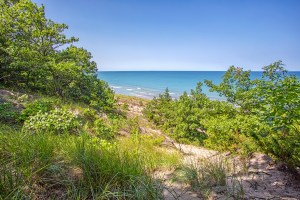 I have noted in posts during previous spring seasons that my affection for the landscape of the northern Indiana shoreline exists beyond the various obvious levels I repeatedly highlight in journal entries, including appreciation for the natural beauty, cultural history, and environmental importance of the area. I also hold a personal and compelling emotional attraction to this region, especially for the sandy narrow paths that stretch through woods along a ridge above Lake Michigan, where Pam and I walked during our first date 35 years ago. As I have mentioned elsewhere, Pam and I spent that visit to the Indiana Dunes hiking high above the beach on April 20, which happened to be Good Friday. During that clear and warm afternoon, we could look into the distance across calm lake water to see a sun-brightened outline of the Chicago skyline. In fact, that spring seemed milder than most, flowers had begun blooming and the trees were filling with rich foliage. With the brilliant new season in evidence displaying such a promising view, that day seemed a perfect metaphor for the start of our relationship.
∼ April 17, 2019 ∼ “Spring Winds at Central Beach”
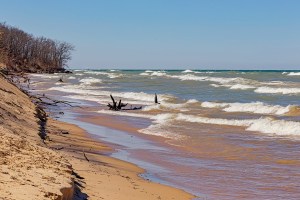 After spring storms slide by the northern Indiana shores of Lake Michigan, clouds clear quickly but swift onshore winds often continue for a day or two. Stretches of shoreline along the Indiana Dunes are swept away by a high and turbulent surf that undercuts accumulations of coastal sand, slicing wide strips of the strand. Erosion seems even more evident where the beach bends, its curves appearing vulnerable to being shaved by waves approaching from any angle. This afternoon much of Central Beach lies submerged beneath a few feet of water, and the way ahead—east or west—remains impassable. Therefore, I walk the loose sand on a high dune ridge parallel to the lake and take a photo of the seasonal damage, including fallen trees with roots that had been weakened by winter weather, now sliding down carved sand dunes, some limbs gathered as driftwood at the bottom by a rush of incoming current.
∼ April 14, 2019 ∼ “Introducing the Indiana Dunes”
 I had the pleasure of offering a presentation about landscape photography on Saturday afternoon in the auditorium of the Indiana Dunes Visitor Center. I had been invited to introduce the natural beauty of the area, including the newly designated Indiana Dunes National Park, and to explain how it inspires the artwork evidenced by the photographs and writings in my ongoing project. As I displayed sequences of my images on a large screen, I discussed basic approaches to taking pictures, including various theories of composition, influences of weather or seasonal conditions on selections of locations for photo hikes, and specific techniques or tips for optimal camera settings. For those in attendance who were from outside the region, I shared favorite views and recommended a number of scenic spots along trails or beaches in both the state and national parks. However, as I concluded the hour-long program I also found myself reminded once again why I enjoy engaging in these activities among the many appealing places in this environment along Lake Michigan.
∼ April 6, 2019 ∼ “April Afternoon Abstract at Indiana Dunes”
 When walking a trail through dune woods on a ridge running along the coastline only about one week into April, I already can hear the high-pitched songs of small birds have begun returning to the otherwise empty upper limbs of these tall trees. Today, the lake has been quite calm under a clear sky. Even the long thin leaves of marram grass in the foredunes have stopped their rhythmic swaying. A strengthening spring sunlight shines on the sandy shore and illuminates those still waters beyond in differing tints of green or blue. A couple of narrow sandbars appear nearby, barely peeking from under that shallow depth beside the beach. The bright daylight seems to softly paint everything in pastel shades. Capturing the view in an abstract photograph displaying gradations of color, as I sometimes do, I am reminded of an observation by Paul Cezanne, who noted that “nature is more depth than surface, the colors are the expressions on the surface of this depth.”
∼ March 31, 2019 ∼ “Beach Tree with Broken Branches at End of March”
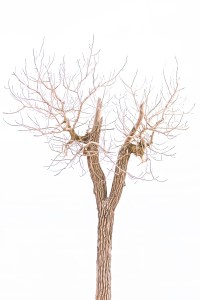 The start of spring offers warmer weather and an opportunity to view scenes at more remote locations difficult to visit in the midst of winter snow or when trudging through thick summer overgrowth. Indeed, the end of March and first few weeks of April particularly allow for photographing images at various spots normally out of reach or hard to capture during my hikes in other seasons. I especially appreciate taking deceptively simple pictures displaying chaotic networks of extended thin limbs on trees most vulnerable to damage done by gusts along the coast, some survivors with bare branches broken by those strong onshore winds during wintry storms. Stretching sharply against the blank backdrop of an incoming fog or a pale overcast of cloud cover, each seemingly expressive example appears aesthetically pleasing, perhaps like a carved work of art with the deep ridges etched into bark on its trunks also exhibiting a greater sense of texture.
∼ March 26, 2019 ∼ “Anticipating Spring and Summer at Indiana Dunes National Park”
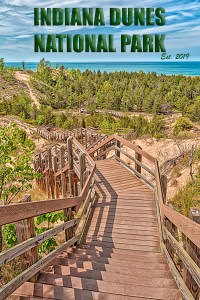 After the federal government re-designated the 15,000 acres of Indiana Dunes National Lakeshore as Indiana Dunes National Park on February 15, I noted in a journal post (Feb. 25) that the action “fulfilled a dream held by a number of activists and artists who organized at the start of the twentieth century to initiate state and federal conservation measures.” Additionally, as I had predicted in various previous entries, this change in status resulted in greater publicity and promotion of the location. In fact, the local Northwest Indiana Times newspaper quoted Lorelei Weimer, Indiana Dunes Tourism Executive Director, as reporting that initial press coverage resulted in the news reaching “an estimated 72 million to 76 million people, generating an estimated $750,000 in free advertising.” When the weather warms during spring and summer, I expect to witness evidence of increased interest in visiting the nation’s 61st national park, and I will be curious how much this transformation will enhance the area’s already healthy tourism economy.
∼ March 20, 2019 ∼ “Spring Light Arrives at Indiana Dunes”
 With the arrival of spring today, I am reminded of my appreciation for specific characteristics of daylight, particularly at this time of year as the lengthening of hours and intensity in brightness of sunshine begin to increase at the Indiana Dunes. I have frequently written about the importance of perceiving different types of light when capturing images with a camera. In fact, I have repeated a well-known quote by George Eastman a few times in past journal posts (please see my entries from May 28, 2017, July 10, 2017, and May 31, 2018): “Embrace light. Admire it. Love it. But above all, know light. Know it for all you are worth, and you will know the key to photography.” Perhaps the significance in regarding illumination of the landscape is best recognized and emphasized when the seasons shift and a differing angle of sunlight creates a transformation in the overall tone of a certain location. Although the returning green leaves of trees and the colorful blooms of flowers are weeks away, a noticeable change in daylight has already occurred.
∼ March 18, 2019 ∼ “Sandhill Cranes at Great Marsh in March Snow”
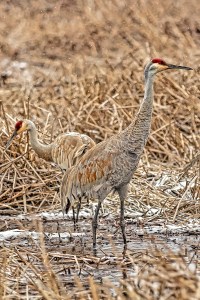 I follow a path through underbrush—dried, brittle, and bristly with late-winter decay. One or two trees exhibit a few lingering leaves withered and yellow, all around now also flecked white with flakes from a light late-season snowfall that appears to muffle even more any sound drifting from the turbulent surf of Lake Michigan somewhere in the distance, perhaps less than a quarter mile away. The dark water of this Great Marsh, frozen so long, has thawed, and it ripples with every shift of wind gust. The day has grown slate gray as the sky’s cloud cover seems roughly brushed by a fresh layer of flat paint, pale and dull. When I step around a bend in the trail, I suddenly hear loud and distinctive bugling from a pair of sandhill cranes blending with their background—one bending to walk away, each nearly four feet tall and merely a few yards in front of me—calling as if to offer a warning, whether to me or to one another appears unclear.
∼ March 16, 2019 ∼ “Remembering W.S. Merwin”
 News arrived yesterday about the death of W.S. Merwin at the age of 91 in his home near Haiku-Pauwela, Hawaii, a location he loved. I remember Merwin as someone from whom I have been guided in an affection for language and an appreciation of nature, a couple of characteristics I hope continue to be evidenced in my writing about the Indiana Dunes. Merwin’s works were among my first and most significant influences as an apprentice poet. I had the pleasure of meeting and speaking with him at various times, including his initial kind and supportive words during a conversation soon after he’d won his first Pulitzer Prize more than forty-five years ago when I was introduced to the author by my teacher, Mark Strand, at the Gotham Book Mart in New York City, a few blocks from where I worked. I regularly visited to browse new titles of small press publications at the legendary store—where I would later attend a reading by Merwin and where a reception would one day be held upon release of my own debut book of poems—and to this day I often associate Merwin, whom I also consider legendary, with my treasured memories of that bookshop. More importantly, however, I am indebted to him for the early encouragement, and I think of his excellent example whenever I use my own carefully chosen words to express admiration for the natural world.
∼ March 15, 2019 ∼ “Shelf Ice Breaking Away”
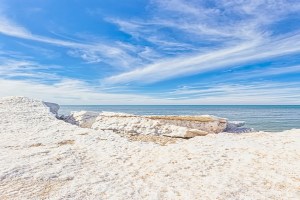 Beneath the stubborn influence of a strong southern breeze, this week’s temperatures slowly rose into the sixties, and the remaining fringe of shelf ice around the lake finally started to break away from this curving coast. I have repeatedly seen how the lakeshore reshapes itself in each season. I walked the length of the beach at the Indiana Dunes State Park on an early afternoon, listening to collapsing bits of ice as they split from the shoreline to slip into the blue water below. I also witnessed solid bits of old snow buildup as they fell from the edges of sand mounds along the surf, forming a drifting flotilla of small white bergs floating not far offshore, every one bobbing gently in the sway of tiny waves. Bright sunshine hastened the thawing, creating a melting process with strengthening rays angling across the landscape, perhaps indicating an end to winter was at last drawing near as the sun’s intensity already was beginning to resemble spring light.
∼ March 13, 2019 ∼ “Celebration of Re-Designation”
The Indiana House and Senate celebrated today a recent re-designation of the 15,000 acres that comprised Indiana Dunes National Lakeshore as the country’s newest national park. Through a concurrent resolution (HR 32) the state’s two legislative bodies applauded the action by the federal government. In doing so, the lawmakers recognized completion of a protection and preservation plan for the Indiana landscape along Lake Michigan that started with activities by environmental activists or artists early in the twentieth century but has taken over one hundred years to achieve. (Please see my journal entry of Feb. 25, 2019.) Although the transition in status was made official just less than a month ago (Feb. 15) and visiting the grounds this week I noticed entrance signs have yet to be updated, I constructed this postcard photograph of a view I captured from atop Mt. Baldy, an iconic image of the new national park, as my way to celebrate the occasion.
∼ March 12, 2019 ∼ “Shelf Ice, Selfishness, and Selflessness”
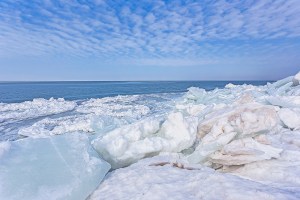 As I mentioned in my previous entry, the past weekend brought dramatic changes in weather patterns and an apparent end to wintry conditions in the Indiana Dunes, so I sought to snap a final few shots of shelf ice on Friday. With thawing and initial signs of the approaching spring one can also anticipate an increase in attendance at the state or national parks. When temperatures dip to zero or below, the terrain is covered in snow and even the surface of Lake Michigan is frozen; therefore, much of the time I find myself alone as I photograph the frigid scenery. Like most landscape photographers, I must acknowledge a certain selfishness, enjoying isolation in nature and an opportunity to capture images without the distractions caused by visitors. Nevertheless, I know my photos and those of others serve to popularize locations we feature in our pictures. Indeed, I actively advocated and promoted the recent designation of Indiana Dunes National Park in order to advance exposure to a wider population. Consequently, I look to the selfless example of early activists and artists who discovered the allure of this region yet shared its celebration, some even sacrificing their own properties to protect and preserve the environment for public use by all.
∼ March 10, 2019 ∼ “Shoreline Shelf Ice”
 This weekend began with a distinct shift in winds and warming weather conditions; therefore, I wanted to photograph whatever wintry images lingered along the Indiana Dunes while they still existed. Indeed, the Midwest forecast called for rising temperatures and heavy rain by Saturday. In addition, with the upcoming time change scheduled for Sunday, which would create later sunsets, I certainly felt the winter season slipping away. As I arrived at the lakeshore near noon on Friday, the skies remained totally overcast with a solid ceiling of slate gray. Although Lake Michigan no longer appeared completely frozen over, sheets of white ice floes covered much of the horizon and the shoreline was yet fringed with thick shelf ice. Having checked the precise hourly predictions on my computer app, I set my tripod by the beach and patiently waited for sunlight with a clearing expected about one o’clock, and I listened to a persistent sound of thawing, the consistent cracking and constant popping of melting ice all around me.
∼ March 8, 2019 ∼ “Beach Tree Before Fog Above Lake Michigan”
 When I arrived at the waterfront of Beverly Shores along Lake View in the Indiana Dunes National Park, I was surprised to find an approaching line of lake-effect snow with a white-out of wind-blown flakes and the whole coast already mostly enclosed by haze. Despite a steady northwest wind that normally clears the air, visibility had diminished to no more than a couple hundred feet offshore. However, I consider this type of winter setting an ideal scene for specific types of images, especially those favorites of mine that include bare trees beside the beach. With the pale background of clouds from low overcast skies, the gauze of incoming fog, and frost-smoke rising from an expanse of ice-covered water, the bent trunks and twisted limbs extended dramatically in contrast like attractive elements of a metal sculpture surrounded by white walls in an art gallery.
∼ March 6, 2019 ∼ “Beach Trees Beside Frozen Lake Michigan”
 With yesterday’s blue sky now shut from sight by a new line of low clouds rolling over a frozen Lake Michigan, a light snow still falls in the distance. I walk alone along a white beach with its tan sandy strip mostly hidden beneath a stretch of shelf ice. Moving within the murmur of an onshore breeze, I admire the twisted forms of empty trees, almost silhouettes with rich brown bark and dark shadowless limbs bent in different directions by years of wind and sun. Some trunks are bunched beside the shoreline like a small herd of animals who huddle their bodies together against intermittent gusts during colder weather. Although already early March, the absence throughout this scenery seems stuck in one of those midwinter months when each overcast and snowy day arrives like a turning of the next pale page in a blank notebook.
∼ March 4, 2019 ∼ “Chicago Skyline Emerges from Cloud Cover Beyond Frozen Lake Michigan”
 The start of March 2019 in this section of the Midwest might be the coldest on record. According to regional weather reports, in many places Monday exhibited the coldest high temperature ever for any March day, and wind-chills dipped to twenty below zero or worse. A frigid front caused by northern winds flowing over Lake Michigan had brought a series of lake-effect snow squalls during midday Sunday, and visibility was reduced to nearly nothing while white-out conditions existed. Eventually, the heavy haze and thick cloud cover slowly lifted, revealing a vast expanse of white as the lake water had once again frozen over. I was standing in the midst of strong gusts on the beach at Indiana Dunes State Park when the skyline of Chicago suddenly began to appear in the distance, seemingly connected to this Indiana shoreline thirty-four miles away by the immense layer of ice cover extending between the two stretches of land.
∼ March 3, 2019 ∼ “Winter Lingers a Little Longer”
 An old line of contrail widens as it crosses among a few remaining clouds in a clearing noonday sky. A slight westerly wind silently rides the air current winding through those openings in bare upper limbs of trees along the riverbank. Earlier, I watched a hawk circle effortlessly over the frozen water then slash toward the north until out of sight. According to the meteorological calendar, spring started on the first of March. Nevertheless, the long-range weather forecast calls for colder temperatures, perhaps with record lows, and more light accumulations of snowfall day after day into the near future. Despite this morning’s bright sunlight following an overnight squall, a persistent chill still lingers in the region, and in some places a thin layer of white continues to cover the landscape. Astronomical spring officially begins to bring its transition in less than three weeks, but today the end of winter certainly appears to be a bit more distant.
∼ February 28, 2019 ∼ “Photography at the End of February”
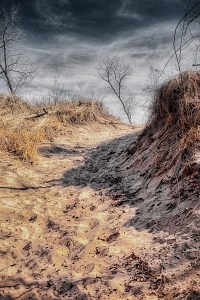 I find the end of February and the start of March to be among the most difficult portions of the calendar to capture attractive landscape images in the Indiana Dunes region. By this time of year, notwithstanding a bit of milder temperatures, many days remain somewhat cold. Therefore, even as winter is beginning to give way to spring, the colorful signs of life with budding branches or blooming flowers are still distant. Although most, if not all, accumulations of snowfall and shelf ice have disappeared, the damages to the land done during the past few months by northern storms, wind gusts, and erosion—those effects that had been camouflaged by smooth white snow cover—become evident, and the lingering stark silhouettes of leafless trees with trunks of damp bark contribute to a darker mood throughout the area. Despite the lengthening span of daylight hours, much of the weather continues to display gray overcast skies usually appearing gloomy or offering an ominous tone when viewed in photographs.
∼ February 25, 2019 ∼ “Preserving the Indiana Dunes”
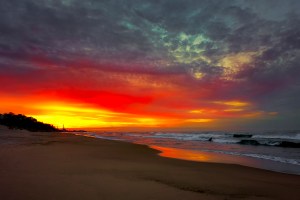 The designation of Indiana Dunes National Park ten days ago fulfilled a dream held by a number of activists and artists who organized at the start of the twentieth century to initiate state and federal conservation measures. These individuals exhibited the foresight needed to protect and preserve a crucial band of land beside Lake Michigan. They recognized the threat of expanding manufacturing sites along the coastline on both the eastern and western ends of the Indiana Dunes that eventually could eliminate this natural environment rich with a diversity of distinctive features. Indeed, smokestacks of factories are still visible from beaches within the sanctuary. Whenever I photograph images of the shore, I almost always arrange my wide-angle compositions in a way that excludes such intrusive elements from inside the photo’s frame to retain a sense of untainted scenery. However, on occasion I will allow the lingering signs of industry to show on the horizon, as in the accompanying picture, like tiny reminders of the encroachment that would have occurred without those efforts begun over 100 years ago.
∼ February 22, 2019∼ “Iceberg at Kemil Beach”
 It seems the beam of a balance already has been tilted as winter proceeds toward spring. This morning, with weather conditions and temperatures continuing to fluctuate in the Midwest during the last half of February, sections of the accumulated shelf ice begin to separate from the land and wander offshore like tiny icebergs. As parts of the once-frozen lake thaw, some larger segments of the formations that have detached from the coastline float and bob among other smaller remnants that surround them like a sheet of shaved ice. I photograph one example, about 35 feet wide and 15 feet high, drifting beneath bright sunlight a few hundred feet from Kemil Beach of Indiana Dunes National Park. In the distance a thin white line of horizon displays places where the water yet remains under a receding solid snow cover.
∼ February 19, 2019 ∼ “Marking the Start of Indiana Dunes National Park”
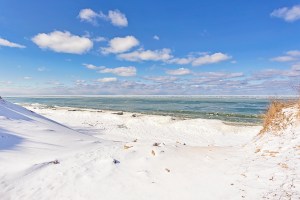 Following reports on Friday that the naming of Indiana Dunes National Park had become official. I decided to visit the lakeshore Monday after morning snow and photographed frozen Central Beach under brightening skies within the newly-designated land. Art critic, painter, and poet John Berger, in response to reading Susan Sontag’s classic yet controversial On Photography, once declared: “What makes photography a strange invention is that its primary raw materials are light and time.” I remain conscious of this well-known quote whenever I press the button on my shutter release to preserve a scene during a specific occurrence. Indeed, the mechanism’s speed determines how much exposure a subject receives and to what degree or how distinctly a moment is stilled forever. However, as Berger correctly concludes, “unlike memory, photographs do not in themselves preserve meaning.” In fact, often images like this need to be seen within the context of circumstances or under influence of the written word to be imprinted in the mind with significance.
∼ February 11, 2019 ∼ “Swamp Forest Notes Following Snowfall”
 Yesterday’s crowd of thick clouds slid easily across the sun and all about me became a landscape shaded in vague gray, its features fading away toward shapelessness, but today’s clearing brought new details of imagery to record. Like my literary inspiration, Henry David Thoreau, I try to think of the right words to write tonight, random reflections again collected in this notebook. Bare branches that still had been masked by lingering fall foliage merely a couple months ago have nothing left to quiver in an increasing wind. After brightening afternoon skies, a low but luminous glow sifts through the bare branches to create narrow shadows. Splotches of sunshine surround silhouettes of limbs beneath these leafless trees like the white space around scrawled letters on a lamplit page. Inhaling this chilly air brought from the north, I then watch the steam of my exhaled breath lift and scatter, dissipating like those pale wisps of smoke drifting overhead upon dousing of a summer campfire with a bucket of water.
∼ February 4, 2019 ∼ “Mid-Winter Light Before Thawing”
 I’ve arrived in time to photograph this snow-covered scenery before the predicted thawing begins. Afternoon sunlight filters between threads of thin clouds scattered and stretched like white fibers in this winter sky. Yesterday’s continuing chill still lingers a bit, although I know weather reports call for the weeklong cold spell to end by nightfall, when these strong northern winds will settle a while, then switch to a southern current, offering a warmer morning tomorrow. Each dawn during this season seems to release a new view—every day a different configuration of drifting clouds, an unceasing variation in the angled slant of sunlight sketching stray silhouettes of leafless trees, a fresh movement of shifting snow among the sand dunes, and maybe a sudden addition of sodden driftwood peeking through the gleaming slickness of shelf ice along the shore. In moments like this, even the faint shadows of bare branches scrawled across the frozen surface of lake water seem like an artistic design formed by long brushstrokes.
∼ February 2, 2019 ∼ “River Trail Bridge in Winter”
 As I hike toward the north, a cold landscape unfolds in front of me, this river path snow-covered and thinning in the distance until the trail appears almost as narrow as its printed line on the park map. All along the way seems edged with pallid elements emphasizing winter’s absence of vivid color—the pasty-gray shadows of empty trees, pale packs of frozen flow, withered undergrowth layered by a shiny glaze of ice, and a tiny footbridge with handrails whitened by last night’s light snowfall. Beneath a sky tinted blue and reflected by a slim ribbon of water, the treetops and most of the upper limbs still sway slightly, tilting a bit in decreasing winds following the exit of yesterday’s storm. I stop just for an instant, listen again for the lost language of summer—perhaps a pleasurable narrative of nature, that soft far-off song with imagined lyrics sifting through these dune woods from a couple of birds hidden in foliage. Instead, today only a lone woodpecker’s intermittent rhythm of staccato tapping provides any sound.
∼ January 31, 2019 ∼ “End of January Cold Spell”
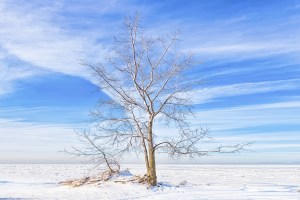 Like all sorts of noise muffled by the snow-covered landscape, the whoosh of wind gusts now seems more like indiscernible words of a sentence spoken too softly or perhaps hissed in a sibilant whisper. Though early winter’s weather had been milder than most, a record cold front with pockets of frigid air has quickly drifted into the region at the end of January. With temperatures falling well into double-digits below zero and wind chills of -50 or lower, the recent accumulation of snowfall has developed a thin coating of ice. Its slick crust crunches and crumbles underfoot and colors my black boots with slim smudges looking like white chalk marks when I make my way along a wooded trail winding north toward the lake edge, where I eventually see a beach tree extends its twisted limbs before the vast expanse of frozen Lake Michigan, and I notice the deceptive impression of warmth brought by bright sunlight descending from a sky suddenly veined with wispy clouds.
∼ January 29, 2019 ∼ “Frozen Lake Michigan”
 Following a period of snow squalls, storm clouds clear and northern winds move inland from Lake Michigan. At times the cold becomes uncomfortable for some with crisp temperatures dipping into single-digit figures or below zero. Walking through woods toward the coast, I hear sporadic clicking in the tangled snow-coated limbs and crackling on ice-covered ponds in this deep freeze, splintering a serene silence otherwise broken only by the crunch of my footsteps on the crusted trail. When setting up my tripod in the middle of bright light, I consider the false appearance of warmth such sunshine brings. I photographed this beach scene just last week when waves still crashed onshore (see my 1/24 entry); however, in the past few days Lake Michigan finally has frozen over. Nevertheless, I know the clear air of a winter afternoon with low humidity usually seems to sharpen the focus on images in photographs, perhaps presenting one welcoming gesture from nature and offering a reason to remain in such frigid conditions.
∼ January 27, 2019 ∼ “Ice Forming on Beach Tree”
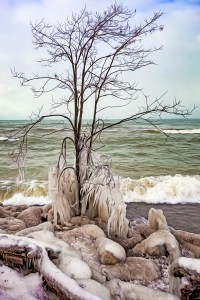 Each season I see beach trees, large or small, with branches broken under the weight of ice in cold weather, their roots exposed by erosion, or split trunks toppled in brisk winds. Even the strong summer sun sometimes seems to take its toll. Whenever I find one alone, increasingly frail and vulnerable to those elements at the edge of the lake, I make a note to return in the future to follow its fate. Today, brightened only by the indirect white light typically evident in winter when almost everything is covered in snow and dulled by a mostly overcast sky of low clouds hovering above like a pale sheet, I stood and watched the windswept waves swell, erasing whatever buffer of beach sand had remained. The turbulent surf started to surround this tiny resister, survivor thus far of so many recent storm surges, and coated the rocks or driftwood around it with a thickening ice glaze. Already the lower limbs were bent and encased in drooping icicles, oddly attractive—maybe artistic—despite the danger of permanent damage they represented.
∼ January 24, 2019 ∼ “Path to Lake in Winter”
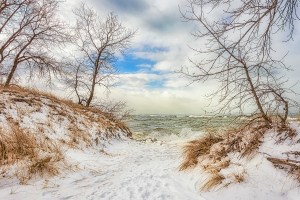 The slow shift of winter weather continues. Last evening’s northern breezes brought a cold front over the coast, and by this morning those stunted tufts of grass seen beneath bared branches of trees seemed to be decorated anew with beads of ice. Earlier, I hiked a winding trail through woods leading to a tall dune. As I arrived at a rise toward a narrow shelf overlooking Lake Michigan, I leaned into the steep slope with each step, and then I descended a sandy path layered with fresh snow. I’d like to think those distant clouds I witness drifting above the horizon beyond today’s turbulent waters and the wind-driven waves regularly breaking into white lines along the shore are more metaphors than just signs of nature’s adjustment to the season. I listen to the steady surge of surf breaking below me as if timed to a metronome. Patiently waiting awhile beside my tripod for the right alignment of sunlight shining through a blue opening in the sky between the tops of two empty trees, I hope my camera can accurately capture such a moment.
∼ January 22, 2019 ∼ “Lake Waves Before Approaching Storm”
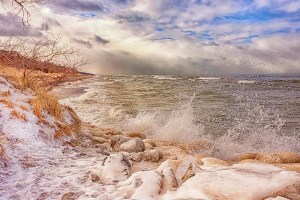 As the wind direction shifted during the day and began to blow over Lake Michigan from the north, suddenly bringing a surge of colder air, files of dark clouds started to form offshore. In the distance, a squall line of lake-effect snow approached, already blotting the horizon. Pale ribs of breaking waves still illuminated by fading sunlight extended the length of the shore while a churning surf washed away much of the nearby beach. Standing between a pair of bare trees on a small rise beside the lake, where frozen water and last night’s snowfall cloaked stones or covered sand, I planted my tripod legs through the thin glassy surface of white ice atop a shallow pool created by repeated sprinklings of overflow, and I continually wiped drops of spray from the front of my lens with a microfiber cloth. I watched as light blue skies gradually gave way to a gray overcast, hoping to capture in a photograph nature’s marvelous state of chaos that seemed to be erupting along the whole coastline.
∼ January 20, 2019 ∼ “Creek Under Snow in January”
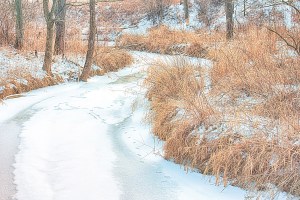 The morning’s winter province was thickened by clustered little crystals of frost here and there, decorating the dark bark of bare branches or burdening tall stalks bending in the underbrush. Following a swiftly moving early storm cleared by northern currents, only a caravan of slow clouds, seemingly stitched to one another in a long line, now drift across the countryside. I appreciate the way this day’s sifted soft light leans weakly over the landscape from the southern sky and seeps through the dune forest as if filtered by these empty trees. A line of animal tracks dots a shallow accumulation of snowfall along this creek, today mostly hidden beneath a thin skin of ice. Here, where I’ve sometimes seen deer dip their heads to drink, I notice tan tufts of growth—lengthy blades of grass that appear to flow in ripples with every sudden gust of wind—still show through the fresh snow and add a bit of color. Although I am alone with no one else present to witness this simple image or to listen to me, I find relating such details afterward in my notes helps define why I like to walk this course in colder weather.
∼ January 18, 2019 ∼ “Almost a Month into Winter”
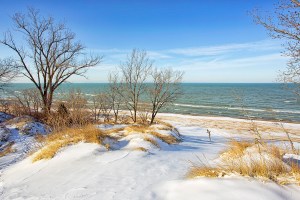 This morning’s short snowstorm has passed and a lingering icy mist has at last lifted as a couple of gulls just off shore rise and wheel above, gliding like white kites swiftly dipping into an insistent wind. I watch those birds whirl overhead as if fully enjoying their challenge, making the most of the situation and never settling for less. Almost a month into winter, a gap in dune hills opens to the beach below the trail where I walk. Although only a little bit of chill can be detected in the air current right now, weather reports suggest a stronger storm arriving from the north will soon take away any opportunity for sighting of the moon and stars. Local forecasts also offer advice about sub-freezing temperatures continuing and warn of additional accumulations of heavy snowfall totals by this time tomorrow. I was once wisely told by my father that a frigid cold invigorates the soul, as evident in each visible cloud of breath exhaled; therefore, one must appreciate whatever type of day we’ve been given.
∼ January 16, 2019 ∼ “River Trail After Clearing Skies”
 This cold front in the middle of January drags frigid north winds behind it. Long leaves of weeds among the underbrush where I walk have withered in the wintry weather. Nearing a bend, I see scores of fallen limbs that have littered the waterway. Branches of one empty tree with roots that I remember had been loosened during spring flooding are leaning out far over the river trail and appear to point ahead, as if coaxed forward to greet me and to offer guidance. I notice an old nest of twigs and reeds seemingly threaded together, a forgotten remnant of summer, embedded in a dead trunk almost wholly hollow, and I imagine it once sheltered some small and scrawny animal that worked to braid those bits and pieces. Today, the ground beneath my boots appears to be nothing but hardened mud and damp sand covered by a dusting of day-old snow. This morning’s heavy layer of gray skies finally gave way to a wide clearing of light blue tattooed with only a few little wisps of white clouds already disappearing in the distance.
∼ January 14, 2019 ∼ “Dudley Beachfront After Overnight Snow”
 This place (please see yesterday’s entry) often feels sacred, especially when illuminated by late daylight in the middle of January, so I return. The lake’s waves seem almost luminous as they ripple and glitter under sunlight, perhaps like a vivid vision seen in someone’s dream. Today, though the air may be cold and light overnight snow covers the coast, the influence of winter’s frigid figure diminishes amid such brilliant sunshine. The easterly breezes blowing this afternoon are rare most of the year. A few clouds—tiny, white, and wispy—slide easily before the distant hinge of the horizon, lazily chasing one another above nature’s straight-line crease. Most folks don’t know the significance of this location. Sometimes, even I must remind myself this is the scenery Frank Dudley once would watch with paintbrush in hand from his wide cabin windows on a sandy bluff among those foredunes just above the beach. Frequently, I like to imagine his little building is still there among the marram grass, a squat and squared structure tucked under the hillside rising behind it.
∼ January 13, 2019 ∼ “Dudley Site in Mild Winter Weather”
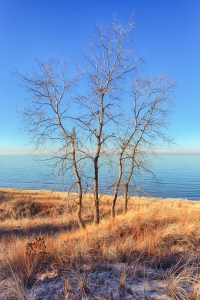 I have frequently written about my indebtedness to artist Frank V. Dudley, “The Painter of the Dunes,” for inspiration and influence when I photograph scenes among the Indiana Dunes. My journal notes repeatedly report about Dudley’s history during the first half of the twentieth century as an environmental activist who sought to protect and preserve this landscape along the southern coastline of Lake Michigan. His images of the region served to remind all about the beauty found in the Indiana Dunes and were persuasive in depicting the importance of this habitat. Consequently, I often visit the site along the beach where I’ve discovered Dudley’s famous studio once stood, a cabin that had been situated on a dune mound facing the Chicago skyline across the water and had been removed like all other structures when the land was returned to its natural state. Last week, when the weather warmed considerably for winter, I again hiked to the location, now merely a nondescript bluff with a group of young trees growing among blades of marram grass, but perhaps appearing very much like a setting in a Dudley artwork.
∼ January 8, 2019 ∼ “Traveling Trail Seven Toward the Shore”
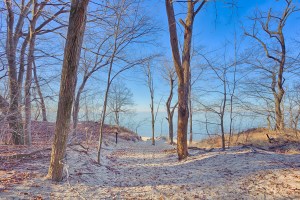 Soft topsoil mixed with damp sand crumbles and slides backwards under every boot step, and a couple squirrels scatter through these woods, startled by a shuffling noise as I slowly rise the final incline of Trail Seven toward an overlook of the lake. Along with an unusual lack of cold for this time of year, a golden flow of afternoon sunshine seems to glow on the trunks of trees now almost ghostly with their limbs at last free of all autumn leaves. The light from such a bright sky allows a faster shutter speed, but I will still follow ritual and level my tripod for each shot I take. I know I’m close to the coast—only a few hundred yards away—when I notice a lone gull circling momentarily in the distance, its white wings angled and luminous, before it descends once more toward the beach. Since I’m yet sheltered from even the slightest onshore breeze by this dune hill, I adjust my camera settings and pause for a drink of water, just enough to quench my thirst while I check the pedometer to note the distance I’ve traveled thus far.
∼ January 6, 2019 ∼ “Warmer Weather in Winter”
 I choose a new path to follow that eventually bends from Trail Four and reaches toward the shore between bunches of short trees, their branches bare and a couple broken recently by strong storms. Moving down a steep slant above the coast, I slowly lower from a ridge-line slope—its sand still slick and slippery where I step—toward the vast expanse of smoothed beach below. The sky has shifted to all blue. What few clouds there were earlier have faded away or folded over the horizon beyond Lake Michigan, and that little bit of southern wind I’d witnessed this morning has stilled, calming the water current and halting the gentle swaying motion made to blades of marram grass that had been waving among the foredunes. Yesterday’s slight yet chaotically swirling snow is now only a memory with just some small white patches remaining, sheltered from the warming sun by shadows among the landscape. Instead, a sense of relaxation spreads across the area as an end of daylight approaches with the season’s early sunset.
∼ January 4, 2019 ∼ “Trail Two in Winter Fog”
 Another early winter day drags its gray sky across this landscape, groups of clouds gathering together in nearly an uninterrupted pattern. The setting seems stark with almost all the trees stripped of their last leaves by weeks of swift winds sweeping onshore from Lake Michigan. Yesterday, I waited out the changing weather as a sprinkling of rain briefly shifted to snow showers and back again, but today only pockets of fog remain among some low-lying places inland, and I will try to find a subject for photographing. The packed damp sand beneath my feet has hardened from a repetition of cold overnight temperatures underneath a layer of yet colorful leaves, and I have followed for a while this path burdened with curves. I persist because I know that often a long walk leads to a quick picture—my shutter closing no slower than one hundredth of a second—and a frozen moment worth preserving as memory to be retrieved each time I view its scenery in a print.
∼ January 2, 2019 ∼ “A Note of Appreciation in the New Year”
 I start the third year of “Photographs & Paragraphs,” my chronicle of personal experiences and observations in the Indiana Dunes. During 2018 the accumulation of my prose paragraphs surpassed 100,000 words, and I thank all who have read any excerpts of the entire narrative. Of course, most of the focus in my project, and much of the interest from visitors, concentrates on photographic rendering of the natural beauty that inspires emotional or spiritual responses, and I appreciate the kind comments extended by so many about the pictures I have shared. I am also grateful for ongoing support from the Indiana Arts Commission in conjunction with the National Endowment for the Arts, which generously offered a grant for continuing my explorations in word and image through 2019. I look forward to the next twelve months. As mentioned in my initial post in the opening of 2017, I am again “reminded of a note by Henry David Thoreau in an 1858 log to his journal: ‘Each new year is a surprise to us.’”
Journal: 2018
∼ December 27, 2018 ∼ “Late Sunlight at Indiana Dunes”
 In various past journal posts I have spoken about my fondness for certain abstract interpretations of nature. To observe previous examples, please visit the 2018 commentaries of 6/25, 5/29, 5/27, and the 1/28 entry, where I explain: “I sometimes prefer a less representational perspective that allows for the primacy or purity of light and color, perhaps the way a painter might produce an abstract landscape.” Additionally, one of the subjects (“Sunset, Shore, and Skyline Abstracts”) included on my Photo Essays page from May 2018 mentions a particular interest in color field paintings by Mark Rothko or Helen Frankenthaler. Rothko regarded his emphasis on juxtapositions of vivid swatches, rather than a specific depiction or defined rendering of nature, as a spiritual exercise. As I note in that case, I sometimes experiment with my photographic technique to create images about “the interaction of light and color” with an “ethereal mix of illumination and hue in the environment” minus the distraction of distinct and clearly identifiable objects.
∼ December 21, 2018 ∼ “Warmer Weather Near Winter Solstice”
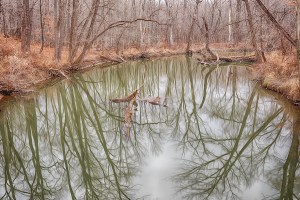 Although the weather has warmed into the fifties, I know rain in winter is worse than snow for photos. After the last shower has passed, I see the slow roll of cloud cover continues to cross over a shadowless landscape. The bark of empty trees appears dark with remnants of wetness. A doodle scrawl of underbrush dripping like lines in a Pollock painting moves through dune woods hushed by an absence of birdsong. However, when I get somewhere ahead, beyond the next bend where a murmur of water current deepened by snowmelt suddenly interrupts the silence, I will witness a deer in the dim distance, tilting its body in the little bit of wind and dipping its head among river reflections for a drink, but too far and indistinct from the brown surroundings to permit a pin-sharp picture. Over the years I have learned to accept that often the best images are those unavoidably omitted from my photographs but I hope might be better remembered and captured by the words I write.
∼ December 19, 2018 ∼ “River Bend in December”
 I return to this stretch of river trail in each season with a recurring sense of uncertainty. When I walk this way in the middle of spring, a lilting music greets every bright new morning with sounds of birdsong in the branches above. Even on a gray afternoon in late April, the chirping of small birds seems never to cease. However, by the end of November or in early December the surrounding forest falls quite silent except for a sporadic whisper of wind moving through these thinning woods and maybe the patterned tapping of a red-headed woodpecker. My camera shutter opens and closes quicker than the blink of an eye, yet in that time I can capture whatever the sun’s light—whether brilliant in blue sky or dulled by a thumbprint of cloud cover—will allow. Until I arrive home and try to print an image, I am never really sure how closely my photo will resemble the little window of scenery I remember witnessing on the viewfinder in front of me, but I always enjoy just such a state of anticipation and surprise.
∼ December 13, 2018 ∼ “Trail Two Bridge in Mid-December”
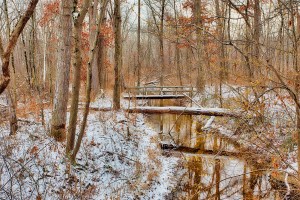 Once again alone on my way toward the Trail Two bridge, I hear the persistent patterned tapping of a red-headed woodpecker lingering among the last thin patches of late autumn foliage. Although winter’s bitter cold is almost here, and the forest where I pass is now filled with stubbled underbrush covered by the yellow and rust colors of leaf-fall seemingly frozen in place, I still like to hike this twisting trail between inland dunes, remembering the busyness of birds moving through these woods in April, May, or June. I must confess I miss spring’s insistent birdsong and the flitter of feathers briefly seen before disappearing into a filter of green overgrowth overhead. Nevertheless, when flurries swirl around me during a wintry walk, or accumulation from an overnight snowfall clothes these limbs of leafless trees with white sleeves to be suddenly sun-brightened during clearing after a storm, in my solitude I also admire the silence and serenity of stark scenery brought by the new season.
∼ December 7, 2018 ∼ “Little Calumet River After Morning Snow”
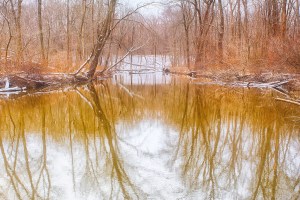 As if observing a ritual, I again follow a route through these woods and beside the river that I travel to take photographs exhibiting change in each season. At times, I see the ripples spread by a small fish still moving in shallow water beside the bank. Some bright sunlight momentarily seeps between a lingering layer of clouds, as white as this morning’s new snow, then quickly disappears again. I also notice the reflections of overhanging trees—all the leaves long gone, though I recall their tints of green in spring or the brilliant fall foliage—and the brown bark of branches that had nearly been hidden during summer appears clearly now. A gray squirrel scampers across a network of fallen limbs before climbing a nearby trunk. I wait awhile before beginning my final walk of the day toward a trail that will end with the steep incline of a dune hill to a skinny ridge edging above the lake, where the chill of a slow but steady north wind already seems almost always to flow as the end of the year approaches.
∼ December 5, 2018 ∼ “Crossing Clouds and Angled Autumn Sunlight”
 Lit from the south under an angled sunlight of late autumn, lines of clouds file across the sky over a northern horizon as they usually do, moving west to east, eased along their way by a slight breeze beginning to bring a bit of colder air into the region. I like this almost indirect illumination, often exhibiting a softened glow filtered by thin overcast and lacking that harsh brilliance or bleaching of summer sunshine steeped amid a backdrop of deep blue. The official forecast calls for a dusting of snowfall sometime overnight, though perhaps starting as rain or sleet, with maybe just enough accumulation to whiten stubby tufts of grass or place pale sleeves on the slim upper limbs of coastal trees that have been recently stripped of their leaves and are now etched in black against this changing background displaying a notable absence of birds. Even the apparently ever-present gulls are gone from the beach today, though I see some circling in the distance between me and the far-off Chicago skyline.
∼ December 3, 2018 ∼ “Creek Bridge After Weekend Winds”
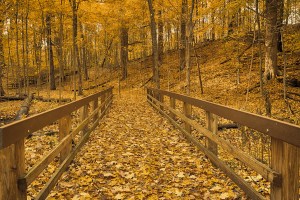 Temperatures dipped quickly with those strong storm winds spinning in from the north. Overnight brought a bit of melting snow mixed with drizzle, and this morning, the path ahead yet thick with fallen leaves that crunch under my boots, a broken gray overcast hangs heavy just above the tops of these thinning trees. I cross this seasonal creek—almost dry and most months merely a twisting ditch slit between two dune hills—on a wooden bridge built last spring though now still slick with its layer of autumn color. Peering to where I know the trail narrows and curves around a boulder surrounded by smaller stones, then bends farther on beyond another short span, slipping deep into the darker distance, I remember when flooding filled this ravine after a series of summer thunderstorms. I stop awhile to position my camera tripod for the slower shutter speed needed in this dim light and to capture a particular angle looking back at the setting, a slightly yellow tone of the scenery seen in my viewfinder seemingly imitating some vintage image one might find in an old photo album.
∼ December 1, 2018 ∼ “Late Autumn Light”
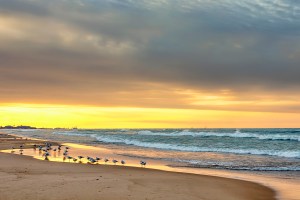 Nearing the end of autumn, I decided on a roundtrip hike along a ridge that shoulders the shore. When I walked this way earlier today, the distant vista was screened by a light swirl of snowflakes and seemed like scenery encased in a holiday snow globe or perhaps simply a part of nature’s dress rehearsal for winter. However, the weather warmed a bit by my return later in the day and melted away what little had fallen. Even the sun struggled to briefly free itself of thick cloud cover still floating overhead this afternoon, showing enough just before sunset to shine from the horizon onto the wind-smoothed sand and scooped-out dunes or to brighten whitecaps and the tops of breaking waves in Lake Michigan. Standing silently at attention without a wobble in the wind, about three dozen gulls gathered in a group beside the water’s edge as if to guard the surf along that stretch of empty beach from some invisible intruder. Before leaving for home, I hoped to photograph a moment that might capture the atmosphere, to exhibit each tint shifting in that sudden slant of sunlight.
∼ November 27, 2018 ∼ “Late Autumn at Trail Ten”
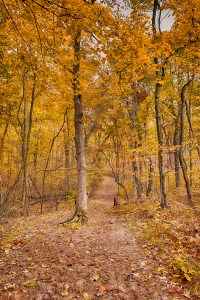 Each step forward seems to reveal scenery of a landscape rearranged by the new season—broken branches, toppled trees, lost leaves lining the way, and an absence of shadows amid limbs painted with this lingering palette of yellow, orange, bronze, and gold. Like Thoreau, I am impressed by the “simplicity of light” at this time of year, even on an overcast afternoon when a filter of thin cloud cover softens the sunshine. However, everywhere a distinct smell of autumn woods also fills the air, surrounds me with its faint scent of slow decay. But especially here, where Trail Ten extends alongside high marsh water maintained by recent days of rainfall and snow showers, I can sense this great spectacle of foliage has nearly reached its end. One almost might think that the whole vivid fall setting appears to offer an atmosphere exhibiting attitude, as though displaying such color represents its final act of resistance before reluctantly fading away, relenting to the inevitability of winter’s pale arrival.
∼ November 25, 2018 ∼ “River After Morning Mist”
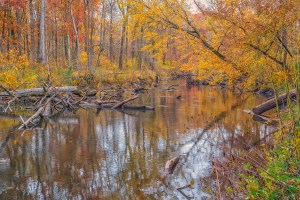 The low glow of sunshine filtered by this morning’s mist looked a little like the light from last night’s moon viewed through cloud cover. Now, the river runs slow and smooth beneath trees still lit by lingering fall foliage, although the vivid palette evident in upper limbs has faded a bit from the diffusion of fog, and the image in my viewfinder appears somewhat fuzzy. The worn landscape of autumn begins to fizzle out, and already a loss of leaves has started to accelerate, as a number of them can be seen drifting easily downstream. Some broken branches clutter the banks, while others emerge from the depths and are reflected on the water’s surface, a few even redirecting the river current. By late afternoon, the slurred speech of an increasing wind from the west will slip quickly through thinning overhead limbs, dissipating any haze, and the clarity of blue skies will return to the region. For photographers this season is almost sacred and certainly much too short. In fact, I know that soon the brilliance and warmth of color witnessed in this scenery around me will be dulled by efforts from the cold hand of winter.
∼ November 23, 2018 ∼ “Trail Ten in November”
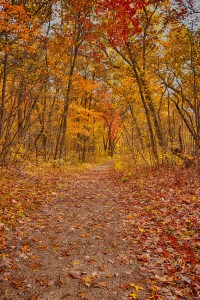 As always, Trail Ten stretches like a main artery from the west toward that thick forest near the distant eastern end of Indiana Dunes State Park. Soon, this landscape will be reshaped. These trees will be stripped of their last leaves by northern winds sweeping over Lake Michigan, and the bare branches, exposed as gnarled and knotty, will reach dramatically into the empty air with an apparent sense of expression, perhaps like arms of interpretive dancers or extensions on an abstract object of art. The ground beneath my boots seems a mixture of moist sand—still a bit damp from when this morning’s sudden squall line of snow showers left a thin white layer, since melted—and wispy tufts of dead grass, now tinted an autumnal brown. Even after the sky becomes clear of cloud cover, late daylight fades to a dull gray quickly, and routes deep in the dune woods darken early. I will return to the trailhead before nightfall and frost arrive, looking forward to printing images I have taken during my time traveling along the trail.
∼ November 19, 2018 ∼ “November Weather”
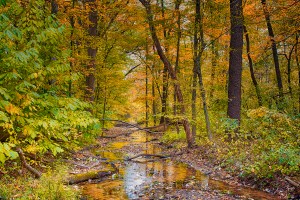 In his poetry, Charles Wright has written that “November is dark and doom-dangled, fitful bone light / And suppuration, worn wrack, / In the trees, dog rot and dead leaves, watch where you’re going…” (“Disjecta Membra”). Lately, as darkness arrives earlier each day and bare branches begin to overtake the landscape, the more difficult weather of winter seems to lurk not too far off. Last night’s clear but quite cold conditions—though showing a moonless sky highlighted by an array of stars absent frequently during the past weeks’ strong storms—perhaps presented a gesture suggesting late autumn finally may be about to fade away. Today, while wet dead leaves, some still lifting and twisting with every sweep of an increasing breeze, yet spread across wooded trails, I nevertheless appreciate even more this crisp scenery seen in the low-angled sunlight of mid-afternoon that will soon be buried beneath the next season’s repeated snowfalls.
∼ November 17, 2018 ∼ “Lake View with Lone Rowboat in the Distance”
 An overcast that continued until noon has at last begun to drift easily toward the east and clear the area. Now, everything appears still on this windless afternoon, except for a lone rower pulling his boat slowly over the water in the distance and seen through my viewfinder only as a tiny featureless figure below a low-hanging limb yet filled with red or rust-colored fall foliage. This small lake in northwest Indiana, collared by a late display of vibrant November trees, seems to shine brightly beneath an increasing sunlight. Rough reflections of soft white clouds—only a bit blurry in their mirror images, though I have assured the photo is in focus—skim the blue surface around bare remnants of a broken branch poking from below and shown to be almost as pale as bone. Today, all is quiet across this hushed landscape. In fact, already the notable absence of birdsong during a middle month of autumn merely emphasizes that silence and stillness I sense around me.
∼ November 14, 2018 ∼ “Chellberg Trail in Autumn”
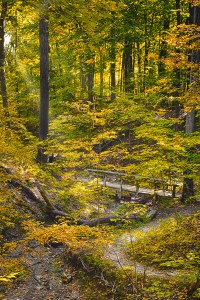 Another year grows old with less than two months remaining until we open the pages of a new calendar. Most of the thick cloud cover brought overnight by northern winds has now rolled over the coastline and cleared the dune hills. Its mist has moved slowly toward the south. A bright patch of sky shows through an opening overhead, appearing like a glow of illumination seen sliding through some skylight window. In the distance, narrow rays of sunshine spread through thinning limbs, though a pocket of cold air continues to rest in this ravine, left over from the arrival of last night’s weather front. The black bark of tree trunks and the slim reeds of these wilting weeds still rising from shadows along the trail are yet wet with the melt of morning frost. Despite current conditions, the radio forecast to which I listened while driving here suggests that shortly after noon a warming breeze will quickly drift into the area from the west, and soon this day will reinvent itself.
∼ November 11, 2018 ∼ “Photography Program and November Sunset”
I offered a landscape photography program in the auditorium of the Indiana Dunes State Park Nature Center yesterday. I have spoken there a few times in the past, and I always enjoy meeting all the friendly individuals who attend. My presentation was held with support from the Indiana Arts Commission, which has supplied an Arts in the Parks and Historic Sites grant through partnership with the National Endowment for the Arts that enables me to conduct such events in cooperation with kind staff members of the state park. Topics I addressed included the following: guidelines for composition of images, recommendations for determining best conditions when capturing particular types of scenery (woodland, sunset, fall foliage, snowy locations, etc.), suggestions about picking gear or choosing lenses for certain situations, selecting correct camera settings, conducting software processing, and the importance of finishing with a production of prints. I also provided a narrative about the series of twenty-five photos I showed on a large screen. Additionally, an exhibition with a dozen of my framed photographs (which will be on display through December) was available for viewing along the auditorium walls. I very much appreciated the discussion with the participants, who were attentive, asked a number of great questions, and engaged in relaxed informal follow-up conversation. In fact, the session had been scheduled to last one hour but ran at least an extra half hour, and afterwards I joined a few fellow photographers on the beach to capture a magnificent November sunset.
∼ November 9, 2018 ∼ “Finding Friends”
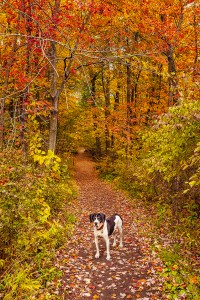 While hiking through the Indiana Dunes, I often meet a variety of sightseers, vacationers, or tourists along the way—visitors from nearby or elsewhere in the state, as well as other states, or from numerous countries around the world, frequently including fellow photographers with whom I sometimes speak and suggest prime locations for photography. However, I usually travel the trails on solitary trips with only the accompaniment of nature, including various animals I observe, such as deer, beaver, raccoons, rabbits, squirrels, snakes, and a wide assortment of birds—from larger cranes, egrets, geese, gulls, herons, and hawks to the smaller swallows, starlings, jays, wrens, warblers, and woodpeckers. However, I also have come across a number of dogs at times, usually striding beside their humans who strike up pleasant conversations. Nevertheless, on one occasion a friendly golden retriever appeared alone and walked alongside me in a loping pace as my companion for about an hour and more than a mile, supplying a favorite memory. Additionally, as I was photographing the peak of fall foliage at Trail Eight last week, I encountered another amiable canine wearing a red collar who suddenly stepped into the frame of my viewfinder and stood still as if to pose (see photo), perfectly providing foreground interest to the vibrant scenery in the image. Apparently, it had run about a quarter mile and five minutes ahead of the owners, who soon appeared around a bend in the path, and when they greeted me, I shared on my camera display this picture I had preserved of their dog.
∼ November 8, 2018 ∼ “Leaf Fall at Dunes Creek”
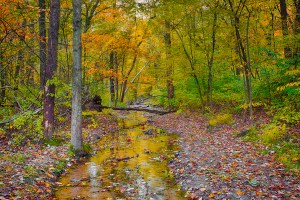 The day’s temperatures hovered comfortably just above fifty degrees. The peak of seasonal transition was still at least a week away. When I spoke earlier with the interpretive naturalist at the state park’s nature center, she advised that trees along waterways or bordering the marsh would likely be the first to show fall foliage. Beside Dunes Creek—running nearly dry this time of year before disappearing into the distant darkness of thicker woods now with upper branches backlit by a hazy wash of sunshine—colorful leaves continually fluttered under these overhanging limbs and drifted in whatever breeze there was. I noticed how all fall down to slowly fill the ground almost like snowflakes in winter. When I stepped across the creek seeking better position to frame a photograph, the soles of my boots and the feet of my tripod would sink a bit in soil still damp and soft. As I tried to avoid movement blur by awaiting a lull in leaf tremor caused by brief gusts, I imagined these words I might use in my journal to describe the moment.
∼ November 6, 2018 ∼ “Trail Eight in Autumn”
 Last night’s wind has faded away, and I see through the limbs of these thinning trees, now noticeably silent with the absence of birdsong, how a couple of wispy clouds appear nearly still. Yesterday’s weather is merely a memory. Those large lake waves that had broken into lines of white foam along the beach have disappeared, and only a lazy drift of water continues to lap at the sandy shore. The week of peak fall foliage finally arrived, and each turn of a bend in this trail yet reveals another image resembling a resplendent work of art, filled with texture and flush with color—orange, rust, red, yellow, gold, green, bronze, and brown. The rough bark of trunks sometimes also seems to be silver. Even leaves shed by overnight gusts decorate the way, leading me toward the dune woods and little hills ahead. The setting does not look like the same place it was a month ago, and I know this lavish scenery will not last much longer. But I want to capture as much as I can with my camera; therefore, today I will stay as late as it takes.
∼ November 3, 2018 ∼ “Dune Trail to Beach in Mid-Autumn”
 A bit of blue shows through clouds still drifting to the east over Lake Michigan. A scattering of crisp dead leaves spots this crooked trail winding between dunes and descending toward the beach. Most of these trees beside the shore have been swept clean of their leaves during recent storms with gusting winds. Although now November, the sand yet absorbs what little afternoon sunshine seeps between breaks in an overcast sky and whitens just enough to brighten the scenery. Despite some autumn color remaining in coastline shrubbery and underbrush, winter’s fingerprints are already all over this setting, and the daily extent of daylight shortens more each week. Soon, the first northern storm with cold Canadian air will spread its own shallow layer of snowfall around the dark trunks of bare trees and add a pale covering across the whole landscape like textured gesso or a base coat of paint applied lightly on an artist’s canvas awaiting additional attention.
∼ November 1, 2018 ∼ “Dunes Creek in Middle of Autumn”
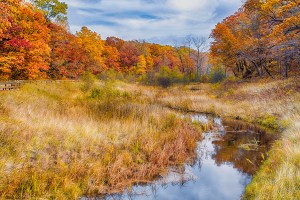 Dunes Creek slowly flows through one last stretch of lowland, cradled between small hills still hidden by trees filled with fall foliage, only a couple hundred yards before twisting north and being embraced by Lake Michigan. I have traveled just three miles thus far this morning, but by noon I have witnessed a luminous change in the weather. Already, patches of dead grass whiten along the banks in beginning sunshine, while final clouds of a cold front that brought overnight rain yet hang above a distant tree line now displaying its chaos of color in the brightening daylight. I hike a walkway from the west, following the creek’s contour toward the state park’s public campsite. Overhead leaves shudder and treetops nod in an onshore breeze that has begun to sweep clean the skies, as lambent light flickers between thinning and swaying trees, and the landscape again exhibits its autumnal brilliance. I photograph the scenery, knowing that soon their branches will be bare.
∼ October 30, 2018 ∼ “Trailhead in Autumn”
 After parking my car in an empty lot beside the trailhead, I check adjustments on my camera gear and start toward a route through colorful dune woods. Beginning my hike in the lingering cool temperatures of mid-morning, the day’s landscape lies ahead like an open book yet unread. I always wear a pedometer hooked onto a belt loop, segments of my progress measured by steps or miles, and I plan to hike about five miles. Today’s smooth spread of bright sky, finally uncluttered after a weekend of thick and almost black cloud cover, nevertheless appears tinted a bit gray by haze, perhaps like a pigment of paint or the way color cast affects a captured image of lake water on a foggy day. Last night’s broken line of heavy rainstorms arriving from the west somehow missed this stretch of terrain; however, a light shower has left the sandy trail damp, and the narrow path underneath a layer of leaves remains slightly muddied. Although I will revisit scenery I have photographed during past trips, I know details in each location will seem different during this time of year, as they nearly always do, with these natural settings once again rearranged by autumn’s seasonal change.
∼ October 28, 2018 ∼ “Trail Bridge in Autumn”
 Late morning, I make my way through the dune woods again with an uncertainty of afternoon weather ahead. Some rain showers—perhaps even a few snow flurries—are expected to arrive with a cold front drifting over Lake Michigan by evening, and winds have begun to shift from the north once more. All along the route, a windfall of broken branches litters the ravine. Despite today’s slightly milder temperatures, last night’s freeze created a thin white crust of ice on those puddles of water that lie along the bottom of this narrow valley, but the frost faded away by the time I had hiked my first mile. The landscape wears its new look well, as autumn’s yellow and orange foliage seems to illuminate this trail a little, each cluster of leaves nearly radiating light like the warm glow seen behind lace curtains in a distant window. I pause a moment and adjust my camera settings to capture an image where this path passes beneath arching limbs then crosses a short footbridge suddenly sunlit over a seasonal creek already almost dry.
∼ October 25, 2018 ∼ “A Walk and a Lone Hawk in Early Autumn”
 Sometimes the calm, deep, and almost dreamlike gold or yellow colors of foliage spotted on an early autumn day seem like elements in imagery one might experience during a good night’s sleep. Stillness lingers late this morning before more afternoon cloud cover will arrive, slim white lines already gathering over the thinning limbs above me, and the forecast calls for chill from new north winds, which will increase toward evening. I have been hiking only an hour and a half, following narrow trails that twist through woods and bend alongside a waterway. Earlier, three white-tailed deer veered past me—each leaping a large log nearby—and then hurried into the darker shade of a swamp forest where, suddenly out of sight, their crashing and splashing continued to smash the silence that had been all around me. However, when I reached the slowly flowing water of this nearly still river, I stopped a while to watch a lone hawk quietly glide in the sky, gracefully rising and sliding against that patch of blue just visible above a ragged tree line stretched beside the far bank.
∼ October 23, 2018 ∼ “Sun After Autumn Storm”
 Following a strong autumn storm with gusty northern winds continuing during the weekend, this sunny afternoon seems serene. When I walked along the shore this morning, I noticed how much erosion the lake’s high waves had created overnight with sections of beachfront severely sliced by the rising surf. But farther inland I’m surprised as I hike a wooded trail protected by dune hills on either side. Despite details in this scenery appearing delicate, the landscape seems to have shrugged away any lasting impact from the recent gales. Even these trees lining the way still remain mostly filled with green leaves. Although the official long-range prediction originally had been for fall foliage to reach its peak this week, the forecast has been amended and extended about ten days. I meet a pair of other photographers on the path also searching ahead for spots of yellow, orange, and red. They, too, had hoped to capture colorful images—or perhaps record storm damage, such as toppled trees or broken branches—but we agree a mild September, added to the warmer and wet summer months, must be the reason for this postponement of seasonal transition a bit longer.
∼ October 19, 2018 ∼ “October Sunlight Through Swamp Forest”
 While propping my camera on a tripod to capture the darker image of fall foliage within a still thickly covered section of trail, I hear a sudden rustle of underbrush and clattering of loose stones clamoring nearby. A trio of white-tailed deer, dashing in a line from left to right and darting through this intricate maze of trees, passes quickly in front of me and then hurriedly disappears into the distance, though the loud sound of their crossing continues as they splash along the shallow edge of a swamp forest just a couple hundred yards away. After taking the picture for which I had set up my gear with the slight click of a shutter release, I choose to move in the same direction as those three animals. I follow their jagged path toward the wooded wetlands, where I find a low sun in the southern sky shines through trees and illuminates colorful leaves decorating that region beneath the surface of the water, which has cleared of algae since summer. I snap an unscheduled photograph of this scene that seems a gift brought about by the unexpected guidance of nature.
∼ October 17, 2018 ∼ “River Bend in Mid-October”
 Following a few days of rain, I photograph the swollen Little Calumet River, an array of thinning branches now reflected and extending like a network of veins on its glassy surface, which has recently been freed from some of the clutter accumulated all summer, numerous toppled tree trunks or scores of fallen limbs. Although lingering layers of cloud cover continued most of the week, this morning’s sky has cleared and the landscape appears illuminated by bright daylight. The yellowing of early autumn has already begun to occur as an almost golden tint affects leaves along the bank and glazes the slowly flowing water, still somewhat muddy from spots of flooding and runoff. Despite daytime temperatures yet comfortable for mid-October, a series of nights with chilly weather conditions dipping to freezing has withered much of the floral coloring that had gathered for months among the underbrush lining a trail alongside this river.
∼ October 12, 2018 ∼ “Trail from Mt. Tom in October”
 Yesterday’s brief dazzle of sunlight has disappeared, and the forecast calls for more thunderstorms tonight. I am hiking through dune slopes today under a gathering gray sky, my feet sliding quite a bit, almost stumbling with every step I take where this sandy trail, wide and off-white, descends from the park’s tallest peak toward an empty beach and lake water now darkening beneath growing cloud cover. Unlike the usual pattern during summer months, on this October afternoon no boats—large or small— slide across the horizon. The surf’s little waves offer their insistent whisper in the distance, as if inviting anyone forward. In moments like this, the elements of nature’s scenery seem to me like discrete characters in a sacred language. Once again, I carry my camera strap slung over a shoulder as I anticipate images I might find ahead, perhaps focal points for those photographs I hope will aid in saving these memories of the day for another time.
∼ October 9, 2018 ∼ “Hiking After Early Autumn Rain”
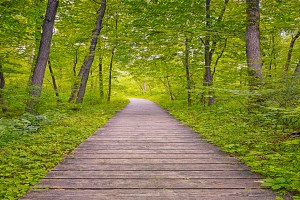 After a night of rain, blackening the bark of tree trunks and fallen limbs, a morning fog that had been rising slowly, almost like smoke, has finally lifted its gray curtain by midday, and the landscape appears once again. I notice that the top triangles of some trees along the way have begun to lose their leaves, the bared branches seemingly sharp and pointing in a variety of directions. This trail’s stretch of wooden walkway winds through the thick dune woods as I move toward a footbridge spanning the darkened water of a large marsh. As the afternoon weather clears even more, only a few feathery clouds will still drift in the stiffening wind, whitening slightly a newly blue sky. I detect a hint of something burning from the park campsite beyond my sight in an opening tucked somewhere on the other side of these trees. The scent has an appealing smell—perhaps a late lunch or early dinner, someone cooking slabs of steak over a small fire or a lit grill less than an eighth of a mile away.
∼ October 7, 2018 ∼ “Early Autumn Sunset”
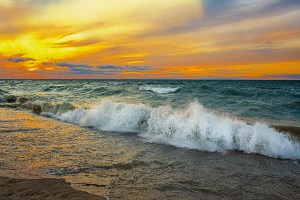 I have been walking paths through the foredunes beside Lake Michigan all afternoon, but I linger a bit longer before leaving, as I anticipate a late-day show by nature above the horizon. The last flash of sunset is displayed behind an array of clouds, and a growing chaos of color paints the sky once more. Rolling lines of small waves whiten as they slowly reach the shore and release onto a sheen of darker sand extending along the beach. A northern wind, just beginning to weaken to a brisk breeze, washes onshore and chills the coast, promising even colder air will return overnight. Where narrow shadows of trees earlier had splintered dune ridges and the tops of little hills just inland, the slow slide of nightfall has now made its move. I adjust my camera settings to compensate for the quickening changes in illumination of the landscape, opening the aperture wider and increasing the sensitivity level of the camera sensor.
∼ October 4, 2018 ∼ “Anticipating Autumnal Color”
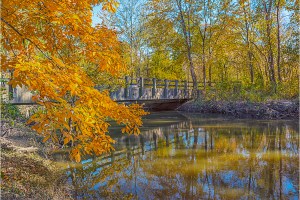 On Monday I visited the Nature Center at Indiana Dunes State Park to install a display of my photography exhibition to be available for viewing throughout October and November in the auditorium. This show features mostly photos of fall scenery, such as the accompanying image, to reflect the anticipated transition of foliage that will occur throughout the next two months. During this time frame I am also scheduled to conduct a pair of events as part of my Indiana Dunes Arts in the Parks and Historic Sites project that has been funded by the state of Indiana with cooperation from the National Endowment for the Arts. With guidance by the park’s interpretive naturalist, I will be leading a photography hike along a trail in the Indiana Dunes that extends through woods toward the beaches at Lake Michigan on Saturday as an activity included in this weekend’s Outdoor Adventure Festival. Additionally, I will return to the auditorium on November 10 to offer a lecture presentation about landscape photography in the Indiana Dunes.
∼ October 1, 2018 ∼ “Opening of October”
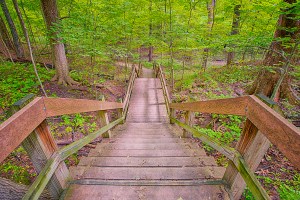 October opens with a mixture of shining light from a sun drifting farther south and the chill of a strengthening northern wind. On days like this, I look to the landscape—the clinging of green leaves lingering in limbs above me, other early casualties of autumn dotting a wooden walkway or spotting the cool ravine creek extending beneath them with touches of color—as the scenery starts to shrug off evidence of summer’s lush conditions. Although any significant snowfall yet remains at least four or five weeks away, for the first time the level in local thermometers during recent nights began flirting with freezing temperatures. Soon, each break of dawn will welcome signs of morning frost—a dusting of white on slender shoots of marram grass among foredunes along the shore, a thin and transparent sleeve of ice on the darker bark of bare branches, a frail and glassy layer upon the clear surface of nearby trailside ponds. As I follow once more a path descending deeper through dune woods in this calendar month that also contains on its page the date of my birth, I again anticipate those changes that might lie ahead.
∼ September 28, 2018 ∼ “Path Toward Shore at Start of Autumn”
 I watched as lingering light stretched across the bright sky beyond Lake Michigan just a few minutes after sunset. Brilliant tints glinted on the water’s surface beneath a dramatic horizon suddenly displaying vibrant pastel swaths, and I recalled a line of poetry by Charles Wright: “The world becomes more abundant in severest light.” A northern air current whipped waves toward a darker shore, and I heard the rumble of white swells of surf tumbling, one after another, spilling onto packed sand. With each onshore gust, the first surge of colder weather arrived as well, marking the start of autumn. Walking a winding path through the foredunes, I noticed a high level of lake water that rose over the beach and approached the trail’s end, where I tried to hold steady my camera level in a vigorous wind. Narrow leaves of marram grass wavered with each accelerating breeze, and every element in the entire scene seemed active, the whole setting now filled with the fresh breath of this new season.
∼ September 26, 2018 ∼ “Some Thoughts on Early Signs of Autumn”
 Late September’s seasonal shift has commenced. Already I note a lessening of the hum from insects no longer evident in the air around me as I hike this path along the dune ridge above a tan bandana of beach. A sharpening in the angle of late afternoon light, at times almost golden, occasionally gives a slight glint to lake water below and pierces through to woods beginning to thin, some upper branches becoming bare, their lost leaves littering the way where I walk. Foredunes mottled with marram grass are now filling with a brighter tinge of yellow. Splotches of sunlight spot the shadowy darkness of forest tree trunks along trails deeper inland though yet mostly shaded by foliage. Those leaves that remain overhead have taken to wavering beneath the sweep of an easy northern breeze moving onshore from Lake Michigan, its bit of chill seeping into valleys between little hills among inner dunes with temperatures just shy of sixty degrees. Somewhere unseen in the distance before me, a few small birds still softy sound their high-pitched song.
∼ September 23, 2018 ∼ “Last Sunset of Summer”
As we reached toward the autumnal equinox this weekend, quickly changing weather circumstances seemed designed to emphasize the seasonal transition. Thursday presented a record 95-degree temperature accompanied by a lingering high humidity that felt like sticky mid-summer air. However, a cold front drifted through the region Friday morning, bringing a narrow line of showers, and measurements on the thermometer dropped about twenty degrees. Suddenly, chilly overnight conditions significantly lowered temperatures, which slipped into the forties. Moreover, with southerly breezes shifting to strong northern winds gusting onshore from Lake Michigan, a turbulent surf churned along Indiana Dunes beaches. Consequently, as I stood at the shoreline, looking toward the Chicago skyline yet evident in the distance, to capture a closing sunset of summer in a photograph, the setting seemed a bit more impressive, almost as if dramatically signaling a foreshadowing of fall’s arrival.
∼ September 15, 2018 ∼ “Lake Beneath Clear Skies Near End of Summer”
 Watching news reports this weekend about the arrival of Hurricane Florence along the coastline of Southeastern states and empathizing with folks dealing with disastrous winds or damaging flooding, I was reminded how the influence and interaction of weather systems across the United States regularly impact our local meteorological circumstances. Whenever strong storms or hurricane-level disturbances appear in the eastern half of the country, eastward movement of high-pressure zones across the Midwest usually stalls; consequently, cloudless skies will often linger for a longer period of time over Lake Michigan. Indeed, calm conditions with ample sunshine and somewhat warmer temperatures have been evident in the region during this mid-September, settling in the area for an extended stay as we enter the final stretch of days before the official end of summer only one week away.
∼ September 12, 2018 ∼ “First Signs of Approaching Fall Season”
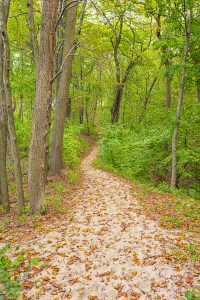 As I hike a ridge trail high in the dunes rising above Lake Michigan, I feel a cool onshore breeze moving through the trunks of trees lining this winding path, creating a hint of autumn in the air. Peering between the trees beside me and looking far into the distance, I notice a growing surf as whitecaps of waves wash onto tan sand bordering the shoreline. Already, a number of leaves have fallen from upper branches ahead, those most vulnerable to swift northern winds. Although we are yet in early September and the calendar officially indicates the season is still summer, this wooded route shaded by cloud cover has begun to resemble what one expects from the approaching fall. Indeed, I have heard a couple of fellow photographers comment in recent days about their anticipation of the new season, looking forward to the visual transitions, especially the lush colorful changes that soon will be in place when walking through these dune woods. However, I am willing to be patient, to wait awhile and enjoy the fresh breath of weather evident at this time of year.
∼ September 10, 2018 ∼ “Historic View”
 I have often written in journal entries about my interest in photographing Indiana Dunes landscape sites with ties to the history of particular locations, especially capturing images as they appear today of scenes with specific significance in the past. For instance, I have shared pictures that reveal the current conditions of land where the Prairie Club Beach House, painter Frank Dudley’s legendary cabin, or the Indiana Governor’s summer cottage on a ridge above Lake Michigan (a view from its spot seen here) existed before being removed—along with hundreds of other structures—to return the terrain to its natural state. Consequently, in order to become more informed of the chronology of events and roster of individuals who worked to help preserve the local environment, I attended yesterday an enlightening and entertaining presentation at the Indiana Dunes State Park Nature Center with perspectives offered by Serena Ard, Curator at the nearby Westchester Township History Museum. The lecture, with key situations or figures depicted by numerous vintage photographs, provided delightful insights into the development of the region from the nineteenth century through the twentieth century, as well as the eventual establishment of protected parkland, especially through efforts by members of the Prairie Club, an organization formed in the early 1900s by a group mostly from neighboring Chicago who adopted the worthy cause of saving the beauty of the Indiana shorefront for future generations.
∼ August 30, 2018 ∼ “Trail Ten Toward Shore and Approaching Storm”
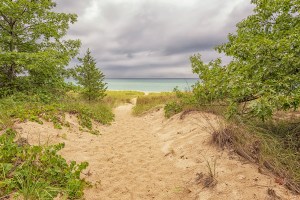 Although I have hiked the length of each trail within Indiana Dunes State Park a number of times, I must acknowledge traveling the complete distance of Trail Ten only on a few occasions. Frequently, I have walked portions of this route, especially those sections near where it intersects with Trail Eight and Trail Nine. Indeed, the mostly-flat and comfortable journey along Trail Ten does not present as much difficulty as the steep climbs up high dune hills or loops around the narrow rims of blowouts one experiences on those other trails. Additionally, I find various elements of Trail Ten interesting and attractive, especially where it moves through thick woods of white pine or black oak and beside the Great Marsh, where a bird observation deck allows for viewing over the wetlands and a precarious boardwalk crosses the water to Trail Two. One stretch of Trail Ten, just before exiting the forest through an opening toward the shore, even carries the title Paradise Valley. However, at about six miles, which includes a long but pleasant walk of three miles along the coast of Lake Michigan, from the eastern end of the property to the pavilion at the popular public swimming beach and past all the major dune blowouts, Trail Ten extends farther than any other in the park.
∼ August 28, 2018 ∼ “Windswept Waves with Lone Gull”
 As August comes to an end and the calendar shifts into September, with most local schools resuming classes and dwindling numbers of summer vacationers visiting the region, I find walks along the Lake Michigan shoreline also become somewhat solitary and serene adventures. Especially on weekdays at those more remote beaches in the Indiana Dunes, I sometimes seem all alone as I hike beside a windswept surf—roiled by the gradual introduction of increasingly chilly northern winds—occasionally joined only by a few of the ever-present gulls that appear to accompany me whenever I’m there, no matter the season. Even as I slowly approach the birds to snap a photo, they usually continue to walk ahead calmly toward the darkened tan within a narrow strip of wet sand, acting as though they are oblivious to my presence on one side or as if they are unperturbed by the turbulent water and tumbling waves evident on the other.
∼ August 26, 2018 ∼ “River After August Rains”
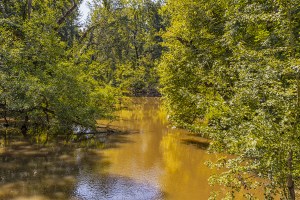 In my previous pair of journal entries, I chronicled some changing conditions in the region. My 8/16 post noted the low level of waterways, particularly the Little Calumet River, following almost a month-long spell of mostly dry days, and my 8/22 commentary examined the aftermath of a strong summer storm on a narrow beach along the Indiana Dunes. Today, with a week of wetter weather soaking the local landscape finally behind us, I present a different picture of the Little Calumet River, suddenly full again and spreading up its banks, erasing the usually sharp outline of its course to swirl around the thick trunks of bordering trees and to extend into the low-lying land of nearby woods. The current once again conceals some of the fallen limbs and other natural debris seen in the earlier image, branches and underbrush that had been deposited into the river due to gusting winds and that had been exposed by those low levels of water witnessed only ten days ago.
∼ August 22, 2018 ∼ “Central Beach After Summer Storm”
 Following a period of heavy downpours from a strong storm front that moved through the Midwest on Monday and Tuesday, Wednesday morning brought clear skies and swift northern winds yet continuing to drive Lake Michigan’s waves onto beaches along the Indiana Dunes. The shorefront at Central Beach, which had been swept clean by the previous days’ heavy rainfall and blustery gusts, appeared smooth, even absent of others’ footprints, as I walked the full length. Although still summer, this late August afternoon seemed more like early- or mid-September with its temperatures in the low seventies and a refreshing lack of humidity. Quick and cool onshore breezes blew over the beach, and the swath of cloudless blue above looked almost like a color field in an abstract painting, a wide shape complemented by a pair of irregular borders—one on each side of me as I timed my steps between waves—formed by an eroded edge of sloping dunes and those scalloped fringes of surf staining a stretch of tan sand extending ahead.
∼ August 16, 2018 ∼ “River at Low Level in Late Summer”
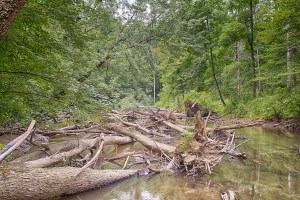 In a few previous posts I noted the changes of precipitation totals logged during recent weeks. For instance, in my July 10 journal entry with a photo of a full Little Calumet River I spoke of wet spells of weather in much of the region throughout the first half of summer that had raised levels higher than normal for the time of year at local waterways, and I related “news reports of a few local rivers reaching near their flood stage.” However, as conditions changed with an extended period of dry days, my August 1 commentary observed some tributary currents had begun to dwindle, including “Dunes Creek, which was so low that its bared sandy bed—full with flowing water in May—now showed in places….” Yesterday, I hiked a trail parallel to the Little Calumet River, and I discovered its flow had slowed almost to a standstill, while the low waterline revealed a clutter of fallen trees extending from one bank to another and blocking the way downstream.
∼ August 6, 2018 ∼ “August Landscape”
 Each year when the calendar pages are turned to August, I experience mixed emotions about arrival of the new month. Recently, I heard a well-known landscape photographer declare August his least favorite month because the deep overgrown greens seemed tedious or monotonous in images; however, I have looked forward to the fullness of rich foliage that has steadily increased during the summer. Additionally, I enjoy the lingering warmth that allows for appreciation of comfortable hikes through woods cooled by shade made with a lush canopy of tree limbs overhanging and interlocking above walking trails. Since almost all of my life I have been engaged with academia, this part of each year also marks the start of my refocusing on school matters and anticipating the Fall semester, which unfortunately begins at the end of this month, well before summer is up. However, I am always reminded of an alternate meaning of the word “august” when spelled with a lowercase “a”—something celebrated for its impressive quality or grandeur gathered over time. Indeed, this definition may be most appropriate for expressing my attitude toward the mature growth of nature I now pass along paths I follow.
∼ August 3, 2018 ∼ “Start of Trail in Beginning of August”
 Bright sunny skies gave way to a growing overcast of slate gray clouds, and long limbs of tall trees now suddenly swayed easily in a strengthening breeze. The day’s constantly changing weather allowed for a variety of differing conditions in which to capture images of the landscape. Even as I started my hike toward the north, crossing a wooden footbridge over marsh water that had become hidden from sight, camouflaged by midsummer’s accumulation of overgrowth, I knew the tone of any photograph taken along the way would seem serene, perhaps a bit strangely lit, softened somewhat by the diffused light seeping through a thin filter of cloud cover low overhead. In front of me lay a sandy path extending beyond this area of wetlands and moving through thickening dune woods before rising up the last slopes of hills bordering Lake Michigan. I heard a high-pitched chorus of squeaking or chirping birds active somewhere in the full foliage above, and a few of the span’s loose planks creaked beneath my feet.
∼ August 1, 2018 ∼ “Dunes Creek During Dry Days”
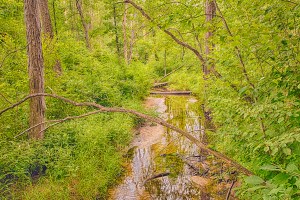 Following a cool and wet spring, much of summer in the area has been warm and dry. In fact, region meteorologists reported that the past month has been the driest July since before World War II. I have mentioned in another journal entry that many days in recent weeks have been completely cloudless. Consequently, rainfall registered throughout July has been approximately a third of the average accumulation for that month. However, the final day of July brought a totally overcast sky offering diffused soft light with a lack of wind. As I have noted in previous posts, such an absence of shadows under harsh light and a stillness of foliage present ideal conditions for photographing woodland images. Therefore, when I visited the Indiana Dunes State Park Nature Center yesterday to remove my display of photos that had been exhibited in the auditorium during June and July, I also decided to capture images while hiking a couple of trails through the woods and along Dunes Creek, which was so low that its bared sandy bed—full with flowing water in May—now showed in places along the way.
∼ July 25, 2018 ∼ “Damaging and Dangerous Waves”
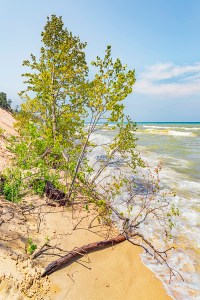 As I noted in my previous journal post, northern winds created high waves and a surging surf along the Indiana Dunes during the past week. Although I seek such conditions because they usually seem suitable for interesting photographs, I have chronicled how they also sometimes cause damaging erosion to the Lake Michigan coastline, washing away layers of beachfront sand and toppling trees at the edge of the shore. When I visited the Indiana Dunes National Lakeshore the other day, I came across a couple who were enjoying themselves by surfing the rough waters, and when I asked about the state of the waves, I was informed they were “fine, just a bit choppy,” apparently not too different from surfing in an ocean for these experienced surfers. However, for most folks the lake current could be hazardous, and for several mornings local advisory warnings alerted all about continuing rip tides that were especially dangerous throughout the region. In fact, at least a half dozen people needed life-saving rescue efforts in recent days, and unfortunately in one sad instance a young woman drowned.
∼ July 23, 2018 ∼ “Surf After Summer Storm”
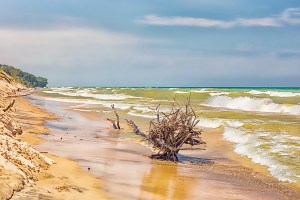 As a landscape photographer, I regularly consult meteorological data and weather forecasts in order to determine when or where to visit various locations for capturing images. Consequently, following a couple of days with rain and cloud cover this past weekend, I checked conditions along the Lake Michigan coast, where beach hazard statements had been posted due to high waves of 5-8 feet and had warned about dangerous rip tides. Although the solid overcast began to clear near noon on Sunday, reports indicated continuing north-northeast winds would maintain a turbulent surf through the afternoon. Therefore, I returned to the narrow ribbon of sand at Central Beach, which I have noted in previous journal posts (please see my 4/10/18 and 3/15/18 entries) tends to be washed away by incoming waves under such wind currents. Indeed, as I walked the slim shoreline usually busy with swimmers or sunbathers on blankets, my feet frequently submerged in rising water overrunning the beach and reaching toward the steep incline of dunes, the entire stretch seemed isolated and inaccessible, creating a serene sense of solitude to savor.
∼ July 18, 2018 ∼ “Sand Trail to Dune Ridge”
 As we passed the mid-mark of the month, regional meteorologists reported the first half of July in this area was among the sunniest on record. Consequently, many days have exhibited cloudless skies of clear blue. While hiking through the Indiana Dunes I arrived at a route rising high up a small hill, and I peered toward the peak where the path of a sand trail seemed to disappear, swallowed by powder blue. When framing an image, photographers always are aware of various elements of composition, including color harmony or which emotions might be evoked by color combinations. Due to the dominance of green foliage and blades of grass under blue skies, summer scenery usually suggests serenity. More than other colors, green creates a sense of ease on the eyes that relaxes the mind of observers. Furthermore, blue is considered a calming influence for any viewer. Therefore, I find hiking during this season in settings like this to be an ideal way for anyone to reach relief from the anxieties of everyday existence, and so I captured this simple image for sharing.
∼ July 13, 2018 ∼ “Clear Sky Above Lake Michigan”
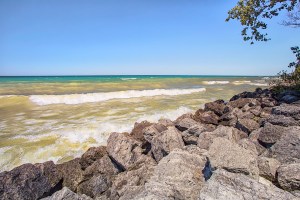 News reports yesterday indicated that thus far this summer has been the sixteenth wettest in the region’s recorded history. As I noted in my previous posts, there has been a continuing pattern of powerful storm fronts moving though the Midwest with a series of heat spells between those days of heavy rainfall. Consequently, this season to date has also started with higher temperatures creating a daily average that currently stands among the top twenty warmest meteorological summers on the books. The skies in the past week—since our strong Fourth of July thunderstorms—have remained clear. Indeed, the wide blue fields above seemingly have rarely been crossed by an isolated cloud lately. Although such pure blue skies usually aren’t appreciated by landscape photographers because sunlight becomes harsh and the bland emptiness appears boring, I frequently encounter individuals who comment about how I must enjoy these conditions for my photography, as one friendly beachgoer said to me just before I snapped the accompanying image. Nevertheless, when preparing to capture the scenery, I deliberately chose to take advantage of the lack of clouds and to use the overhead blue as a contrasting element to the surf and stones in the lower section of the composition.
∼ July 10, 2018 ∼ “River After Summer Thunderstorms”
 The weather throughout much of latter spring and early summer has continued to feature heat spells interspersed with wet days displaying heavy rainfall. Consequently, the scenery has remained pleasing to the eye, lush with green leaves, grass, and underbrush. Sometimes in drier years, the landscape has become somewhat spotty with patches of brown by this time of the season. In addition, levels of local waterways often would be at their lowest points. However, a couple of days after another wave of strong rainstorms blew through the region late last week, and hearing news reports of a few local rivers reaching near their flood stage, I decided to hike a favorite trail along the Little Calumet River so I might examine its condition. Although not overflowing the banks, the slow current seemed to have swollen to capacity, its muddy and almost still water spreading the entire width between the thick foliage of tree lines on either side.
∼ July 7, 2018 ∼ “July Afternoon at Central Beach”
 Although the weather has been hot and humid during much of the past few weeks, as I noted in my previous post, a line of strong thunderstorms passed through the region Wednesday evening. Indeed, all Fourth of July fireworks displays in the area needed to be postponed as downpours of rain and powerful gales swept away the evening’s festivities. Consequently, a spectacle of thunderclaps and lightning bolts provided the only entertainment, and an eventual shift in wind directions temporarily brought cooler temperatures. Additionally, northern gusts caused authorities to close local beaches along Lake Michigan to swimmers due to dangerous conditions with high waves and hazardous rip currents. Therefore, I traveled to the Indiana Dunes on Friday to photograph the coastline. When I arrived at Central Beach, I found a surprising number of sunbathers crowded together, clustered in a section where the sandy strip had narrowed because of the incursion of an incoming surf, but a little bit of space for blankets persisted. However, as I walked farther on, I came upon a stretch of shore where the water had washed away any place that could accommodate beachgoers, and the scenery suddenly seemed more appealing.
∼ July 1, 2018 ∼ “Dune Wood Trail in Summer”
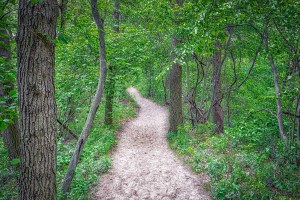 Like much of the eastern half of the nation, our region has been experiencing a spell of scorching temperatures in the mid-90s with heat index levels around 110. Of course, since this weekend bridges the end of June and the beginning of July, one expects to experience such conditions, perhaps repeatedly, in the next month or more. However, whenever the weather reaches toward record high levels, I am reminded that among the best walks in the Indiana Dunes at this time of year might be leisurely hikes along those upper trails winding through the woods just inland from Lake Michigan, where whatever onshore breezes that exist might yet be felt and the thick canopy of trees provides abundant shade. Indeed, in summer some air temperatures on the routes through the dune woods can be cooler by ten degrees—maybe even closer to twenty degrees less than on the sunny lakeside slopes of dunes where the reflective sunshine and heat waves rise from the shoreline sand. I always enjoy traveling toward the coast under the green umbrella of leaves filling branches arching overhead, especially when slowly walking in sections of the forest alive with birdsong yet near enough to the lake to also hear the insistent sound of surf inviting one to eventually emerge from the woodland and step into its refreshing water.
∼ June 27, 2018 ∼ “Just Before Sunset at Central Beach”
 After an early summer afternoon with partly cloudy skies and comfortable temperatures, I decided to drive to the Indiana Dunes for a late visit before darkness fell over the coastline. Often, especially in this season, I will walk one of the beaches along Lake Michigan during evening hours as I seek a sunset photo. Though I frequently suggest no sunset is disappointing, I must acknowledge some are more favorable for photography. Indeed, to capture the best sunset image along the lake various preferred conditions—in lighting, cloud cover, wind, waves, shoreline, beach crowds, bathers, motor boats, etc.—need to be in place. In most instances at least one element seems to be uncooperative. Therefore, although the stretch of beach I selected was completely free of other visitors and the weather was mild, I was not surprised when I found clouds and haze clotted along the horizon, a dark band also covering the distant Chicago skyline, which I knew would prevent a true sunset shot. Consequently, I chose to capture an alternative image just before sunset while indirect sunlight still lit the sky and reflected on the surface of the lake.
∼ June 25, 2018 ∼ “Hazy Sunset, Late June, Lake Michigan”
 As I mentioned in a previous journal entry and in commentary accompanying a recent photo essay, I enjoy depicting Lake Michigan in various luminous images, especially under a late slant of sunshine or at sunset. In the description with my photo essay I noted how “I sometimes prefer to blur the figurative forms in a scene to allow for the primacy or purity of light and color.” I regard these photographs as mirage images. On certain evenings when the sky displays a narrow layer of cloud cover or, especially in summertime, when a day of humidity creates a haze over the faint horizon line, filtered sunlight often offers a magnificent exhibition that may be reflected on the calm surface of the water. Indeed, the entire scene sometimes seems to resemble an abstract artist’s painting with a vivid array of colors splayed across the canvas, or perhaps the vista might appear similar to Claude Monet’s famous ghostly impressionist sunsets that he mirrored in the Thames River or on the water of a Venice lagoon.
∼ June 14, 2018 ∼ “Wooded Trail to Dune Ridge in June”
 In an interesting book I have mentioned before in a pair of journal posts (please see my entries of 8/2/17 and 8/20/17), On Trails: An Exploration by Robert Moor, a variety of characteristics and determined values of hiking trails are defined on its pages. Among Moor’s observations about desirable traits of such trails, he suggests the “most important, it must be deemed worth exploring—which is to say, people must first have learned how to derive worth from it, be it aesthetic or aerobic.” Certainly, my appreciation for various paths winding though the Indiana Dunes includes both aesthetic and aerobic attributes. I enjoy the rich colors of foliage and quality of textures among my surroundings, and I recognize the gain received from exercise, especially when climbing steep and sandy dune routes. Moreover, as I frequently note, during my travels through dune woods I always anticipate the reward of finally arriving at the top of a ridge rising high above Lake Michigan, where I look forward to that first glimpse I will find at the top, a place to view a vista of the whole coastline extending far into the distance, as shown in my previous post.
∼ June 11, 2018 ∼ “Late Spring Lake Water Levels”
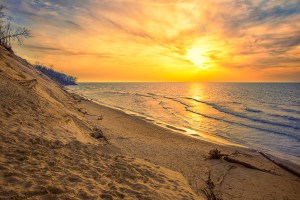 Although the water level of Lake Michigan fluctuates throughout the seasons and will vary each year, current measurements indicate the lake’s surface this spring has risen by its highest amount in two decades. News stories report figures kept by the U.S. Army Corps of Engineers display May’s numbers are significantly above average. Though not yet reaching any records, wet weather in June could cause the lake level to approach those heights. The elevated level for the Great Lakes may be good for commerce, allowing ships to carry greater cargo loads and to enter harbors more safely; nevertheless, visitors to the Indiana Dunes this summer will see beaches with narrow bands of sand and will notice increased incidents of erosion at the base of those dunes along the edge of the coastline, especially if strong winds from summer storms force powerful waves onshore. Such developments could exacerbate damage already created during this past winter’s storm surges and northern gusts, as I have noted in previous journal posts (please see my 3/15, 4/10, and 4/23 entries). However, experts suggest the raised levels observed each of the past three years are temporary, and the lake could return this winter to a stage with readings lower than average, as was the case just four years ago.
∼ June 5, 2018 ∼ “First Glimpse of Lake Michigan Looking Toward Chicago”
 When I guided a group of fellow photographers for a photo walk along Trail 7 at Indiana Dunes State Park on Saturday, National Trails Day, I especially enjoyed my conversations with each of the friendly participants as we traveled though woods and climbed the inland side of the dunes. Although we often slowed our progress to observe a few clusters of flowers or paused to capture with our cameras the texture of bark on a fallen tree trunk, during our discussions I repeatedly expressed my enthusiasm for the scenery we would eventually witness when reaching the top of the final heights to obtain our initial glimpse of Lake Michigan with the faint image of a Chicago skyline possibly in sight, barely visible a distant fifty miles away. Indeed, whenever I hike routes though the dune forests, no matter the season, I anticipate rising over one last ridge for that first view of the lake’s expanse spreading below me and extending toward the horizon. However, especially in late spring, the suddenly bright and colorful vista seems even more magnificent when experienced by emerging from the shadows of fresh foliage finally filling the landscape or sometimes when framed by bare limbs of a still-empty tree.
∼ June 3, 2018 ∼ “Trail 7 Photo Walk”
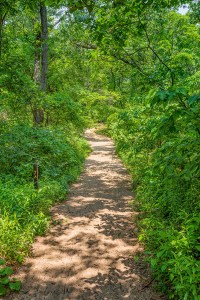 Saturday afternoon I assisted Marie Laudeman, a naturalist at Indiana Dunes State Park, in guiding a wonderful group of nearly 20 visitors on a photography walk along Trail 7. Marie provided valuable information about plants, trees, birds, butterflies, and points of interest for photos, such as distinctive mushrooms or flowers. I offered advice on certain elements of photography, such as composition and camera settings. I enjoyed speaking with the group in a preliminary introduction and then engaging in friendly conversations with each of my fellow photographers as we traveled the short route to Lake Michigan and back to the Nature Center, a bit more than a mile each way. I also spoke about Frank V. Dudley’s famously influential paintings created at the Indiana Dunes, and how my pictures sometimes attempt to imitate a few of the artworks by shooting the photos in locations or with perspectives similar to the ones Dudley chose. An active man, Dudley frequently hiked trails deep within forests just inland from the cottage he and his wife had built beside the beach in 1921. Dudley’s waterfront studio was situated at the base of a sand dune below Mt. Holden. Paths leading to the shore not far from the Dudley structure would include Trails 4, 7, and 8. Not surprisingly, these trails seem to be depicted in a number of his pieces. Indeed, one of the paintings bears a title identifying itself as The Seventh Trail (1953), an image of which we carried with us in order to identify the exact spot where Dudley might have stood while working on his canvas.
∼ May 31, 2018 ∼ “Lakeside Trees in Late Afternoon Light at End of May”
 Although capturing a sunset over Lake Michigan had been my prime intention when visiting the Indiana Dunes recently, I temporarily turned my camera toward the opposite direction while I awaited the right time. As I photographed a calm lakeside scene in late afternoon sunshine under a clear sky at the end of May, I was reminded of one cliché in photography that claims light is the most essential element in any image. The great nature photographer Galen Rowell famously declared he never sought an object in the landscape when looking for subject matter. Instead, his first thought was always of light. George Eastman advised: “Light makes photography. Embrace light. Admire it. Love it. But above all, know light. Know it for all you are worth, and you will know the key to photography.” Of course, painters also recognized the importance of luminosity in perceiving the landscape. Claude Monet observed that he enjoyed any opportunity to focus on “the object enveloped in sunlight and atmosphere, with the blue dome of Heaven.” Indeed, he believed “a landscape does not exist in its own right, since its appearance changes at every moment; but the surrounding atmosphere brings it to life—the light and the air which vary continually.”
∼ May 29, 2018 ∼ “Mirages on Memorial Day”
 1.) In my most recent photo essay, I noted how “I sometimes prefer to blur the figurative forms in a scene to allow for the primacy or purity of light and color, perhaps the way a painter might produce an abstract landscape.” I regard these more sensuous images (such as “Spring Shoreline” included here) to be “mirage photographs.” 2.) Though winter temperatures lingered through March and April, with spring weather finally arriving late this year, the last weekend of May suddenly appeared to signal a skip from spring into an early arrival of summer heat. Region highs reached from the mid- to upper-nineties, and these record levels almost seemed to erase my memory’s mirage involving the long hold of cold conditions on the region. 3.) In fact, as I lay on a hammock in my screen porch enjoying the warmth, a cool drink in my hand and a refreshing breeze from a fan flowing over my body, I reread Teaching a Stone to Talk, a collection of essays by Annie Dillard. Appropriately, in a piece titled “Mirages” Dillard writes how each season sometimes seems to be a mirage. For instance, in winter “it is as though summer itself were a mirage, a passive dream of pleasure, itself untrue. For in winter the beaches lie empty; the gulls languish; the air is a reasonable stuff, chilled and lidded by clouds.” Likewise, summer surely “is a mirage. The heat is on, and the light is on, and someone is pouring drinks…. This is the life of senses, the life of pleasures.”
∼ May 27, 2018 ∼ “Religious Twilight’: Mark Rothko and Stanley Kunitz”
 When I arrived at Lake Michigan Friday evening, I had hopes for photographing a stunning sunset. All afternoon an interesting blend of fluffy clouds and sunshine promised to offer an ideal situation for a dramatic image. However, as I stood on a beach at the Indiana Dunes with my tripod set along the water’s edge on that windless evening, I watched the skies transform when strips of dark clouds slowly approached above the far shore and a faint haze spread in the distance, extending across an almost still lake. By the time sundown arrived and the blue hour began, the horizon had become nothing more than a painted sky, a gathering of colorful bands with an indistinct and somewhat dull violet cast covering the surface of the lake. The skyline resembled a Mark Rothko multiform painting with blurred blocks of concentrated color floating across a large canvas, which seems ironic since Rothko expressed a strong dislike of nature and being categorized as “an abstract landscapist.” Rothko considered his artwork to be spiritual, more than a juxtaposition of color fields, and he prized his relationship with poet Stanley Kunitz, who helped inspire and encourage the painter, as can be detected in an audio interview with him about Rothko. In his comments, Kunitz explains the desired effect of “a religious twilight” in Rothko’s famously dark Chapel paintings, a term I felt appropriate for the scenery opening in front of me.
∼ May 26, 2018 ∼ “Poetry, Photography, and Romanticism”
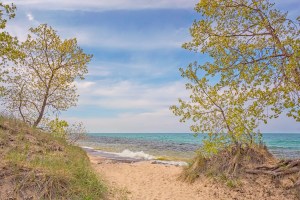 This past week I published the newest issue of Valparaiso Poetry Review, a journal I founded and have edited since 1999. Anyone who knows me or has followed my work would be aware that I am both a photographer and a poet. The poems in my books frequently adhere to the three themes Charles Wright has identified as the main concerns in his great poetry: language, landscape, and the idea of God. As Wright recognizes in his summaries about attitudes of contemporary critics, this trio of topics is often regarded as out of fashion and perhaps even seen negatively as sentimental. However, I prefer to view them instead as productively continuing the precepts of Romanticism, especially as practiced by the pair of nineteenth-century poets Wright admires and observes as models, Emily Dickinson and Walt Whitman, whose approaches to poetry he attempts “to marry” in his own work. Likewise, my perspective on landscape photography also aligns closely to Romantic perceptions. My intention when capturing images in nature remains the depiction of an individual, emotionally heightened, and sometimes almost spiritual response to the natural environment accompanied by commentary containing a tone I hope appears similar to that in the prose of another Romantic author, Henry David Thoreau.
∼ May 20, 2018 ∼ “Afternoon Light in Late May”
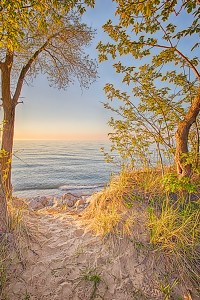 Now that the academic year has reached its end with finals and graduation this past week, I have begun my annual habit of summer reading, which normally consists of two lists of books—those texts read in the past that I revisit for another examination and new titles I have decided to explore—including poetry, fiction, and nonfiction. Consequently, as I started by returning to the poetic works of Charles Wright, I remembered a piece titled “May Journal” (from Xionia, 1990), which seemed a suitably timely poem with which to open my ritual process, especially since milder spring weather finally has appeared after weeks of delay due to unusually cooler conditions. I have been fascinated by the strengthening seasonal sunlight, though I find it even more interesting because the radiance remains angled from the southern sky a bit. The daylight’s increasing brilliance lately has often cast a fantastic hue of warmth onto the landscape, across the surface of Lake Michigan, and along the distant horizon, particularly later in the day or in the evening as sunset nears. In his poem, Wright describes such an influence as “the sunlight / sweeping the high May afternoon with its golden broom.”
∼ April 30, 2018 ∼ “Awaiting April Weather in May”
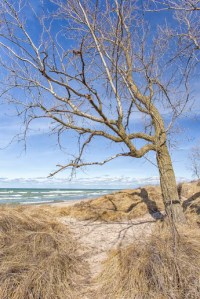 As this month comes to a close and May arrives, we are still awaiting typical April conditions that haven’t yet appeared. This might qualify as the coldest April in recorded history for the region, or at least the coldest since the 1800s. Monthly meteorological statistics at nearby Chicago indicate the average high temperature for the past four weeks stands at about 47 degrees, while the normal April average high would be 59 degrees. The daily difference of a dozen degrees has significantly influenced the water temperature of Lake Michigan (which I noted in previous journal entries), keeping air temperatures quite cool, and stymied the development of spring conditions in the landscape around the lower lakeshore. Hiking trails or walking paths through the dunes, I cannot recall another year when tree limbs remained bare and wildflowers were rarely seen upon the arrival of May. Indeed, last week a botany photo walk activity in the dune woods that had been scheduled to capture images of blooming flowers or budding branches needed to be redirected to focusing on other aspects of the scenery.
∼ April 23, 2018 ∼ “Earth Day Sunset at Central Beach”
 Since Sunday was Earth Day, I decided to celebrate by revisiting Central Beach for an opportunity to photograph the sunset beyond Lake Michigan. In previous posts (please see my 3/15 and 4/10 entries) I have spoken about the extensive erosion that occurred here due to storm surges and strong northern winds during the winter months. In the case of this isolated stretch of coastline in the Indiana Dunes National Lakeshore, the beach had been completely washed away and a number of trees from a crumbling dune ridge along the shore had fallen to the surf. Yesterday, I was pleased to see a thin ribbon of sand once again visible beside the calm lake, though it only could be reached by climbing down a steep incline from high above the water’s edge. Indeed, the beach still seems vulnerable to erasure on any day displaying large waves. Though a cold breeze kept temperatures chilly, the sun dipped below the horizon just south of the Chicago skyline and warmed the western skies.
∼ April 21, 2018 ∼ “Path to Beach at Sunset on Chilly Spring Evening”
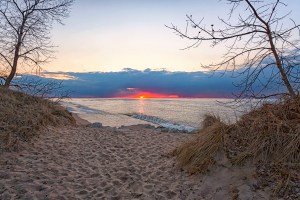 As we move three weeks into April, a near record chill has continued across the region, and the growth of foliage on trees or flowers along trails usually seen at this point of the season has not yet occurred. Most days this month have witnessed onshore winds cooling the Indiana Dunes shoreline with currents blowing over lake water still much colder than normal for this time of year. Indeed, some reports indicate this April perhaps may be the coldest since the late 1800s. Consequently, the Lake Michigan water temperature has remained quite low. In fact, apparently the shoreline temperature measured at Chicago is fifteen degrees colder than on this date in the past year, and the overall surface of Lake Michigan is more than three-and-a-half degrees less than last year. Water levels have also risen significantly in comparison to 2017. Importantly, when examining previous Aprils exhibiting similarly cold conditions, almost without exception those years also experienced cooler than normal summer seasons, partly because the lake temperatures never fully recovered.
∼ April 12, 2018 ∼ “Chill of Winter Lingers into Spring”
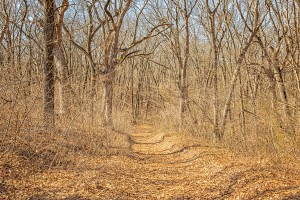 I noticed a report yesterday indicating the first ten days of April this year ranked as the second coldest opening of that month in the region’s recorded history. Certainly, the chill of winter has lingered into early spring, but I usually enjoy traveling trails through the Indiana Dunes in such conditions to seek initial signs of the season. Since the trees remain bare, a walk in the woods sometimes resembles an entrance into an artistic environment. Limbs crisscross and bend in different directions. Arching branches frame the way ahead, and the remnants of last fall’s leaves still litter the ground, now almost golden under strengthening sunshine. Views through the openings between tree trunks allow for occasional glimpses of deer rustling among stark features of a yet empty forest. All animals are difficult to detect once the undergrowth thickens. Moreover, I am able to spot a woodpecker at the source of that sharp tapping heard from some distant location, which will be hidden from sight when foliage fills in late spring or the beginning of summer. Such details remind me of a passage in Walden; or, Life in the Woods where Henry David Thoreau wrote: “I am on the alert for the first signs of spring, to hear the chance note of some arriving bird, or the striped squirrels chirp…or see the woodchuck venture out of his winter quarters.”
∼ April 10, 2018 ∼ “Beach Erosion Revisited”
 In a journal entry posted on March 15 I noted the passage of an Indiana law that had just been signed by Governor Holcomb calling for “companies removing sand from the shoreline of Lake Michigan as part of construction or renovation projects to relocate the removed sand directly onto designated beaches along the Indiana Dunes.” Since I had focused on examples of erosion along the Indiana Dunes east of the state park—such as Central Beach in the accompanying picture—through previous commentary and a photo essay, I was pleased to see this act put in place. However, in Sunday’s newspaper an article indicated the effectiveness of the law might be minimal in the immediate future since its enforcement does not begin until July 1, and the language of the rules might only apply to new permits rather than those already existing. In addition, the Portage Lakefront and Riverwalk, a popular area farther west and evidencing severe erosion, is endangered further since the Army Corps of Engineers conducting dredging offshore doesn’t seem to need a permit. Any study that could compel the Corps to ship sand onshore, as had been determined by similar research involving the Mt. Baldy beachfront, would likely extend three years. Nevertheless, officials are searching for quicker solutions, such as petitioning for inclusion in a special Beneficial Use of Dredge Material Pilot Program or hoping for funding from a possible national infrastructure budget proposed by President Trump. This is an issue worth watching, especially as the summer months arrive and the region becomes busy with visitors.
∼ April 7, 2018 ∼ “Print as Performance”
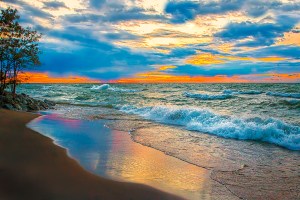 I do not discuss the practical photographic process very much in this forum, and I very rarely mention gear. I acknowledge normally finding writing and reading about such subjects can be somewhat boring or tedious. However, I must admit I enjoy personally printing digital images since they usually appear more impressive than when viewed on a monitor, particularly when computer screens vary in their color calibration. During my days as a college student, although I maintained a darkroom with equipment for developing black-and-white or color film, I never really liked the conditions—the chemicals, the cost, the fragility, the isolation—about which other photographers seemed so fond. Nevertheless, this weekend I was reminded of my delight in digital printing as I prepared a photograph for display at a charity silent auction in which I have been invited to participate. I decided to prepare the accompanying photo for exhibition at the event in an 18”x24” frame, which is the largest size I am able to print in my home studio without unnecessary complexity. Since I will be signing the work, I wanted to manage every stage in the image production—photographing, processing, and printing. When I provide a larger format, such as a 24”x36” print, to fulfill an order by a client, I reluctantly must outsource the printing to a lab, which does a wonderful job, but I feel frustrated by not having control over every aspect of the picture’s appearance. As Ansel Adams famously commented: “The negative is the equivalent of the composer’s score, and the print is the performance.”
∼ March 31, 2018 ∼ “Good Friday at Sunset”
 In the past I have written about the added significance for me of Lake Michigan scenery on Good Friday at the Indiana Dunes. A journal entry last year noted: “Pam and I spent our first date with a walk along dunes overlooking Lake Michigan on Good Friday years ago. Hiking high above the beach on a clear and warm afternoon, we could look across the water into the distance to see an outline of the Chicago skyline. Actually, that earliest trip to the shore by Pam and me took place on April 20; however, I have always remembered the day simply as being Good Friday, and over time I have emphasized that ‘good’ is an understatement.” Then, flowers already were blooming and beach trees displayed almost full foliage. Since Easter weekend arrives in the end of March this year, though the evening was quite pleasant, the weather was not as warm when I captured an image of the Good Friday sunset. Indeed, the sun barely brightened a sliver of the horizon below deep blue skies and a line of clouds covering the Chicago shoreline, but the glimmer of light allowed visibility of the city skyline once again, this time bathed by a beautiful orange glow.
∼ March 22, 2018 ∼ “Homage to My Hiking Boots”
 After more than four years of hiking an accumulation totaling about a thousand miles—between trees, down dunes, into swamps, up hills, along ridges, on beaches, through marshes, and across creeks—while wearing my favorite boots, I have finally replaced them with a new pair. Although the sole of one was coming loose and the cloth ankle collars had torn, separating from the leather, I had continued to use these shoes because of the wonderful comfort they offered. When traveling in them, despite their rugged sturdiness and dependable waterproofing, I felt almost as if I were wearing slippers. This week I trekked Trail Nine, one of the longest in the Indiana Dunes State Park (at times steeply rising to the tops of dunes then circling above the Beach House Blowout and Furnessville Blowout) with the new pair, which fortunately felt just as comfortable as the old ones. Indeed, in preparation for transitioning to the new boots for my nature hikes, I had already worn them frequently during everyday walking in most seasons for almost two years. This is a process I am following once again, as I purchased another new pair last week that I will prepare for substitution the next time around.
∼ March 20, 2018 ∼ “Spring Begins at Kemil Beach”
 Although a slight northern breeze still sweeps across the cold water and shifts cooler air onshore from Lake Michigan, the official beginning of spring occurs today. As days lengthen, strengthening sunlight illuminates the dunes, tinting the white sand a bit more tan, at times almost golden, and gradually rising temperatures hint at warmer spring weather ahead. A familiar pair of trees flanks the entrance to Kemil Beach. Their branches remain bare, yet the limbs are lightened by bright sunshine. Perhaps as metaphor, this entrance through the dunes—with its trail reaching to the beach below, where the horizon opens above a smooth lake surface that had been covered with thick ice less than a month ago—offers hope for more pleasant days to come in the new season. Once again, I am reminded of Henry David Thoreau’s observations written in March of 1846 on the start of spring: “Suddenly an influx of light, though it was late, filled my room. I looked out and saw that the pond was already calm and full of hope as on a summer evening, though the ice was dissolved but yesterday…. It was no longer the end of a season, but the beginning.”
∼ March 15, 2018 ∼ “New Law to Help Replenish Eroded Indiana Beaches”
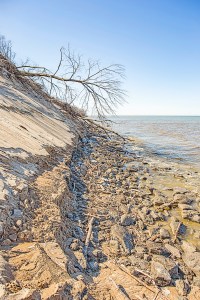 A new act passed by the Indiana Senate—one that would compel companies removing sand from the shoreline of Lake Michigan as part of construction or renovation projects to relocate the removed sand directly onto designated beaches along the Indiana Dunes—was signed by Governor Eric Holcomb on Tuesday. A key sentence in Senate Bill 178 states that sand taken “from the bed or from under the bed of Lake Michigan…may only be deposited on the beach of Lake Michigan and may not be removed to any other place or used for any other purpose.” As I recently indicated in my journal entry of March 6 and in a couple of my March photo essays, due to extensive erosion caused by winter storms and strong northern winds, many locations on the coast desperately need to be replenished. Indeed, as my accompanying photograph of the destruction at Central Beach displays, entire sections of Indiana beaches have been severely damaged, and in some cases completely washed away.
∼ March 8, 2018 ∼ “Woods with Late Winter Snow”
 Northwest Indiana weather conditions in March can vary as much as or more than at any other time period during the year. This month’s historical meteorological record presents evidence of the largest increase in average daily temperature compared to the other eleven; extremes seen in the past range from a low in the minus double-digits to a high nearing ninety degrees. Consequently, despite sometimes experiencing a brief series of milder days, opportunities for photographing an occasional line of late winter snow slipping across the region can be expected from the end of February through the first few weeks of March. (Since the clocks are adjusted ahead an hour for Daylight Savings Time as well, one must also adapt to this shift for capturing images of sunrise or sunset.) Nevertheless, light snowfall this far into the season can be appreciated by all for the temporary decoration of tree trunks, bare limbs, and shrubbery, particularly since everyone knows melting and a return to more moderate weather will occur quickly.
∼ March 6, 2018 ∼ “Exploring Eroded End of Path at Mt. Baldy Beach”
 When I explored the shore line along Lake Michigan this past week in an effort to examine the extent of damage done to the beaches and dunes by winter weather, I decided to hike the short trail to Mt. Baldy Beach. As I noted in a journal entry posted last summer, the coast beside Mt. Baldy recently had reopened after being closed to visitors for a few years. However, access to the lake is still limited to a narrow dune path that emerges from the woods at a height above the waterline. The descent normally proceeds gradually along a lane between posts linked by rope lines. [An image of the intact passage taken last summer accompanies my August 3, 2017 journal commentary.] Due to winter’s winds, snow accumulations, and heavy rains, I discovered much of the sand dune supporting the path has collapsed, creating a sudden drop of about thirty feet. Fortunately, one of the ropes dangling toward the beach provided an opportunity for me to rappel to the shore line to capture a series of images offering evidence of erosion at the water’s edge and then to climb back to the trail afterwards.
∼ March 2, 2018 ∼ “Dunes Creek at Start of March”
 The start of March seems to offer indications wintry weather now stands in the past. Although the official beginning of spring remains nearly three weeks away, the sun has already begun to strengthen as the angle of light shifts farther north each day. Dunes Creek yet runs almost full due to last week’s heavy rains that also melted all lingering accumulations of snow. In this slant of sunlight, the tall grasses along banks of the waterway appear nearly golden. Bare branches of trees bend above the trail, and long shadows of limbs reach toward the north. As I walk in this late morning, I am reminded of Henry David Thoreau’s Journal comment from late winter during 1852: “The sky appears broader now than it did. The day has opened its eyelids wider. The lengthening of the days, commenced a good while ago, is a kind of forerunner of spring.” [Journal, February 19, 1852]
∼ February 24, 2018 ∼ “Indiana Supreme Court Ruling on Lakeshore Beaches”
 Ten days ago, coincidentally on Valentine’s Day, the Indiana Supreme Court offered a gift to all who appreciate and have affection for the shoulder of land along Indiana’s shoreline by issuing an important ruling influencing public access to beaches beside Lake Michigan. In a 4-0 decision, the justices reaffirmed a longstanding premise that land extending from the highest water mark occurring due to fluctuations in the level of Lake Michigan all the way down to the water and into the lake belonged to the people of Indiana, thus could not be claimed by private ownership. In an extensive 29-page explanation authored by Justice Mark Massa concerning a case about a disputed stretch of Long Beach in LaPorte County, the court apparently confirmed this definition repeatedly declared since Indiana statehood happened in 1816. Though the issue is more complex than news reports suggest and there are justified concerns expressed by the plaintiffs, I was pleased to see such a commonsense description upheld by a unanimous decision of the court. (One member, Justice Geoffrey Slaughter, recused himself from the case because his family owns lakefront property.) However, I also trust visitors rewarded by this ruling will regard and retain the purity of the beaches, and I hope they will respect the rights, as well as the privacy, of those who own land adjacent to the coast.
∼ February 22, 2018 ∼ “Flooding in February”
 Following a couple of days with steady and heavy rain, I returned yesterday to the Little Calumet River, where I had walked a trail along its bank on Sunday in calm conditions and warming weather to observe the process of thawing. (Please see my previous journal post.) However, after rainfall within the region amounting to totals between five and seven inches, which added to the accumulation of melting snowfall already on the ground, I found the path I’d hiked had disappeared under a half dozen feet of water. The river had widened well beyond the bordering woods and far in the distance, inundating deep into forested land and flowing over the only road that passes through the location. For a while I was the sole individual exploring the transformed landscape, much of it unrecognizable from its usual appearance. However, as I returned to my car parked near a bridge where the water level met the road, another visitor arrived with his camera and we spoke, both agreeing the river seemed to have risen to the highest we’d ever witnessed.
∼ February 20, 2018 ∼ “Little Calumet River Trail During Tranquil Thaw in February”
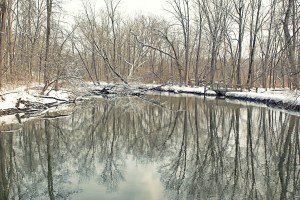 The weather in Northwest Indiana transitioned dramatically during the past few days. Cold and snowy conditions overnight Saturday and into Sunday morning gave way to moderating temperatures, and by Monday through Tuesday steady rainfall, at times in the form of heavy downpours with flood warnings, was accompanied by warming southern winds bringing the thermometer toward a record high level. I managed to hike a few locations at both the Indiana Dunes National Lakeshore and Indiana Dunes State Park during the thaw and before the stronger thunderstorms moved across our region. I walked the Little Calumet River Trail while the landscape remained fringed with white, and I photographed a few spots along the waterway, including a bend where the already thawed water stayed still enough to reflect those bare branches of bending trees along the banks. During my travel this weekend I only came across one other individual hiking along the Bailly-Chellberg Trail, a birdwatcher carrying his binoculars instead of a camera. Upon greeting one another, both of us noting the calm and quiet of the setting, he smiled and commented: “When I am out here, I don’t have a care in the world.”
∼ February 19, 2018 ∼ “Brauer Museum 3-D Tour with Frank V. Dudley Exhibition”
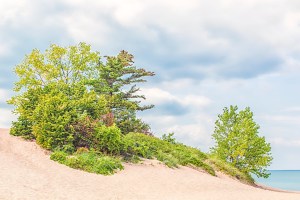 In a few journal entries published during the fall and summer I mentioned an excellent and extensive art exhibition of Frank V. Dudley Indiana Dunes paintings in the Brauer Museum at Valparaiso University. (To view the commentaries, I suggest visiting the following posts: Nov. 3 2017; Sept. 17, 2017; Sept. 9, 2017; Aug. 25, 2017; and Aug. 23, 2017.) I have frequently expressed my appreciation for the art and activities of Dudley, who along with other environmental activists worked to protect and preserve the natural habitat in Northwest Indiana along Lake Michigan. Indeed, I have credited this “Painter of the Dunes” as a main inspiration for my works, images like the accompanying photo, which often display his influence in composition and tone. I am now delighted to report that the Brauer Museum offers a 3-D tour online for all to visit, and the production occurred while the terrific Dudley exhibition was installed. Therefore, if you didn’t have an opportunity to observe the show, here is your chance to enjoy the artworks at the online link.
∼ February 13, 2018 ∼ “Beach Trees Beside Frozen Lake Michigan”
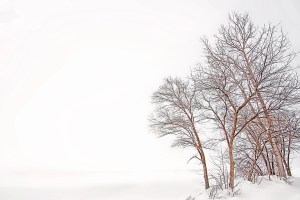 With a series of snowfalls moving through the region during the past week much of the landscape seemed to appear as if captured in images approximating monochrome when photographed. I frequently remark upon my enjoyment experiencing cloudy and snow-filled wintry scenery. Although I am aware of an absence in vivid colors, especially those evident during glorious sunrises or sunsets in summer months, the simplicity of composition in muted winter images that approach minimalist pictures appeals to my appreciation of aesthetic clarity, particularly when there are clear lines stretching or tangled amid a field of pale space. As I was walking along the shore this weekend, the whole of Lake Michigan frozen and white beside me, I noticed how the beach trees drew more attention than when competing with the rich colors of lake water, blue skies, green leaves, golden sand, and sunset tints. Indeed, the bare limbs, reaching toward a blank atmosphere above and leaning over an almost ghostly coast, become even more artistic and elegantly pleasing to me.
∼ February 11, 2018 ∼ “Forest Footbridge After Snowfall”
 Whenever hiking through the Indiana Dunes landscape after a snowfall, I find myself challenged to be the first to arrive upon a trail so that I can photograph the scenery without the disorder or distraction of footprints. Since I must travel a distance and the dunes routes are popular even in winter with hikers or cross-country skiers, rarely do I discover paths untouched by previous visitors. However, following Friday’s heavy snowstorm, which lingered with waves of snowfall overnight, I managed to make my way on Saturday morning to a few locations along the shore of Lake Michigan and into the nearby woods that had not yet been tread upon. Perhaps the cold temperatures and knee-deep accumulation of snow had dissuaded others from trudging through these courses; nevertheless, I was pleased to see the clean surface of snow extending smoothly ahead of me in many places, including this forest footbridge along the Calumet Dunes Trail.
∼ February 9, 2018 ∼ “Snow Day”
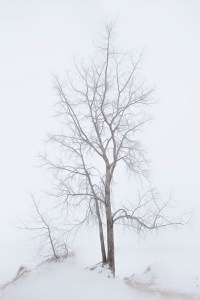 Another series of snowstorms has swept across the Midwest this week, and with accumulations from a new wave today expected perhaps to add about a foot of snow, most businesses and schools have declared a “snow day” and closed their doors. In fact, Valparaiso University shut down Thursday night at nine o’clock in anticipation of the weather event, and reopening is now scheduled for late Saturday afternoon, although a couple more storm fronts are predicted possibly to add snowfall Saturday night and during the day on Sunday. A whiteout due to the heavy and steady snowfall contributes to an atmosphere that transforms the landscape into an eerie setting I find attractive, especially when ghostly trees are seen in silhouette against a gauzy backdrop. Indeed, the Indiana Dunes along Lake Michigan are among my favorite places to visit during wintry conditions, especially when the visibility of the lake water fades into a pale background and the bare limbs of lonely trees extending over ridges above the beach seem so expressive.
∼ January 28, 2018 ∼ “Sandy Shore and Still Waters at Sunset”
 The weather this weekend has been mild and calm for January, and the span of hours displaying daylight has begun to lengthen. In fact, as my wife, my son, and I were walking outside yesterday at about 5:15 p.m., we noticed the distant sky still retained some brightness and the horizon line exhibited a thin flare of sunset. The conditions reminded me of some favorite images I have captured along Lake Michigan at the Indiana Dunes, sunset and shoreline photographs that might be said to consist of three simple characteristics—light, color, and shape—combined to create dramatic scenery. I am often fascinated by the way that light and color interact in a natural setting, especially when looking west from the northern shore of Indiana at a sunset spreading its tints across the grand width of lake. Indeed, the specifics of shapes representing detailed objects one discerns in an image frequently divert attention away from the ethereal mix of illumination and hue in the environment that contains those physical things. Therefore, I sometimes prefer a less representational perspective that allows for the primacy or purity of light and color, perhaps the way a painter might produce an abstract landscape.
∼ January 25, 2018 ∼ “Cowles Bog Trail in Indiana Dunes”
 I enjoy sharing my photographs online in various venues of social media—such as Facebook, Instagram, Twitter, and elsewhere. However, I must acknowledge a special sense of appreciation for opportunities to view my images in other more tangible forms. For instance, I regularly process and print photos myself on quality paper for compilation in an ongoing portfolio. Holding the pictures in my hand and examining the details, included in this bigger size and produced with precision in ink that seeps into the texture of the paper, I value the experience. Moreover, when I increase the image for large format prints and framing, whether for display in an exhibition or for private sale, the scenery seems to be enhanced as well. Finally, as an author who has published written works for decades in books and journals, I find myself particularly pleased whenever my photographs are solicited for book covers or are featured within a magazine. Therefore, I was delighted when the editor of Here—an elegant magazine released every two months in the region that is devoted to arts, culture, fashion, style, and travel—requested one of my photographs of the trail at Cowles Bog for a full-page presentation as a visual epilogue at the end of the current (January/February 2018) issue.
∼ January 22, 2018 ∼ “Tree with Some Remaining Leaves in January Fog”
 Temperatures rose over the weekend and melted most of the snow that had accumulated due to a few earlier squalls of lake-effect snowfall; consequently, thick fog once again enveloped the region. All day Sunday visibility seemed severely limited, especially when driving back roads through wooded areas. Although the hazy conditions appeared to erase many details normally evident in the landscape, I felt a certain sense of intimacy with my surroundings, as I always do when the whitened atmosphere restricts distractions and allows for focus on individual features one at a time. In such weather I usually discover winter trees, whose thin trunks and bare branches create intricate silhouettes, to be some of the more interesting objects among my surroundings, perhaps pieces of natural art. However, on occasion I will come upon one whose slim limbs have held onto a number of its leaves—easily seen against a pale and opaque backdrop—which to my eyes tend to act as decorative elements and present a touch of expression with their little addition of color to an otherwise monochromatic setting.
∼ January 18, 2018 ∼ “Trail of Footprints on Shelf Ice at Lake Michigan”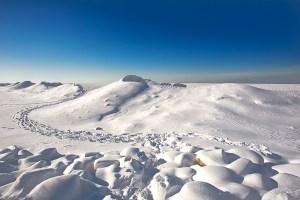
Following a week of frigid temperatures and a day of heavy lake-effect snowfall, Wednesday morning’s clear skies and bright sunshine revealed the shoreline of Lake Michigan at the Indiana Dunes had transformed into unusual scenery reminiscent of an arctic setting. I walked along the beach unable to distinguish where the edge of the coast normally gives way to water. Shelf ice had accumulated into large pale mounds nearly twenty feet high due to solidifying of breaking lake waves, and the whole of Lake Michigan appeared as a craggy white moon-like surface all the way to the horizon. Although the extremely cold air and frozen atmosphere kept most folks away, and prominent warning signs cautioned about a life-threatening situation if one steps onto the shelf ice, a few individuals had carelessly ventured onto a ledge for the full view toward the north, trailing a track of footprints winding from a cluster of coastal stones covered in snow and eventually rising onto a slight gap in the ridge of shelf ice.
∼ January 16, 2018 ∼ “Broken Tree After Snow”
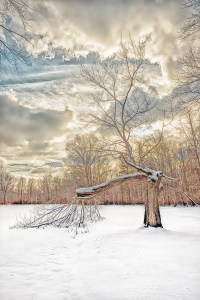 The beginning of the year has been characterized by cold snaps and intermittent snowfall from quickly passing storms or lake effect squalls due to strong onshore winds. Consequently, each time I visit the forests of the Indiana Dunes, I find the landscape changed by the latest spell of weather. Sometimes a coating of ice seems to varnish the bark of trees along trails in the state park, and on other occasions I witness the woods transformed by a decorative fringing of white along tree limbs. In addition, those gales sweeping onshore from the north have damaged or broken numerous branches—thin or smaller ones litter the way while many larger examples remain attached though cracked and angled toward the ground. When I walk these paths in winter, my attention often becomes attracted to constant transitions in the terrain and those natural artworks created by the season’s conditions. Dramatic cloud formations and a low sun positioned just above the tree line in the afternoon sky also can contribute to the overall mood suggested by the setting.
∼ January 12, 2018 ∼ “Tree in Fog After Snow”
 The brief warm spell in the Midwest this week seemed to create a couple of days with thick fog from moisture rising above the layer of snow that had accumulated recently. These conditions caused a dramatic atmosphere in which natural objects appeared to loom through the pale haze, isolated against a surrounding bleached backdrop. Consequently, each feature drew greater attention as though cloistered by the gauze covering everything or placed on a natural stage amid the vast landscape and enclosed in the bright circle produced by soft light of a diffused spotlight. While I hiked a few snow-covered paths winding between empty trees, many hidden by haze until I came close to them, I frequently felt that they were presented to me one-by-one as centers of attention the way an individual might walk from one exhibit to another in the stark environment of a museum setting where white walls serve as neutral background in order to avoid distraction when artworks are viewed with full consideration by visitors.
∼ January 9, 2018 ∼ “Closed Road After Overnight Snow”
 During the final day of an extremely cold spell of sub-zero temperatures and stormy weather that lasted nearly two weeks and bridged the end of 2017 with the start of 2018, I visited Indiana Dunes State Park once again. Although strong northern winds still swept onshore, blowing snow and sand across the beach, when I moved inland between the dune hills, everything appeared calm. Following an overnight accumulation of a few inches, only a scattering of large flurries continued, floating gently between bare branches in the upper reaches of empty trees. As I hiked trails within the park, I noticed locations where an absence of footprints indicated no one had passed all morning. Walking Trail Two toward the east, I also came upon a dead-end side road usually open, even if less traveled than others; however, on this day the staff had placed a chain across the entranceway to prevent passage by automobiles. Consequently, a clean white stripe extended through the woods and into the distance as far as my eyes could see.
∼ January 6, 2018 ∼ “Shelf Ice at Beverly Shores”
 Like much of the country, Indiana has been gripped by an extended spell of extremely cold weather to start the new year. Larry Mowry, meteorologist at the Chicago ABC television station and a graduate of Valparaiso University, reports that this stretch of frigid conditions with twelve consecutive days displaying high temperatures below 20-degrees matches previous records only twice before recorded: those marks were reached in 1895 and 1936. Despite the sub-zero overnight lows and wind chill indicators of -30, I hiked a couple of short trails yesterday at the Indiana Dunes State Park and walked the coast line at Beverly Shores. Though only a few snowflakes fell while on paths through the state park, the shoreline at Beverly Shores was caught in the midst of a strong lake-effect snow band with brisk wind gusts, and I noticed the field of shelf ice had grown tremendously. In fact, the walls of the shelf ice are so tall that one cannot view the lake from the beach. However, even when standing on a high dune in the blasts of onshore winds, one sees that the thick cover of rough white ice extends as far as the eye can see, and the lake has disappeared beneath scenery reminiscent of arctic images.
∼ January 2, 2018 ∼ “Beach Trees and Shelf Ice in Winter Light”
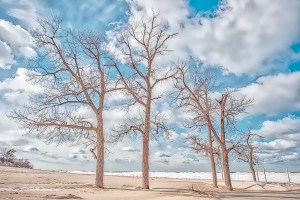 With overnight temperatures sliding down to -13 and wind chills in the -30 to -40 range in areas near Lake Michigan, the weather at the start of 2018 has been sharply different from this time last year. Reviewing a few of my journal posts from the beginning of January in 2017, I notice high temperatures for the first week seemed to hover in the mid-forties. In fact, I wrote about the traditional “first-day hike” last New Year’s Day: “the weather was unseasonably mild, many had gathered to start 2017 with a casual stroll through nature.” Nevertheless, I did manage a few short hikes over the weekend, and I had an opportunity to walk the beach at Indiana Dunes State Park. Strong winds whipped onshore, filtered through bare branches of beach trees, and swept snow from the dunes, leaving much of the sand clear and tan under an angled sun slipping between quickly moving clouds. However, thick and widening shelf ice already had accumulated at the edge of the water, completely blocking any view of the lake from much of the beach and allowing only bursts of spray from breaking waves to rise into sight.
Daily Journal: 2017
∼ December 31, 2017 ∼ “Great Marsh During Fog and Frigid Weather”
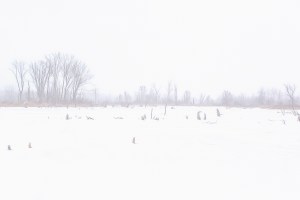 This post with a faint picture of the Great Marsh in frigid and foggy December weather represents my 365th entry for 2017. When I began the Indiana Dunes journal at the start of January, inspired by the writings of Henry David Thoreau and celebrating the 200th anniversary of his birth year, I mentioned that I would “initiate a personal chronicle” to offer brief and reflective commentary about my hikes through the Indiana Dunes region. I did not expect to present an entry every day, but I managed to keep that daily documentary schedule. My regular habit of authoring a short prose piece reminded me how much I appreciate the Thoreau example, and I am pleased to have completed my task. As noted in a previous post, I am happy to report I have received an Arts in the Parks and Historic Sites grant for 2018 from the Indiana Arts Commission in conjunction with the National Endowment for the Arts to further my examination of the region, particularly Indiana Dunes State Park. However, in 2018 my primary focus will be upon my more artistic images, as influenced this time by Frank V. Dudley, the famous “Painter of the Dunes” who was born 150 years ago in 1868. Consequently, although I will continue to post journal entries, they will be less regular than my daily habit during the past twelve months. Instead, I will be adding a series of photo essays to my output in the new year. I appreciate anyone who has followed this journal. As well, I am grateful to those who responded to my photographs and paragraphs in 2017, and I hope you will enjoy my offerings in 2018. Happy New Year!
∼ December 30, 2017 ∼ “Cabin in Snow”
 The year seems destined to end with a spell of extremely cold weather. Strong Canadian currents crossing Lake Michigan have created sub-zero temperatures and brought intermittent waves of snowfall. Though I find myself still willing to walk trails throughout the Indiana Dunes, I think about the advantages I have living in this time period. I wear modern insulated clothing that keeps me warm, and I travel in a heated automobile with hot chocolate in a thermos to the locations I explore. When I return home, I am comfortable in a house with forced-air heating, and I shower in hot water. Consequently, whenever I visit the historic sites of nineteenth-century residences at Chellberg Farm or the Bailly Homestead during my hikes, I imagine what life might have been like for their inhabitants during brutal wintry conditions. Even as I stand in a brisk wind and attempt to steady myself or my tripod for capturing an image, I try to envision the people who once lived there and might have stood in the same spot two centuries ago.
∼ December 29, 2017 ∼ “River in Early Winter”
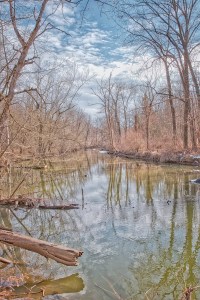 On a partly cloudy day last week as I was walking along a bank of the Little Calumet River, I stopped to watch a deer that I could barely discern through the chaos and confusion of bare branches so typical of a forest in early winter. For a while the animal stood still, seemingly facing my direction, though I really couldn’t quite see which way its eyes were aimed, and I was unable to take its picture from my distance. When I heard the loud staccato tapping of a woodpecker high overhead, I looked for a few minutes at upper reaches of a nearby tree, also too far for my lens to capture, and I watched him go about his work until he flew away. By the time I turned back to the area where the deer had been, it was gone; so, I moved on. I continued down the river, seeking to photograph a section that extended east, passing through a corridor of empty trees before bending north, its calm water reflecting overhanging limbs and the random ragged pattern of clouds slowly shifting above, none of these features in danger of getting away from the focus of my camera.
∼ December 28, 2017 ∼ “Raccoon Tracks on Partly Frozen Creek”
 Overnight temperatures dipped below zero, and Wednesday morning’s bitter winds continued to bring sporadic bands of lake-effect snow across parts of northern Indiana. Despite the frigid conditions, I decided to hike a few spots near Lake Michigan to examine the effects of the weather. When I left home, about a dozen miles inland, the skies were clear and sunny. However, by the time I arrived at Kemil Beach in the Indiana Dunes National Lakeshore, a thick layer of shelf-ice edged the lake and darkness had descended on the landscape due to a ribbon of clouds moving onshore, bringing more snowfall. I also walked a trail at the Great Marsh, but the scenery was partially hidden by a series of snow bursts. Therefore, I drove farther west to Indiana Dunes State Park, which lay in some breaks of sunlight from openings in the overcast. Nevertheless, temperatures remained in the low single digits, but I actually enjoyed the extreme cold, which felt invigorating. Nobody else seemed to be visiting the park, and the entrance gate house had no attendant. However, while there, I traveled along Dunes Creek, which had become mostly frozen and displayed sets of raccoon tracks across the icy surface. Though I have seen raccoons in this location in the past, on this day the woods seemed empty. I only noticed a pileated woodpecker knocking dully on bark high in the bare branches of trees along the creek.
∼ December 27, 2017 ∼ “Walk Through Wintry Woods”
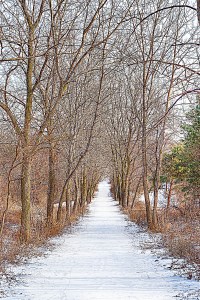 On New Year’s Day I wrote: “I begin this journal mindful that 2017 marks the 200th anniversary of Henry David Thoreau’s birth year” and “the influence of Thoreau’s comprehensive commentary kept in his journals for decades often will be evident in the entries included here. I regularly return to the collected works of Thoreau and read with great interest his observations on nature or speculations about the human spirit.” Consequently, as the Midwest seems in the grip of a bitter cold spell with temperatures falling below zero and only a handful of days remaining in the year, I return once more to Thoreau’s thoughts in “A Winter Walk”: “…we tread briskly along the lone country road, crunching the dry and crisped snow under our feet…. The wonderful purity of nature at this season is a most pleasing fact. Every decayed stump and moss-grown stone and rail, and the dead leaves of autumn, are concealed by a clean napkin of snow. In the bare fields and tinkling woods, see what virtue survives. In the coldest and bleakest places, the warmest charities still maintain a foothold. A cold and searching wind drives away all contagion, and nothing can withstand it but what has a virtue in it, and accordingly, whatever we meet with in cold and bleak places, as the tops of mountains, we respect for a sort of sturdy innocence….”
∼ December 26, 2017 ∼ “Solitude and Silence: Swamp Forest After Snow”
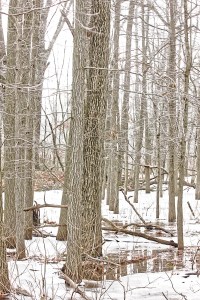 In commentary I shared about two weeks ago within my 12/13 post, I noted an interest in hiking along trails that pass through less traveled locations near Lake Michigan at this time of year. Indeed, I appreciate the solitude and silence associated with such paths. I commented: “When wintry weather washes over the Indiana Dunes region, I like to visit the swamp forests, marshlands, and bogs, which transform into remarkably different settings during this season.” I also spoke of a fondness for words included in Henry David Thoreau’s “A Winter Walk,” such as the following: “It is invigorating to breathe the cleansed air. Its greater fineness and purity are visible to the eye, and we would fain stay out long and late, that the gales may sigh through us, too, as through the leafless trees….” In addition, I noted how “in cold winter conditions, especially when a chilly wind is blowing off Lake Michigan, the air feels crisp and clear, and I find myself energized by the atmosphere as I move through this environment.” Walking through the frozen wetlands, silence fills the surroundings and is only broken by the occasional crack of ice beneath bare branches or the overhead creak from upper tree limbs moved by a sudden gust of northern winds.
∼ December 25, 2017 ∼ “Footbridge After Lake-Effect Snowfall”
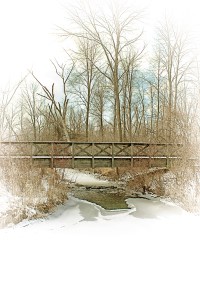 Light but steady snow fell most of the day on Christmas Eve, some of the greater accumulations occurring near Lake Michigan and along the Indiana Dunes where narrow ribbons of lake-effect snow extended onshore. Though the cold deepened after midnight when temperatures continued to slip into the teens with a growing flow of northern winds, and a couple of squalls reached the beaches in the overnight hours, by morning the skies had mostly cleared, leaving a white landscape appropriate for pleasing images of wintry scenery. Indeed, the transition—from late fall’s stark setting of bare branches overhanging trails lined with dead and brittle leaves to winter’s concealing of everything under a smooth and bright cover of snowfall—closely coincided with this week’s arrival of the winter solstice. Suddenly, even ordinary sights, perhaps like this footbridge spanning a partially frozen creek, seem to adopt a new and more beautiful appearance.
∼ December 24, 2017 ∼ “Trail Eight at Start of Winter”
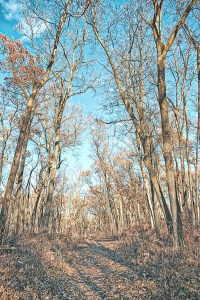 In a commentary I posted during early March, I noted publication of a book by Florence Williams titled The Nature Fix: Why Nature Makes Us Happier, Healthier, and More Creative. (Please see my 3/7 entry.) At the time, I stated “the text suggests contemporary society and the technological environment of everyday living provide further evidence humans must interact with the natural world on a more regular basis.” Williams concludes that an engagement with nature restores humans’ energy and empathy, bolstering physical and emotional well-being. Additionally, an article published in the current issue of Forbes (“Living Near a Forest Will Make You Happier, Study Finds”) authored by Trevor Nace relates an in-depth investigation printed in Nature Scientific Reports that suggests “humans are better able to cope with chronic stress and are happier when connected with nature. However, this study finds that forests, in particular, are one of the best remedies.” I am not surprised by this information, as I wrote “about my enjoyment traveling trails through the woods” recently in my 12/5 post, declaring such an activity to be “especially relaxing and rewarding.”
∼ December 23, 2017 ∼ “River Bend in December”
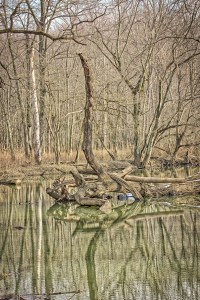 I have written a number of times in this journal about the historic Bailly Homestead located along the Little Calumet River at a bend seen in the accompanying photograph, and now situated within the Indiana Dunes National Lakeshore. As I have noted in previous posts (for example, please see my 2/26 entry), Joseph Bailly, the first white settler in the region, built a trading station beside the river at this point, along a popular Indian trail and at an ideal place to trade with local tribes for animal pelts or other goods. This river also connected with other waterways leading toward Lake Michigan, a pivotal spot for commercial trade. Henry David Thoreau once observed in “A Week on the Concord and Merrimack Rivers”: “Rivers must have been the guides which conducted the footsteps of the first travelers. They are the constant lure, when they flow by our doors, to distant enterprise and adventure, and, by a natural impulse, the dwellers on their banks will at length accompany their currents to the lowlands of the globe, or explore at their invitation the interior of continents.”
∼ December 22, 2017 ∼ “Dune Ridge Trail on Mild December Day”
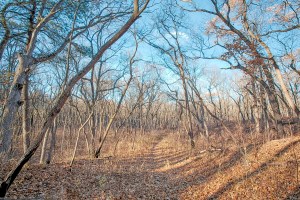 Winter officially arrived late Thursday morning, though evidence of wintry conditions has been limited thus far this year. In fact, the meteorologist on a local television station reported the region has experienced milder than usual temperatures, which have resulted in the least amount of recorded snowfall ever in the period prior to the start of winter. Indeed, thermometer readings yesterday remained above freezing, even during overnight hours. Consequently, I find myself easily hiking along passageways that normally would have been difficult to travel due to accumulations of snow and ice at this time of the season. Those paths often avoided in harsh weather that I have chosen recently include steep dune ridge trails or routes deep within wooded terrain, where to me the most impressive features remain leaning tree trunks or gnarled bark on bare and twisted branches, all seen against a backdrop of cool blue skies.
∼ December 21, 2017 ∼ “Editorials on Official Federal Status of Indiana Dunes”
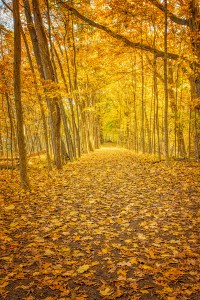 Recently, I was referenced in a minor way as part of a debate over officially designating the Indiana Dunes National Lakeshore as the Indiana Dunes National Park. As I noted in a previous post (see my 10/5 entry), the change in status “would recognize the more than 15,000 acres of land in the Indiana Dunes National Lakeshore as the first national park in Indiana and the 60th in the United States.” A 12/5 editorial in the Chicago Tribune by John Copeland Nagle, a Notre Dame environmental law professor, declared such a transition “a really bad idea” because the Indiana Dunes is not “incredibly special,” and its inclusion as a national park would diminish the stature associated with lands deemed “national parks.” The following day, Dwight Adams reported in the Indianapolis Star on Nagle’s essay and opposing viewpoints, particularly as represented by Indiana congressional members. Adams’ article appeared online and included a number of posts on twitter about the Indiana Dunes National Lakeshore, including one by me from 11/27 that featured the fall photograph accompanying this commentary. Now, Save the Dunes has released a response by Patty Wisniewski in which she outlines details that she believes make the Indiana Dunes National Lakeshore “a special place,” declaring that it “meets every criteria of the definition of a national park in incredibly special ways that no other national park can.” I invite everyone to read the various opinions.
∼ December 20, 2017 ∼ “Chicago Skyline in Mid-December”
 Though a slight haze hovers above Lake Michigan, a slant of sunlight illuminates the skyline of Chicago as seen from the shore of the Indiana Dunes. Much of the time during cold conditions in mid-December low cloud cover keeps the city skyline hidden from view. However, this week’s series of mostly clear and mild afternoons, with temperatures reaching into the fifties, has allowed observation of the city across the forty-mile distance between Northwest Indiana’s beaches and the Chicago skyscrapers. By next month the whole coast could be dotted with small white bergs and shelf ice might begin forming along the shore line, but thus far those elements usually associated with winter’s imagery have not started to take hold, and in today’s absence of wind the lake water remains a rich blue field filled with a sense of texture as it exhibits only little ripples of waves.
∼ December 19, 2017 ∼ “Trail End at Lake Michigan in December”
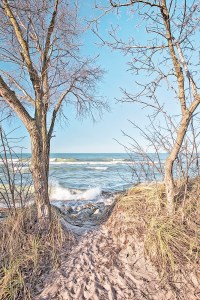 My son and I chronicle meteorological conditions each day, so I was fascinated to find temperatures fell to a record low of -13 on this date last year, but today the weather will warm into the 50s. All evidence of snow and ice has disappeared. In fact, the clarity of blue skies over Lake Michigan almost reminds one of summer, but the empty limbs of trees through which the setting is seen acknowledge winter’s official appearance this week. When I walk favorite trails through the Indiana Dunes until I reach the beach, I feel much the way Walt Whitman must have as he peered at the ocean and regarded the sea as “a continual miracle.” Each time I arrive at the shore in any of the four seasons, I am amazed at the ever-changing elements in the scenery—the continual rearrangement of waves breaking on sandbars, the transition of tints in the surface color as daylight shifts or cloud cover moves over the water, the rising or lowering level of the lake, the slow erosion then rebuilding of the coastline, and the expressive image of windblown leaves or wavering bare branches seeming to offer a symbolic signal of salute, a gesture of respect at the great lake’s edge.
∼ December 18, 2017 ∼ “Lifting Morning Fog on Ly-co-ki-we Trail”
 Weather warmed this weekend as temperatures rose into the forties, and when I walked on Sunday morning along the old Ly-co-ki-we Trail—which has been united with and renamed the Glenwood Dunes Trail System—I noticed most of the snow had melted. In addition, a calm had settled over the region, causing a stillness in the woods, as the air felt humid, though the persistent early fog finally started to lift just before noon. I parked my car at the lot for the Kemil Road trailhead near Route 12, where the way is paved for about one-third of a mile, and then I hiked south along a few marsh forests yet displaying frozen surface water until I came upon a couple of trail signs that still bear the Ly-co-ki-we Trail title. The markers also indicate these sections of the path are open much of the year (mid-March to mid-December) for horseback riding, although the equestrian season ended for the winter on Friday. Indeed, at this point the footing changed to loosely-packed dirt or deep sand, soft and seemingly more suitable for horses.
∼ December 17, 2017 ∼ “Mild December Day at Indiana Dunes”
 I am pleased to share that I have been awarded an Arts in the Parks and Historic Sites Grant from the Indiana Arts Commission in conjunction with the National Endowment for the Arts to further explore the Indiana Dunes in 2018 through prose and photographs. My approach in the new year will differ from the current format, which now contains 350 daily posts and was modeled somewhat after Henry David Thoreau’s journal, since 2017 marked the 200th anniversary of his birth. I described my journal in the initial entry on January 1 as “a personal chronicle, which will consist of brief informal musings or reflective evaluations on various events and experiences….” I will offer more specific details in a couple of weeks about my project for the new year, but I can report the activities tentatively include two month-long exhibitions of my photographs, a pair of lecture/workshop presentations (one in the spring and one in the fall) on form and technique in landscape image composition, and perhaps photo workshop walks through the Indiana Dunes. In addition, I will continue to write commentary and post photographs, though not on a daily basis.
∼ December 16, 2017 ∼ “River in Mid-December”
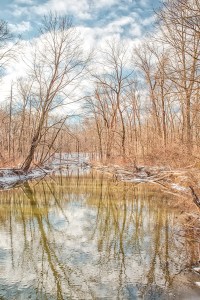 The bare limbs of trees rise and arch from opposite banks to crisscross above Little Calumet River in the Indiana Dunes National Lakeshore. A quick mid-December storm passed through the region overnight, and its scattered remnants of white clouds struggle today against being overtaken with blue, all illuminated by fresh afternoon sunlight shining from the southern sky. Last night’s brisk onshore winds that brought lake-effect squalls have disappeared, and the downstream current, now nearly still except for tiny ripples lifted by a slight breeze, offers an impressionist reflection of everything. A few fallen trunks and broken branches collect at the edges of the river, and a small snow-covered hill can be seen in the distance, where this river suddenly bends sharply toward the west. A light layer of snow also shows on shallow slopes along the water. The trail ahead winds beside the river. A path yet hidden between trees leads the way where I will walk.
∼ December 15, 2017 ∼ “Cowles Bog Walkway in December Snow”
 In commentary I posted last month (please see my 11/22 entry), I noted the reopening of Cowles Bog Trail after a lengthy period involving renovation and reconstruction of the walkway spanning a section of the wetlands. At the time, I described that “I had an opportunity to photograph the newly restored footpath, which is raised a few feet higher than the old wooden boards that had been placed at the surface and often would be overrun with floodwater…. In addition, the natural planks have been replaced by composite plastic imitation wood slats, and side rails have been installed.” Following my practice of often photographing details in the Indiana Dunes during various seasons, I returned last week after the first snowfall of December to capture an image of the same scenery but in stark wintry weather. Though skies had cleared as an overnight storm moved east, and the cold weather and fresh snow suggested uncomfortable conditions, I enjoyed traveling the path and found the setting somewhat comforting.
∼ December 14, 2017 ∼ “Lake Shore After Overnight Snow in December”
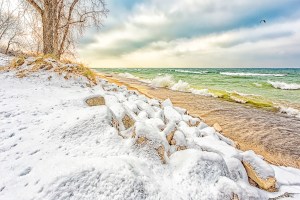 Although I share with most others an appreciation for the Indiana Dunes during summer months when warm weather draws many visitors to cool by the shore and to wade shallow waters, I must confide a particular fondness for observing the same setting in wintry conditions. With thick and heavy cloud cover and a turbulent surf caused by strong northern winds, the Lake Michigan scenery seems to exhibit a dramatic tone. An accent of lake-effect snowfall along the coast only emphasizes the frozen and almost foreboding atmosphere created under such conditions. Indeed, even the dull light on gloomy mornings in this season and an absence of people on the beaches add to an eerie feeling one might more likely associate with a moody movie set. Therefore, on days displaying inclement and disquieting weather, especially from the beginning of December through the end of February, I detect an impressive sense of character in the environment, an essence that I seek to capture with my camera.
∼ December 13, 2017 ∼ “Cowles Bog Trail Following Early Snowfall”
When wintry weather washes over the Indiana Dunes region, I like to visit the swamp forests, marshlands, and bogs, which transform into remarkably different settings during this season. Trails lined with trees seem to offer direction with their long and white leading lines extending among the suddenly stark landscape. Walking in cold winter conditions, especially when a chilly wind is blowing off Lake Michigan, the air feels crisp and clear, and I find myself energized by the atmosphere as I move through this environment. In “A Winter’s Walk,” one of his more famous essays that first appeared in print in 1843, Henry David Thoreau expressed similar emotions: “It is invigorating to breathe the cleansed air. Its greater fineness and purity are visible to the eye, and we would fain stay out long and late, that the gales may sigh through us, too, as through the leafless trees, and fit us for the winter—as if we hoped so to borrow some pure and steadfast virtue, which will stead us in all seasons.”
∼ December 12, 2017 ∼ “Trees Beside Pond After First Snowfall”
 I have acknowledged in previous comments that I am attracted to trees as subject matter in my photography. Hiking through woodlands in any season, I am drawn to the expressive forms of these features, whether the branches display blossoms in spring, are full in summer, show fall foliage, or appear stark as dark silhouettes in winter light. No other element of nature exists as often as a focal point in my images. Even the dramatic and dynamic surf along the Indiana Dunes shoreline fades to second when counting details in my photos. The history of photography contains many famous pictures of trees. In fact, the Victoria and Albert Museum currently hosts an exhibition, Into the Woods: Trees in Photography, including numerous famous photographers, such as Ansel Adams, Paul Strand, and Henri Cartier-Bresson. The museum explains: “Trees have long been a source of inspiration for artists. They can evoke a primal sense of wonder and the strong patterns of their branches, bark and leaves consistently offer visually arresting subjects.”
∼ December 11, 2017 ∼ “Little Calumet River After First Snowfall”
 As I noted in my previous post, the first substantive snowstorm slid across northern Indiana on Saturday morning. Wintry weather lingered much of the day due to lake-effect snowfall caused by strong onshore winds from Lake Michigan. Although the storm left a total accumulation of only a few inches in its wake, as I mentioned in yesterday’s entry, the landscape seems to have shifted into a permanent appearance of winter despite the official end of fall yet ten days away. Therefore, when Sunday morning revealed mostly sunny skies and calm conditions, I decided to hike the Little Calumet River Trail, a location I visit frequently throughout the year and have discovered often offers some of the best images exhibiting seasonal transitions. Temperatures had lifted into the low- to mid-thirties by afternoon, and the ground cover of snow already seemed to be thinning to the point that it remained in my photograph merely as a decorative white accent contributing to the overall attractiveness of the scenery.
∼ December 10, 2017 ∼ “First Snowfall in December”
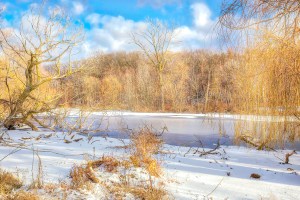 A fast-moving storm swept through the region Saturday morning, bringing snowfall ranging from two inches to five inches locally, heavier amounts occurring where lake-effect squalls moved onshore. When the first accumulation of snow arrives across Northwest Indiana each year, a seasonal shift immediately seems to take place, and I find my mental attitude quickly alters as well. Though the official beginning of winter remains about a dozen days away, the landscape now features horizons of bare trees against a backdrop of blue and white sky, the colorful fallen leaves of brittle branches suddenly hidden beneath a layer of snow. Each evening’s freezing temperatures appear to be aided by a quicker close of daylight, causing a thin skin of ice on area ponds or small lakes. Consequently, my expectation for photographs transitions to capturing settings displaying the different textures available and various elements exhibiting suggestions of cold conditions in wintry scenery.
∼ December 9, 2017 ∼ “Great Marsh in Late Autumn”
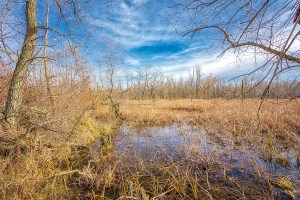 When the weather chills as winter approaches, the Great Marsh Trail transforms into a different landscape from that witnessed much of the year. The lush scenery, thick with growth that conceals segments of the terrain, seems to become somewhat more open for observation. Bare branches and thinning ground cover allow travelers to photograph parts of the parkland usually beyond reach for months—from early summer through the peak of fall season. Even though as I hike the path I discover sections along the way to be slightly flooded, I know the time is now right for exploring this stretch of wetlands. Water rises halfway up my boots when I step through some sections of the trail, but in a few weeks, when wintry storms have left ice and snow, the footing could become more difficult, the frozen ground slippery, and fresh snowfall might disguise the treacherous conditions of hollow gaps, knee-deep craters, or small holes caused by erosion remaining hidden beneath a depth of drifting snow.
∼ December 8, 2017 ∼ “Red-Bellied Woodpecker at End of Autumn”
 Walking a winding trail of the Great Marsh in Indiana Dunes National Lakeshore late in the day after a windless afternoon during the end of autumn, I hear only the intermittent tapping of a Red-Bellied Woodpecker somewhere ahead and high above. Seeking the origin of the interruption in the silence of this setting, I aim my long lens upward and discover the culprit perched perhaps forty feet over my head. Unlike summer or early fall, when a thick camouflage of leaves conceals all sorts of birds, in this season the source of such sharp acoustics—the sound resembling that of an insistent knocking by an unexpected intruder, but on dark and weather-roughened bark rather than a smoothly-sanded front door—easily can be spotted through a yet congested network of bare branches. In fact, by the beginning of December not many other birds are witnessed lingering in the region’s wetlands or woods. I enjoy the woodpecker’s activity of poking a hole in search of food, its beak building a steady beat like that of a heart when driven into the trunk of a dying tree, and the echoing created as sound waves rebound off surrounding trees, offering one of the few signs of life in this scene.
∼ December 7, 2017 ∼ “Trail Two Trees at Start of December”
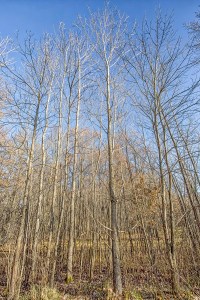 Just a couple of weeks ago most trees along a favorite section of Trail Two in Indiana Dunes Sate Park were yet decorated with colorful fall foliage. However, their limbs are now empty of leaves, and the whole landscape has changed significantly. I have mentioned in previous journal entries my appreciation for the natural art and aesthetically pleasing expressive appearance of bare branches, especially when seen with the backdrop of clear blue skies. In his essay titled “Winter Walk,” Henry David Thoreau writes about the emergence of scenery with empty trees and openings in the wooded setting while traveling through the countryside, their “arms to the sky on every side; and where were walls and fences, we see fantastic forms stretching in frolic gambols across the dusky landscape, as if nature had strewn her fresh designs over the fields by night as models for man’s art.”
∼ December 6, 2017 ∼ “Dune Hill Under Angled Autumn Sunlight”
 The first four days of December presented warmer than usual weather with clear skies and brisk southern breezes at times sweeping over the higher ground of inland ridges. Walking through the interdunal valleys near Lake Michigan, areas remaining sheltered from most of the stronger winds, I noticed the fields of tall grass on some inclines of dune hills had been fading from orange to yellow in this late stage of autumn, and narrow sandy trails winding behind those mounds offered grand views of the landscape. I paused at one stretch of Dune Ridge Trail of the Indiana Dunes National Lakeshore to photograph a shallow slope rising toward the north, where the coastline lay just beyond. Although upper limbs were thinning in parts, a file of trees yet exhibited evidence of fall colors along the crest. Angled sunshine accented the brighter foreground, as shadows of tree trunks lengthened in the afternoon light.
∼ December 5, 2017 ∼ “Traveling North on Trail Nine”
 As I was hiking along Trail Nine in the Indiana Dunes State Park toward Lake Michigan on a mild autumn afternoon this past week and thinking about my enjoyment traveling trails through the woods, I realized I find two activities to be especially relaxing and rewarding: walking and reading. Then I remembered acute observations about the connection between the two offered by author Tom Montgomery Fate in his fine book of essays, Cabin Fever: “Some days reading and walking seem like the same thing, like part of the same journey. Reading, too, is a kind of saunter, the sentences a faint path we track through the writer’s consciousness. Some readers wander off in a direction the writer never imagined, following a faint, muddy paw print, or the warm ashes of a recent fire, toward some new idea or theme. Others get down on their hands and knees and savor the color and scent and flavor of certain words as if they were sacred. But many don’t. Most of us want a clearly marked trail on which we can stop from time to time to briefly smell or touch or taste whatever is new, whatever momentarily startles or excites us.”
∼ December 4, 2017 ∼ “Afternoon Light in Late Autumn”
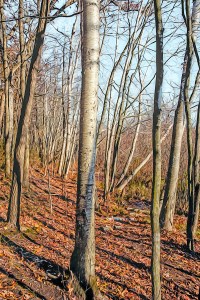 As I mentioned yesterday, December has started with sunny weather and unusually mild temperatures, permitting comfortable walks in the woods of the Indiana Dunes. Even during the midday hours and into late afternoon, sunlight near the end of autumn offers a distinctive angle of illumination, as the sun moves toward its farthest southern position. Combined with the new openness in wooded areas where leaves have fallen and layer the landscape, allowing direct lines of sunshine through the bare upper limbs of trees, sections of the forest hidden in dark shadows for months now appear available to hikers for easy viewing. Suddenly, details of the ridged and scarred bark on tree trunks and branches become prominent features, almost as if at last given their conspicuous moment in the spotlight. Brightened by the daylight, each tree seems a work of art, gracefully rising toward the sky with a natural elegance.
∼ December 3, 2017 ∼ “Beach Tree on Warm December Day”
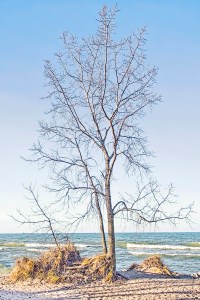 The delightfully warm weather in this opening weekend of December, offering temperatures twenty degrees above average, presents a sharp contrast along Lake Michigan of strong sunshine and southern gusts—similar to trends expected in summer—with the wintry appearance of trees displaying an expressive array of bare branches. These empty trees almost seem to be caught suddenly out of season, their limbs exposed too early. Nevertheless, the Indiana Dunes scenery, especially at the edge of the water, becomes even more compelling with light blue skies above and bluish-green lake water below, as though designed to be a backdrop helping to frame the image of a lone beach tree surrounded by wind-dimpled sand. Indeed, the textures—tan sand scalloped by steady breezes, tree bark etched with dark lines, white lake waves, and drooping leaves of yellowed marram grass—add photographic interest to a composition that might otherwise be seen as an ordinary picture.
∼ December 2, 2017 ∼ “Marsh Trail at Start of December”
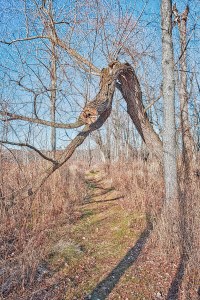 As the month of December begins, I return to a location along the Great Marsh Trail in the Indiana Dunes National Lakeshore that I visit frequently. A distinctive fallen tree frames the way at this spot along the route. When I wrote about the setting at the start of the year, I mentioned that “I am often intrigued when I come across a felled tree while hiking. I have taken a number of photos in the past of tree trunks leaning over trails I’ve traveled. Recently, I captured an image of a tree arching over the Great Marsh Trail, appearing almost as if it were an elaborate entranceway inviting hikers to explore the curious and extraordinary landscape beyond it.” (Please see my 1/8 entry.) I also noted how I “admire the beauty of its naturally artistic presence, especially in winter when the exquisite skeletal structure, gnarled and twisted, has been exposed, and its aesthetic elegance yet remains evident for all to see.” However, comparing my image of the tree taken about eleven months ago, I now notice half the fallen tree has broken off and been removed by the park service. I photograph scenery over time and in different seasons in order to chronicle such changes in various elements of the landscape.
∼ December 1, 2017 ∼ “Late Afternoon Light at Lake Michigan”
 Mild weather due to soft southern air currents sweeping across northern Indiana in the beginning of December would seem to invite visitors to the Lake Michigan shoreline for more enjoyment of the vast view it offers. In fact, as I walk along the coast during late afternoon, the landscape appears especially dramatic due to a low angle of sunlight flowing over ridges of dune hills to exaggerate its features. Brightening white water of surf breaks on the beach, and an extended file of small waves creates a leading line reaching toward the western horizon, an ideal element for my photograph. Though clear skies continued through the morning and only a few clouds have now arrived from the south, highlighted by a diminishing glimpse of sunshine, the blue distance beyond the lake already starts to darken. I stand alone with my camera and appreciate the stunning scenery, surprised to find on this day that the whole location remains empty of others.
∼ November 30, 2017 ∼ “One Red Leaf, the Last of Its Clan”
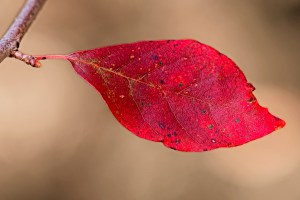 Yesterday, as I hiked the wooded Dune Ridge Trail that I had travelled just two weeks ago—at that time discovering fall foliage in its peak and preserving a number of vivid images—I found the landscape had changed again. Wind, rain, and colder temperatures have stripped the trees of their leaves, and the setting’s tone has been reduced mostly to shades of brown and yellow. Almost everything exists as an element in a sepia image. However, I observed a single leaf tenuously holding onto a lofty limb on this calm afternoon and retaining its rich red tint, though spotted by tiny dark marks. Since I was carrying my zoom lens to photograph woodpeckers easily visible and still working among the bare branches, I captured an image of this sole survivor, and I thought of lines from Samuel Taylor Coleridge’s poem, “Christabel”: “There is not wind enough to twirl / The one red leaf, the last of its clan, / That dances as often as dance it can, / Hanging so light, and hanging so high, / On the topmost twig that looks up at the sky.”
∼ November 29, 2017 ∼ “Trail Bridge at End of November”
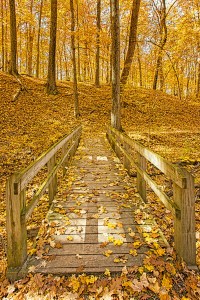 Whenever I walk through northern Indiana woods in the state or national parkland near Lake Michigan and arrive at a footbridge erected across one of the narrow creeks amid deep ravines between dune hills, I find the scenery somewhat emotionally appealing and physically attractive. Perhaps the sudden introduction of order in the midst of chaos—straight lines of those wooden planks or handrails among crisscrossing branches and crooked trunks throughout the backdrop of forest—acts like an instance of assurance that the way will lead to somewhere worthwhile. After all, one can expect a sense of purpose to such a manmade object. Additionally, in autumn the whole setting appears decorated by nearly golden foliage, now mostly blown underfoot by wind gusts or forced from branches by recent rain, but also a portion yet to fall catches the low angle of sunlight and increases interest in the landscape.
∼ November 28, 2017 ∼ “Cowles Bog Trail in Late November”
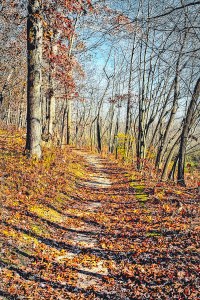 Last week I visited Cowles Bog Trail in the Indiana Dunes National Lakeshore to examine the renovation of a walkway crossing wetlands near the start of the path. (Please see my 11/22 entry.) The way had been closed to hikers for a couple of months to allow the construction to occur. As a result, nobody was able to view the normally vivid display of leaves on trees bordering the route during peak fall foliage. Therefore, when I recently walked the length of the reopened trail, the autumn season’s transitions had nearly reached completion. Nevertheless, the scenery still seemed compelling as I travelled through the woods before turning north toward dune hills along the shore line of Lake Michigan. The sunny afternoon followed a few days of rain and strong winds. Consequently, most of the branches angling overhead had been stripped of their leaves, permitting the appearance of interestingly shaped trunks and thin limbs, as though premiering their presence after being hidden all summer from the eyes of passersby.
∼ November 27, 2017 ∼ “Fall Walk in Woods”
Six weeks ago I posted a photograph displaying the cart trail at historic Chellberg Farm in the Indiana Dunes National Lakeshore. (Please check my 10/14 entry.) At the time, “I noticed the foliage of trees yet remain full and rich with green. Only a limited number of fallen leaves littered the route. Indeed, the scenery seemed little different from a similar picture I’d taken in spring.” I also lamented the late arrival of autumn colors, “the absence of a shift to fall’s vivid tints, a transition which has been delayed by an unusually warm early autumn….” I frequently return to locations in the Indiana Dunes to view the scenery in different seasons and to capture contrasting images. Consequently, I visited the site once again this past week to snap a photo of the setting from the exact same spot following fall’s transition and just before the loss of all the leaves.
∼ November 26, 2017 ∼ “Big Blowout Ridge in End of November”
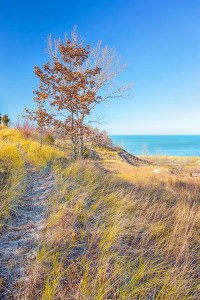 In yesterday’s journal entry I mentioned hiking Trails Nine and Ten at the Indiana Dunes State Park on Friday as a way of participating in Opt Outside Friday. The photograph I posted displayed Trail Ten as it moved through a tunnel of arching trees in the interdunal woods. However, I also approached the coastline by climbing the incline of Trail Nine where it rises high above Lake Michigan at the Big Blowout. The daylight appeared bright without a cloud in the sky, and afternoon temperatures were mild for late November, but the warmth resulted from strong southern winds, which turned to gusts rushing over the ridge as I reached the peak of a dune hill around the inland rim of the blowout. Nevertheless, I managed to shoot a few photos of the sandy path descending toward the shore through a slope of green and yellow marram grass, its long leaves bending under pressure from the brisk wind and lit by a wash of afternoon sunlight.
∼ November 25, 2017 ∼ “Trail Ten in November”
 While most of the television news reports aired videos of shoppers searching for super sales at malls or large box stores on Black Friday, some folks in the nation chose alternative activities in recognition of Opt Outside Friday, a day on which various state and national parks across the country allow free admission to attract visitors. Although the event encouraging ventures in nature was initiated a few years ago by REI—a company specializing in clothing and gear for camping, hiking, or additional outdoor activities—partially as a promotional marketing campaign, the adventurous spirit has spread, and now many take advantage of time off from work or school on the day after Thanksgiving to explore the outdoors. For my part, I decided to hike along the two longest trails in the Indiana Dunes State Park—numbers Nine and Ten, which together extend for more than nine miles. I found a higher than usual number of others also enjoying the pleasant conditions for late November—sunny skies and temperatures in the sixties—though gusting winds created a bit of difficulty when trying to capture images of the few trees still exhibiting some remaining leaves.
∼ November 24, 2017 ∼ “Dunes Creek Trail Bridge in Autumn”
 As I have noted a number of times in past posts, I enjoy hiking Trail Two at the Indiana Dunes State Park, especially in the peak of fall color and during winter snowfall. Though about three miles long, the route is fairly flat and an easy walk. However, since the path parallels Dunes Creek at times and elsewhere crosses marshland in the center of the park, summer months create overgrown conditions with swarming mosquitoes, making much of the way more difficult to travel. I often choose a footbridge along the trail that spans Dunes Creek as a focal point for my fall photographs. Vibrant foliage on the surrounding trees and shrubbery can provide brilliant imagery, and the winding waterway—murky with a growth of algae in warm weather—clears by late autumn, allowing a bright display of its yellow sand-filled bed and a deep reflection of the blue sky showing through upper limbs on sunny days.
∼ November 23, 2017 ∼ “Trail Stairs in Autumn”
 After last week’s early mornings of frost, followed by heavy rains and strong winds, first from the north and then from the south, the leaves of most trees along the shore of Lake Michigan finally have fallen to the ground. Consequently, as I hike through the Indiana Dunes woodland, I notice the whole landscape has changed during the past few days. However, among inland ravines deep within the forest, some locations have withstood the shift in weather enough to hold onto their foliage just a little longer. Walking from lower terrain in the Indiana Dunes National Lakeshore, I climbed a set of wooden stairs on the Bailly-Chellberg Trail rising toward a cluster of trees with a few remaining patches of green and yellow leaves backlit by afternoon sunshine slightly warming the air yet chilled by a bit of northern breeze. Once again, the end of November presents enough evidence of daily transition to offer a different perspective each time I turn a curve in the path and pause to take a photograph.
∼ November 22, 2017 ∼ “New Walkway Crossing Cowles Bog”
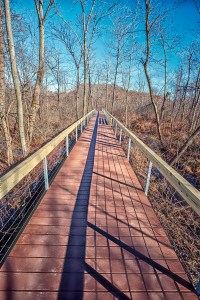 When I visited the Cowles Bog trail more than a month ago, I was disappointed to find the route closed for renovation of the walkway over a part of the wetlands. I spoke with a member of the construction crew, who explained the process of restoration currently underway and showed me the updated materials that would be used to erect a new bridge. I thanked him for his time and the pleasant conversation, though I was disappointed when he informed me the route would not reopen until mid-November, most likely after the peak of autumnal colors. Although the fall foliage lasted longer this season, I was unable to return until this week, a sunny afternoon just after days of rain and strong winds that had stripped leaves from most of the trees. Nevertheless, I had an opportunity to photograph the newly restored footpath, which is raised a few feet higher than the old wooden boards that had been placed at the surface and often would be overrun with floodwater. (To see an image of the old structure, please check my 4/11 post.) In addition, the natural planks have been replaced by composite plastic imitation wood slats, and side rails have been installed.
∼ November 21, 2017 ∼ “Fallen Leaves”
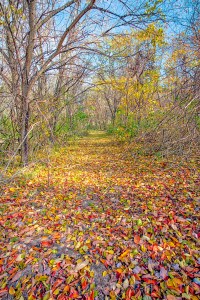 In a short work titled “Fallen Leaves,” included in the “Autumnal Tints” group of essays, Henry David Thoreau wrote about the delight of observing autumn’s leaves lying on the ground after first frost: “The ground is all party-colored with them.” Thoreau enjoyed the brief display of foliage lying beneath trees and along paths as he passed over them. He commented: “I go by trees here and there all bare and smoke-like, having lost their brilliant clothing; but there it lies, nearly as bright as ever, on the ground on one side, and making nearly as regular a figure as lately on the tree, I would rather say that I first observe the trees thus flat on the ground like a permanent colored shadow, and they suggest to look for the boughs that bore them. A queen might be proud to walk where these gallant trees have spread their bright cloaks in the mud.”
∼ November 20, 2017 ∼ “Quiet and Colorful Surroundings”
 Near the end of his wonderful bestselling book, A Walk in the Woods, Bill Bryson nicely describes a forest scene “at the height of foliage season” that he witnessed on his final afternoon in the wilderness, expressing sentiments closely resembling how I often feel during my hikes through dune woodlands and wetlands at this transitional time of year. In those closing pages, Bryson’s elegant language reflects upon “…one of those glorious days when the world is full of autumn muskiness and crisp, tangy perfection and the air so clear that you feel as if you could reach out and ping it with a finger. Even the colors were crisp….” The autumnal landscape scenery exalts his emotions, as he reports: “I hiked with enthusiasm and vigor, buoyed by fresh air and splendor.” He especially appreciates the moment because he realizes: “Autumn is fleeting….” At times, I also find myself pausing among nature’s display, simply standing among quiet and colorful surroundings, breathing the rich fragrance of damp soil amid already fallen leaves, as I attempt to absorb the atmosphere of this season of leaf change that seems much too brief.
∼ November 19, 2017 ∼ “November View from Dune Ridge Trail”
 Though a short route of less than a mile, Dune Ridge Trail rises from a small valley inland of the dune mounds along Lake Michigan and rises to a height that offers a variety of sights, including views of the wetlands and woods extending toward the southern horizon. Part of the Indiana Dunes National Lakeshore, the course begins adjacent to a parking lot that provides spaces for visitors to nearby Kemil Beach, just a half mile to the north. However, except for summer months, this area remains almost empty of cars. Although I regularly hike this trail in each of the seasons, I find the peak of fall transition to be best for photographing the terrain, especially since the autumnal colors highlight various distinctive features displayed in the landscape and add a sense of depth to the wide vista of scenery that can be seen from an opening in the shrubbery at the top of the hill. Especially on an overcast afternoon in November, images of the foliage bordering the path and the thinning tree line of a distant forest seem to exhibit an atmosphere a bit more emphatic and dramatic than at other times of the year.
∼ November 18, 2017 ∼ “Thoreau’s ‘Autumnal Tints’”
 In a previous entry I cited Henry David Thoreau’s terrific extended essay titled “Autumnal Tints.” (Please see my 11/6 post.) In its collection of related commentaries, Thoreau celebrates fall foliage: “Most appear to confound changed leaves with withered ones, as if they were to confound ripe apples with rotten ones. I think that the change to some higher color in a leaf is evidence that it has arrived at a late and perfect maturity….” In a couple of the work’s sections the author particularly remarks upon perceptions of the richly colored leaves, especially the red ones, sometimes displayed later in the season: “How beautiful, when a whole tree is like one great scarlet fruit full of ripe juices, every leaf, from lowest limb to topmost spire, all aglow, especially if you look toward the sun! What more remarkable object can there be in the landscape? Visible for miles, too fair to be believed. If such a phenomenon occurred but once, it would be handed down by tradition to posterity, and get into the mythology at last.”
∼ November 17, 2017 ∼ “Still Woods in Autumn”
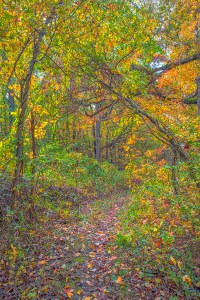 During the past few days I have been re-reading Annie Dillard’s book of essays, Teaching a Stone to Talk: Expeditions and Encounters. In the title chapter she writes about becoming attentive to sound, or the lack of it, when walking in nature: “Now I will stop and be wholly attentive. You empty yourself and wait, listening. After a time you hear it: there is nothing there.” Reviewing my own commentaries concerning walks through the woods, I notice too little mention of noises or, more importantly, stillness. Of course, there are moments I report coos, caws, or the tapping of woodpeckers; all of which I am consciously aware, particularly in late spring after a long spell when most birds have been elsewhere. Also, I have described on occasion the rustling of underbrush as a deer or other animal rushes past my path, as well as the murmur of water flowing in a nearby stream. In winter, I have even noted the crackling of ice sleeves on limbs of trees. However, what I feel I have failed to accurately portray is the ever-present absence of sound that seems so calm, a silence especially soothing and appreciated amid autumn color, a quiet contrasting with the insistent and persistent din that fills much of everyday society.
∼ November 16, 2017 ∼ “Peak Leaf Season”
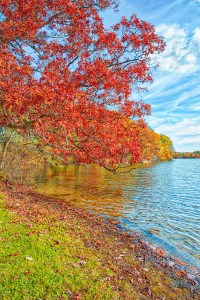 The past couple of weeks at last offered colder weather causing a vibrant show of peak seasonal color, conditions arriving later than usual after being delayed by a mild October. As a landscape photographer and writer who enjoys description of nature, I had been anticipating this period of autumnal transformation since late September. Indeed, I must admit my thoughts were focused on capturing images of brilliant fall foliage as early as Labor Day weekend. Consequently, I seemed more eager than ever to hike trails finally exhibiting scenery representative of northern Indiana in transition, and I wanted to preserve pictures suitable for demonstrating this annual spectacle. Therefore, when I walked a path beside a nearby lake under clear skies during a brief break between rainy days, I made certain to take a snapshot of a setting displaying vivid leaves on branches overhanging the water’s edge and illuminated by a spell of bright November sunlight.
∼ November 15, 2017 ∼ “Bailly Trail in Autumn”
 Most that is first written on any subject is a mere groping after it, mere rubble-stone and foundation. It is brought together only when many observations of different periods have been brought together that he begins to grasp his subject….—Henry David Thoreau I passed the three-hundred-day mark for composing daily entries in this journal nearly three weeks ago, and the accumulation of my commentary concerning the Indiana Dunes now totals more than 80,000 words. When I started this project on the first of January as a way to grasp my subject of the Indiana Dunes, I began “mindful that 2017 marks the 200th anniversary of Henry David Thoreau’s birth year,” and I acknowledged a debt to the influence of Thoreau on my writing would be evident. As the close of the year approaches with less than fifty days remaining until the end of December, I appreciate even more the tremendous accomplishment represented in Thoreau’s task of beginning a journal at the urging of friend Ralph Waldo Emerson in 1837 and maintaining his chronicles for almost twenty-five years, a literary achievement eventually surpassing two-million words.
∼ November 14, 2017 ∼ “River in Autumn”
 As evidenced numerous times in my daily chronicles, I particularly like to hike a trail that at times winds along the Little Calumet River and presents compelling scenery for photography in all seasons, but especially when the path offers vivid views in autumn. Also, in a note I posted during early October (see my 10/3 journal entry) I mentioned appreciation for completion of a long-term project to clear the Little Calumet River of clutter, or even complete blockage, from tumbled tree trunks or broken limbs after years of work from crews organized by the Northwest Indiana Paddling Association with assistance from other groups. Today, I was additionally pleased to see reports of a new and promising development with endowment of a $275,000 grant to three organizations—Save the Dunes, Shirley Heinze Land Trust, and the Dunes Learning Center—with some provisions for various restoration efforts, trail improvements, and environmental enhancements to continue along sections of the river.
∼ November 13, 2017 ∼ “Start of New Trail”
 I often find the initial image I see when starting down a fresh trail shapes my mood for the rest of my trek. Therefore, when I recently viewed an opening between trees with colorful foliage framing the way leading toward an unmarked branch of a passage along Dunes Ridge Trail, I knew the day would offer opportunities for capturing vivid images of autumn. Even the dark bark on thick trunks or long branches looming in the distance, though almost silhouetted against remaining green leaves in upper limbs, presented a sense of mystery with their bent and contorted shapes, which perhaps even created an atmosphere that approached the magical as I moved forward. Most of the fallen leaves decorated the soil underfoot with a scattering of red or auburn as though marking the pathway, inviting me to hike in its direction as I discovered my new route through these woods.
∼ November 12, 2017 ∼ “November Overcast at Northern Indiana Lake”
 When hiking I often hear those folks I meet along the way offer friendly encouragement, especially when they see the skies are clear and sunny. “A perfect day for taking photos,” they usually say. However, I frequently prefer cold, calm, and overcast days, which are particularly ideal for fall photography walks. The colors of autumn appear more vivid in such conditions because cloudy skies prevent bleaching of leaves by harsh sunshine and eliminate the dark distractions of shadows crisscrossing the landscape. Indeed, faint sunlight filtered by a layer of clouds illuminates the scenery with a subtle bit of brightness the way a professional photographer’s artificial soft box does in controlled studio settings. Low temperatures reaching below freezing also increase the richness of fall foliage, and the crisp chilliness causes greater amounts of interesting ground cover by a scattering of dropped leaves. Finally, the stillness of a windless afternoon allows for sharper images as motion blur created by moving limbs and fluttering leaves can be avoided.
∼ November 11, 2017 ∼ “Lake in Mid-November”
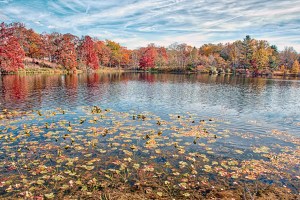 This week’s shift in weather with temperatures dropping below freezing each night has hastened the transition of fall foliage in the region. Although the local landscape has seemed slow to change thus far in the season, suddenly the trees are undergoing their transformation to a palette of rich colors. In addition, as I walk along wooded trails, a steady spill of leaves can be seen drifting in the wind—floating, fluttering, and slipping to the ground. Yesterday, hiking in this season’s coldest conditions, including a slow but consistent northern flow of air bringing a sub-twenty-degree wind-chill, I rounded a small nearby lake with a normally sleepy shoreline now awakened and exhibiting vivid imagery of autumn.
∼ November 10, 2017 ∼ “Trail Through Dune Woods in Early November”
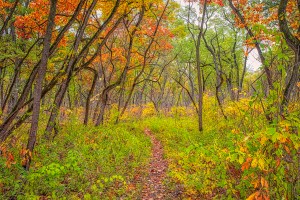 The Indiana Dunes region has served as inspiration for a number of artists and writers, including Edwin Way Teale, who spent much time at his grandparents’ home in Furnessville while growing up. Teale credited his experiences exploring the northern Indiana forests, wetlands, and dunes along Lake Michigan for initiating his interest in becoming a naturalist who eventually won various prestigious awards for his publications, including a Pulitzer Prize in 1966 for Wandering Through the Winter. Indeed, he recorded his childhood reminiscences in an autobiography released in 1943 titled Dune Boy: The Early Years of a Naturalist. Teale chronicled his adventures in the Indiana Dunes and elsewhere in nature across the nation through both writing and photography, and whenever I walk the Glenwood Dunes Trail with my camera near where Teale once owned his own cottage, I am reminded of his example.
∼ November 9, 2017 ∼ “Fall Foliage Fills Dune Hill”
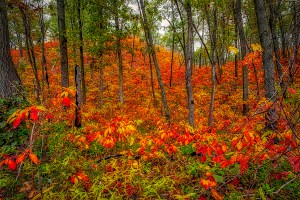 Every landscape photographer in this region awaits autumn the way most children in the area anticipate Christmas morning. I look forward to the peak of leaf change each year, and I appreciate opportunities to hike wooded trails where evidence of vivid fall foliage fills the forest. Earlier this week as I walked a marked course in the Indiana Dunes National Lakeshore on an overcast afternoon, I discovered an unexpected turn in the route I’d never followed before. Pursuing this path for a few hundred feet, I suddenly came upon a stunning scene in which a dune hill was blanketed with a wide sweep of rich red and orange rising from the valley floor up to its top. When I first observed the setting, I simply stood and admired the beauty of nature. Indeed, although I knew I wanted to capture the image with my camera, I paused for a while in awe and waited to absorb the moment before setting up my tripod.
∼ November 8, 2017 ∼ “Cabin in Autumn”
 As I have noted in previous journal posts, I have photographed the storage cabin at historic Bailly Homestead on numerous occasions, attempting to capture its image in different seasons. (Please see entries of 7/4 and 2/4 for a couple of examples.) Consequently, I revisited the location to snap a photo of the structure in November. Contrasted with the surrounding trees displaying an array of autumnal colors, the weathered gray of the logs appears even more forceful, especially when the pattern of parallel lines is viewed against the chaotic backdrop of disarray exhibited by the fall foliage. In fact, the scattering of leaves leading to the front door offers additional texture to the scene. Many limbs display a thinning of coverage, and already some of the higher branches are bare, allowing the light blue sky to show through. Finally, a couple of thick trunks nearby nearly match the shade of brownish-gray seen in the hewn wood witnessed in a few of the logs.
∼ November 7, 2017 ∼ “Central Beach in Beginning of November”
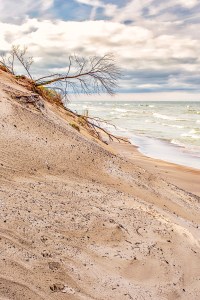 With the autumnal shift in weather the past couple of weeks, I have seen consequences for the Indiana Dunes shore line. The stronger northern winds have increased erosion along many of the beaches bordering Lake Michigan, greatly diminishing the expanse of sand available for walking the coast, and in some cases limiting access for visitors. As I hiked the short way from the parking lot to Central Beach at the end of last week, I discovered the entrance trail leading to the surf’s edge ended abruptly at a steep cliff, creating difficult and dangerous conditions for anyone even attempting to descend to the water line. Due to persistent winds and pounding waves washing onto the dunes from an already high lake level, the normally gradual slope lowering to the shore had been sliced away, leaving a sharp drop from a tenuous ledge. Indeed, peering into the distance, I could see most of the beachfront curving toward the western horizon had been inundated with the rising waters.
∼ November 6, 2017 ∼ “Dune Woods Trail in November”
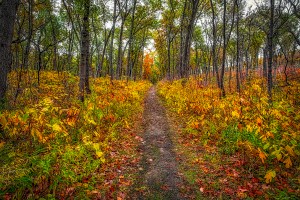 My favorite hikes through those Indiana Dune woods routes strung along the southern shore of Lake Michigan occur in autumn when an array of fall colors begins to reach its peak. Each twist in the trail offers a new vivid view full of brightly hued delight that I try to save in photographs or render in descriptive language. In his wonderful work titled “Autumnal Tints,” Henry David Thoreau notes how he wishes he could collect all the colorful fall leaves or paint them into a portfolio for review throughout the year, but concludes that as a writer he must resort to presentation with words: “What a memento such a book would be! You would need only to turn over its leaves to take a ramble through the autumn woods whenever you pleased. Or if I could preserve the leaves themselves, unfaded, it would be better still. I have made but little progress toward such a book, but I have endeavored, instead, to describe all these bright tints….”
∼ November 5, 2017 ∼ “Lake Edge in Early November”
 In a journal entry written about one week ago I noted that foliage on most trees edging the southern coast of Lake Michigan seemed to be evidencing fall color more quickly than those protected from winds on the inland side of sand dunes or farther away from the shore. In fact, I commented that many of the branches of trees along the beaches already had been stripped of their leaves by onshore winds. Indeed, walking wooded trails in the interdunal valleys this weekend, although there remains some evidence of autumn, one finds much of the forest still predominantly green. Nevertheless, as I moved toward the shore and hiked a few sections along the waterline on Friday, observing the white water of waves whipped up by strong northern gusts, I photographed an image of the turbulent surf with a brightly colored bush in the foreground, yet persisting into November among tufts of yellowing grass.
∼ November 4, 2017 ∼ “Trail in Early November”
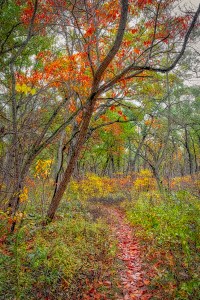 Although autumn’s transition of the landscape has been slow to occur this year, the leaves on trees in some sections of the Indiana Dunes appear almost ready to reach peak coloring. Indeed, on Wednesday when I saw Kelly—a friend and ranger at the Indiana Dunes National Lakeshore who had assisted me with setting up my exhibition of photographs at the Indiana Dunes Visitors Center—I asked if she had noticed any particular locations that had begun showing fall foliage. She recommended Dune Ridge Trail, where she had recently been hiking. While I walked that route through dune woods not too far from Lake Michigan early Friday after a nighttime rain, I could hear swift breezes still blowing among treetops and the pounding of waves on nearby Kemil Beach. However, despite the trail’s name, fortunately much of the path remains in a valley protected from the lake winds by dune hills, and the conditions were perfect for photographing woodland scenery—cloudy, calm, and cool.
∼ November 3, 2017 ∼ “Path Through Dune Woods on Autumn Afternoon”
 In yesterday’s journal entry I reported the unanimous passage of a bill in the House of Representatives to designate the Indiana Dunes National Lakeshore as the state’s first national park. I noted that action for this upgrade in status can be traced back as far as 1917, exactly one hundred years ago. On Wednesday evening I attended an informative and interesting presentation at Valparaiso University’s Brauer Museum of Art by James B. Dabbert, an expert on artist Frank V. Dudley, “The Painter of the Dunes,” and his influence on the preservation of the Indiana Dunes. In Dabbert’s latest book, The Indiana Dunes Revisited: Frank V. Dudley and the 1917 Dunes Pageant, he declares: “…Dudley began to exhibit Dunes paintings both in Chicago and nationally to promote the Dunes, an agenda championed in National Park Service Director Steven Mather’s Report on the Proposed Sand Dunes National Park, Indiana, published in 1917.”
∼ November 2, 2017 ∼ “Bailly Bridge in Autumn”
 This week I once again visited the Indiana Dunes National Lakeshore landscape along the Little Calumet River, and I photographed the bridge just below higher ground where the historic Bailly Homestead stands. Yesterday, I was pleased to learn the House of Representatives unanimously approved upgrading the status of the Indiana Dunes National Lakeshore to designation as the country’s newest national park. The official re-classification now only requires Senate ratification. In my October 5 journal entry, I reported: “This move would recognize the more than 15,000 acres of land in the Indiana Dunes National Lakeshore as the first national park in Indiana and the 60th in the United States. Moreover, this next step, which could be completed by the close of the year, will mark the end of a journey begun just about 100 years ago when the National Park Service was instituted in 1916 and Stephen Mather, who visited the Indiana Dunes and held hearings on the proposal for ‘Sand Dunes National Park,’ became the first director of the National Park Service in 1917.”
∼ November 1, 2017 ∼ “Glenwood Dunes Trail in Autumn”
 In a journal entry submitted a couple of days ago I mentioned my pair of month-long exhibitions of photographs on display at the Indiana Dunes Visitors Center and the Indiana Dunes State Park Nature Center were to come to a close with the final day of October. However, I am pleased to report that I have been invited to continue my showing of photos at Indiana Dunes State Park for another month. The kind staff have informed me that many visitors have expressed enjoyment with the variety of images available among the dozen pictures included in the exhibit. Since this project is supported by an Arts in the Parks and Historic Sites grant sponsored by the Indiana Arts Commission with an intention of sharing scenes of the Indiana Dunes region seen in the photographs, I am especially delighted to find even more individuals spending time at the state park will be able to appreciate the artwork in person through the end of November.
∼ October 31, 2017 ∼ “Farm Cart Path Bend at End of October”
 With the end of October holiday upon us today and the transition of the seasons now in full view, I find the change of leaves currently occurring to be most appropriate, especially since Halloween orange appears as a prominent color emerging among overhanging branches as I travel along various trails. In fact, walking a cart path at a nearby northern Indiana farm that has been converted into grounds for a county park, dark and twisted limbs on many of the trees lining my way—and still fringed with autumnal orange, red, and yellow—seem to be reaching overhead like ghoulish arms. Indeed, during the last weeks of October the routes through Sunset Hills Farm County Park are transformed each evening into haunted passageways upon which children take popular hayrides in the cold night air. During their journeys, huddled together for warmth and for comfort from the scary surroundings, they are surprised by numerous skeletons, monsters, scarecrows, vampires, and other examples of frightening special effects or moody lighting.
∼ October 30, 2017 ∼ “Marsh Bridge in October Light”
 As October is about to come to a close, so will my pair of month-long exhibitions showing landscape photographs at the Indiana Dunes State Park Nature Center and the Indiana Dunes Visitor Center, both of which end tomorrow. I thank the staffs of the state and national park systems who assisted me in displaying the Indiana Dunes images as part of my project sponsored by an Indiana Arts Commission’s “Arts in the Parks and Historic Sites” grant. I am pleased by reports I have received that the exhibits seem to have been very successful. I have had to replenish the depleted supplies of information cards about my project that were available at each location, and online statistic counters tracking hits at the project web pages indicate dramatic spikes in viewership throughout the past month. In addition, as I noted in my 10/15 journal post, I had an opportunity to offer a presentation of my photography to an encouraging audience in the auditorium at the Indiana Dunes State Park Nature Center. I also enjoyed speaking with attendees following my talk, and I have been delighted to hear further from some folks through subsequent e-mail messages expressing appreciation.
∼ October 29, 2017 ∼ “Lake Waves Seen Beneath Autumn Leaves”
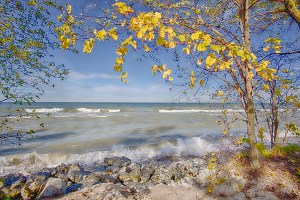 With a steady schedule of autumn weather finally settling over northern Indiana during the past week, many changes in the landscape have begun to become evident. Although most inland woods have seemed slow in their transition to fall foliage due to warmer than usual conditions throughout much of September and October, as well as shelter provided by dune hills rising along the lakefront that protect from those harsh gusts sweeping onshore from Lake Michigan, I notice trees along the edge of the coast appear more advanced in their coloring or even exhibiting loss of leaves. Walking the shoreline to watch white water breaking on the beach from waves created by northern winds following a passing storm, I pause to view a scene of slightly turbulent surf through trees always vulnerable to the elements and whose limbs were full with deep green leaves not long ago.
∼ October 28, 2017 ∼ “Trail Eight in Late October”
 Transitions in the landscape witnessed during late October create new images to capture in some of those old locations I’ve previously visited earlier in the year. As I walk Trail Eight in the Indiana Dunes State Park, I notice leaves of trees lining the path at last have begun to exhibit autumn colors. This route moves through inland woods near the central marshland of the park and is partially protected by dune hills from intermittent onshore gusts sweeping over slightly choppy waves of Lake Michigan. Nevertheless, a sporadic breeze filters through the upper limbs of this forest. Though those thinner branches above waver a bit in an inconsistent stir of wind, and at times the arrangement of fall foliage flutters with sudden movement, a quick shutter speed permits me to still the motion for a photograph.
∼ October 27, 2017 ∼ “Leaf Fall After Rain”
 Henry David Thoreau: “…it is after moist and rainy weather that we notice how great a fall of leaves there has been in the night….” As I walked a trail though woods along the Indiana Dunes landscape this week on a day after heavy rain, I discovered the way suddenly filled with layers of fallen leaves, and I thought of excerpts from a favorite book by Thoreau, Autumnal Tints, written as a lecture essay during the final year of the author’s life and first published posthumously in the October, 1862, issue of Atlantic Monthly. Consequently, Thoreau’s awareness of his mortality seems to make his perceptions throughout the volume of endings visible in autumn images somewhat more poignant. “October is the month for painted leaves. Their rich glow now flashes round the world. As fruits and leaves and the day itself acquire a bright tint just before they fall, so the year near is setting. October is the sunset sky; November the later twilight.”
∼ October 26, 2017 ∼ “Chellberg Farm in Late October”
 After three days of almost steady rain, the thick cloud cover finally cleared and a bright sun broke through, shining on a northwest Indiana landscape beginning to exhibit more evidence of fall. As nighttime temperatures dropped close to freezing and a northerly breeze continued to sweep onshore from Lake Michigan, conditions on Wednesday suddenly seemed a little more autumnal. To witness the extent of flooding due to the recent spell of rainfall and to capture changes in foliage during the past week, I decided to hike a short stretch along the Little Calumet River near the old Bailly Homestead and then follow a trail to Chellberg Farm. Although the way was muddy and a layer of wet leaves left the path a bit slippery, I enjoyed the afternoon. Along the way, I only passed a couple of groups of school children guided through the two historic sites, and I paused to photograph a cow lazily grazing in a field with the backdrop of a tree line displaying fall foliage.
∼ October 25, 2017 ∼ “Trail Bridge in Autumn”
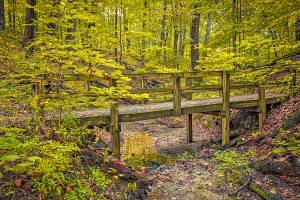 I have commented a number of times during recent weeks about the delay in transition to fall foliage by many trees in the region whose leaves have remained green. Curiosity by many concerning the fact that this autumn’s colors have been slow in showing themselves caused the Indiana Dunes National Lakeshore to share information provided by the United States National Arboretum titled “The Science of Color in Autumn Leaves.” Among its details, the document reports ideal conditions for a vibrant fall landscape: “A growing season with ample moisture that is followed by a rather dry, cool, sunny autumn that is marked by warm days and cool but frostless nights provides the best weather conditions for development of the brightest fall colors. Lack of wind and rain in the autumn prolongs the display; wind or heavy rain may cause the leaves to be lost before they develop their full color potential.”
∼ October 24, 2017 ∼ “Creek Under Autumn Leaves”
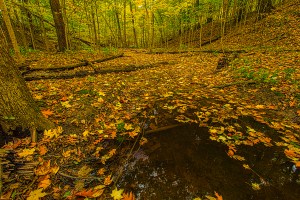 Two days of rain and wind have altered the landscape in northern Indiana. Although the extended stretch of warm autumn weather for the last month thus far has slowed the full transition to fall foliage, and many trees remain green, blustery conditions during the past couple of days have suddenly left a covering of fallen leaves on everything. Indeed, the forest floor seems carpeted with vivid coloring. In addition, waves of squalls from the southwest arriving with heavy downpours have swept into the region and across Lake Michigan, filling creeks winding through the dune woods that had been completely dry only a couple of weeks ago. As a photographer who awaits with anticipation this season’s peak, I know the danger of such a quick change can be that those branches overhanging inland trails will empty too swiftly, and the opportunity for brilliant fall photographs will close too soon.
∼ October 23, 2017 ∼ “Dark Forest Trail”
 When the weather turned stormy this weekend, southwesterly winds swept lines of rainfall across the region then drifted to the northwest, lowering the long spell of unusually warm temperatures, and by Sunday evening a cold front drove the area’s overnight lows to those more common in autumn. On occasions like this the atmosphere along trails through wooded sections of the Indiana Dunes shifts toward a tone moodier and more mysterious. Although most of the trees yet remain green, some leaves have already dropped and decorate the way ahead. In addition, this upcoming week promises to create a more complete seasonal transition and finally exhibit a peak in fall foliage. Meanwhile, walking paths on the Bailly-Chellberg Trail through sections of dark forest, I appreciate the altered scenery, and I look forward with anticipation to further changes in the landscape.
∼ October 22, 2017 ∼ “Pond in Late October”
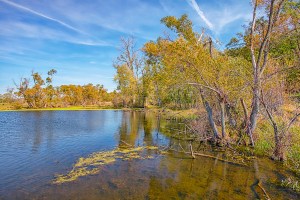 Although the weather in northwest Indiana has been warm for autumn and the region has not yet felt a freeze, nighttime temperatures have been cool enough for a few fall changes to occur, especially with the steady lessening of sunlight strength as the season progresses. At sporadic spots along my walks I witness subtle transitions in the landscape. In one instance as I hiked a favorite trail passing a pond this week, I noticed a scattering of leaves on bordering trees, some with branches leaning over the pond’s edge, had started to shift their coloring, and the surface of the water had lost most of its summer murkiness, a mixture of green and yellow. In fact, the translucency of the pond on the side where I was standing to photograph the scenery seemed a foreshadowing for later in the year, when the entire pond becomes almost transparent for a while, offering a distinct clarity until frozen solid and covered by white drifts of snow in midwinter.
∼ October 21, 2017 ∼ “Warm Autumn Weather”
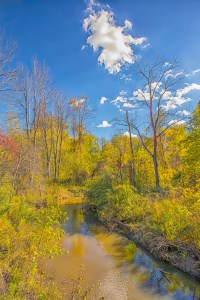 This autumn’s warm weather continues with southern winds bringing temperatures reaching 80 degrees. Conditions suggest a lingering of summer, but the calendar already indicates late October is upon us. Walking under bright sunshine, I appreciate the way the light accentuates trees and shrubs just beginning to display fall foliage. Even the color of the creek water seems enhanced by such strong illumination. As I hike a flat path toward the north, I feel a brisk breeze at my back, and I notice my elongating shadow on the partially sandy trail extending ahead of me. The steady but distant sound of birdsong still accompanies me as I move through this nature preserve, knowing the peak of seasonal transition appears to be only about one week away. Although I anticipate the possible opportunities for vivid photographs, I try to imagine what it would be like if mild days like today could continue further into the future.
∼ October 20, 2017 ∼ “Ravine Trail in Mid-October”
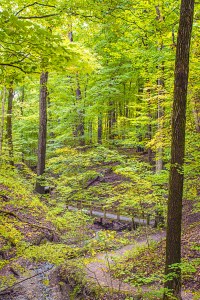 The section of trail in the Indiana Dunes National Lakeshore that winds along a seasonal creek in a ravine behind Chellberg Farm provides a perfect place for walking at all times of the year. I like the way this route moves through woods usually exhibiting the landscape’s changing character within each season. One part of the way displays a dramatic view where visitors descend to the path’s lower level. (To examine a couple of my previous photographs taken at this site, I recommend checking my 3/1 and 5/15 entries.) However, as I strolled the location this week, I discovered the region’s warm autumn weather has delayed coloring of fall foliage, and leaves on most of the trees remain various shades of green. In fact, my research indicates peak for fall foliage may still be seven days away. Consequently, the picture I captured seems little different from the one seen in my spring post last May, and I will need to return again next week.
∼ October 19, 2017 ∼ “Flood Level”
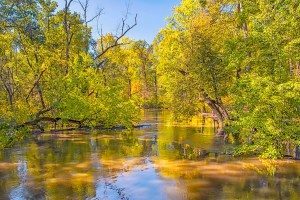 In my posts the last couple of days I noted the record-breaking rainfall during this past weekend that brought flooding to the region. I examined how the Little Calumet River’s surface had risen significantly, overflowing banks and swallowing the surrounding landscape. Indeed, traveling deep within woods along the river, I explored the expanse of forest suddenly under water, as seen in my 10/17 journal entry. Although the high water level wiped away the trail I usually hike, I managed to find my way to locations exhibiting the extent of spreading floodwaters, and I photographed a few scenes displaying the calm after the storm, including what seemed to me a surprising sense of splendor offered by the transformed setting seen under bright autumn sunshine.
∼ October 18, 2017 ∼ “Creek Bend in Middle of October”
 This past weekend’s weather brought a deluge of rain filling local waterways that had been low and flowing slowly due to a month with hardly any precipitation. The creek water deepened and the current quickened by the time I walked a winding trail following its course. Though a few hints of fall color had begun to tint elements of the landscape, much of the scenery seemed more like early spring when winter snowmelt seeps into smaller streams. Indeed, except for the presence of a couple of tall trees with bare branches, I felt like I was hiking in another season, experiencing mild temperatures under bight sunshine. When I turned around a bend toward the north, a soft breeze moving the few clouds above also blew through the trees, cooling the air just a touch and stirring thin reeds rising from the edge of the creek, and those long weeds that had grown all summer alongside the path now bent a bit in the light wind.
∼ October 17, 2017 ∼ “Flooded Forest After October Rain”
 According to local weather reports, Saturday’s all-day storm and torrential downpours resulted in the rainiest October day on record. Consequently, waterways throughout the region that had been at low levels after a month of little precipitation suddenly swelled and even overflowed banks. Therefore, I decided on Monday to revisit the Little Calumet River near the historic Bailly Homestead, which I had passed during a hike only a couple of days earlier. When I arrived at the river, I discovered evidence of extensive flooding that had spread far into the forested landscape on either side and completely erased any trace of the trail. In the past I have witnessed such conditions only in springtime during rainstorms on top of snowmelt after a winter with significant accumulations. Indeed, as distant as a quarter mile from the water’s normal course, I photographed the floodwaters, now still in windless conditions and with a surface almost artistically reflecting the woods upon which they were encroaching.
∼ October 16, 2017 ∼ “Little Calumet River Trail in Early Autumn”
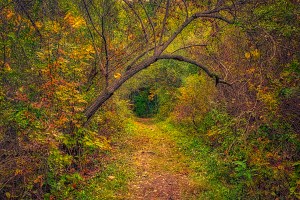 Sections of the Little Calumet River Trail in the Indiana Dunes National Lakeshore at times seem to tunnel through the woods. Especially on overcast afternoons, the route could be viewed as almost a mysterious passage toward the unknown as it surrounds any traveler, suddenly trapped beneath dark overhead limbs filled with foliage. In fact, when I walk this length of the way between the river and a forest ravine farther away, I am always reminded of a few lines from Robert Frost’s famous poem, “The Road Not Taken,” about trying to discern the path ahead: “long I stood / And looked down one as far as I could / To where it bent in the undergrowth….” Although autumn has begun, and some of the trees seem to be thinning, today enough of the leaves—many just starting to show fall’s vivid colors—remain to complete a feeling of enclosure.
∼ October 15, 2017 ∼ “Stormy Beach in Autumn”
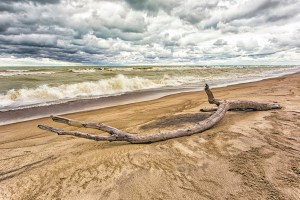 I was pleased to offer an hour-long presentation of my photographs at the Indiana Dunes State Park Nature Center yesterday, during which I described my ongoing project sponsored by the Indiana Arts Commission. The afternoon’s blustery and rainy weather chased many campers and visitors indoors for shelter, and hot chocolate was provided for everyone, which helped increase the attendance, as the auditorium was pretty full by the time I was kindly introduced by Cookie Ferguson, the interpretive naturalist on duty. I appreciated the attention of those in the audience as I narrated conditions and situations in which the various images were captured, and I had a few pleasant conversations with folks who remained a while after my talk. I enjoyed the opportunity to discuss the scenery in my pictures, as well as addressing elements concerning the history and geography of the Indiana Dunes, in much the way my prose commentaries accompany the photos in my journal. Again, I am grateful for the invitation to speak.
∼ October 14, 2017 ∼ “Chellberg Farm Cart Trail in Mid-October”
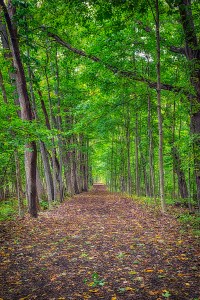 The skies were overcast on Thursday, so I decided to hike wooded trails in the Indiana Dunes National Lakeshore. Clouds, calm winds, and comfortable temperatures in the mid-sixties are ideal conditions for photographing woodland landscapes. In fact, the lack of direct sunshine guarantees images without harsh shadows or bleached colors, and the still air allows for slow shutter speeds without blurriness due to movement of leaves. As I walked along a cart path at Chellberg Farm, a remnant from the nineteenth century, I noticed the foliage of trees yet remain full and rich with green. Only a limited number of fallen leaves littered the route. Indeed, the scenery seemed little different from a similar picture I’d taken in spring (see my 5/18 entry). Therefore, my only frustration with the weather came from the absence of a shift to fall’s vivid tints, a transition which has been delayed by an unusually warm early autumn and may be at least another ten days away.
∼ October 13, 2017 ∼ “Geologic Story of the Indiana Dunes”
 The Indiana Geological & Water Survey at Indiana University has created a pamphlet titled “The Geologic Story of the Indiana Dunes,” available online in a PDF format. Accompanied by a few graphic illustrations, the guide’s text offers a history of the landscape’s development since the withdrawal of glacial ice from the area. The brief narrative presented to curious readers outlines how various elements of the terrain—such as sand dunes, forests, blowouts, moraines, and interdunal marshlands—were established. As the narrative states: “The expansive beach, rolling dunes, and wide wetland features illustrate the effects of water, wind, and vegetation growth in reshaping the surface of the land since the departure of the glacier from this region about 18,000 years ago.” This interesting source of information can be found at the following: Indiana Dunes State Park Guide.
∼ October 12, 2017 ∼ “Photography at Indiana Dunes State Park”
 I am pleased to mention that the Indiana Dunes State Park announced yesterday my upcoming talk about photographing the local landscape and lakeshore, as well as the ongoing exhibition of my photos, currently at the park’s Nature Center Auditorium and scheduled to remain on display through the end of the month. The presentation, showcasing captured images of the Indiana Dunes, will take place on Saturday, October 14, at 2 p.m. Once again, I appreciate the support and friendly assistance offered by the Indiana Dunes State Park staff. As their promotional post on Facebook noted, my year-long project—including the photography display and the special program on Saturday—was made possible through a 2017 Arts in the Parks and Historic Sites Grant from the Indiana Arts Commission in conjunction with the National Endowment for the Arts. In addition, I am grateful for funding provided by a Creative Work and Research Grant received from Valparaiso University.
∼ October 11, 2017 ∼ “Walking Trees”
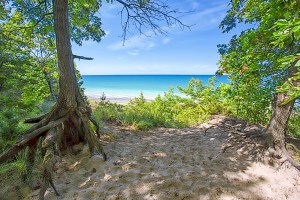 In past posts I have described Trail Nine at the Indiana Dunes State Park and characterized the path as one of my favorite routes for hiking. In my 9/22 entry I particularly spoke about how an isolated eastern length of the trail “turns and parallels the shoreline on a dune crest high above the coast. Each stretch of the way offers an impressive and extensive view of Lake Michigan, and much of the walk moves at a great height through an edge of woods lining the ridge, allowing hikers to experience cool lake breezes and offering some welcome shade on warmer days.” However, since the passage extends across high dune hills vulnerable to lake winds, many trees along the crest present an interesting feature, as the sandy ground around them has mostly eroded and left their roots uncovered, which gives these trees an appearance of walking the ridge trail alongside their visitors.
∼ October 10, 2017 ∼ “Late Light in Early October”
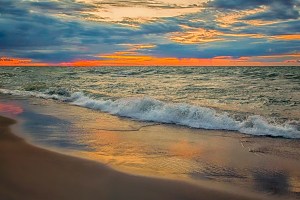 By regularly devoting a defined amount of time to displaying and describing scenery along the Indiana Dunes through prose accompanied by photos in my journal as part of a year-long project, I have discovered an added appreciation and attachment to the landscape. In a chapter titled “Landscape and Imagination” from his 1991 book, Secrets of the Universe: Scenes from the Journey Home, which I also referenced yesterday and in my 1/12 commentary, Scott Russell Sanders writes: “It is a spiritual discipline to root the mind in a particular landscape….” He suggests the explorations by which we seek “to see our home ground afresh may be physical ones…or they may be journeys of the mind, such as those we take through stories and photographs and paintings. By renewing our vision of the land, we rediscover where it is we truly dwell. Whatever the place we inhabit, we must invest ourselves there with our full powers of awareness if we are to live responsibly, alertly, wisely.”
∼ October 9, 2017 ∼ “Approaching the Coast”
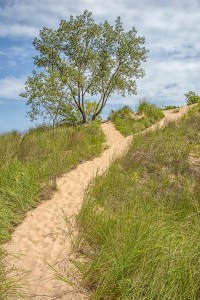 Early in the process of my ongoing project to chronicle the Indiana Dunes in prose and photos, I quoted from a fellow Hoosier author, Scott Russell Sanders, on the importance of “memory, knowledge, and imagination” when attempting to fully appreciate the landscape one experiences. In that 1/12 commentary, I wrote about how “I attempt to bring these ingredients into my own observations and reflections on the Indiana Dunes.” Now nearly nine months later, as my journal has reached 75,000 words, I believe the descriptions and opinions I have offered concerning the surroundings through which I have traveled continue to be informed by those three features listed above. As Sanders further states, to write about the local nature one must rely on “lessons in seeing, from people and memories and books.” Reviewing my writings thus far, I can attest to the necessity of blending those forms of understanding to reach a more complete picture of the region I am exploring.
∼ October 8, 2017 ∼ “Dune Crest View Toward Chicago”
 I have offered observations in the past about how delightful, even inspiring, the scenery can be when arriving at a dune crest after hiking along a winding trail through inland woods and climbing a steep slope on the lee side of a sand hill. An initial glimpse at the blue waters of Lake Michigan extending toward the horizon establishes a pleasing contrast easy for the eye. Often, a soft onshore breeze suddenly feels refreshing following my long walk toward the shore. On this day I pause on a high ridge just above the beach at the Indiana Dunes State Park, and I find myself facing not only the lake, but also the distant skyline of Chicago on the other side. An outline of the city can be seen framed between rough clusters of shrubbery still green in early autumn and almost inexplicably growing from an arid mound of sand.
∼ October 7, 2017 ∼ “Clearing Skies”
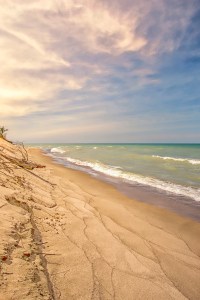 After more than a month of mostly dry conditions, the past couple of days have delivered a fair bit of rainfall. Though the wet weather is welcome, opportunities for hiking and photography are severely limited. However, I must acknowledge the times immediately following rainstorms often provide some of the finest settings for capturing images. The horizon displays a sharp contrast between departing scraps of clouds and the arrival of clear blue skies, even as the sun seeps between the thinning overcast and illuminates the scenery with filtered light. The continuing presence of white water from windswept waves offers a slightly higher surf that narrows the reach of the beach significantly, creating a leading line for the photo. An absence of visitors allows for sand, still damp and exhibiting shades of tan, to remain yet unblemished by footprints. In addition, traces of older waves that rose toward the dunes during the passing storm show themselves in lengthy stretches of scalloped lines etched onto the beach.
∼ October 6, 2017 ∼ “Late Lakeshore Waves”
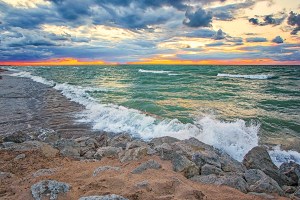 In yesterday’s entry I mentioned the proposal sent unanimously by a House of Representatives committee for passage in Congress that would designate the Indiana Dunes National Lakeshore as Indiana Dunes National Park. In my search for the text of the bill (H.R. 1488: “The Indiana Dunes National Park Act”), I discovered language in the findings section that testified to the importance of this region in Northwest Indiana. Some statements included the following. “The southern shore of Lake Michigan includes some of the most geologically and biologically diverse areas in the United States….The unique features that comprise the southern shore of the Lake Michigan, also known as the Indiana Dunes, were formed over the course of 12,000 years by natural forces, including glaciers, wind, and water. Glacial melting and fluctuations in the water level resulted in the formation of as many as 7 shorelines. This process resulted in the biologically diverse beaches, sand dunes, and inter-dune wetlands that can be seen today.…The Indiana Dunes National Lakeshore and the adjacent Indiana Dunes State Park are comprised of over 15,000 acres of dunes, oak savannas, swamps, bogs, marshes, prairies, rivers, and forests that are currently preserved for public enjoyment…. The Indiana Dunes National Lakeshore is one of the most biologically diverse National Park Service units, containing 2,336 unique species, including 896 animal species and 1,407 plant species…. The Indiana Dunes National Lakeshore is an especially important feeding and resting area for migrating land and water birds, boasting 350 unique species.”
∼ October 5, 2017 ∼ “Significant News for the Indiana Dunes”
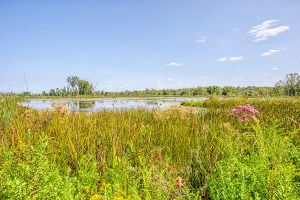 Yesterday brought significant news that transformation of the Indiana Dunes National Lakeshore to official designation as a national park appears imminent. A House of Representatives Committee on Natural Resources unanimously approved the change in a bill that now merely awaits ratification by the entire House and the Senate. This move would recognize the more than 15,000 acres of land in the Indiana Dunes National Lakeshore as the first national park in Indiana and the 60th in the United States. Moreover, this next step, which could be completed by the close of the year, will mark the end of a journey begun just about 100 years ago when the National Park Service was instituted in 1916 and Stephen Mather, who visited the Indiana Dunes and held hearings on the proposal for “Sand Dunes National Park,” became the first director of the National Park Service in 1917 with recommendation for such a status. Unfortunately, that proposal coincided with World War I, and it was set aside at the time; however, the good work and dedication of many individuals over the decades now seem ready to be rewarded.
∼ October 4, 2017 ∼ “Early October at Lake Michigan”
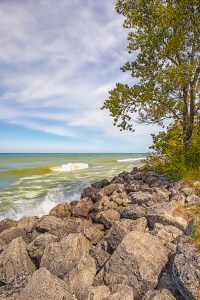 Daytime temperatures have remained in the seventies throughout this first week in northern Indiana, and walking along the Lake Michigan shoreline during morning hours with a slight onshore breeze offers a sense of calm. There have been years in the past when the start of October in the region brought a few days of overnight frost, blustery winds, and snow flurries; however, this season continues mostly mild, and even the cooler night wind has presented us with crisp, clear, and refreshing air. The extended spell of relative warmth we’ve witnessed seems to be delaying transitions to fall colors, keeping leaves various shades of green on lakeside trees. I am reminded of Henry David Thoreau’s reflections on weather of another October long ago: “Each morning now, after rain and wind, is fresher and cooler, and leaves still green reflect a brighter sheen.” [Thoreau, Journal: October 2, 1858]
∼ October 3, 2017 ∼ “River Reflection in Early Autumn”
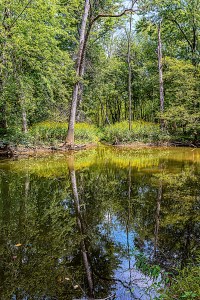 Although most of the leaves have not begun to transition to fall colors, the cool and crisp weather this early autumn has provided ideal conditions for hiking trails just inland from Lake Michigan. Indeed, the full foliage contributes to reflections on the still surface of ponds or slow-flowing streams and low-level river current along the way, where thus far the water remains only sparsely spotted with fallen leaves. Walking a path beside the Little Calumet River—whose course has recently been completely cleared of blockage from tumbled tree trunks or broken limbs for the first time in three decades after years of work from crews organized by the Northwest Indiana Paddling Association with assistance from other groups—reopened for navigating with kayaks or canoes, I still listen for birdcalls from nearby trees and watch for deer moving through the woods. I also recall the importance of this narrow waterway, which once served as a commercial connection to Lake Michigan and along which the first trading post was constructed early in the nineteenth century. [For more details, please see my 2/26 entry.]
∼ October 2, 2017 ∼ “Photographs on Display”
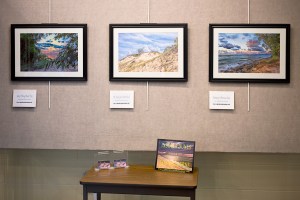 In yesterday’s entry I reported my installation of photographs in an exhibition at the Indiana Dunes Visitor Center. (A few can be seen in the accompanying picture.) This show with a sampling of images from various locations in the landscape along Lake Michigan represents part of the project I began in January to chronicle the Indiana Dunes through photos and prose. I am honored that this year-long endeavor is sponsored by the Indiana Arts Commission in conjunction with the National Endowment for the Arts and with assistance from a Valparaiso University Creative Work and Research grant. I also have been pleased by the encouragement, support, and cooperation I have received from representatives of the Indiana Dunes National Lakeshore and the Indiana Dunes State Park. Indeed, the complimentary comments, encouragement, and assistance offered by park rangers have been especially heartening, since I am aware how much these individuals value knowledge and respect for the local landscape, characteristics I attempt to display in my captured images and journal comments.
∼ October 1, 2017 ∼ “Indiana Dunes Photography Exhibit: Oct. 1-31”
 Yesterday I closed the month of September by installing an exhibition showing some of my Indiana Dunes photographs in the Exhibit Hall at the Indiana Dunes Visitor Center in Porter, Indiana. The facility is shared by Indiana Dunes Tourism and the Indiana Dunes National Lakeshore of the National Park Service. The selection of my images on view throughout October represent a sampling of scenes captured at Indiana Dunes National Lakeshore locations, including Mt. Baldy and various beaches or trails within the parkland. In addition to taking the pictures, I printed them myself; but I am especially thankful to my wife Pam, who did a wonderful job carefully framing the photos for display. In addition, I want to express my appreciation to Kelly Caddell, the friendly park ranger who assisted me in hanging the artwork. If you are in the area, please stop at the Visitor Center, which also houses a number of other features detailing aspects of wildlife, landscape, and Lake Michigan, as well as a library of brochures or area guides, bookstore, and souvenir gift shop.
∼ September 30, 2017 ∼ “View to Chicago at Sunset in End of September”
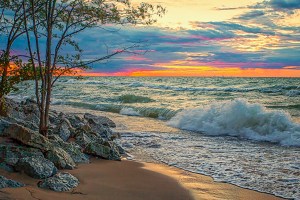 In his 1836 essay titled “Nature,” Ralph Waldo Emerson writes the following: “The health of the eye seems to demand a horizon. We are never tired, so long as we can see far enough.” Emerson’s influential work helped shape Henry David Thoreau’s perceptions of the landscape and served as a foundation for other American Romantic thinkers. On this weekend at the end of September, Lake Michigan sunsets as seen from beaches of the Indiana Dunes continue to glow beneath islands of drifting clouds, illuminating the distant skyline of Chicago. Though the slightly colder northern winds blowing over the water create a steady rhythm of waves and offer a taste of autumn, the chilly atmosphere seems camouflaged by those bright and warm colors of late sunlight. When I walk along the shore, the pulsing sound of the surf causes a calm tone. Even the brilliant reflection on the wash of water climbing the darker wet sand presents a sense of nature’s elegance, evoking Emerson’s spiritual evaluations of the world around us.
∼ September 29, 2017 ∼ “Dune Hill in End of September”
 When the weather begins its changes in late September, bringing quick clouds blown by northwesterly winds, the scenery along Lake Michigan frequently becomes more interesting. Though cool breezes seem to suggest a fall chill will soon arrive, the early autumn sun remains strong enough to moderate temperatures in midday. Even the green leaves of dune trees seem reluctant to make the transition to a new season. Standing on a sandy hill above an empty beach, I watch from a distance as a steady series of windblown waves washes onto the shore, each string of surf slowly approaching like a thin line, perhaps the way a slice of white stretches across a canvas on an aqua background in a minimalist artwork.
∼ September 28, 2017 ∼ “Rip Currents”
The long heatwave we’ve been experiencing came to an end on Wednesday, and I visited the beach at the Indiana Dunes State Park. Although temperatures were normal for the closing days of September, the contrast with the hot and humid conditions present throughout the past week caused me to feel a bit chilly. In fact, since wind directions had shifted and northern gusts were coming onshore from Lake Michigan, I suddenly needed a light jacket as I walked through the dunes and approached the water’s edge. Hazard warnings due to powerful rip currents—which create dangerous waves of six feet or more that then quickly pull away a strong underflow from shore—had been posted, and the entire beachfront remained empty of any other visitors. However, as is often the case, the scenery seems even more dramatic when the weather turns turbulent.
∼ September 27, 2017 ∼ “Dunes Creek in Dry Times”
 In yesterday’s entry I mentioned how the lack of rainfall this month has slowed the flow of current in Dunes Creek to a standstill. In fact, when I hike inland on a trail along the creek, I approach sections where the water levels have lowered significantly or the course has dried almost completely. Moreover, in this last week’s heat spell, during which daytime highs have reached records seven consecutive days, the landscape along the way yet resembles mid-summer conditions. Much of the foliage remains green, and the still-thick underbrush continues to overgrow the banks of the waterway. Indeed, at times the winding route of the creek appears hidden beneath lush camouflage or seems to disappear altogether, replaced by a mere muddy strip. Though I look forward to the arrival of autumn with its rich palette of fall colors in two or three weeks, I find myself enjoying this unexpected extension of warm weather while it lasts.
∼ September 26, 2017 ∼ “Dunes Creek in September”
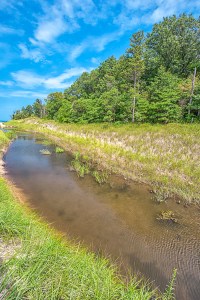 Dunes Creek runs through much of the Indiana Dunes State Park property, draining from the large marsh that fills quite a bit of the interdunal wetlands and winding to the western end of the park. In previous posts I have included images of the creek in various sections of its course—where it turns through a valley just beyond the dunes, where it approaches the campgrounds, where it parallels Trail Two, and where it blends with swamp forests. The final stretch of Dunes Creek that bends toward the shore and empties into Lake Michigan was once unseen to visitors because it was buried for nearly 80 years by a parking lot positioned behind the beachfront pavilion housing showers, comfort stations, and refreshment stands. However, in 2012 this portion was reopened when a restoration project attempted to return the waterway to its original and more scenic state. Even in the dry conditions experienced thus far in September, when the flow of water has slowed almost to a standstill, the setting seems more appealing with the visibility of the creek lined by woodland as it extends to the public beach just beyond.
∼ September 25, 2017 ∼ “Dune Path in Late September”
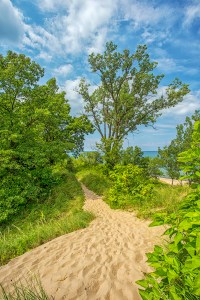 When I choose a section of the Indiana Dunes to visit, I often do not know which direction I will travel or what new paths I will find along the way. On such occasions I consider Henry David Thoreau’s observations in his essay simply titled “Walking”: “What is it that makes it so hard sometimes to determine whither we will walk? I believe that there is a subtle magnetism in Nature, which, if we unconsciously yield to it, will direct us aright. It is not indifferent to us which way we walk.” Indeed, I usually find myself hiking sandy trails winding through foredunes or along ridge crests while allowing the beauty or interest in the landscape to influence the directions I will walk. Consequently, I am delighted by the surprisingly simple yet stunning images I witness as I wander among the reeds of marram grass, prickly thistles, sprouting weeds, wildflowers, and beach trees along the shoreline.
∼ September 24, 2017 ∼ “Central Beach in Late September”
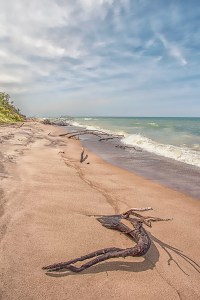 A series of days with record high temperatures has delayed significantly the transition to autumn. Although only a week remains in September, the weather continues to resemble mid-July conditions, as the landscape scenery also seems stuck in summer. Bright sunlight bathes Central Beach, and its narrow strip of sand in front of me yet unmarked by footsteps extends into the distance, littered with broken sticks of driftwood and small trees fallen from eroding dunes along the Lake Michigan shore. Despite a gradual accumulation of early afternoon clouds drifting from the south and shifting across the coastline, the region’s lengthening dry spell remains in place. A thin haze stretches over the horizon at the farthest edge of land, then disappears above the water, replaced by wide skies of deepening blue. A movement of air stirred by the steady waves of a cool surf feels refreshing and—like the warmer weather—I will linger a little longer.
∼ September 23, 2017 ∼ “Sandy Trail Through Dune Ridge”
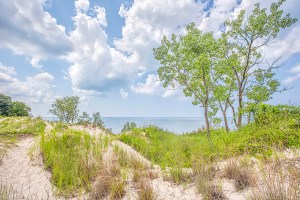 The arrival of autumn coincided with Indiana stuck in the middle of a heat wave. Record-breaking temperatures in the mid-90s reminded everyone summer may be over but the weather remains independent of expectations connected with calendar markings. Consequently, the Indiana Dunes continue to offer images less likely to be associated with the end of September. Indeed, the green leaves and bright sunshine I still find while hiking again across dune ridges above Lake Michigan resemble scenery one might more readily identify with July or August. However, while most folks are enjoying the reprieve from chilly situations, I keep in mind that this extension of a hot season, combined with the previous few weeks without significant rainfall, could create a shorter span of time for fall colors. Dry and warm days in September may mean a sudden loss of leaves once October’s colder conditions take hold, and the window for photographing fall foliage will close more quickly this year.
∼ September 22, 2017 ∼ “View from Eastern Rim of Beach House Blowout”
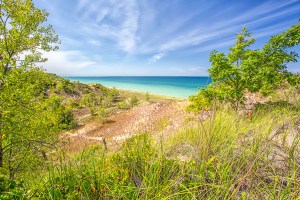 Traveling east along thick woodland on the level ground of Trail Nine, the route suddenly climbs from the inland forest up the steep dunes behind the Beach House Blowout and winds around its narrow rim toward the shore. At that point the path turns and parallels the shoreline on a dune crest high above the coast. Each stretch of the way offers an impressive and extensive view of Lake Michigan, and much of the walk moves at a great height through an edge of woods lining the ridge, allowing hikers to experience cool lake breezes and offering some welcome shade on warmer days. Looking out from the eastern side, the bowl of open landscape formed by wind erosion shows as it leads toward the vast expanse of water and the distant skyline of Chicago visible on the horizon beyond.
∼ September 21, 2017 ∼ “Pond Near End of September”
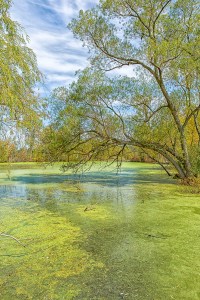 Much of the landscape within the Indiana Dunes consists of marshes, bogs, ponds, and swamps, where the overhanging foliage or undergrowth of weeds and stalks of reeds rising from the water maintain a richness in color throughout the summer due to excessive moisture, even during periods without much rain. With this week’s warmer temperatures and a continuing dry spell that has lasted a month, the weather entices one to hike through the cool shade of those woods interspersed among the wetlands. Sometimes when walking these trails near the end of September everything seems even greener and more lush than in mid-summer, particularly because some surfaces are now completely covered with a layer of algae. Although a number of trees already appear to be losing a few leaves, their almost elegantly twisted and thinning limbs begin to lend a sense of aesthetic stylishness to the scenery, an artfulness that will become more prominent with bare branches in winter.
∼ September 20, 2017 ∼ “Blowout View”
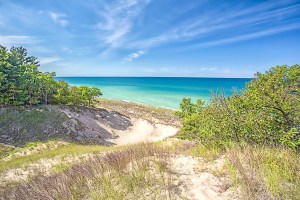 On this warm mid-September day, after walking a long narrow stretch of sandy shore line toward the Beach House Blowout, I turn inland and climb a steep dune hill to hike the eastern leg of Trail Nine, which extends to the Furnessville Blowout on high ground overlooking Lake Michigan. This portion of the path runs along a ridge peak just inside the first growth of woods and offers an atmosphere significantly cooler than experienced on the beach below. Beneath the shade of full foliage only showing a bit of transition to fall colors in small patches of leaves, I feel a building onshore breeze blowing from the north with a sudden touch of autumn in its chilliness. Traveling about a half mile along the way, I come upon the bowl of a smaller unnamed blowout that creates a large gap in the tree line, an opening that presents a wide view of the lake in the direction of the Chicago skyline barely visible on the other side.
∼ September 19, 2017 ∼ “East of Beach House Blowout”
 In this last week of summer, I hike the length of beach in Indiana Dunes State Park. Clear skies and comfortable temperatures in the low seventies allow easy walking along a surf displaying small but steady waves caused by a gentle northern breeze. When I cross from east to west along the beach fronting the Big Blowout and the Furnessville Blowout, I find the sandy stretch to be the best of all to rest a while. In this location the depth of the sand between the surf and the foredunes extends the greatest, in some places seemingly between 150 and 200 feet deep. In addition, due to the trek necessary to arrive at this isolated beach, the whole location remains untouched. However, as I move farther west and approach the shoreline reaching to the Beach House Blowout, even on this relatively calm day I discover the lake has swept away the beach all the way to ten-foot cliffs rising toward foredunes beyond, and access appears cut off until I measure my steps and time my movement between waves.
∼ September 18, 2017 ∼ “Dune Trail to Lake at End of Summer”
 Despite a few chilly nights in the first half of September during which temperatures slipped into the forties, the weather continues to be mostly pleasant, some afternoons actually quite warm, as the close of summer approaches. However, with the official beginning of autumn only a few days away, I realize opportunities to capture images of lush lakeside scenery soon may become limited. Indeed, I eagerly anticipate the approach of abundant colors brought by the generous range offered in a palette of fall foliage, as well as those brilliant tints in illumination due to greatly angled lighting from a more southerly sun. Nevertheless, I still like to photograph rich summer scenery that remains in evidence even into the waning stage of this season, such as a sandy trail through foredunes yet warmed by sunshine and filled with the deep green in leaves of shoreline trees or the various shades displayed in shrubs and grasses lining my pathway. I also appreciate the backdrop of a blue sky speckled with white clouds shifting in an easy breeze above a surface of water exhibiting a different hue of blue.
∼ September 17, 2017 ∼ “Dune Oasis”
In a recent entry I reported attending the opening of a Frank V. Dudley exhibition in the Brauer Museum of Art at Valparaiso University. (Please see my 9/9 post.) I have often written about the importance of Dudley, “The Painter of the Dunes,” on my decision to chronicle the Indiana Dunes in photos and prose, and I have attributed his influence on the compositions of scenery displayed within my photographs. Among the characteristics witnessed in Dudley’s artworks, I especially appreciate settings in which he isolates a patch of marram grass, wildflowers, shrubbery, or small trees among the sand dunes with a glimpse of Lake Michigan seen in the background. I frequently marvel at the ability of foliage or flowers to appear and to bloom along the beachfront in the middle of an arid area. In fact, I regard such a location of growth as a dune oasis, a distinctive spot of interest and engagement for the observer.
∼ September 16, 2017 ∼ “Still River in September”
 Despite cooler conditions and chilly nights during the first half of September, the final seven days of summer have begun with a return to warm weather offering temperatures rising into the mid-eighties. Soft southern currents have swept over the area, restoring a soothing sense of summer’s serenity. Though only a bit of rain has fallen in recent weeks, the trees and underbrush along the Little Calumet River remain lush, a nice variety of green tints, and their rich images are reflected by the still surface of the water under a sky mostly clear of clouds. Unlike other locations I’ve visited recently during hikes throughout the Indiana Dunes region, this setting shows no early signs of fall foliage; instead, this scenery presents an illusion that the summer season will linger a little longer, especially since most birds have not yet begun their migration, and the treetops on the banks of this waterway are still filled with their calming sounds.
∼ September 15, 2017 ∼ “Traveling Along Trail Two in Late Summer”
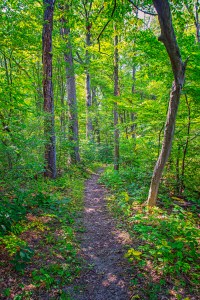 As I noted in my previous post a couple of days ago, I hiked Trail Two through Indiana Dunes State Park for the first time in months. In fact, the last time I traveled this route in spring the trail was flooded in some sections that extend along the banks of Dunes Creek, and I had to step through six inches of water to move forward. However, this week I found the creek had gone completely dry in various locations along the way. Indeed, while I have been aware of the disastrous levels of rainfall occurring at other places in the nation, our area has been lacking much moisture during the past month or so. In addition, daytime conditions have been comfortable while nighttime temperatures have fallen to the cool low forties. Consequently, hiking Trail Two has been mosquito free and easy to negotiate, and although I observe a few splashes of fall color beginning in upper branches or crawling up tree trunks, most of the late-summer foliage remains a rich and inviting green.
∼ September 14, 2017 ∼ “Drifting Clouds”
After watching news reports of hurricane activity along the nation’s southern coasts during the past couple of weeks and witnessing the scenes of devastation impacting millions through flooding or damage from storm gusts, it feels somewhat trivial to note that ragged remnants of Hurricane Irma reached the beaches of Lake Michigan Tuesday evening and during the day on Wednesday. Widely spaced splotches of cloud cover followed by intermittent overcast skies and sparsely scattered showers slowly drifting over the northern Indiana shoreline, propelled by just the slightest bit of wind, briefly contributed a few periods of light rain to a landscape that has been mostly dry throughout the last month. One can only wonder at the realization that these minimal weather disturbances and unthreatening conditions were caused by the same meteorological system that not too long ago created such havoc elsewhere.
∼ September 13, 2017 ∼ “Early Signs of Autumn Along Trail Two”
 In yesterday’s entry I mentioned visiting the Nature Center at Indiana Dunes State Park for a presentation about the region’s landscape throughout the seasons. Afterwards, I hiked Trail Two, which extends through woodland and marsh in the center of the park. I avoid this less-traveled path much of summer since a large part of the route is overgrown as it winds alongside Dunes Creek and over wetlands, which often attract swarms of mosquitoes in July and August. However, the cooler weather in these first two weeks of September, during which nighttime temperatures regularly dipped into the forties, meant traveling this trail would be more comfortable. The whole way I had no problem with insects. In fact, I also met no other visitors along the trail, and during my slow stroll I found myself observing only two deer, a woodpecker, and a dead snake. Additionally, I noticed a few small patches of colorful leaves in trees already displaying a sampling of fall foliage.
∼ September 12, 2017 ∼ “Untouched Beachfront at Indiana Dunes”
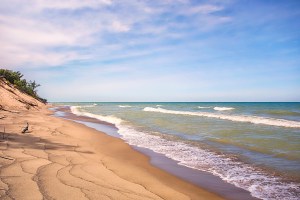 On Sunday afternoon I visited the Indiana Dunes State Park’s Nature Center for a presentation on the region’s appeal throughout the year. The Interpretive Naturalist, Cookie Ferguson, offered a warm and welcoming introduction to the park as she displayed numerous wonderful images of the landscape in each of the four seasons. In addition, she shared informative details and explained historical events that led to the preservation of this portion of the Indiana shoreline. I particularly enjoyed those old photos showing beachfront cabins and shacks that littered the coast before the property was secured as parkland. Some estimates suggest more than 250 structures were removed from the dunes and beaches. Contrasting those pictures against current scenes of clear sandy expanses along Lake Michigan I capture with my camera nowadays causes me to appreciate even more the care and efforts exhibited by those early twentieth-century figures who led the battle for protection of the Indiana Dunes.
∼ September 11, 2017 ∼ “Trail Eight Marsh Bridge in Late Summer”
 In Leaves of Grass Walt Whitman speaks of the poetic inspirational influence he receives whenever moving beneath trees and surrounded by foliage: “Why are there trees I never walk under / But large and melodious thoughts descend upon me?” I often feel similar emotions during my travels through the Indiana Dunes. In fact, with about ten days left until the transition to autumn, I hike a familiar route through the interdunal forest as I follow Trail Eight from an inland shelter toward the shore, and I begin by crossing a marsh footbridge I’ve walked many times before, though now becoming overrun with its accumulation of green summer growth. The bright sunlight on this clear September afternoon illuminates the tree’s leaves and seems to bleach the weathered gray of wooden handrails a little bit. However, cool air of a light lake breeze already hints at the shift in seasons soon to be upon us, and I consider returning in a couple of months to photograph fall colors overhanging the path.
∼ September 10, 2017 ∼ “September Weather”
 With weather conditions causing havoc in various locations around the nation, the calm and comfortable days we’ve seen during the first two weekends this early September in northern Indiana seem to exhibit so much of a contrast. Indeed, as television news reports offer dramatic hurricane coverage displaying stressful events occurring at coastlines along the Gulf of Mexico, I share the concerns felt for all in the endangered areas, especially my family and friends. Additionally, I appreciate even more my relaxed hikes in the Indiana Dunes as I move across dune hills above the smooth waters of Lake Michigan in these waning days of summer. Afternoon temperatures top off in the low seventies, and a light breeze shifts onshore while only a few scraps of clouds drift overhead as though merely intended to present some variety to the scenery and to add a greater sense of depth to the rich blue skies.
∼ September 9, 2017 ∼ “September Sunlight at Dunes”
 Last night I attended the opening of an exhibition featuring Frank V. Dudley paintings in the Brauer Museum of Art at Valparaiso University. I mentioned this event in a past journal post (please see my 8/25 entry). I have written frequently about my admiration for Dudley’s art depicting the shoreline along Lake Michigan, as well as his importance in protecting and preserving the Indiana Dunes as natural landscape. I have also reported how his artwork has influenced the way I use light and compose scenes when capturing images of the Indiana Dunes. The extensive catalog in this show presents more than fifty pieces, and I was delighted to find many works I’d not seen before. In addition, as I have noted previously, Dudley’s family was involved in photography and owned a business in Chicago during the beginning of the twentieth century. Frank’s brother Clarence appears to have been the chronicler of family activities and historic moments at the Indiana Dunes, such as the famous 1917 Dunes Pageant—the hundredth anniversary is celebrated by the exhibition, which includes Dudley’s well-known painting titled The Dunes Pageant 6/3 ’17. However, Frank also occasionally used photography as a preliminary step in his process and would frame settings in front of him through a lens holder. Indeed, the exhibit even includes a pair of Dudley’s vintage Kodak folding bellows camera models from the early 1900s and his tripod.
∼ September 8, 2017 ∼ “Dune Tree in Early September”
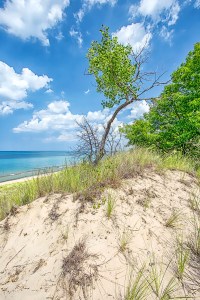 Anyone who reads my journal entries or views my photographs will notice how often I mention trees and place them prominently in my images. In winter when most limbs are expressively bare or as spring buds begin to exhibit themselves or throughout summer’s full foliage or during fall’s vivid colors, I find these objects to be interesting and reflective of the seasons. In addition, as I walk along the shore of Lake Michigan I like to include the surf, sand, foredunes, and initial hint of woods on dune ridges in my pictures, allowing observers to witness the various transitions in lakeshore scenery. My attention increases when I come across trees in tentative circumstances and endangered by wind erosion or drifting dunes, particularly those nobly struggling to survive despite half-dead branches. Indeed, one seems easily tempted to attribute human characteristics to nature and personify these distinctive trees that evoke emotional responses.
∼ September 7, 2017 ∼ “Lake Waves Toward Sunset in Early September”
 Cooler weather moved across northern Indiana, and onshore winds shifted over the coast causing rare lake-effect rains along the shore. As I approached Lake Michigan after the showers had passed farther to the east, I drove through a few places where low-lying sections of roads were about four to six inches under water. The thick overcast of late afternoon had broken, and a partial clearing allowed an evening sun to illuminate the western edge of the lake. In fact, the skyline of Chicago could be viewed in silhouette beneath the remaining clouds, which assumed a shade of blue that contrasted with the hints of bright orange and yellow tints seeping between them. Swift and steady waves washed onto beaches of the Indiana Dunes, and the crisp air suggested an approach of autumn is not far off.
∼ September 6, 2017 ∼ “Driftwood at Mt. Baldy Beach”
 Looking back at previous posts, I notice that I have mentioned the presence of driftwood along the Indiana Dunes lakeshore about a dozen times during the past eight months. In each entry I include this element of the scenery, perhaps representing an added attraction, as if a natural decoration had been placed in position to enhance the imagery around it. My gravitation toward the presence of a piece of driftwood along the shore seems rooted in careful observations on the interesting physical features presented—the almost abstract artistic shape, the tactile sense of texture offered by the object, the colors that may range from the tone of bone to the tan of damp sand to the darker shade of wet leather, as well as the rough appearance displayed by peeling bark, bleached wood, or splintered limbs. Furthermore, these broken branches or lengths of tree trunk serve as ideal foreground focal points for my photographs of the lake’s surf.
∼ September 5, 2017 ∼ “Last Turn in Trail Toward Shore”
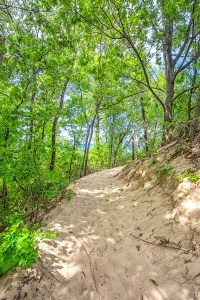 Traveling a short trail toward the recently reopened shoreline below Mt. Baldy, I hike through the cool route under shade of a black oak forest until the path shifts from soil to sand and begins to rise up a dune hill. Though the last stretch may be steep, I already catch a glimpse of blue through the bright green leaves of trees lit by afternoon light. On this clear and windless day at the start of September, the calm water of Lake Michigan appears like an azure field reflecting the sky on the other side of a ridge, and only one turn of the path lies ahead. This final section of the trail eventually descends toward the beach, the passageway following a roped walk set up by the Indiana Dunes National Lakeshore to protect the precarious slope of the wandering dune and to prevent visitors from climbing the more dangerous areas toward Mt. Baldy that are still off limits to the public. I always enjoy the combination of satisfaction and anticipation I feel whenever I reach this point along the trail.
∼ September 4, 2017 ∼ “Labor Day Leisure”
 Although nearly three weeks remain until the close of the season, Labor Day represents the end of summer for many. Some years the holiday weekend displays a climate ideal for outdoor leisure, and the surroundings seem perfect for a final few moments of fun or a last opportunity to rest and relax in natural surroundings. Such were the conditions in northern Indiana the past couple of days as visitors to Lake Michigan enjoyed sunbathing on the beach or rowing the calm waters just off shore when temperatures rose into the eighties under mostly sunny skies and with diminishing breezes. Indeed, as I have discussed in previous posts, late August and early September sometimes offer the best weather in this region, and I look forward to photographing the slow transition toward autumn during the next month and into the beginning of October, which will bring its own attraction in the form of fall colors.
∼ September 3, 2017 ∼ “Mt. Baldy Beach on Labor Day Weekend”
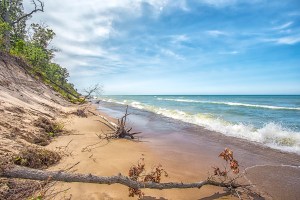 The rugged shoreline along this section of northern Indiana, with tree trunks tumbled from small hills edging the coast, often creates more interesting photographs, especially when the beach seems to be suffering under an onslaught of wind-driven waves. As I noted in previous posts (for examples, see my 6/21 and 8/3 entries), Mt. Baldy Beach was reopened by the Indiana Dunes National Lakeshore in the middle of this summer after being closed nearly four years. Due to dangerous conditions, the large well-known wandering dune, Mt. Baldy, remains off limits to the public except for reserved guided hikes by park rangers. Today, as I walk from east to west along the surf—the sand beneath my feet smooth, damp, and dark, marked by the morning’s higher level—I observe those steep and continually eroding dunes that line the lake, and I find quite a few trees newly in danger of toppling toward the water below.
∼ September 2, 2017 ∼ “Lake Waves Wash Away Central Beach”
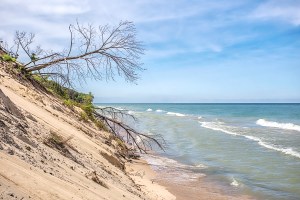 In July (see my 7/9 entry) I wrote a post about the reopening of Central Beach in the Indiana Dunes National Lakeshore. As I noted upon my return to the area, this section of the shoreline initially had been closed to the public in July of 2015 as too dangerous due to loss of beachfront from erosion caused by rising lake levels, winter storms, waves, and wind. Although access has been allowed again, I also observed that the thin strip of sand now defining the beach remains precarious and could easily become submerged when northern air currents create a rough surf from wind-driven waves. This first weekend of September has begun with cooler temperatures lowered by strong northeasterly breezes. Therefore, as I revisit Central Beach, I find it has once again been temporarily washed away by waves of Lake Michigan that sweep over the beach and roll all the way to the slopes of sand dunes normally a little bit inland from the water’s edge.
∼ September 1, 2017 ∼ “Dunes Creek at Start of September”
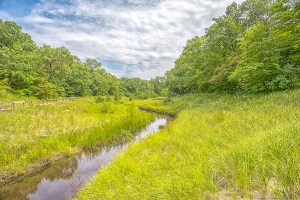 Dunes Creek wanders through the grounds of Indiana Dunes State Park, at times paralleling Trail Two and also branching toward the marshland at the center of the park. The west end of the creek eventually extends along the short Beach Trail that serves as a shortcut to the shore for visitors at the campground. The winding waterway finally curves around Devil’s Slide and intersects Lake Michigan just beside the Pavilion at popular Waverly Beach. Although a brief path about a half mile long, the Beach Trail snakes beside Dunes Creek as it wends its way between two wooded dune hills. As I mentioned in my 2/1 entry, in winter this inland route offers a clear view of the creek, appearing as if twisted ribbon let loose of its spool, especially when contrasted with snowfall on either bank. (Please see my winter photo of this same scene at the 2/1 entry.) However, as September starts this weekend, the entire area is filled with rich green foliage and lush slopes displaying tall reeds of grass lining the dark water.
∼ August 31, 2017 ∼ “View from Blowout Ridge”
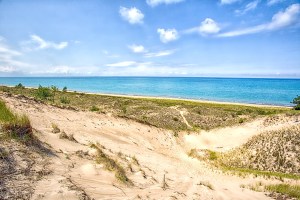 On this final day of August, I realize the lure of Lake Michigan grows greater as summer nears its end. When selecting locations to explore, I find myself more often choosing dune ridge paths with lake views and long walks down the beach rather than following inland trails, like yesterday’s, that wind through woods or skirt the marshland. In recent weeks I have repeatedly visited the various well-known blowouts—Beach House Blowout, Furnessville Blowout, Big Blowout—witnessed at distanced intervals along the shore in the Indiana Dunes State Park. From the marram grass of the foredunes to the skeletal dead trees in the bowls of the blowouts to the imposing slopes toward crests of hills spotted with wildflowers and those steep drops to black oak forests behind them, these lower locations and their surrounding ridges seem to present an interesting and biologically diverse terrain. Moreover, the cooler weather with clear skies and light lake breezes we’ve experienced lately have eased hiking these features.
∼ August 30, 2017 ∼ “Trail Ten Bridge”
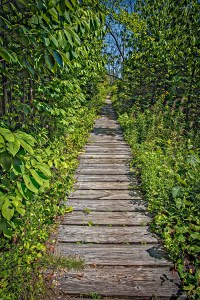 Trail Ten extends the greatest distance of any in Indiana Dunes State Park, although much of its length follows flat sandy beach along the shore line. The farthest inland section of this trail might be among the least traveled by visitors as it reaches to the eastern end of the park grounds. Hiking the route from the western direction, I pass through a couple of named areas, “The Pinery” and “Paradise Valley,” each forested on the northern side of the path and bordering marshland on the southern side until the course turns toward Lake Michigan. Much of my walk in this region is shaded by tall trees, but a couple of times I must cross narrow boardwalk bridges that allow passage over wetlands and spongy soil. In late summer these locations have become mostly overgrown with ferns and weeds encroaching upon the wooden planks, and the way appears almost as if it were a long green corridor through which one must maneuver.
∼ August 29, 2017 ∼ “Sandy Trail Above Waverly Beach”
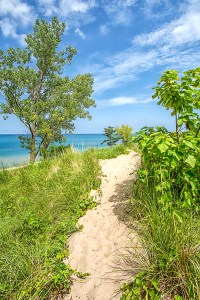 I captured the accompanying scene of a sandy trail above Waverly Beach at the Indiana Dunes State Park yesterday, and I also stopped at the Nature Center, where I met with two interpretive naturalists, Marie and Cookie, who were very friendly and helpful, as I have found to be the case with all staff members at the state and national parks. We discussed my Arts in the Parks and Historic Sites project for the Indiana Arts Commission, plus we finalized plans for my photography exhibition and talk scheduled to occur in October. The art show will consist of a dozen framed photographs that will be placed on display October 1 in the Nature Center auditorium and appear throughout the entire month. My presentation at the Nature Center will occur on October 14 at 2 p.m. I will discuss the Indiana Dunes project, my process of photography, and historic connections to the locations in some of the images. During my talk I look forward to sharing many photographs on a screen to accompany my commentary. If you are in the region, please keep these dates in mind.
∼ August 28, 2017 ∼ “Sunset at End of August”
 Sunset time slips beneath 7:30 p.m. during this last week of August, and already the evening air these last few days has begun to suggest autumn’s arrival will not be too far away. Consequently, I have decided that I will appreciate the final month of summer even more. In fact, as I started teaching my fall semester courses this past week by discussing the influence of nineteenth-century Romantic writers on contemporary thought, I reread Henry David Thoreau’s “Life Without Principle.” I was reminded of Thoreau’s emphasis on observing sunrise and sunset as a way to place a proper perspective on ourselves within this world that all too often appears to overwhelm with its news. Thoreau wrote the following: “Really to see the sun rise or go down every day, so to relate ourselves to a universal fact, would preserve us sane forever.”
∼ August 27, 2017 ∼ “Lake View from Trail Nine”
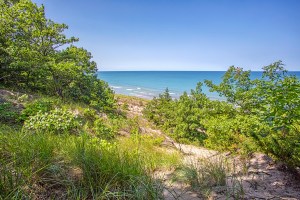 This late August day is comfortable, calm, and quiet as I travel the length of Trail Nine toward the eastern end of Indiana Dunes State Park. Already weary, I come to a remote section of the landscape far from the Nature Center or the public beach and certainly less visited than other routes. By the time I move through shade and pause to rest on a bench in an inland black oak forest, I’ve reached the more challenging stretch of an elevated passage edging a rim overlooking the Furnessville Blowout. I finally find myself approaching the coast and walking a narrow path hidden along a wooded ridge high above the beach. The tree line opens every once in a while and allows for fantastic views of Lake Michigan extending into the distance toward the far off shore of Illinois, where a small faint image of the Chicago skyline can be seen on most days.
∼ August 26, 2017 ∼ “Clear Skies and Seagull”
 Temperatures remained in the low seventies and a cool breeze blew inland as I hiked along the shore toward the Furnessville Blowout on Friday. By the time I’d walked a few miles the beach appeared clear as far as I could see to the east or the west. Only a sole seagull accompanied me, sauntering nearby for a fair distance during my stroll. Though the weather felt more like mid-September and any interesting cloud formations had been wiped from the sky by quick air currents, I liked the brilliant tints of blue and green in the water, as well as the slightest hints of magenta and purple in the slick sand dampened by the surf. Lake Michigan often offers appealing variations of color, dependent upon wind or wave movement and the intensity level of sunshine or a sharp angle of light reflecting on the surface. On this afternoon the lack of clouds created a dull sky, but the clarity of the day seemed to increase the scenic beauty of lake hues.
∼ August 25, 2017 ∼ “Frank V. Dudley Exhibition Opening”
 In my journal entries this week I again noted my appreciation for the artwork by Frank V. Dudley, who produced his paintings in or around a lakeside cottage named Duneland Studio and whose influence can be seen in many of my own photographs. I also mentioned the new exhibition of Dudley’s work that started this week in the Brauer Museum of Art at Valparaiso University as part of a trio of fall exhibitions. An opening reception, free and open to the public, will be held at the Brauer Museum of Art on Friday, September 8, at 7 pm. The Dudley display takes place one hundred years since an historic celebration of the arts at the Indiana Dunes. As I reported in my 4/24 post: “The famous Dunes Pageant, which took place a century ago in June of 1917 and may be credited with initially promoting the Indiana Dunes to a wider audience, was staged in a dune blowout that exhibited the semicircular shape of a natural amphitheater.” The cover of a book accompanying the show offers Dudley’s artistic rendering of the pageant activities and the setting, which also may resemble my photo of the Beach House Blowout in that 4/24 post. Unfortunately, the feature of the landscape depicted by Dudley no longer appears as it once did.
∼ August 24, 2017 ∼ “View from Governor’s Cottage Site”
In yesterday’s entry I indicated a personal attachment to the location where artist Frank V. Dudley maintained a beachfront cottage named Duneland Studio. Certainly, my knowledge of Dudley contributes to my interest in the Indiana Dunes, and his scenes on canvas serve as inspiration for my photography. From the 1920s to the 1960s, the Governor of Indiana also had a summer residence, known as Camp Indiana, just a short distance west of Dudley’s cottage and close to Mt. Tom along the narrow path of the Cabin Trail. As I noted in a previous post about the Governor’s home: “Like numerous other structures within the Indiana Dunes State Park property, that building was demolished more than fifty years ago to reclaim the natural landscape. All that remains today, hidden amid the woods, is a short stack of bricks that once supported steps to a porch overlooking the lake.” Whenever I walk this way, I always capture an image of the setting as seen from the perspective of the Governor’s front door.
∼ August 23, 2017 ∼ “Dune Trail Below Mt. Holden”
 The wide and sandy trail from the peak of Mt. Holden down to the beach might be one of the best brief walks in the Indiana Dunes State Park. Though the way may be a bit steep at times, the whole descent offers an impressive view of Lake Michigan. As I have mentioned in my 6/22 entry, this location happens to include a favorite site that I find inspirational, since this trail passes the spot where Frank V. Dudley, “the Painter of the Dunes,” once lived in his lakeside cottage, hosting visitors in attempts to promote and protect the Indian Dunes landscape. In fact, as I stand in the place where Dudley once created his artwork, I am pleased to note that an exhibition of Dudley’s paintings, “The Indiana Dunes Revisited: Frank V. Dudley and the 1917 Dunes Pageant,” is opening at Valparaiso University’s Brauer Museum of Art and will be on display through December 10.
∼ August 22, 2017 ∼ “Eclipse Aftermath”
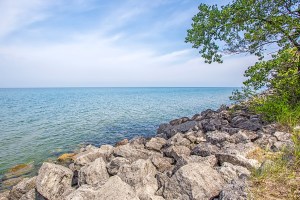 As other photographers aimed their cameras at the heavens and numerous beachgoers searched the sky through special glasses to follow the progress of the moon’s path across the sun during yesterday’s eclipse, I spent the afternoon at various locations by the shore of Lake Michigan examining changes to the scenery brought about by this rare occurrence. Although the total eclipse happened farther south, our area did witness just under 90% coverage, and the slow transition from sunshine to shadow influenced my surroundings. As expected, when the peak time arrived, the air temperature cooled noticeably, shadows disappeared, and a dense gauze of fog that had been growing during the event eventually filled the lake. The atmosphere suddenly resembled any cloudy evening along the waterfront. However, just as steadily, the conditions reversed themselves, gradually returning from a slightly dark setting to somewhat brighter skies marked only by a few wispy clouds and a banner of remnant haze hovering above the horizon.
∼ August 21, 2017 ∼ “The Devil’s Slide”
 When visitors pass through the ticket gate at the entrance to the Indiana Dunes State Park and drive into the main parking lot behind the Pavilion located at Waverly Beach, a steep sandy slope rising just to the east seems to attract much attention. This feature, named The Devil’s Slide, rises about 100 feet and appears appealing as a moderate challenge for climbing. In fact, the dune apparently provides the only place in the park permitted for sledding in winter. However, viewing its current appearance and contrasting that with past photographs, particularly those taken decades ago, one discovers a transformation has occurred. In those old photos the entire hill looks to be bare of trees, grass, and underbrush. As evidence, a couple of pictures from the late 1950s can be found here. As I mentioned in my 8/11 entry about the Big Blowout: “Many scenes in these vintage images seem much more barren and dominated by sandy slopes, a consistent characteristic I find in my observations. In the period of time since this terrain has been preserved by the state and federal park systems, the shoreline dunes have greened significantly.”
∼ August 20, 2017 ∼ “Hiking Trails Overlooking Lake Michigan”
 Environmentalist Edward Abbey once offered guidance to hikers: “May your trails be crooked, winding, lonesome, dangerous, leading to the most amazing view.” I appreciate walking a winding path with blind bends that hide what lies ahead. I especially enjoy following new trails through wooded routes that seem to envelop their travelers until suddenly opening to unveil an interesting image, such as today’s hike to view Indiana Dunes scenery above Lake Michigan. Robert Moor relates in his recent engaging book, On Trails: An Exploration, that the definition for the word “hike” has evolved over the past couple of centuries, and “the meaning ‘to walk for pleasure in open country’ dates back just two hundred years.” In fact, Moor reports common employment of the gerund “hiking” only came into use during the past century. Previously, “hike” was employed in a more negative fashion: “somewhere between ‘to sneak’ and ‘to schlep.’” This transition in meaning may relate to the transformation in living patterns from mostly a rural setting in the nineteenth century, during which extensive walking was usually occupational rather than leisurely, to a contemporary society mostly centered in urban locations with residents for whom hikes in nature are parts of vacation, exercise, and recreational activities.
∼ August 19, 2017 ∼ “August Afternoon”
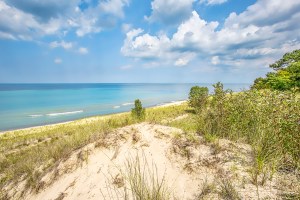 In a note I posted a couple of days ago, I spoke about how much I like visiting the Indiana Dunes during the last two weeks of August. As I mentioned then, in this time of year I often find myself isolated when hiking through foredunes filled with green blades of marram grass or as I walk along the thin strip of beach. Despite the continuing warm weather, much of the shore already seems empty of swimmers or sunbathers, especially on weekdays. When I climbed Mt. Tom on an early afternoon this week, I descended a trail down a steep sandy slope that flattens briefly into a ledge overlooking Lake Michigan, an ideal location to rest a while and appreciate the vast view before me. Noticing the clear coastline stretching into the distance as far as I could see while also observing the untroubled waters extending so blue and smooth toward the horizon, I enjoyed the slight cooling of an easy breeze suddenly drifting inland.
∼ August 18, 2017 ∼ “Trail Four Toward Shore”
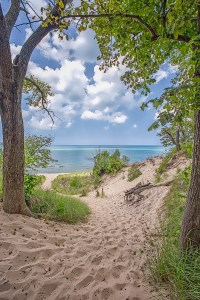 Walking inland from Lake Michigan, once again I climb Mt. Tom—at nearly 200 feet, the highest peak among the Indiana Dunes—where I pause to rest a while and view the panorama of impressive scenery it offers. Then traveling Trail Four, descending from the summit toward the east, I move through a wooded hollow sheltered by the inland side of the coastal mounds. This is one of my favorite paths in the Indiana Dunes State Park during all seasons, as I noted in my spring post of 5/24 when I mentioned how the course extends on the lee side of the dune hills where hikers are protected from onshore winds or the heat of the sun. The terrain in this natural haven remains especially refreshing and milder in mid-summer. After a short distance in the cool shade of trees, I arrive at an intersection with Trail Seven, where the two routes unite, emerging from overhanging branches and stretching toward the lake. The sandy way winds down a slope toward a shoreline yet spread under bright August sunlight.
∼ August 17, 2017 ∼ “Dune Trail to Beach”
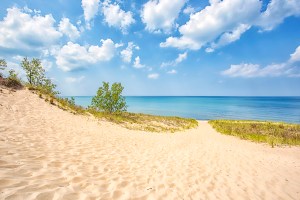 The last half of August always seems to me an ideal time to hike ridge trails in the Indiana Dunes and to wander long stretches of the beach along Lake Michigan. Since public schools in the region have started classes and the number of out-of-state vacationers at the coast has already diminished significantly, I find the natural landscape less crowded and quieter than in recent weeks. Meanwhile, the weather remains warm; sometimes like today the conditions are even hot and the cool blue water welcoming. Therefore, I leisurely travel the length of the old Cabin Trail that extends high above the shore in the state park, moving through shadows of trees protecting from the sun’s heat, and I occasionally descend sandy slopes toward the lake for easier walking and the refreshing touch of a slight onshore breeze.
∼ August 16, 2017 ∼ “Marshland in Midsummer”
 As I have noted in past posts, I appreciate the marshland, swamp forests, and bogs throughout the Indiana Dunes. These features of the topography provide compelling scenery, and they remind one about the original state of this area’s natural surroundings. Consequently, I was pleased to learn that during this past week Save the Dunes, an important environmental watchdog group initiated 65 years ago, was awarded a grant to aid in restoring locations of panne habitat at inland parts of the Indiana Dunes. These sites consist of sections with lowland enclosed by higher grounds that trap water and establish seasonal variations in moisture content. Since most are small tracts of terrain, they are more likely to become overgrown by invasive species or to be tainted by human pollution. Efforts to protect and preserve interdunal wetlands add to the ongoing restoration process throughout the northern Indiana coastal landscape—especially by the Indiana Dunes National Lakeshore and Indiana Dunes State Park—in an attempt to conserve native plant species, some unique to the region. The wetlands also support various types of local wildlife—including snakes, frogs, and turtles—and serve as destinations or stopping points for bird migration.
∼ August 15, 2017 ∼ “Walking West Along Foredune Trail”
 Traveling west from Kemil Beach, I follow a narrow path winding through the foredunes. The nearly still waters of Lake Michigan lie to my right like a cool pool of light blue beneath a sky brightened by late morning sunlight. After leaving behind the more populated stretch of shoreline, I find myself isolated once again on this quiet August day, silenced even more by a lack of sound from today’s relaxed surf where a pace of breaking waves usually provides a rhythmic background beat. I capture a few images along the way just to chronicle the calm all around me. Though walking the beach would be a little bit easier, this route toward higher dunes offers more variety for me to observe. In fact, at times like this I am reminded of Thoreau’s treatise titled Walking in which he speaks about “the art of walking” and the ability to obtain new experiences in nature even during a hike through familiar landscape: “An absolutely new prospect is a great happiness, and I can still get this any afternoon. Two or three hours’ walking will carry me to as strange a country as I expect ever to see.”
∼ August 14, 2017 ∼ “Summer Sunset from Dune Ridge”
 Today we celebrate Pam’s birthday, and among the many reasons I have to be thankful for her presence in my life—such as her love and caring for Alex and me—I am grateful she introduced me to the Indiana Dunes when I moved to the region. As I mentioned in my previous 4/14 entry, Pam and I spent our first date with a walk through dune woods along a ridge overlooking Lake Michigan. We had hiked a path above the beach on a clear and warm afternoon during a spring so mild that blooming flowers already were coloring the landscape and green foliage was beginning to fill the trees. On that April day we gazed across the lake to view an outline of the Chicago skyline on the horizon, and on this August day in Pam’s honor I offer an image of a colorful summer sunset seen from nearly the same position where she and I had once walked, a location I visit frequently with feelings of fondness and appreciation.
∼ August 13, 2017 ∼ “New Route”
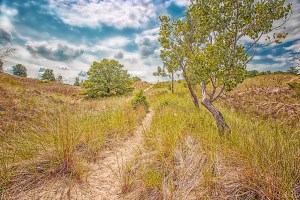 Whenever I discover a new route through the Indiana Dunes toward inland woods or wetlands, I anticipate the scenery I might see along the way, especially since I have traveled much of the state park’s terrain in the past. Therefore, following a sandy trail uphill today from the shore along a blowout ridge among a scattering of young trees, I look forward to the unknown view awaiting me on top. Though the sky remains spotted with drifting clouds after a night of light showers, this morning’s shifting winds have begun to chase them away. In this isolated section of the landscape beside Lake Michigan, I meet no other visitors as I pass between waving blades of marram grass. In fact, even as late afternoon arrives, by the time I’ve looped around the blowout and returned to the beach, only a half-dozen quickly moving little sand lizards have crossed my path while walking.
∼ August 12, 2017 ∼ “Beach Pebbles and Stones”
 In past posts I have mentioned intimate landscape photography, an instance when photographers offer a detailed examination at a selected section of the scenery. Most often these photos establish an image dependent upon shape, color, light, and form much like productions by an artist. (Please view my 5/20 and 5/12 entries for examples.) As I mentioned in my 8/10 commentary, when I was walking the beach near the Big Blowout the other day I noticed the ribbon of shoreline seemed to be filled with distinctive stones and pebbles. Sometimes I come across beachgoers collecting these colorful objects, as well as specimens of beach glass and crinoids, which I spoke about in a previous 6/26 note. Choosing to capture a close-up of those small stones covering the beach, I discovered the resulting image resembled an irregularly patterned abstract artwork.
∼ August 11, 2017 ∼ “Hiking Inland at the Big Blowout”
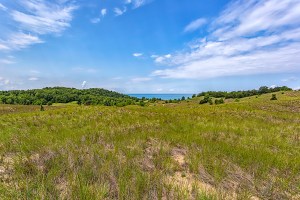 Since my main interests in the Indiana Dunes include its history and photography, I enjoy examining old photos from the early twentieth century of the landscape’s prominent features and noting various differences with their appearances today. Many scenes in these vintage images seem much more barren and dominated by sandy slopes, a consistent characteristic I find in my observations. In the period of time since this terrain has been preserved by the state and federal park systems, the shoreline dunes have greened significantly. One of the sites where this transition can be viewed, the Big Blowout along Trail 10 and located at the eastern end of the Indiana Dunes State Park, exhibits extraordinary change since pictures of it taken nearly one hundred years ago. (Check out an example here.) In fact, as I hike the Big Blowout deep inland from Lake Michigan I notice almost all of the land overtaken by sand has been covered by marram grass and small trees, particularly since the coastline foredunes have rebuilt themselves to an extent that they now appear to protect the inner expanse from further erosion.
∼ August 10, 2017 ∼ “Beach at Big Blowout”
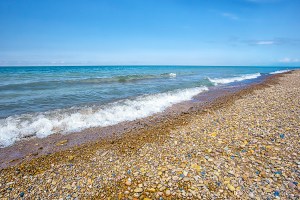 In my post a couple of days ago I noted how I had hiked trails along the high ridges of blowouts at the east end of the state park. Since the location is situated a distance from public access and parking, I found myself arriving at the Big Blowout by walking a deserted stretch of beach—mostly covered with colorful pebbles rather than sand—that I consider among my favorite spots in the Indiana Dunes. Although I mentioned in yesterday’s entry a common landscape photographer’s desire for dramatic clouds and fog hovering over the lake ideal for capturing dramatic images, whenever I’m at this remote section of the shore I appreciate the isolation and serene scenery, which seems especially suited to the clear skies and comfortable temperatures that have been in evidence this week.
∼ August 9, 2017 ∼ “Hazy Day at Mt. Baldy Beach”
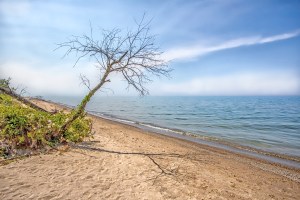 Although most folks look forward to clear skies and bright sunshine when traveling to the shore, I tend to prefer some clouds or maybe haze that creates a seemingly moody atmosphere. Admittedly, seeking compelling scenes to photograph serves a primary purpose for me as I hike along the beachfront rather than the opportunity to swim or sunbathe many others anticipate. Boring uniformly blue skies and harsh daylight present problems in the process of composing persuasive imagery, and these conditions are common concerns for landscape photographers. Consequently, when I walk the slim and sandy stretch of an empty Mt. Baldy Beach on an overcast morning just as sunlight begins to break through the fog and a rising wind starts to dissipate the cloud cover, I appreciate the overall emotional tone suggested by such scenery. The drama of this setting only increases with bare branches of a tree at the edge of a dune reaching out toward the surf and casting thin shadows of its limbs on the sand.
∼ August 8, 2017 ∼ “Spray-and-Pray Day”
 Whenever I photograph landscapes, I almost always position my camera on a tripod. This habit assures steadiness for sharpness in focusing, and it allows for slower shutter speeds needed when lighting is dim, such as during sunsets or in woods on overcast afternoons. Although carrying my camera on a tripod resting over my shoulder adds a burden and requires greater exertion, especially as I hike hills or move through swamps, the practice has become comforting for me, particularly because the results are more satisfactory. The process also has forced me to slow down and be patient, more deliberate in choosing compositions for my photos. Consequently, my advice to others often includes use of a tripod. Nevertheless, at least once each season I decide to have some fun by leaving the tripod behind and engaging in a spray-and-pray day, simply snapping lots of pictures quickly as I walk a long route. Yesterday, I hiked an arduous and narrow trail around the high ridges of a couple of blowouts—including the Big Blowout (which I previously described in my 6/28 entry)—quickly capturing images as I went on my way, such as this view of Lake Michigan.
∼ August 7, 2017 ∼ “Awaiting Sunset in August”
 Warm colors of sunlight lower over Lake Michigan for another summer sunset, although the sun has drifted farther south each evening and colder nights this weekend, with temperatures slipping into the fifties, felt almost like autumn. In fact, as my wife, my son, and I walked a path at a nature preserve late Saturday afternoon, Alex noted that leaves already were beginning to fall from one of the trees. Tonight, those branches overhanging the beach tremble a bit beneath even the little effort of an onshore breeze, and stones along the coast have quickly cooled to the touch. The repetition and similarity of vivid imagery presented by sundown disguises a slow erosion of this season only six weeks from its end. While I hiked the trail toward a perfect position beside the water for photographing the scenery in front of me, I met a family of four from northern Virginia who were touring the Midwest. The father explained they planned on rushing to get as much into their travels as they could during the final days before school starts, and I understood the hurry.
∼ August 6, 2017 ∼ “Ring-Billed Gull”
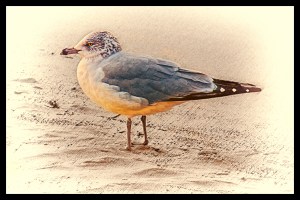 As I have noted in previous posts, whenever I hike toward the shore or along the beaches at the Indiana Dunes, ring-billed gulls seem to be constant companions, and I am fond of their presence. Indeed, a quick search of my journal entries thus far this year reveals I have spoken of the birds in nearly twenty commentaries. Unlike summer’s population of migrating birds, even in mid-winter these gulls can be seen gliding through the sky or standing at the edge of the surf. In my February 17 observation I viewed a few that would “fidget at the water’s edge and strut on the wind-smoothed sand.” In my entry of May 8 I reported the adult bird’s appearance—described in the National Audubon Society pocket guide I frequently carry with me to identify other less-common species—as about twenty inches in length: “The adult has a white head and underparts with a gray back and black-tipped gray wings. The legs are yellowish, and the yellow bill has a black ring near its tip.” By the time August arrives, the ring-billed gulls are so accustomed to beaches busy with seasonal visitors and the scraps of food they sometimes leave behind that the birds act less skittish than ever and will just about sidle up to anyone walking their way.
∼ August 5, 2017 ∼ “Beach Entrance at Beverly Shores”
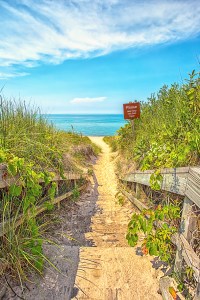 When I was a small boy in New York and my father took me to attend a major league baseball game at Yankee Stadium, I remember that moment after passing through the ticket gate as we climbed stairs toward the section with our seats and peered through an opening in the grandstands for a first peek at the deep green playing field. The scenery was so much more vivid and majestic than I had imagined from having seen games only on a black-and-white television. I immediately knew my experience would be enjoyable. Years later, when my first poetry publication appeared, a friend and well-known critic presented the finest complimentary description I could desire for the back cover when he wrote as commentary: “Reading a poem by Edward Byrne is like emerging at the top of a stadium ramp for the first glimpse of authentically green grass.” Similarly, ever since I was a child growing up near the Atlantic Ocean, I loved visiting the shore. Even today, I always feel excitement when approaching the coast and descending toward the beach to obtain an initial sighting of rich blue water spread under a wide sky.
∼ August 4, 2017 ∼ “View of Mt. Baldy from Lake Michigan”
 As I noted in yesterday’s post, I visited the newly accessible Mt. Baldy Beach on Wednesday. I hiked the short trail through a black oak forest and walked the length of the shoreline. On a few occasions I spoke with folks vacationing from out of state, including one family stopping on their drive home to my birth state of New York. None of those with whom I had conversations knew the beach had recently reopened, and I explained the circumstances of its closing, which I also wrote about in my previous entries of 6/12, 6/13, 6/21, and 8/3. While standing on the sand at the edge of the surf, I noticed an impressive view of the large wandering dune. When I climbed to the top a couple of times in June under the guidance of a park ranger, I photographed the scenic panorama perspective directed toward Lake Michigan during daytime and then at sunset. (Please see photos in my entries of 6/12 and 6/21.) However, this time I captured an image of Mt. Baldy looking inland from the lake, and I believe the splendid setting evokes emotions and initiates inspiration, easily explaining why this feature seems to be a traditional attraction for those tourists who travel to the Indiana Dunes.
∼ August 3, 2017 ∼ “Trail to Mt. Baldy Beach”
 In June I offered a few posts noting a couple of trips I took to the top of Mt. Baldy at the Indiana Dunes. (Please see my 6/12, 6/13, and 6/21 entries.) As I mentioned then, Mt. Baldy is more than 125-feet high and famous as a wandering dune that shifts inland at a steady rate, pushed by northern winds and eroded by winter storms with accompanying melting of snow and ice. When the accumulating sand envelops trees their trunks are buried, die, decay, and decompose, leaving an empty silo-shaped chamber within the dune that can be dangerous as a sink-hole for hikers. I also reported a case in which a young boy nearly lost his life when he tumbled into one of the depressions. Consequently, this popular site has been closed to visitors since 2013. However, the Indiana Dunes National Lakeshore occasionally offers opportunities to climb a safe route to the summit under the supervision of a park staff member. Although this large dune remains off limits for public use, the Lake Michigan shorefront at its base has recently reopened and is accessible by walking an easy half-mile trail through black oak forest and along a roped path down to the beach.
∼ August 2, 2017 ∼ “Trail Through Woods”
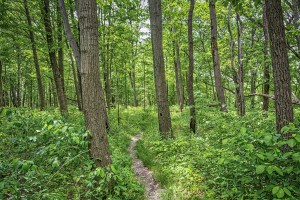 As I write this entry, the total of words in my more than 200 Indiana Dunes commentaries approaches 55,000, and by necessity some terms have been among the most used, including “trail” and “path.” In fact, a quick search indicates I have mentioned “trail” about 200 times thus far and “path” on almost 100 occasions. As a writer, I sometimes try to distinguish between the two, recognizing different connotations that might be perceived by readers. However, I also confess to alternating the pair, along with other synonyms, in a paragraph just for the sake of variety. Consequently, when I read the following passage in a book on my summer reading list that examines the history and significance of trails, I find the explanation interesting: “The words we English speakers use to describe lines of movement—trails, traces, tracks, ways, roads, paths—have grown entangled over the years. I am as guilty of this conflation as anyone else, in part because the meanings of these words, much like the things they denote, tend to overlap. But to better understand how trails function, it helps to momentarily tease them apart. The connotations of trail and path, for example, differ slightly: a ‘path’ sounds dignified, august, and a bit tame, while ‘trail’ seems unplanned, unkempt, unruly. The Oxford English Dictionary editors define a trail, rather sniffily, as a ‘rude path.’ As they point out, trails only ever pass through wild regions, never cultivated ones….” [On Trails: An Exploration by Robert Moor]
∼ August 1, 2017 ∼ “Late Light Above Lake Michigan”
 As I offer commentary in this first entry of August, I am reminded of a mindset that I have held ever since I was a young boy who viewed the opening of this month as the beginning to the end of summer. As my wife Pam will attest from my numerous comments on the topic, I perceive this season as one that moves too rapidly. I know others might share my opinion, especially those in northern locations where warmer weather slips away too soon or those who measure their years quarterly, such as students or teachers—categorizations to which I have been included almost my entire life. However, I am even more aware of the gradual drift towards autumn each evening I set out to photograph a summer sunset. The shift toward shorter days actually begins with sunset on July 3 (one minute earlier than the previous night) which prompts one of my observations to Pam that July 4 initiates the downward slide. Indeed, the extent of daylight has shortened significantly during the past thirty days and sunset arrives more than twenty minutes earlier than it had at the start of July. Moreover, by the close of August sundown will be a whole hour earlier than had been true at the close of June. Consequently, I sometimes feel an obligation to preserve as many summer sunsets as possible.
∼ July 31, 2017 ∼ “Calm Lake Waters”
 During the first half of this last July weekend winds whipped from the north and waves grew throughout the southern shores of Lake Michigan. Indeed, due to the turbulent surf and dangerous rip currents, the waters at public beaches in the Indiana Dunes were closed to swimmers. However, by Sunday calm conditions had reestablished along the coast, and the scenery seemed more serene. Indeed, although the weather may be more dramatic to photograph when gusts stir the setting, I also find myself drawn to images that evoke emotions of relaxation and peacefulness. Consequently, even when a sunset approaches that promises vibrant tints in the western sky, I sometimes arrive early and aim my camera in the opposite direction, where the colors are yet subtler and soothing. With an absence of white water breaking on the sand and little movement among leaves of trees barely wavering in a soft onshore breeze, the entire surroundings seem appealing to me.
∼ July 30, 2017 ∼ “Boat at Edge of Marsh”
 Although I do not avoid marshes and swamps of the Indiana Dunes during the heat and humidity of mid-summer, I tend more often to walk along their edges rather than into the thick undergrowth that has overwhelmed the terrain. Indeed, nowhere in the local landscape displays greater saturation in its colors, especially the variations of green tints at this time of year. As I was hiking along the Great Marsh Trail, I encountered workers in row boats continuing to restore the wetlands to its natural state. The marsh once covered much of northern Indiana; however, during the twentieth century the expanse of the marshland diminished greatly due to draining for farms, factories, roads, and private residences. Nevertheless, after establishing the National Lakeshore parkland as preservation property, the government initiated an ambitious restoration project. In an attempt to return the area to its original condition as a sanctuary for migrating geese, ducks, and all sorts of other birds or wildlife—as well as a wetland displaying diverse native plants, grasses, and seasonal flora—sections of the Great Marsh have been revitalized and protected.
∼ July 29, 2017 ∼ “Bridge Amidst Wildflowers”
 The colorful wildflowers are in full bloom during mid-summer, and the underbrush has filled out to the point of overflowing. Therefore, when walking paths at this time of year one feels embraced by the lush scenery. Even as I approach a familiar landmark—such as this bridge over Coffee Creek that appears almost hidden from view—the landscape seems to envelop it. Strolling through these surroundings, I am reminded of amateur botanist Henry David Thoreau’s deep interest, detailed categorization, and descriptive chronicling of floral findings. He wrote, “Where the most beautiful wild flowers grow, there man’s spirit is fed and poets grow.” [Henry David Thoreau: Journals, June 22, 1851] As the local botany authority, Thoreau shared his knowledge and enthusiasm for the subject with friends, including Nathaniel Hawthorne and Ralph Waldo Emerson. Indeed, Thoreau’s Wildflowers, an entire volume published by Yale University Press—with nearly 350 pages and more than 200 illustrations—has been devoted to the topic.
∼ July 28, 2017 ∼ “Creek Deer Crossing in Late July”
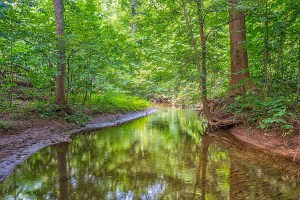 With dense cloud cover predicted for most of the day, I decided to hike the length of an inland trail beside a winding creek that I hadn’t traveled since early spring. I tend to spend more time at the beach or along ridges of dune hills in summer months, seemingly neglecting those routes coursing through wooded terrain. However, as I have noted in past posts, I know overcast skies are frequently ideal for photographing forests. (For example, please see my 7/8 entry.) Nevertheless, when I walked toward a bend in the waterway where I have often spotted deer crossing during previous visits, I noticed a few slants of sunlight suddenly slipping through overhead openings in the upper branches of trees. The dark ribbon of water began to brighten a bit, mirroring tree trunks on either bank, and the green of leaves from overhanging limbs reflected on the surface like smudged brush strokes in an impressionist painting. Under the illumination due to this brief and unexpected break in the weather, I observed that a track of deer prints marked the muddy border at the edge of the creek.
∼ July 27, 2017 ∼ “Late Sun Seen Through Leaves”
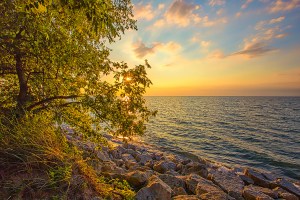 I have written in the past about the Golden Hour, that period of time leading to sunset when soft sunlight illuminates the sky, seemingly painting the atmosphere with a warm tone. (Please see my 7/10 and 7/13 entries for commentary and other examples.) As the sun lowers toward the horizon, the angle of its rays creates greater indirection of light, which lessens the harsh glare seen at midday that normally bleaches elements in the landscape and results in reduced saturation. In addition, the slanting orientation of the sunshine during sundown alters the visible mix of tints offered to the human eye. Moreover, the longer shadows presented among the low lines of daylight emphasize depth and texture inherent in objects within an image. In a previous post I have also noted the necessity of filtering the bright highlights to avoid overexposure when photographing directly into the sun, either by waiting for a cloud (please view my 7/23 entry) to intervene or, as in this scene, by focusing through leaves of an overhanging tree to partially dilute the sun’s great strength.
∼ July 26, 2017 ∼ “Trail to Kemil Beach at Sunset”
 One of the beaches I frequently visit, Kemil Beach, is a part of the Indiana Dunes National Lakeshore situated between the Indiana Dunes State Park to the west and Beverly Shores to the east. When driving to this location, I enjoy traveling U.S. Route 12, the old Dunes Highway, which has an extensive and interesting history. This road once served as the main artery through the area, always busy with traffic in the mid-twentieth century, but nowadays exists as a pleasant less-crowded drive through mostly wooded landscape on either side. When arriving at the short branch of a northern turn-off at Kemil Road, I find an even more soothing section fully canopied by thick foliage of trees bending overhead. Nevertheless, in that little distance one moves from woods to marsh to dune hills to beachfront. The brief walk from the small Dune Ridge Trail parking lot located out of sight from the coast leads to a sandy path winding down the foredunes toward the shore, and on summer evenings a brilliant sunset usually looms ahead as its colors flare above the skyline of Chicago.
∼ July 25, 2017 ∼ “Florida Tropical House at Indiana Dunes”
 The 1933 “Century of Progress” World’s Fair held in Chicago included a fascinating feature—Homes of Tomorrow—showcasing a group of a dozen structures displaying futuristic architecture and interior design. At the conclusion of the fair, five of the houses were purchased by Robert Bartlett, a real estate speculator who owned property along the Indiana Dunes in Beverly Shores that he wished to develop as a resort area. The buildings were transported from Chicago to the northern Indiana coastline by barge and positioned on Lake Front Drive, which parallels the shoreline and overlooks the beach. This section has been designated for preservation by the National Register of Historic Places since 1986 and is known today as the Century of Progress Architectural District. Perhaps the most distinctive and most photographed of the homes, the Florida Tropical House is covered by light stucco painted in a shocking pink, and it seems to complement sunset colors seen above the Chicago skyline across Lake Michigan.
∼ July 24, 2017 ∼ “Monday Morning at the Shore”
 As I noted in a previous message posted a couple of days ago, I had a pair of pleasant conversations about the Indiana Dunes Friday evening with visitors from out of state staying the weekend. (Please see my 7/22 entry.) Knowing the forecast called for temperatures in the 90s and realizing that dunes locations would be crowded any hot Saturday or Sunday in mid-July, one couple inquired as to which less busy beaches they ought to try. Responding, I explained the best ways to avoid traffic and full parking lots, and I also gave directions to some of the least populated or more isolated sites along the shore. However, my best piece of advice would have included the recommendation that, if possible, they extend their stay through Monday, when the weather was predicted to be fairly moderate with clear skies, and those sandy stretches along Lake Michigan also would be fairly clear of most swimmers and sunbathers.
∼ July 23, 2017 ∼ “Setting Sun Behind Lone Cloud”
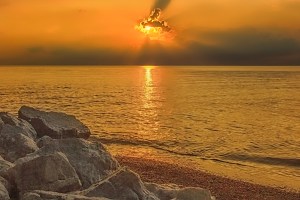 The lake waves have calmed after a day of rainstorms, and the cloud cover has mostly cleared. People walk the beaches of the Indiana Dunes again this evening seeking another impressive summer sunset, but I know for more effective photography I will need a cloud to soften the bright light on display just before sundown. Shooting into an unshielded sun without a filter can create a blown out sky that loses any definition in a captured image. Therefore, I sit among a cluster of stones and wait for a lone cloud to place itself into position so that light moves through it or is deflected by it—may even be blocked in spots by it. In addition, because the brightness of the direct sunlight is diminished, an overall sense of warmth is allowed to color the rest of the sky and reflect on the still water below. On some occasions patience pays, and on this night I am rewarded for my persistence.
∼ July 22, 2017 ∼ “Late Light Between Storms”
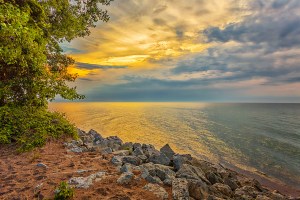 Strong storms rolled over Lake Michigan during the day and into the night, triggering damaging winds and downpours throughout bordering states of Illinois and Indiana. The coastline along the dunes served as a prime location for observing the swift movement of clouds and bursts of lightning brightening the horizon. Knowing inclement weather often provides opportunity for dramatic photographs, I headed toward the shore and reached the beach with a hope of capturing an interesting image. However, when I arrived the entire sky appeared overcast, and a thick layer of gray covered the lake. The sand had darkened, wet from rainfall of a previous passing shower. Nevertheless, while I waited and spoke in separate conversations with two couples, friendly folks visiting from Ohio and North Carolina who had inquired about places to visit in the Indiana Dunes, I noticed an opening suddenly showing in the distant sky, allowing a slant of sunlight to briefly leak through the cloud cover just before sunset.
∼ July 21, 2017 ∼ “Dune Tress on Ridge Above Lake Michigan”
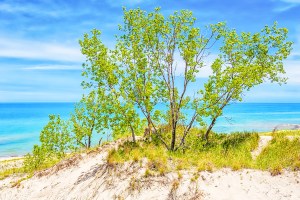 When the hottest days of summer arrive in July and August, following trails along the Indiana Dunes requires planning in order to avoid more humid routes. Rather than traveling across swamps or marshes, I seek wooded and shaded paths through the interdunal forest toward the shore, where the lake often offers cooling onshore air currents. I also like to hike narrow trails among higher ridges of the dunes, most of which extend parallel to the beach and run just inside the first line of trees. Though not official trails nowadays, these paths were once a main way residents of structures that had been built on the coast would pass from one place to another. In fact, in the first half of the twentieth century before the many buildings were razed within the property of the Indiana Dunes State Park, the route was popularly known as The Cabin Trail, and it connected some of the better-known locations, such as the Governor’s cottage, artist Frank V. Dudley’s cabin, and the Prairie Club. Moreover, many spots on the walk present excellent vantage points overlooking Lake Michigan, providing me with wonderful vistas for photography. (Please view my entries of 5/20 and 5/30 for more about The Cabin Trail.)
∼ July 20, 2017 ∼ “Summer Stillness at the Shore”
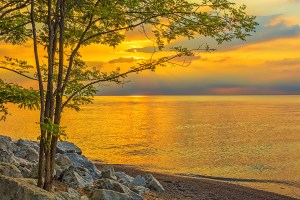 The stillness on a warm mid-summer evening, when the weather’s heat and calm winds have held the region in their spell for a few days, seems so serene. Even the warmth seen in the sky’s colors at sundown and reflected across the untroubled surface of Lake Michigan suggests an atmosphere that always appears comforting to me. As I sit on a small boulder beneath a tree beside the beach and watch the flare of late-day light in the distance, I appreciate the way those heavens above the horizon reclaim my attention each evening. Everything suddenly seems as untroubled as the waveless water extending toward that scenic backdrop now spreading before me. The lack of sound resulting from an absence of steady surf beating against the beach only enhances the quiet tranquility of this setting. Thoreau once wrote in his Journals about such a state of mind: “To be calm, to be serene! There is the calmness of the lake when there is not a breath of wind….” [Henry David Thoreau: Journals, June 22, 1851]
∼ July 19, 2017 ∼ “Western End of Central Beach: 200th Post”
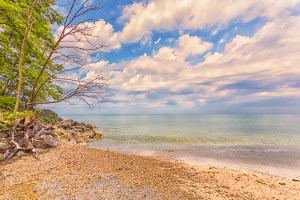 In a previous commentary I reported the reopening of Central Beach, which had been closed as too dangerous for the public after the loss of beachfront due to erosion from strong storm surges as well as high lake levels that washed away the sandy waterfront and flooded the access road, causing damage that made the route impassable. (Please see my 7/9 entry for more information.) When I visited this somewhat isolated location, I walked the length of the beach until I reached the western end just as a rainstorm started moving offshore and cloud cover began to break apart over the lake. [This post represents the 200th journal note in my Indiana Dunes project, and my writings for this project have now accumulated more than 50,000 words. I again invite readers to browse through all the past entries. Moreover, I appreciate all who have viewed and responded to my photographs, and I welcome reactions to my daily commentary as well.]
∼ July 18, 2017 ∼ “July Sunset”
Some of my favorite evenings in summer are spent sitting on isolated rock outcroppings at the Indiana Dunes to watch the sun set over Lake Michigan. With comfortable temperatures and only an easy breeze drifting onshore, I like to find a collection of boulders containing a couple of stones with flat tops ideal for resting and settling my tripod, the wide-angle lens aimed at changing skies above the lake horizon. Few situations seem as relaxing, and the scenery always appears to be impressive. Indeed, every sundown has its own characteristics, and the color pallet differs—sometimes only slightly and on other occasions more dramatically—with every visit; however, one never feels less than rewarded for waiting and observing the atmospheric show on display at the end of daylight. When witnessing the setting upon such opportunities, I recall how Thoreau once wrote that he appreciated discovering solitude at sunset for viewing his surroundings “to behold and commune with something greater than man.” [Henry David Thoreau: Journals, August 14, 1854]
∼ July 17, 2017 ∼ “Sun Setting over Chicago”
 Those viewing the sun setting from the Indiana Dunes during the middle of July each year are able to witness its descent beyond the Chicago skyline across Lake Michigan. Indeed, this period of the summer might be the most popular for observing sundown from the beaches along northern Indiana. In addition, one can expect many photographers taking advantage of the circumstances. On some occasions I have captured a close-up image of the sunlight silhouetting the taller buildings of the city. (Please see my entry of 6/27 for an example.) However, I must acknowledge I usually prefer a wide-angle perspective that places the lowering sun in context with details of the surroundings: the colorful sky, a thin layer of clouds, the cityscape, the lake waves, and the surf washing on an illuminated shoreline. The scene in the accompanying picture even includes a ring-billed gull standing on the wet sand.
∼ July 16, 2017 ∼ “Lake View from Dune Hill”
 I have noted in a previous post that the Indiana Dunes holds a special place of affection in my memory since my wife and I visited this location on our first date more than three decades ago. (Please see my entry of 4/14 for more information.) In fact, whenever I hike the ridge line of trees bordering the shore, I remember moving through the same path with Pam on that April day we first viewed Lake Michigan through the woods, a sheen of spring sunshine glistening on the blue water and brightening the horizon. Consequently, as we celebrate our 29th wedding anniversary today, I fondly offer an image from somewhere near the spot we stood and held one another while watching the wonderful view in front of us with little knowledge of the long trail in time and through life we would follow from that marvelous moment forward to the present.
∼ July 15, 2017 ∼ “Lake Michigan Beyond Big Blowout”
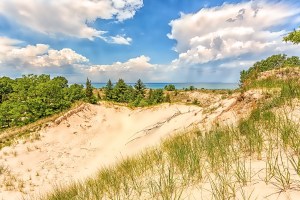 Due to the popularity during July of beaches along the Indiana Dunes, especially Waverly Beach, as well as more traveled trails located adjacent to the state park’s Nature Center, I like to hike farther east on the longest route, Trail Ten. This walk eventually passes the Big Blowout, which I have discussed in a past post as being so far from the center of the park that the setting often remains empty of other visitors, and I feel isolated the whole time I visit. (Please see my entry of 6/28.) While moving through the tremendous gap opened over time by onshore winds and drifting dunes, I arrive at an inland ridge with a glimpse of Lake Michigan in the distance. I pause to observe an impressive landscape, both transitional and tranquil, marked now only by a sole track of footprints serving as a temporary record of my presence.
∼ July 14, 2017 ∼ “Brief Break Between Storms”
 This first stretch of summer has been marked by a series of severe thunderstorms moving through the region. Sparked by July heat and humidity, these disturbances sometimes develop suddenly and depart just as quickly, frequently leaving evidence of damage in various forms, such as scattered instances of flash flooding or branches and power lines downed by destructive wind gusts. I sometimes find myself caught in the changing weather while hiking along trails in the Indiana Dunes. (Please see my entry of 6/29 for an example.) Indeed, when I revisited Central Beach at the beginning of this week I again had to seek shelter at a wooded point along the shore. While waiting for a squall line to pass, I watched clusters of cloud formations sweep across the lake. However, almost as interesting, a brief break of clearing skies and return of calm waters displayed once more the fickle conditions of this season.
∼ July 13, 2017 ∼ “Darkness Falling”
 In a recent commentary I mentioned the preference voiced by many landscape photographers for capturing images in the golden hours surrounding sunrise or sunset. I noted in that post how some shoot exclusively during those prime times for sensational scenery. (Please see my 7/10 entry.) I must confide I find the summer months ideal for such pictures along the Indiana Dunes. Since the beach crowds have left by the later hours and the temperatures usually cool by evening, I enjoy walking along the water and waiting for sundown. However, like all landscape photography, much relies on luck, especially when the weather does not cooperate, which happens frequently. The skies might suddenly become totally overcast or the cloud cover could completely disappear before the sun reaches the horizon, leaving a bland blue field filling my viewfinder. Nevertheless, as I told my wife after a visit to Lake Michigan this week, I can’t think of any other activities in which a disappointing outing still results in the pleasure of standing along the shore in comfortable conditions to observe a sunset, particularly since each one can be captivating in its own way—such as this silhouette shot—even if it might not be as dramatic as I’d desired.
∼ July 12, 2017 ∼ “Celebrating the Bicentennial of Thoreau’s Birth”
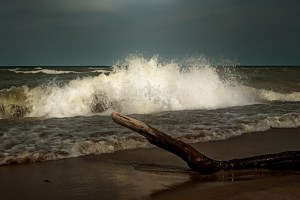 Henry David Thoreau was born on this date two-hundred years ago (July 12, 1817). As I have noted in past posts, including the opening commentary on January 1: “I regularly return to the collected works of Thoreau and read with great interest his observations on nature or speculations about the human spirit.” In addition, I have mentioned in the “Introduction” to my Indiana Dunes project, this journal I have been keeping owes much to the influence of Thoreau’s decades of regular writings. (Please also see representative entries—from more than two dozen about Thoreau—on 7/4, 2/20, and 1/27.) To celebrate this anniversary of Thoreau’s birth and the July full moon known as a“Thunder Moon,” I include an image of Lake Michigan in moonlight, and I remind readers of a lesser-known essay by Thoreau written in 1883, “Night and Moonlight,” where the author offers an observation: “Many may walk by day; few walk by night. It is a very different season. Take a July night, for instance. About ten o’clock,—when man is asleep, day fairly forgotten,—the beauty of moonlight is seen….”
∼ July 11, 2017 ∼ “Wooded Trail to Beach”
 A widening gap of strengthening sunlight shines between green leaves of beach trees, brightening the horizon. Last night’s spells of rain remained well past daybreak but finally gave way to clearing skies, although a few small swells of clouds still billow like pale puffs of smoke overhead. I walk a wooded trail yet wet and pocked with the dark spots of shallow puddles. However, by the time I arrive at the lake, nearly noon, most of the foliage along the shore seems to have been dried by midday heat. The pedometer I wear to measure my steps and pace my progress shows almost five miles traveled today through forest or across dune hills. As the winds shift direction, a refreshing onshore breeze lifts a current of cool air from above the water and drifts inland a bit, jostling leaves that create puzzle-piece patterns of shadows on this sandy path leading to the beach. I will wait here a while and watch for shorebirds as they approach the coast, though now floating like tiny white kites in the distance.
∼ July 10, 2017 ∼ “Late Sun Above Lake Michigan”
 A number of the finest landscape photographers follow a simple rule when scheduling time to capture images. Due to an emphasis on the importance of light in its many variations, they restrict their activities to scenes seen during the golden hours just before or after sunrise and sunset. I have heard some even state that they put their cameras aside the rest of the day. After all, George Eastman famously declared the preeminent power of light in his advice for photographers: “Embrace light. Admire it. Love it. But above all, know light. Know it for all you are worth, and you will know the key to photography.” Although my Indiana Dunes project uses photography primarily as a documentary tool and frequently requires that I hike trails in the less exciting sunlight at midday, I can understand a sentiment by fellow photographers and viewers that expresses preference for specific conditions with sensational light exhibiting spectacular color, and I readily admit enjoying these dramatic images as much as most observers.
∼ July 9, 2017 ∼ “Return to Central Beach”
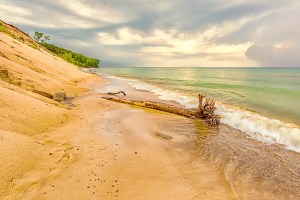 A fine haze remains over the lake and a faint drizzle continues as I hike this thin stretch of beach. Once wide and welcoming, Central Beach has been greatly diminished by erosion from Lake Michigan’s wind-driven waves during the last few years. In fact, when northern gusts approach the coast, the entire ribbon of sand still clinging to the shore becomes submerged under water. Central Beach was first closed as too dangerous for the public in early July of 2015 after the loss of beachfront due to erosion from strong storm surges and high lake levels that washed away the sandy waterfront. In addition, more recent flooding of the access road, which extends through marsh and wetlands of the Indiana Dunes, caused damage that made the route impassable. However, despite the limitations caused by current conditions, the area was repaired enough to be reopened this month, and I decided I had to return to an isolated location that had been a favorite site of mine.
∼ July 8, 2017 ∼ “Marsh Bridge on Cloudy July Day”
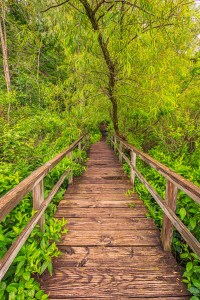 I’ve noted in past posts how cloudy days are ideal for photographing woodlands or wetlands, places where branches and tall weeds would create a network of shadows distracting from the overall image under sunny circumstances. In addition, without the bleaching brought by bright daylight, the green leaves seem more vivid on overcast afternoons, especially when yet wet with rain or dew. Consequently, as a couple of quick thunderstorms swept across Lake Michigan and moved onshore at the Indiana Dunes, I decided to walk a trail through a marsh forest at the state park. By July this setting’s trees and shrubbery appear rich with tints of green, and everywhere the landscape offers a sense of texture one almost wants to touch. Moreover, the remaining moisture from those drifting squalls of rainfall shifting inland deepens the saturation of summer colors and even brings out the tactile characteristic defining the wooden surface of planks or handrails on a walkway bridge.
∼ July 7, 2017 ∼ “Lake Wave Before Sunset”
 Having been born and raised near the Atlantic Ocean, I frequently found myself feeling a fondness for the shorefront. As a boy, I often walked those wharves where fishing boats were berthed, and I enjoyed standing knee-deep in saltwater washing onto the sands of Long Island while surf-casting for fresh catch at end of day with my father. Though I no longer engage in angling, my interest in the coastline setting continues as I hike miles of scenic beach along Lake Michigan at the Indiana Dunes. In the past, I sometimes wrote in my poems about how I particularly appreciated in my early years when sunset would rub its colors across a choppy sea or would tint slim clouds riding the horizon, a golden glare of sunshine barely showing beneath them. Viewing lake waves late on windy days in northern Indiana, I’m reminded of those treasured moments frozen in my memory from so long ago.
∼ July 6, 2017 ∼ “Trail to Beach from Mt. Tom”
 After ascending the highest peak along the Indiana Dunes in sweltering summer heat, I decide to descend from Mt. Tom on a trail winding toward the shore, where a weak breeze off the water offers cooler temperatures. Though the loose sand on dune slopes slides beneath me with each footstep, the walk seems easy in contrast to those steep paths I’ve climbed for the past hour. At last, the blue lake appears endless as it extends into the distance toward the horizon and blends with the blue skies on this cloudless afternoon. I follow the line of white sand with my camera in hand, and although the scene before me seems so simple, I find this setting compelling and comforting. Even the small trees and the green leaves of marram grass seen on either side of the opening ahead present a proper sense of natural framing for the composition in those images I will have captured by the time I reach the beach.
∼ July 5, 2017 ∼ “Calm After Storms”
 The long four-day holiday weekend has ended, and most of those among the large crowds of beachgoers have gone home. Due to an extended spell of vacation days, warm weather, and low gas prices, the ingredients were in place for roads congested with travelers to Lake Michigan. But today the full parking lots at various locations along the Indiana Dunes have emptied, and much of the beachfront seems to have returned to its usual state of tranquility. In fact, though a few lines of strong storms shifted through the region with intervals of heavy rainfall a couple of evenings during this lengthy weekend, the current conditions appear calm. The nearly still water looks soothing, and small waves rippling the surf seem merely to stir lightly those shells or pebbles scattered on the wet sand. I believe the time might be right for resting among the breakfront boulders to observe sunlight brightening the southern sides on a cluster of remaining clouds as they drift above Lake Michigan.
∼ July 4, 2017 ∼ “Cabin in the Woods”
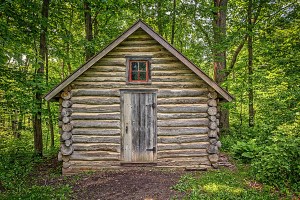 I have photographed in different seasons a cabin at the historic Bailly Homestead, established in the nineteenth-century. (Please see my entries of 2/4 and 6/5 for more details.) However, today I offer an image of the structure to coincide with the date Henry David Thoreau reported beginning his stay in a cabin at Walden Pond during 1845. “When first I took up my abode in the woods, that is, began to spend my nights as well as days there, which, by accident, was on Independence Day, or the Fourth of July, 1845, my house was not finished for winter, but was merely a defence against the rain, without plastering or chimney, the walls being of rough, weather-stained boards, with wide chinks, which made it cool at night. The upright white hewn studs and freshly planed door and windowcasings gave it a clean and airy look, especially in the morning, when its timbers were saturated with dew, so that I fancied that by noon some sweet gum would exude from them. To my imagination it retained throughout the day more or less of this auroral character, reminding me of a certain house on a mountain which I had visited a year before. This was an airy and unplastered cabin, fit to entertain a travelling god, and where a goddess might trail her garments. The winds which passed over my dwelling were such as sweep over the ridges of mountains, bearing the broken strains, or celestial parts only, of terrestrial music.”
∼ July 3, 2017 ∼ “Offshore Storm at Indiana Dunes”
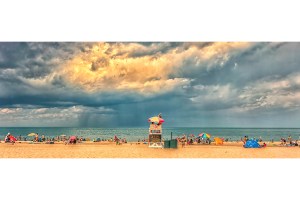 I frequently write in these notes about the impressive image of storm clouds gathering and approaching the coast of northern Indiana. I’ve commented about how such a situation may be among my favorite experiences when hiking ridges in the dune hills. (Please see my entry of 6/29 as an example.) However, perhaps the appearance of a darkening squall line over Lake Michigan seems even more dramatic in summer when viewed by sunbathers and swimmers clustered along the Indiana Dunes beaches, particularly during a holiday weekend. The great heat of an afternoon in June, July, or August builds and the cloud cover becomes more ominous, thickening on the distant horizon with a row of rainfall evident as the stippling water below grows closer. Observed in contrast with the calm and bright conditions along the shore, one senses that the scenery seems to exhibit an intensive element of nature, especially when sunshine reflects off the upper levels of a scudding cloud bank.
∼ July 2, 2017 ∼ “Coffee Creek in Early Summer”
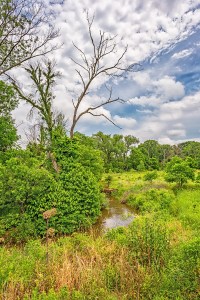 I usually travel alone on photo trips, whether along various wooded trails, on the beach beside Lake Michigan, through dune hills, down a river path, or in a swamp setting. However, on Friday morning my son asked me if he could go for a hike; so my wife and I decided we should drive to the Coffee Creek Watershed Preserve, which covers more than 150 acres, for a short and leisurely walk. Alex, Pam, and I followed one of its easy routes on boardwalks built through wetlands and then winding along the creek, stopping at a few locations where I could capture an image. The three of us have visited this site a number of times in the past, and I am impressed by the numerous migratory birds attracted to the area. We also frequently see deer nearby. In addition, at this time of year the undergrowth is thick and lush, decorated with a wide variety of colorful wildflowers. I have written about Coffee Creek in past posts with photographs. (Please see my entries on 6/1 and 6/8.) However, since I was enjoying sharing the views with Alex and Pam, this was a different experience and I found myself taking fewer pictures. After all, they were observing the authentic scenery of nature and did not need my representation. Instead, in a twist of circumstances I was appreciating their impressions of the environment.
∼ July 1, 2017 ∼ “Little Calumet River at Start of Summer”
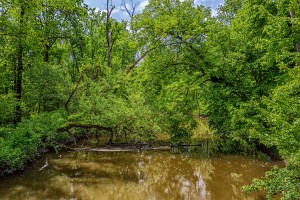 When the river flow slows in summer and becomes more saturated by the erosion from its banks, sediment runoff mixed with algae acts like ink pigmenting the water to cause a coffee-colored appearance. Its rich brown complements the thick trunks or big bottom branches of bordering trees, their bark darkened by dampness and shade. A canopy of overhanging foliage now extends from each side, meeting over the middle of the river almost like an arched entryway. These rich green leaves exist in an ever-changing variety of hues dependent upon the presence and positioning of sunlight shifting during the day. Thinner upper limbs sometimes sag under the seasonal weight of so many leaves, and the lazy current below frequently finds itself redirected by fallen trees or broken branches littering the river. At times, the blue sky of a summer afternoon, marbled by a pattern of streaks or swirls from passing clouds, seems perfect to complete this image, especially when everything appears dully reflected, as if in a sepia tone, on the surface of the river.
∼ June 30, 2017 ∼ “After a Day of Heavy Rain”
 On a day after heavy rain only a few puffs of departing clouds remain in view above the lake. The warmer weather offered by early summer has returned, heating the beachfront and drying the patch of wooded landscape nearby. Yesterday these trees were bent back by seemingly ceaseless onshore gusts, but today they stand at attention in still air, as the hues of calm water—now almost creaseless—deepen under widening blue skies. I carry my camera as I climb over a narrow bank of breakwater, a barrier positioned to prevent erosion from wind-driven waves during winter storms. In my memory I review how those same stones were slippery, slick with ice and misshaped by drifts of blowing snow, during a January visit. (Please see my 1/22 entry.) I notice edges on some of the small gray boulders whiten a bit, brightening in a cast of strong sunlight, adding accent to a shoreline angling into the distance and disappearing toward a sandy point yet out of sight.
∼ June 29, 2017 ∼ “Lake Squall Seen Through Dune Trees”
 Walking a path through the thin line of trees along a dune ridge, I pause to look toward the west where storm clouds gather over Lake Michigan. The still air of a hot summer afternoon suddenly becomes a strengthening onshore breeze beginning to bring refreshingly cooler temperatures. Though only a mile from the nearest shelter, I know I don’t have much time before rain arrives, and I find a familiar location where I sometimes stop to sit and rest, a fallen tree in a thickly wooded recess on a hill above the beach. My camera gear and I will remain mostly dry in this spot, and there is an opening between branches perfect for framing an image. Frequently, weather along the coast changes quickly, and I have often watched the process of squalls sweeping across the lake, darkening the horizon and approaching toward the shore with a long row of dimpled water indicating the progress of rainfall. These systems usually produce showers that move through swiftly then sunshine returns, and I count such moments as among my favorite times, especially when the shifting conditions create contrast leading to interesting photos.
∼ June 28, 2017 ∼ “Big Blowout”
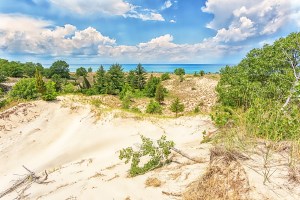 Traveling Trail Ten to the far eastern end of the Indiana Dunes State Park, I hiked inland from the lake at a location known as the Big Blowout. In a past post I spoke about my visit to the Beach House Blowout. (Please see my entry of 4/24.) I explained the origins of blowouts, which appear all along the coast of the Indiana Dunes: “Established by long-term exposure to northern winds arriving from the lake, big blowouts like this one break through the dune hills and can expand into the first interdunal valley. Moving mounds of sand are swept over wooded areas by the onshore gusts, eventually destroying existing trees and creating forest graveyards, while also leveling the terrain, supplying accommodating conditions where grass, small plants, and young pine trees begin to grow.” The Big Blowout lives up to its name, and its vast area felt overwhelming. In fact, because it is so distant from the center of the park, the setting was empty of other visitors, and I was isolated the whole time I remained within this remote landscape, which has become separated from the shore by deep grass-covered foredunes and a series of rolling dune hills.
∼ June 27, 2017 ∼ “Chicago Skyline Silhouetted at Sunset”
 The weather has turned unusually cool for late June these last couple of days as a cold front brought by northern winds continues to drift over the region. In fact, overnight temperatures have flirted with record low measurements. At first, a narrow wedge of showers and substantial cloudiness accompanied the chilly system, but all afternoon some openings appeared, allowing patches of sunshine. When I arrived at the shore, the skies still were mostly overcast, but just before sundown almost all the clouds suddenly departed, washed away by quickening upper air currents. I had hoped a rich mixture of cloud cover might be brightened from behind with angled sunshine to create a dramatic scene. Instead, I found myself looking toward Chicago from the Indiana Dunes as the clearing Lake Michigan horizon offered this crisp view of a silhouetted skyline backlit by a colorful background illuminated with an orange afterglow of sunset.
∼ June 26, 2017 ∼ “Discovering Crinoids”
 I traveled Trail Ten from inland black oak woods through foredunes covered with marram grass and toward the Lake Michigan shore, where I discovered an isolated coastline distant from points of public access. (Please see my previous 6/25 post.) I walked the water’s edge, and the beach seemed decorated with a constellation of colorful pebbles or shells left on the wet sand. As I approached a stretch of surf extending along the location of the Big Blowout, I came across a couple picking through those tiny objects freshly deposited by an incoming current. Speaking with a wonderfully informative woman (Marcia or Marsha: I apologize for not asking about the spelling), she revealed they were searching for crinoids, and when I appeared puzzled, she kindly explained. Apparently, crinoids are fossils found among the shells (and usually confused with them by most visitors). Left by creatures similar to sea urchins or sea cucumbers, the pieces found along the Indiana Dunes are tiny and frequently disk-shaped parts—many five-sided and resembling a star—of the spinal stack. These items are ideal for use like beads in jewelry, especially a necklace or bracelet since the hollow center of the crinoid disk serves perfectly for stringing a chain.
∼ June 25, 2017 ∼ “Trail Ten Toward Shore”
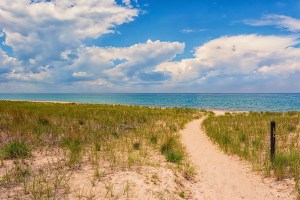 Trail Ten, the longest route (listed at 5.5 miles) through the Indiana Dunes State Park, offers travelers an opportunity to view various types of terrain characteristic of the region. Hiking the length of this path, one will observe sections of marshland, woodland, dune hills, foredunes, beach, and blowouts. Most folks begin their trip on an inland loop near the Wilson Shelter and not far from the Nature Center, which serves as an appropriate starting point for a number of official trails. Another option permits visitors to initiate their walk at the pavilion of the public beach and follow the coastline straight east. However, due to its length, many do not journey the full extent to the eastern end of the park, and they miss some of the most interesting landscape as the inland trail skirts the southern edges of a series of blowouts and exits a dune forest consisting mostly of black oaks through grassy foredunes toward a welcoming remote stretch of shore far from the more populous parts of the park.
∼ June 24, 2017 ∼ “Great Marsh in June”
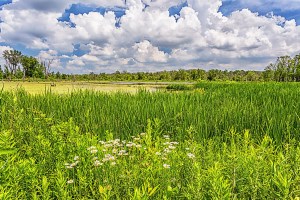 At the start of summer, I like to return to the Great Marsh area in the Indiana Dunes to witness the seasonal transformation of the landscape. At this time of year, perhaps no other location in the region displays such a contrast in appearance when compared with winter. (Please see my previous entries of 2/23, 2/21, and 1/8.) The Great Marsh exhibits characteristics most closely resembling the widespread wetlands as they existed prior to human intrusion through the digging of drainage ditches permitted by the Swamp Land Act of 1850. Indeed, in the past twenty years a restoration project has been underway to allow waters to resume natural patterns of flow and to remove any non-native plants. Consequently, a variety of local wildlife and migrating birds once again populates the area. In addition, as happens every June, the clear surface water seen in colder months has begun to cover with green. Therefore, when I walk a trail through the marsh, I believe I am seeing the setting almost as it might have originally appeared.
∼ June 23, 2017 ∼ “Dune Succession Trail”
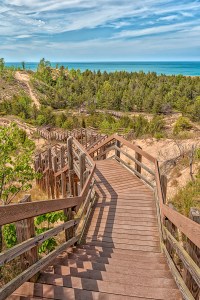 Though the Dune Succession Trail is a short route of just under one mile, it rises to an elevation of more than eighty feet before steeply descending toward Lake Michigan at West Beach. The path is a popular way for visitors to obtain scenic views of the coastline, while the surroundings display transitions in terrain as one walks its length. In this setting one may observe a brief history of the landscape’s natural development over time. Traveling from inland toward the shore, the hills are covered with oak, cottonwood, and pine, and the hike includes movement through prairie grass onto sand dunes to a stretch of beach along the lake. Much of the walk has been made easier by a stairway that is said to have 250 steps, though I haven’t yet verified that total with my own count. An understanding about evolution of the land along the Indiana Dunes region in its different states (wetlands, grassland, forest, sand dunes, etc.) was proposed in the early twentieth century by biologist Henry Cowles, best known as a pioneer of ecology and for nearby Cowles Bog, which I have mentioned in previous posts. (Please see my 4/11, 4/12, and 4/15 entries.)
∼ June 22, 2017 ∼ “A Fine Day at Lake Michigan”
 I frequently mention my debt to Frank V. Dudley—famous for his paintings of the Indiana Dunes—for inspiration and guidance whenever I photograph the landscape near Lake Michigan and capture scenes that are similar to those seen on Dudley’s canvases. (Please see my previous entries on 6/18, 1/20, 1/19, and 1/5.) Therefore, I am pleased to note Dudley also had extensive knowledge and professional experience with photography. As early as the first decade of the twentieth century, the Dudley family owned a photography shop in Chicago. Indeed, during his career as an artist, Dudley acknowledged sometimes aligning his perspectives through a small rectangular metal frame, as one prepares a photograph in a viewfinder, and in later years he even took Kodachrome shots of locations around the lake, employing his camera as a tool to remember specifics when creating a new artwork. Though the dunes have changed continually and dramatically in some places since Dudley’s time, I hope my photos reflect a bit of the spirit he displayed in his paintings of those splendid scenes found every day among the Indiana Dunes overlooking the lake waters, including one titled A Fine Day that displays an image similar to the one in my photograph that borrows for its title as well.
∼ June 21, 2017 ∼ “Summer Solstice Sunset View from Mt. Baldy Toward Chicago”
 Tuesday evening represented the summer solstice, that date when the position of the sun reaches its northernmost point. As a way to celebrate this occasion, I joined some other hikers on a climb to the top of Mt. Baldy, which offers a panoramic view of Lake Michigan and the skyline of Chicago across the way from the Indiana Dunes. As I noted in a previous post, Mt. Baldy has been closed to the public for nearly four years due to the danger presented by life-threatening sinkholes in this large wandering dune. (Please see my 6/12 and 6/13 entries.) Therefore, this hike could be held only with the guidance of an Indiana Dunes National Lakeshore ranger, and our leader, Kelly, provided an entertaining and informative narrative. (Indeed, I have always found all the staff members at the state and national parks to be friendly and helpful.) At this time of the year, the sunset as seen from the Indiana coastline dips below the horizon near Chicago. By late June and early July, the sun will begin to drift back south and actually will appear to drop right behind the tops of Chicago’s tallest buildings. Although all afternoon the skies were completely gray and rain fell for hours, the gloomy overcast departed before sunset. In fact, I was hoping a percentage of cloud cover would remain, and I was a bit disappointed that the clear skies would result in a less dramatic image. Nevertheless, no sunset fails to satisfy.
∼ June 20, 2017 ∼ “Clearing Skies After Rain”
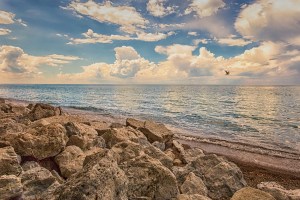 In a past post I mentioned a characteristic commonly attributed to landscape photography by viewers of such images with nature’s features but rarely ever the presence of a person. I countered the observation that people are almost always absent from my pictures by quoting Ansel Adams: “There are always two people in every picture: the photographer and the viewer.” (Please see my entry of 1/29.) However, I do acknowledge my intent in most photos does involve isolating the environment from any apparent human intrusion or cultural influence. In addition, most of the posts I share in this journal narrate hikes I take by myself. Nevertheless, as I travel throughout the Indiana Dunes, I frequently meet amiable and interesting individuals along the trails, especially in summer when walking routes beside the beachfront. I realize I might never engage in discussion had I not been taking landscape photos. Indeed, my camera serves as a common source for the start of conversations, especially when it is attached to a tripod slung over my shoulder. Those people I meet often begin by inquiring whether I have gotten any good pictures or by commenting that the weather seems ideal for photography. Many times, perhaps because my gear indicates I might be trusted taking a photo, when there are couples or families I am also asked to snap a picture of them with their iPhone. Yesterday, as I was capturing images of clearing skies over Lake Michigan following a brief rain, a couple nearby requested I take their photo. During our conversation, I discovered they were on vacation from their home in Cedar City, Utah—where I have travelled in the past—and they had just arrived from attending the U.S. Open golf championship over the weekend. Since I had lived in Salt Lake City for five years and taught classes at the University of Utah, it was great to discuss with Mike and Rhonda their two sons who had graduated from Utah and to compare our fondness for a professional golf tournament in Park City that we had attended. Once again, I was reminded though no person may appear within the frame of my landscape photos, I am pleased my photography allows for the opportunity to meet a variety of friendly folks.
∼ June 19, 2017 ∼ “Lake Between Trees”
 My shadow shifts before me with each step I take toward Lake Michigan. By the time I reach the beach, I see bright sunshine sifting between trees bordering the shore. The sand has also been flecked with yellow that appears almost golden. Each week as the weather has warmed, these scenes become even more appealing. Although the water remains quite cool, its hues of blue and green seem as welcoming as those seascapes painted by William Merritt Chase that I like so much. On this nearly windless day, scraps of clouds hang in the sky like limp articles of laundry draped on an old clothes line. While I frame my composition, a woman walking by me inquires what I am photographing, perhaps puzzled by the emptiness of the setting—nobody posing for a portrait, no boats in the image, and no recognizable landmark to preserve. I simply explain my attempt to capture the light of late spring on the lake, the way nature creates its own artwork.
∼ June 18, 2017 ∼ “A Sacred Space”
 I follow a narrow path through sand dunes spotted with green by the sporadic growth of marram grass. As I always do when passing this way, I stay a moment to rest in the gray stain of shade beneath an isolated tree among the foredunes. Although the landscape before me may appear less interesting than other images I might capture today, this place has become my favorite location in the Indiana Dunes. I consider this a sacred space. Through research I’ve discovered here is where Frank V. Dudley, “the painter of the Dunes,” once built a cabin and worked in his studio facing Lake Michigan with the distant skyline of his Chicago home on the opposite side. As I note in my Introduction: “When considering the magnificence of the Indiana Dunes, Frank V. Dudley set the precedent as an artist most closely associated with personalizing and promoting the landscape in his paintings. Dudley devoted his talent throughout decades of work in the twentieth century almost solely to educate and enlighten others about the significance of this engaging and enriching territory along the southern shore of Lake Michigan. Dudley asserted: ‘I think one of the greatest of God’s gifts to humanity is the beauty and the joy of nature. Yet the great majority of us go through life unmindful of it….’ Dudley’s paintings invited everyone to examine the elegance of the Indiana Dunes landscape. In addition, his endeavors helped establish the area as an inspiration for artists and aided in the social or political movements that eventually led to protection and preservation of this special landscape for the benefit of all.” Dudley and wife Maida would have seen this view each morning from the porch of their cottage or from the six big windows in the front room, which would have been positioned between the trees in my image.
∼ June 17, 2017 ∼ “Heat Spell in Mid-June”
 Barely a breath of breeze in the air, a calm surf creates quiet along the shore while crumpled clouds bunch under a nearly-summer sun like white bolts of linen folded unevenly. This still water is bordered by a golden swath of sand occasionally broken only by the dull color of driftwood limbs and their black shadows. I see farther up the beach that the pale hull of an upturned sailboat awaits its turn in the lake. Each day this week has been hot, as the steady weather has begun to shed that spring uncertainty when every cold front brought angled rainfall blown by a wheeze of northern winds. As soon as I hike through the foredunes and wander toward a small hill, I can feel an increase of afternoon heat. However, when I reach the cool shade of ridge trees on a hidden trail just within the woods but overseeing the coast, I pause to look back at my long track of footsteps, perhaps the way one might find comfort by rereading lines from a passage of verse in a favorite poem.
∼ June 16, 2017 ∼ “Trail Two Walkway Reconstruction”
 Yesterday’s newspaper reported a development at the Indiana Dunes State Park I had heard was in the works. The Indiana State Budget Committee has approved $400,000 for reconstruction of a thirty-year-old boardwalk spanning a half mile of marsh along Trail Two. In commentary accompanying this photo I posted following a January hike, I noted my discovery of the route’s condition: “the state of the wooden walkway has been greatly deteriorated or badly damaged in spots, and currently the path is deemed in a shape too dangerous for passing, so it has been officially closed to pedestrians by park personnel. Alternating periods of freeze and thaw have destroyed portions of the boardwalk. Gaps of differing widths exist in some places where boards have been displaced, and in the rest of its length, sections are uneven, rippling or dipping into a water level raised by snow melt and recent rainfall. In addition, a number of locations are blocked by fallen branches or splintered remnants of toppled tree trunks, seasonal ruin in a transitioning swamp forest.” (Please see my 1/25 entry.) I am pleased to see this crucial trail will be rebuilt.
∼ June 15, 2017 ∼ “Clouds and Coastal Stones”
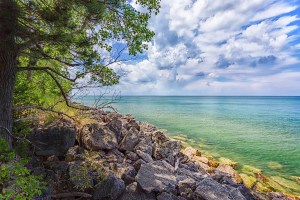 After hiking a few miles of beach along the Lake Michigan shore, the narrow band of sand ran out, replaced by small boulders positioned to preserve the coast from erosion by wind-driven waves. However, on this hot and humid afternoon in June the surf seemed to have eased following blustery overnight thunderstorms. I had traveled far beyond the crowds of sunbathers and swimmers at the popular public beachfront, and I found myself stepping over the uneven barrier of stones under leaf-light of trees with limbs reaching toward an edge of shallow green water that had become nearly still. A cluster of clouds collected above the western horizon, side-lit by tilting southern sunshine, and started to drift inland, perhaps a presage of more storms forecast for later in the day. A couple of gulls turned circles in the distance as if waiting patiently for a change to arrive or like aircraft ordered to maintain a holding pattern.
∼ June 14, 2017 ∼ “The Third Coast”
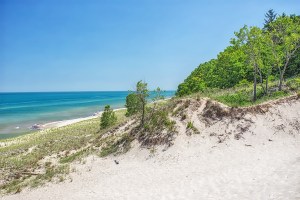 Once again a ribbon of beach sand whitens as if bleached during the heat of early afternoon. Green slivers of marram grass quiver slightly in the bright sunshine, as though a river of narrow leaves lightly flows in a soft onshore breeze. Only one week before the solstice, this shoreline already exhibits rich imagery more reminiscent of mid-summer. The clear blue of open skies, now cloudless following last night’s strong storm, appears to be mirrored by the deeper hue of far-off lake water. Resting on a ridge among the higher dunes after a long late-morning hike, I gaze at this lakeside landscape, known by some as the nation’s third coast, as the scenery extends into the distance and disappears behind a bend where a shoulder of woods borders the shore. Even this hillside filled with thickening trees at the end of spring seems to point like a leading line directing my sight toward the shore, that element of the setting with which I never grow tired no matter the season.
∼ June 13, 2017 ∼ “Tree Swallowed by Wandering Dune”
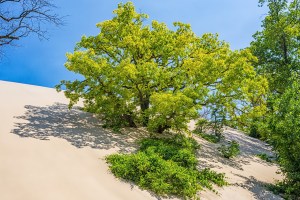 In yesterday’s entry I mentioned my trip to Mt. Baldy in the Indiana Dunes for a guided climb to the top. Though the location has been closed to visitors for the past four years due to hazardous conditions involving possible sinkholes, the Indiana Dunes National Lakeshore staff members occasionally offer supervised hikes. (Please see the 6/12 post.) Part of my fascination with the notable nature of Mt. Baldy concerns its character as a wandering dune, one that constantly drifts toward the south directed by Lake Michigan’s air currents, especially during swift winds in winter storms. As the dune moves, an accumulation of sand swallows trees in its path. In one image I captured on the southern side, a tree has begun to be buried, much of its lower trunk already concealed, while it is flanked on either side by a pair of other trees—one already dead and displaying bare branches but another lower on the slope not yet influenced by the shifting sand. More of the massive mound of sand about to migrate farther onto the trees can be seen looming above.
∼ June 12, 2017 ∼ “View from Mt. Baldy”
Four years ago a six-year-old boy nearly died when he fell into an 11-foot sinkhole while climbing Mt. Baldy, one of the fascinating features in the Indiana Dunes landscape. Fortunately, his disappearance into the dune was witnessed by others who were able to notify authorities. After three hours of meticulous digging in hazardously collapsing sand, the boy was rescued. Examination of the area revealed numerous locations where similar perilous anomalies were discovered. In the intervening years, studies by scientists suggest the presence of this dangerous condition can be traced to the fact that Mt. Baldy is more than 125-feet high and famous as a wandering dune that shifts inland at a steady rate, pushed by northern winds and eroded by winter storms with accompanying melting of snow and ice. When the accumulating sand envelops trees in a dense black oak forest bordering the shore and at the edges of Mt. Baldy, those trees are buried, die, decay, and decompose, leaving an empty silo-shaped chamber within the dune. Consequently, this popular site has been closed to visitors since 2013. However, the Indiana Dunes National Lakeshore occasionally offers hikes to the top under the supervision of a park staff member. With the guidance of an informed and personable ranger named Penny, I hiked through the woods and revisited the top of Mt. Baldy to enjoy the view offered from its height.
∼ June 11, 2017 ∼ “Swamp Forest in June”
 Sunshine unbuttons the cloak of morning haze, as a bright noon daylight seeps through the overcast to uncover the colorful green landscape of this swamp forest in spring. The low croak of a frog echoes among these trees, accompanied by the steady yet rapid beat of a woodpecker hidden in distant limbs still creaking slightly in an easy breeze. Bugs buzz all around, but thanks to protective spray, thus far they stay away from me. Nobody else ever appears to visit this place, and even I rarely do. In fact, the last time I passed this scene, I photographed snow and ice enclosing everything in a cold and desaturated setting. (Please see my 1/30 entry.) However, now the image I view in front of me resembles one of the rich impressionist paintings of leaves by Claude Monet, but today created by nature’s shadows, reflections, and a bit of wind seemingly presenting a beauty unseen by others, offered merely for my observation.
∼ June 10, 2017 ∼ “Tree Above the Beach”
 After days of blustery currents and high waves during the last week, I walked the shore this morning to check for locations showing signs of erosion. Some sections of sand were washed away by the surf as much as fifteen feet, all the way to the foredunes. I hiked a route more than two miles to the east beside the water’s edge and along a couple of dune ridges. Each time I travel this trail I pass places I regard as familiar or favorite spots, including a particularly distinctive tree perched precariously on the side of a dune mound. I have photographed this site on numerous occasions, preserving the scenery in different seasons. (Please check entries on 5/25, 4/28, 3/27, and 3/22 for four more examples.) However, its situation has deteriorated and the tree displays indications of attrition—the roots have become almost totally exposed and the limbs, which now seem weighed down by late-spring leaves, lean over a steep slope worn by windy weather. Every visit to this setting I wonder how much more of the northern winds this landmark will be able to withstand, and I am compelled to capture another image while I can.
∼ June 9, 2017 ∼ “Dunes in June”
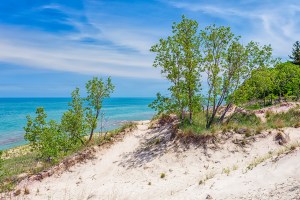 Strolling a sloping trail along a dune ridge above Lake Michigan on an afternoon in late spring, I’ve climbed high enough to see a sun-bleached beach fringed with a calm surf. The blue water beyond expands under white wisps of clouds appearing as if designed by light brush strokes on a canvas. The deep green leaves of trees shaped by sun and wind present colorful contrast as well as a sense of texture to the setting. So do those narrow blades of grass defying expectations and growing out of the sand. Every day I explore another path among the Indiana Dunes, I find new views with scenery that seems to offer delight and provides a never-ending source of inspiration. Indeed, on hikes like this I am reminded of a statement by Henry David Thoreau in his excellent essay accumulated through years as a lecture but first published in Atlantic Monthly during another June (1862)—one month after the author’s death—and titled “Walking”: “My vicinity affords many good walks; and though for so many years I have walked almost every day, and sometimes for several days together, I have not yet exhausted them. An absolutely new prospect is a great happiness, and I can still get this any afternoon.”
∼ June 8, 2017 ∼ “Creek in Early June”
 I hike through cool shade under trees along Coffee Creek, a chorus of birdsong all around me but hidden in a visual riddle of limbs and foliage. Some trees seem to slouch beneath the weight of late-spring leaves, summer merely two weeks away. However, a long bare branch bends and reaches toward the opposite bank, where a dead tree dips into the creek. Shadows of trunks stain the surface of the water. Despite an intermittent breeze that sometimes waggles the treetops and creates waves in the tall grass, I am able to freeze this scene with a faster shutter speed on my camera. A chipmunk scuttles beside one of my tripod’s legs and rattles among a rustling underbrush of little thickets. I’ve walked this way in winter when the landscape appeared desaturated by a covering of snow and a glassy sheen of ice on the creek. But this afternoon the setting seems vividly green with seasonal growth, another subtle reminder by nature about the gradual passage of time.
∼ June 7, 2017 ∼ “Notes from a Walk Along the Windy Shore”
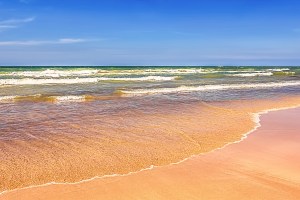 A sudsy look of surf washes upon the shore, where a young child sits in the wet sand sorting shells with her left hand. The other holds a little red shovel. Slanted sunlight reflects off the girl’s already tanning shoulders as a tall and wiry woman stands by her side, watching. I stroll past and view a temporarily empty lifeguard tower now leaning forward with sand eroded underneath. It tilts toward the water and into a swift onshore wind. Its yellow paint of stenciled letters spelling words of warning has been faded by months of winter weather. An almost cloudless field of cerulean in this late afternoon looms above the turquoise waters of Lake Michigan. I know it is not long before this sky will turn to bruise blue in the diminishing illumination at twilight, then eventually give itself over to the evening dark. By the time I’ve walked more than a mile, I again notice the horizon, opening ahead, straight and unbroken, as if part of an artwork designed in a studio and set by a chalk line. I look out at the breezy lake scenery, and I take one more photograph before going home.
∼ June 6, 2017 ∼ “Little Calumet River in Early June”
 Due to a few clusters of sunny and warm days following recent rainstorms, some of the less traveled trails have already begun to become overgrown. Now, I frequently tramp down fresh undergrowth when I walk these paths, as I did today in the thick woods bordering the Little Calumet River. Sometimes the dense and lengthening blades of grass conceal a stone or exposed roots of an old oak; consequently, I often find myself lowering my gaze to survey the way ahead and to scout the ground before me in an effort to avoid a stumble or a stubbed toe. Similarly, the river appears to contain numerous obstacles blocking anyone from maneuvering a canoe, kayak, or rowboat along its course. In a number of locations, the fallen trees, broken branches, and uprooted trunks re-direct the slow-flowing current and act as barricades completely interfering with any opportunity to cruise through their clutter. However, this accumulation of timber tipped into the river does offer interesting foreground features for photographs.
∼ June 5, 2017 ∼ “Two-Story Cabin at Bailly Homestead”
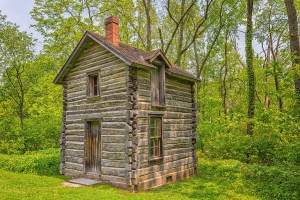 In my previous entry I mentioned hiking the Little Calumet River Trail to the site of the Bailly Homestead, designated a National Historic Landmark in 1962. While at the location, I photographed once again some of the structures on the property, including the unique two-story cabin north of the main house. In a past post (see entry of 2/4) I offered an image of another smaller storage cabin captured during winter snow. I have also discussed a bit of the narrative for this location and the original settler—Joseph Bailly, a fur trader who arrived in the region during the early nineteenth century—in a commentary published at the end of February (see entry of 2/26). My interest in these cabins and Joseph Bailly relates to the historical significance of this individual as the first white settler in the area, but also connects to one of my main inspirations for this journal (as noted in the “Introduction” section), Henry David Thoreau, whose life span overlapped Bailly and who is famous worldwide for his cabin at Walden Pond.
∼ June 4, 2017 ∼ “Bailly Trail”
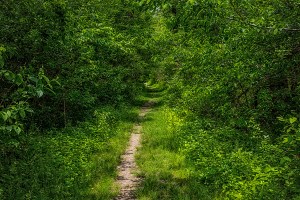 Earlier during my walk brilliant sunlight flickered between silhouetted leaves of trees overhanging the Calumet River Trail. After passing a single willow, I arrived at a grove of oaks bordering the river, its current slowed by a clutter of fallen limbs tipped into the water by winter’s winds. Now the afternoon sky has clouded a little, and the green of the landscape seems deeper, no longer bleached by bright sunshine. I climb a slight rise where the first white settler, a fur trader named Joseph Bailly, built his home above the flood plain in the opening half of the nineteenth century. I often visit this peaceful setting. I appreciate the silence I find in this place on a late spring day. For some reason, even the ever-present sound of distant birdsong seems muted today. The route diverts to a narrower pathway, the Bailly Trail, at this point almost a tunnel with braided branches bending overhead. When I enter I feel a bit like the character in Field of Dreams slipping into rows of tall corn stalks, disappearing from view, crossing to another realm. I imagine myself perhaps transported to the past, and I wonder how differently, if at all, this scenery looked nearly two hundred years ago.
∼ June 3, 2017 ∼ “View Through Trees on Hot Spring Afternoon”
 Though the forecast called for a possibility of rain showers, the sky is now almost cloudless, a blank blue covering Lake Michigan broken only by slim wisps of white over the horizon. The sandy shore glistens under blistering sunshine bringing the first real heat of spring. Walking a trail along the sun-brushed edge of ridge woods, I distance myself a mile from the public beach with its weekend sunbathers, children wading in the little waves, adventurous swimmers heading toward the buoys, and teenaged lovers huddled beneath colorful umbrellas. Many schools have started their summer break. I decide I will hike the interior, get away a while from the glare of this bright daylight to move among the dark bark and cooler air of a dune forest. I will continue and follow a stark path farther inland toward the narrow crossing of an isolated marsh—hot and humid, but in this case a temporary and welcomed emptiness far from the busyness of visitors on vacation. However, I pause first for an extended view between the trees and to capture with my camera the soothing scenery spreading into the distance in front of me.
∼ June 2, 2017 ∼ “Indiana Dunes State Park: Trail Eight”
 Trail Eight threads through the dunes, at times rising to each of the three highest peaks in the state park. I shuffle my feet along its path of soft sand as I travel along an inland forest toward the shore. Somewhere overhead small birds chirp, lost among the full branches like stars unseen during daylight. A couple of crows flutter high above then turn by my right side and land under the upper limbs of a nearby oak. Although elevated quite a bit from the beach, this stretch represents one of the few flat sections of the trail’s winding route as it moves among thickly wooded terrain. Earlier, I passed batches of blue lupine ruffling in the timid wind and illuminated on a sunny slope alongside the pathway. As the sun dragged its brightness between clouds and across the landscape, shadows of trembling leaves scattered back and forth with each gentle breeze, adding difficulty for any photograph. However, as a storm front approaches, an afternoon overcast has stolen the sunshine; yet, I don’t mind because the green of the foliage appears richer as a result.
∼ June 1, 2017 ∼ “Creek at Start of June”
 As if in an attempt to join those others clustered on the southern side, a lone tree leans over this creek becoming the color of weak coffee. Meteorological summer starts June 1, and this scene already seems to identify with the new season. Just hours after an early morning rain storm, and with departing clouds now crowding only the eastern horizon, a steady but slow-flowing current moves through its winding route. This lazy pace will ease even more in the warmer weeks ahead, and the gap between banks will narrow by August’s dry days. So much wet weather this spring has deepened the green leaves of those overhanging limbs, and the long blades of grass along the trail twist into thick clumps catching the feet of my camera tripod as I step forward to capture an image. Moreover, the slanting sunlight creates varying degrees of green in the trees and presents rich reflections on the surface of the water. When I arrived I met a man from Chicago hiking by himself on a weekend trip. As many often do, he stopped to speak, asking what I was photographing. I gave my usual answer, “landscape and light”; however, I also thought about another response I might have given, “a picture painted by the sun,” author Ambrose Bierce’s fine definition of a photograph.
∼ May 31, 2017 ∼ “View from Mt. Tom”
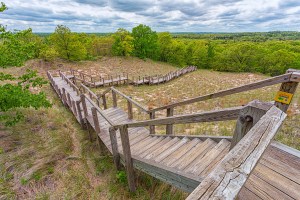 Hiking the Three-Dune Challenge in the Indiana Dunes once again, I arrived at Mt. Tom just in time to see a quickly moving bank of clouds appearing with a spring storm front from the west. I have written about this popular challenge in previous posts. (See entries of May 3, May 24, and May 29). The various climbs up the trio of peaks involved in the task can be steep at times, and parts of Trail Eight, which links the three hilltops, contain sandy slopes on which one’s footing may be labored. In fact, I often find my boots sliding backward with each step, especially since I am carrying camera gear with a tripod. The highest hill in the dunes by a slight margin [Mt. Jackson (176 ft.), Mt. Holden (184 ft.), and Mt. Tom (192 ft.)], Mt. Tom is the most visited of the group, and it might be regarded as the least challenging because of accessibility by stairs on two sides. The accompanying image displays an approach from the west. In my May 24 entry I included a photograph presenting a section of the southern stairs rising toward the summit.
∼ May 30, 2017 ∼ “View from Cabin Trail: Journal Entry Number 150”
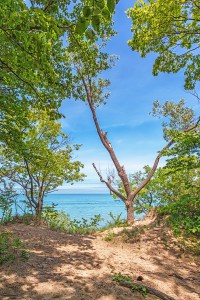 Today’s post represents entry number one-hundred and fifty since I began this project at the start of the year. However, with the Memorial Day weekend ending and warmer weather settling into place, I feel as if I am witnessing a new beginning for the Indiana Dunes landscape. The views I see lately when hiking trails through the dunes or along the shore, where sighting of a bare tree is now rare and stands out, hardly resemble those stark or wintry images, sometimes in snowy scenery, I captured throughout the past five months. Indeed, as I mentioned in a previous commentary shared just before the holiday weekend, I appreciate “the freshness and transitional character” of spring evolving toward summer, which is “especially evident in regions like northern Indiana, where each year one is blessed to witness the full scope of four seasons.” Also, I use this opportunity to invite everyone once again to scroll through past journal posts and browse among the accumulation of observations (nearly 35,000 words) already published alongside my photographs. Perhaps since the time when many are seeking subjects for summer reading has arrived, these brief daily notes of only one paragraph can provide a quick read each day.
∼ May 29, 2017 ∼ “Trail to Lake Michigan from Mt. Holden”
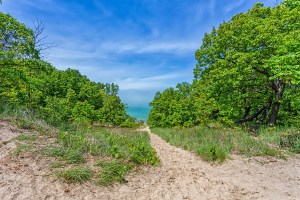 In my previous posts about the Three-Dune Challenge at the Indiana Dunes, I mentioned the trio of peaks one must climb to accomplish the feat. (View my May 3 and May 24 commentaries.) All three are connected by Trail Eight, and the height for each approaches 200 feet. As part of my hikes under bright sunny skies on this Memorial Day weekend, I followed the familiar route once again before descending to the beach. Standing atop Mt. Holden and peering down the thin, sandy trail that leads to Lake Michigan, I could see the shoreline, but the horizon appeared a bit out of focus in my viewfinder. However, no matter what adjustments I made, that edge of the lake would not clarify. Nevertheless, I snapped the image and began my trek toward the water. After all, I consider many of my photos as documentary rather than art. Halfway down the steep slope I realized why my picture seemed to be out of focus: a thick fog was drifting inland and beginning to rise up the dunes. I had been above the fog at the height of Mt. Holden. In fact, by the time I reached the beach, the lake was completely blanketed and had disappeared from sight. Displaying the ever-changing and unpredictable nature of this region, the fog settled over the coast for nearly an hour, then the sunshine finally burned it away, and a beautiful holiday weekend resumed.
∼ May 28, 2017 ∼ “Late-Day Sun at End of May”
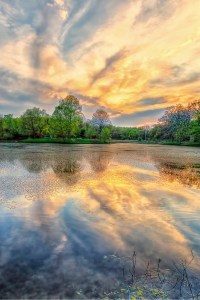 Many photographers emphatically mention light—its quality and quantity—as the most important element in capturing compelling images. George Eastman was quoted as suggesting one dictum to follow: “Light makes photography. Embrace light. Admire it. Love it. But above all, know light. Know it for all you are worth, and you will know the key to photography.” In northwest Indiana each season offers its own degrees and angles of illumination. As temperatures heat in spring and summer, so does the warmth of luminosity in landscape scenery. (Additionally, autumn colors may warm with the changing of leaves.) Consequently, I regard Memorial Day weekend as the start of a separate section on the calendar when I pay more attention to sunrises or sunsets. Indeed, by July I will look forward to the sun setting across Lake Michigan and directly over the skyline of Chicago as viewed from the shoreline of the Indiana Dunes. However, I am also impressed in spring when the slant of the southern sun above tops of trees surrounding small lakes or local ponds seems to contribute to the creation of vivid and brilliant pictures.
∼ May 27, 2017 ∼ “Small Sailing Craft in Spring”
 Although the weather has been wet and windy this week, and there have been warnings of rip currents along the Lake Michigan shoreline, a spring sun seems to be resuming its intensity above the coastal landscape, raising temperatures into the mid-seventies. As the Memorial Day weekend initiates another season of sunshine and leisure at the Indiana Dunes, everything appears prepared for the many visitors who will stream to its beaches. Official reports indicate the water level has lessened a few feet from last year, and my informal hikes along the lake suggest the amount of sand erosion looks to be lower as well. Most bits of debris deposited by winter’s surf have been cleared, and only an occasional log or stick of driftwood decorates the shore like an ornamental addition. The marram grass has greened again and contrasts nicely with the tan sand of foredunes smoothed by onshore breezes. Little waves breaking on the beach will soon be filled with children wading in the shallow water, and the distant blue will be dotted once more with small sailing craft crossing in a soft current of wind.
∼ May 26, 2017 ∼ “Trail Three Trees in Spring”
 At the end of May, I notice a more forceful sunshine illuminating the landscape and adding warmth to everything. Among my favorite features when hiking routes along the Indiana Dunes, I enjoy any moment I arrive at a rise sloping toward a hilltop offering expectations for an interesting view on the other side. I noted in a previous post: “I appreciate that every bend in the trail presents promise of something new, and when I ascend heights over a sharp ridge where the next stretch of scenery remains out of sight, my anticipation grows even greater.” (See my April 23 entry for more.) As an author and a professor of literature, the metaphorical significance of such a setting does not escape me. Especially with the Memorial Day weekend upon us, many people see their attitudes shift from feeling the freshness and transitional character of spring to settling in for the lush scenery and abundance of fun in summer. Naturally, this emphasis on the emotional impact of seasonal differences can be especially evident in regions like northern Indiana, where each year one is blessed to witness the full scope of four seasons.
∼ May 25, 2017 ∼ “Indiana Dunes in Late May”
I photographed this same scene four weeks ago during the calm under a cloudless sky after a streak of strong storms, but at that time the appearance of spring signs still seemed somewhat distant. (See my April 28 entry.) I mentioned walking “a favorite path down a slope toward the extended ribbon of shore line. The wind had stilled, and the lake lay untroubled.” Today, low waves slowly scroll toward the shore, the beach and foredunes yet empty of many visitors. I watch one gull dip into the lazy surf while a few others stroll nearby on the sand. Once again, the strengthening sun appears pinned in place above the southern side of the lake, peeking between a spaced stream of white clouds splintering and floating leisurely overhead. The dune ridge trees have filled with foliage; their green leaves add accent to this landscape. With the approaching holiday weekend, the summer vacation season unofficially will begin, and such empty stretches of this popular lakefront soon will be rare.
∼ May 24, 2017 ∼ “Trail Four Stairs to Mt. Tom”
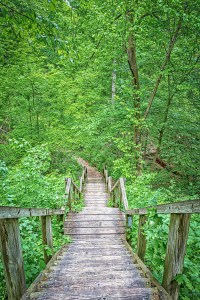 On a blustery day when a shroud of clouds covered Lake Michigan, I chose to travel three routes just inland from the windblown beach, particularly since I prefer photographing interior woods during overcast conditions, as I have noted in the past (see my May 18 post). Trails Four, Seven, and Eight wind behind some of the highest ridges at the Indiana Dunes State Park, and they connect travelers to the three peaks I’ve previously mentioned in an entry on the Three-Dune Challenge (view my May 3 commentary). Since much of their paths extends on the lee side of these hills, hikers are protected from gusts, and the terrain in this natural haven is milder now (though refreshingly cooler in mid-summer), more hospitable to various plant life, especially seasonal wildflowers. In addition, sections of the trails follow a bluff running above a recessed forest, positioning visitors eye-level to uppermost branches filling in spring with multiple flocks of colorful birds chirping in those limbs. As Trail Four tracks west from an intersection with Trail Seven, it rises toward steep stairs that lead toward the tallest spot at the park, Mt. Tom. Additionally, it allows hikers to climb where one suddenly feels fully surrounded by the lush greenery of treetops on display near the end of May.
∼ May 23, 2017 ∼ “Little Calumet River in Late May”
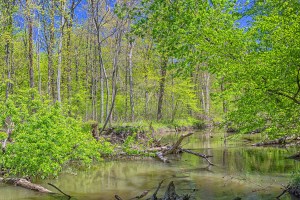 The narrow trail is slick and slippery with thick mud from last night’s thunderstorm, making for loose footing. Three times my feet nearly slide out from under me on this first walk of the season with lighter hiking shoes instead of my heavier boots. Against my better judgment, I pause to use the camera tripod as a walking stick for better balance, while I watch a fat frog easily hop past me. It flops onto a tree stump then plops into the dark water and disappears from sight. In spring, the Little Calumet River is littered with evidence of winter’s damage. Large limbs of downed trees split the river. Clumps of broken branches, some wedged at the edge of a bend, collect and redirect the current. Here and there, overhanging branches droop under the sudden weight of fresh foliage, dip into the river and stir their green leaves in the brown surface of slow-flowing water. Fallen trunks extend from both banks, half on land and half submerged, and a few twisted balls of upturned roots appear almost as objects of abstract art at the water’s border.
∼ May 22, 2017 ∼ “Ravine Creek”
 When the water recedes just days after heavy rains, I follow a ravine creek through woods near Lake Michigan. The canopy of leaves is thickening on surrounding trees already, lessening illumination from sunlight slanting through the timber and striking the bottom of the gulch. The fresh growth of foliage dispenses a slightly green cast over everything. Except for an occasional thunderstorm, this seasonal stream will dry completely throughout much of summer, and the creek will become a viable trail for hikers. A couple of bugs buzz by my head as I step in a muddy mix of sand, soil, and pebbles along the diminished stream of water, but this early in spring the insects do not present much of a problem. My walk slowed by the gritty slop adhering to my feet, I find the shallow slope of a bank and climb to a higher path, narrow and winding between the trees. As I duck under obstacles of lower branches and cross fallen limbs, I remember when I was here on a harsh winter afternoon, and the bare trees offered little interference, though snow and ice presented slippery footing. Nevertheless, even as the going gets more difficult, today these lush leaves seem more inviting.
∼ May 21, 2017 ∼ “Pond in May”
 After the last rains of another spring storm, westerly winds sweep clouds along wavering treetops like the crawl of nature’s language across a scenic screen. Green foliage, the favorite freight of May, begins to fill limbs already alive with increasing birdsong. I wait a while on a trail passing toward the north to listen for the lyrical calls as I think about how each day adds distance from winter’s silence. A few trees remain leafless, standing somewhat steady in the wind and conspicuous in their emptiness, as though posing for one final photograph. The sky’s reflection deepens on the dark surface of this pond, and its edges have blackened with mud. A collection of autumn’s leaves yet shows underneath the shallow water as if to signal a resistance against transformation. I note the weather has warmed to seventy-three degrees—exactly the region’s average high temperature for today now on display in late May. I return here in each season to witness the transition of this landscape, part of my project to chronicle the way change occurs bit by bit in this place.
∼ May 20, 2017 ∼ “Lake Reflections in May”
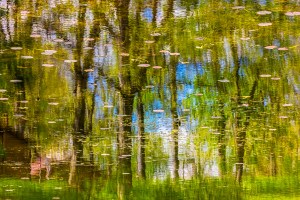 In his influential book of photographs, Intimate Landscapes, Eliot Porter includes a preface explaining the images he presents. Porter comments in this 1979 publication: “Though it is generally accepted that abstract art refers to those works inspired by the imagination of the artist rather than by objective reality, in photography, in which images are produced by the lens, this distinction is difficult to sustain. In the broadest sense of the term, an optical image is an abstraction from the natural world—a selected fragment of what stands before the camera.” Consequently, when photographers offer a detailed examination at a section of the scenery, they are creating a vision dependent upon shape, color, light, and pattern much like an abstract artist. With this in mind, I sometimes turn away from the grand panoramic setting before me and focus on a more concentrated or intimate portion of nature. For another recent example of an “intimate landscape,” I recommend revisiting my “Marsh Green” journal entry of May 12.
∼ May 19, 2017 ∼ “Dune Woods Awakening in May”
 Fringes of color start to cover the landscape, awakening the woods to spring with early evidence of a seasonal transition. Most of the trees have begun to blossom, though a few downed by high winds in a storm during a dismal winter day remain bare and broken. This trail slopes as it extends and flares out to the south, eventually moving through a grove of old oaks toward a narrow creek surrounded by clusters of budding wildflowers trying to brighten the scenery. Today’s hazy light eliminates those knots of shadow that might otherwise gather beneath the trees, dark pockets seemingly staining the ground or perhaps pooling like a spilled bottle of black ink expanding under the fresh foliage. Instead, greening grass now frames a sandy lane. Henry David Thoreau wrote of such grass in his “Spring” section of Walden: “The grass flames up on the hillsides like a spring fire…not yellow but green is the color of its flame.” I will follow this path as it twists into the distance.
∼ May 18, 2017 ∼ “Wide Trail Through Woods”
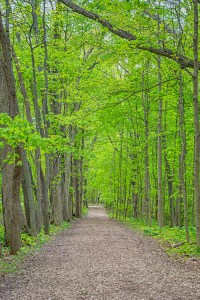 The green of spring leaves deepens on a day without bright sunlight slashing between the trees. Under thin cloud cover, the rough bark of trunks and overhanging branches darkens enough to let the texture show in a photograph with slowed shutter speed. The flat path seems easy to travel. In fact, this wide section might have been used at one time by horse-drawn carts carrying crops for a nineteenth-century farmhouse adjacent to these woods. But the way ahead beyond a bend lies unknown, perhaps like an unread page presenting surprise near the end of a novel. Birds hiding behind the fresh foliage on shadowless limbs offer sweet songs somewhere overhead. I imagine their feathers ruffled by a light breeze, fragile wings fluttering slightly, moving unseen among the new season’s growth. Their soundtrack accompanies me as I hike toward a swamp forest not too far ahead, where the sunshine cannot reach even under clear skies, and on this overcast afternoon, I know in its dim interior I will need to open the camera aperture as much as I can.
∼ May 17, 2017 ∼ “Trail Three in May”
 Trail Three in the Indiana Dunes State Park starts at one of the tall dunes above Lake Michigan and moves inland through thickening woods as the path transitions from sandy hills to a forest ridge. One section of the trail branches toward the west and loops back around in the direction of the lake while edging the park boundary. Although closest to the most popular beach in the Indiana Dunes, this route seems to receive fewer visitors than others. In fact, on this day I followed the full circle of its course without encountering any fellow travelers. Light green leaves beginning to fill the trees presented contrast and definition for a bright blue field of sky, forming an inviting picture with a mixture of features. The elevated path allowed a bit of cooling from a sweeping breeze that also seemed to lift a couple of hawks gliding through the air, the pair continually crisscrossing high overhead.
∼ May 16, 2017 ∼ “Shoreline in Mid-May”
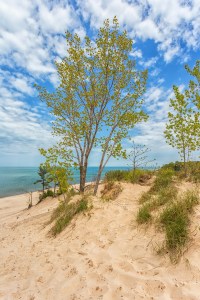 By the end of this month, Waverly Beach at the Indiana Dunes State Park will be crowded with hundreds or thousands of swimmers and sunbathers. However, now I am still able to capture an image of the shoreline with this public beach seemingly empty and serene. The dune trees overlooking Lake Michigan and those tufts of marram grass clustered throughout the sand have begun to green. Increasingly, spring’s warmer air currents, though weakened by the dune hills just inland from the coast, have displaced the stronger northern cold fronts. Due to an absence of lake winds, the water appears smooth and soothing. The clean line of the horizon finds itself propping up a sky slightly clouded but with a rich blue showing through. I will walk toward the foredunes farther east, where a few trails head into the forests and rise high until reaching the tallest peaks—Mt. Jackson, Mt. Holden, and Mt. Tom—which also will soon be busy with visitors attempting the “Three-Dune Challenge” (see my May 3 entry) and seeking to view the shoreline from a more prominent perspective.
∼ May 15, 2017 ∼ “Winding Trail Through Woods”
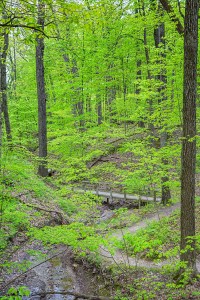 Following a winding trail through woods in the Indiana Dunes National Lakeshore, I was amazed to witness the quick transition that has happened since my last visit. Just three weeks ago these trees were bare and the seasonal creek at the bottom of the ravine seemed almost overflowing, filled with water from heavy April thunderstorms. The landscape presented itself as dark and foreboding. Since then, the rains have provided enough moisture to nourish lush green leaves, and this swift transformation has produced an environment rich with new growth. Indeed, images of the scenery appear to nicely define the rejuvenation and optimism associated with spring, and the setting seems suddenly welcoming. As Thoreau wrote in the “Spring” section of Walden: “The change from storm and winter to serene and mild weather, from dark and sluggish hours to bright and elastic ones, is a memorable crisis which all things proclaim. It is seemingly instantaneous at last.”
∼ May 14, 2017 ∼ “Beaver Evidence”
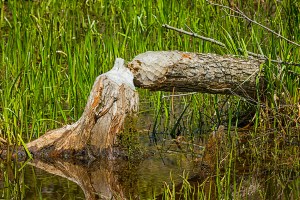 Whenever I hike through the wetlands of the Indiana Dunes, I seek out signs of life left by those inhabitants I rarely encounter, animals almost always out of sight, some nocturnal, who manage to influence or alter the landscape, sometimes leaving their distinctive marks upon its elements. Occasionally, I will come upon a woodpecker tapping his code into the trunk of a tree, and even more frequently I will witness the holes drilled through bark and clustered close together. However, the beaver seems always to elude my viewing. I have yet to arrive at a pond, stream, or marsh while one is at work chewing into a tree trunk; nevertheless, I often come across evidence of extensive damage remaining from activities by these animals. Indeed, trees completely felled by a beaver gnawing at the wood are common to encounter.
∼ May 13, 2017 ∼ “Three’s Company”
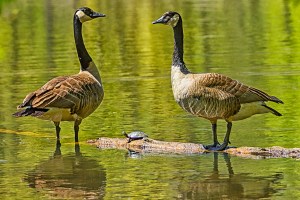 As I regularly hike routes through woods a bit inland from Lake Michigan, a number of locations have become familiar and offer distinctive characteristics. One trail I walk often in the Indiana Dunes National Lakeshore passes an isolated pond in which I frequently see geese and turtles sharing space on the branch of a fallen tree that emerges just above the surface of the water. At times, I have viewed as many as three geese and four turtles basking side-by-side in warming sunlight. Because the spot is situated at the northern edge of the pond, on clear days in May when the sun still rests low in the southern sky, this limb receives complete sunshine while other areas are obstructed by skirts of shade extending from surrounding trees. Therefore, whenever I reach this position along my way, I also pause to watch the gathering.
∼ May 12, 2017 ∼ “Marsh Green”
 Last weekend as I was participating in a birding festival at the Indiana Dunes, I reaffirmed some of my respect for those I know as wildlife photographers, especially the ones who focus solely upon bird portraits. As I have mentioned in previous posts, I admire the abilities and patience displayed by skilled bird photographers. As an individual who exhibits impatience at times—whether standing in line at a department store or waiting in my car for a slow freight train passing at a railroad crossing—I find myself tested whenever I seek to capture images of birds while hiking. Much of the effort involves halting to listen for birdcalls or watching overhead with anticipation and a stiffening neck. Hearing chirps and birdsong among the trees can be encouraging but also frustrating, particularly when the foliage has filled enough to provide perfect camouflage. Indeed, I frequently think that the little creatures are taunting me. Nevertheless, if I discover a lull, I sometimes turn my long lens to snap an intimate painterly picture of the surrounding landscape, such as the first layer of green beginning to cover the brown marsh water in early May, and occasionally the results are rewarding.
∼ May 11, 2017 ∼ “Trail Two Toward Footbridge”
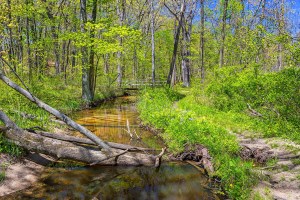 Trail Two at the Indiana Dunes State Park can be an easy hike of three miles along level ground after the once-swollen creek has receded in the weeks following April’s rainstorms. During summer the route becomes more overgrown and might be somewhat uncomfortable as it is inundated with insects, and in many winters the path is often blocked in spots by deep snow. In this second week of May, however, the passage is at its best, beginning to display brightly colored wildflowers and surrounded by trees greening in spring sunshine. The creek water yet remains clear, allowing its glowing golden bed of sand to show. When walking west and one arrives at a bend toward the north, a basic wooden footbridge greets the hiker. The scenery seems understated, but the simplicity appeals to one’s eye as aesthetically pleasing—even the graying weathered tree that has fallen across the creek, almost as if an imitation by nature of the bridge extending a bit farther ahead.
∼ May 10, 2017 ∼ “Little Calumet River Trail”
 I travel this trail often, in all months, always pausing at a bend in the river. During the early days of May as the weather warms and the trees—elm, oak, and hickory—become green, the landscape seems to change in ways that alter one’s attitude. Leaves tremble in a light breeze, shimmer in slanting spring sunshine. Patches of violet wildflowers line a riverside path like dabs of brush strokes on a canvas. Shadows of overhead limbs dapple a wooden footbridge and darken parts of slow-flowing water seemingly going nowhere. A gentle gossip of swamp sparrows murmurs somewhere in the air above. All afternoon, skies fill with brilliant blue in the distance. With the saturation of details seen in this season deepening, the whole setting appears unrecognizable from only three weeks ago. The subdued scenery suddenly vibrant and flushed with color, as though refreshed through the quick flick of a switch, I also feel revitalized.
∼ May 9, 2017 ∼ “Trail to Cowles Bog Beach”
 In the middle of last month, I wrote a few posts about the chemical wastewater spill into a waterway feeding Lake Michigan. Those journal notes can be read in entries dated April 13, April 15, and April 17. I spoke in those reports about how the “uneasy relationship between preservation of nature and spread of industrialization stands as a unique characteristic in the history of the Indiana Dunes.” I also observed that one of the locations I had visited just before the accident was among those closed to the public until testing of the waters could be completed. Fortunately, subsequent samplings revealed the toxins had not infiltrated the lake to a significant level deemed dangerous, and the restricted sections of the coast were re-opened within a week, including an isolated beach reached by hiking the lengthy Cowles Bog Trail and inaccessible by automobile. This portion of the shore contains wide foredunes and often appears untainted by human presence. I am pleased to see this feature of the lakefront available again before the warmer weather of spring and summer settles over the region.
∼ May 8, 2017 ∼ “Ring-Billed Gulls Along the Shore”
 The most prevalent bird viewed when walking the Indiana Dunes, the Ring-Billed Gull, constantly contributes to the scenery along the southern shore of Lake Michigan. A National Audubon Society pocket guide I frequently carry with me to identify other less-common species describes the animal as about twenty inches in length when reaching adulthood: “The adult has a white head and underparts with a gray back and black-tipped gray wings. The legs are yellowish, and the yellow bill has a black ring near its tip.” As I hike the beach foredunes, even in winter, these birds frequently seem to follow at the water’s edge—sometimes soaring in the steady flow of air current coming off the lake and at other times floating in the low waves of the surf as they approach the shore. Today, on this early May afternoon, I watch as a few arch through the light blue of a spring sky overhead, arrowing toward a distant dune mound, feathers bleached even whiter when brightened by strong sunshine.
∼ May 7, 2017 ∼ “The Voice of Nature”
 I am on a mailing list to receive location notifications from the Indiana Department of Natural Resources when the first bird of each migrating species is sighted returning to the Indiana Dunes region. In the past few days, probably partially due to the many participants in the Indiana Dunes Birding Festival, this has been an active source, citing reports of various findings, including a Golden-Winged Warbler, a Worm-Eating Warbler, a Little Blue Heron, a Least Bittern, a Nighthawk, a Willet, a Trumpeter Swan, an American Avocet, a Laughing Gull, a Clay-Colored Sparrow, a Snowy Egret, and others. In this first week of May, the skies are busy again with avian visitors and the greening trees are filled once more with their music. As Henry David Thoreau stated in his journal note of March 18, 1858: “Each new year is a surprise to us. We find that we had virtually forgotten the note of each bird, and when we hear it again, it is remembered like a dream, reminding us of a previous state of existence. How happens it that the associations it awakens are always pleasing, never saddening, reminiscences of our sanest hours. The voice of nature is always encouraging.”
∼ May 6, 2017 ∼ “Owl in Side Light”
 As the popular Indiana Dunes Birding Festival continues this weekend, I find myself fascinated by an animal normally associated with night rather than daytime—the owl, a nocturnal creature usually accustomed to the dark and difficult to capture in a photograph. Nevertheless, this bird presents dramatic features—prominent eyes, hooked beak, and flat face—enhancing each image in which it appears, and these characteristics especially are appealing to photographers. Because of the accommodating environment, throughout the Indiana Dunes owls are fairly abundant in certain seasons. In fact, the Nature Center in the state park often offers a public program, begun in 2009, during which members of a particular species of owls are banded by a ranger and released. Those of us signed onto the mailing list receive urgent e-mails at various times of night in autumn months informing that a smaller, migratory Saw-whet Owl has been caught to be registered, banded, and released back to its habitat within an hour. The program monitors migration patterns and owl populations. Anyone who receives the e-mail and can quickly drive to the location is welcomed to witness the process.
∼ May 5, 2017 ∼ “Birding Festival”
During this first weekend in May many will travel to the Indiana Dunes for an annual birding festival that celebrates the region as a prime location for viewing various types of birds, native or migratory. Indeed, more than 350 species of birds can be found along the southern coast of Lake Michigan within the course of a year. Although the start of spring has been cool and rainy, more migrants are arriving all the time. Due to the different habitats available in the Indiana Dunes—marshland, swamp forests, woodland, dune hills, bogs, fens, prairie, rivers, sandy beach, and lake shore—a multitude of local settings serve perfectly for hosting the variety of winged visitors. In my experiences, I have found taking pictures of any wildlife can be difficult, but capturing images of birds may be among the most frustrating of all forms of photography I have tried. I hold much admiration for those I know who excel at the task, an endeavor requiring great patience and exemplary ability. Rarely do I attempt this genre. Nevertheless, although as a landscape photographer I usually carry a wide-angle lens on my camera, I occasionally find myself drawing out the longer lens for an avian close-up.
∼ May 4, 2017 ∼ “Trail in Early May”
 Lured to the shore by bright daylight after a morning with slackening winds and cloud cover, I hike a sandy trail that whitens under the sunshine, loops through dunes, and disappears into the quiet and darker woods. Much of the way in this inland forest now appears brown, muddied following flooding from a week of rainy days. One portion of the path traces along edges of a swollen creek and seems isolated from those busy beaches just beyond a high hill. Some summer bugs already have begun their return and hover over my head as I bend beneath ribs of branches still bare in the beginning of May. Screeching birds in upper limbs of a nearby tree splinter the silence as I pass by them. By the time I complete this route, I will have arrived once more at the shore. I will return home later in the day, when sunlight sloughs away and a twilight sky extends across the length of Lake Michigan.
∼ May 3, 2017 ∼ “Three-Dune Challenge”
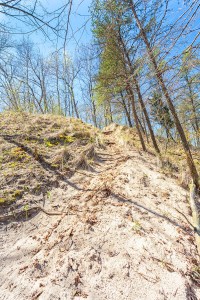 A favorite feature for touring trails in the Indiana Dunes during recent years, the Three-Dune Challenge involves climbing the tallest hills in the state park: Mt. Jackson (176 ft.), Mt. Holden (184 ft.), and Mt. Tom (192 ft.). Some more athletic participants even run the route. Indeed, the event has its own web page. The distance to travel does not seem difficult, since it extends only about one-and-a-half miles in total length. However, the heights and terrain can be more of a test for many visitors. The trio of peaks are stitched to one another by sandy paths twisting through a dune forest. Sometimes the trails rise at sharp angles steep enough to keep one’s feet sliding backwards with every step. This course appears to become most popular in spring when weather warms but has not yet become as overbearing as summer heat. The task is a bit more demanding in winter when heavy snow and slick ice cover the landscape. Throughout my many travels through the dunes in all seasons, I have accomplished the challenge in a single trip a few times, and I have reached the peak of each hill separately on numerous occasions. However, unlike others who relish the reward at the top of each hill, the trails themselves supply my most enjoyable element. As Ralph Waldo Emerson stated: “…find the journey’s end in every step of the road….”
∼ May 2, 2017 ∼ “Upturned Tree Blocking Ridge Trail”
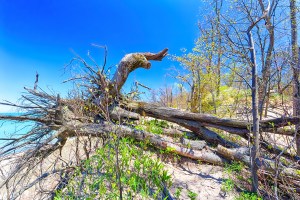 For months, much of the winter wind tugged at this vast expanse of sand, shaping and re-shaping the foredunes bordering Lake Michigan. Squinting into springtime sunshine, I now see some of the subtle changes made to the the landscape. In a few places the lake has claimed more of the shore, and the width of the beach has narrowed, whole sections have been eroded by air currents and the steady beat of the surf. In other locations, shallow dune slopes have encroached upon the fragile forest edging this coast and rooted in loose soil. More dramatic signs of transition are apparent. Branches broken by gusts litter ridge trails, and upturned trunks sometimes create obstacles for passing, especially when I’m carrying a tripod and camera gear. However, when following such a slim path high in the hills, I have no choice but to climb over the obstruction.
∼ May 1, 2017 ∼ “Tree Cemetery”
 April has faded away and May has finally arrived. After days of rain, a bunch of local waterways have overrun with floodwaters. I hike through dunes drying under a midday sun. Following a skinny path winding among rough ridges above a gentle ripple of waves, I find another small tree cemetery spread on a slope tilting toward the lake. Due to northern winds and the continual movement of the dunes, blowouts often occur on the Indiana shore, intersecting wooded hills lining the coast. Sand surrounds the vulnerable trees and their roots. Consequently, these trees slowly die and decay, usually leaving weathered stumps of trunks jutting just above the surface, rising like graveyard markers. The three largest blowouts are Big Blowout, Furnessville Blowout, and Beach House Blowout (which I discussed in the April 24 entry to this journal and can be seen in a larger photograph at the April photographs page).
∼ April 30, 2017 ∼ “Late April Above Lake Michigan”
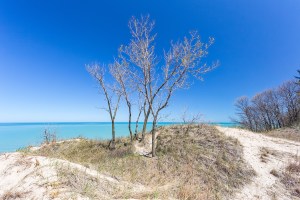 All morning a warm front seemed to be embracing Lake Michigan. The sharp scent of still water drifted onshore. Wrinkles of sand at the edge of the surf-stained shore were sprinkled with small shells and pebbles, many black and rounded like rosary beads. Nearing noon, the flare of light from a rising sun, now positioned high above the horizon, appears as if pinned in place. At the end of April these dune ridge trees have begun to display their first buds. I walk a trail leading from the beach to Mt. Tom often, and I frequently pause at this ledge to view the water below. In the first half of the twentieth century, the Governor of Indiana maintained a summer home only about two-hundred feet east of here, a space that has become overgrown with trees. Like numerous other structures within the Indiana Dunes State Park property, that building was demolished more than fifty years ago to reclaim the natural landscape. All that remains today, hidden amid the woods, is a short stack of bricks that once supported steps to a porch overlooking the lake. However, whenever I snap a photograph in this setting, I always imagine the scenery as seen from that cottage’s front door so long ago.
∼ April 29, 2017 ∼ “A Sacred Place”
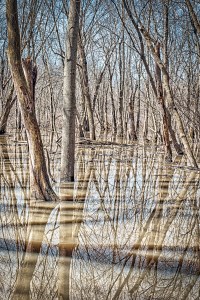 The week’s heavy storms have filled local wetlands once again with fresh rainfall, and this scenery always seems to draw my attention even more, particularly the painterly effect of bare trees reflected in the smooth coffee-colored water. My wife—as do others—wonders why I like hiking through swamps, bogs, and marshes so much. I’ve offered personal responses to this question somewhat in various previous entries, and expressed my reverence for those locations, but today I want to reference a couple of Henry David Thoreau’s thoughts about such environments, which he considered richer and more interesting than those domestic landscapes commonly regarded by society as beautiful settings: “I derive more of my subsistence from the swamps which surround my native town than from the cultivated gardens in the village.” Elsewhere, he remarks: “When I would recreate myself, I seek the darkest wood, the thickest and most interminable, and, to the citizen, most dismal swamp. I enter a swamp as a sacred place—sanctum sanctorum. There is the strength, the marrow of Nature.”
∼ April 28, 2017 ∼ “Prairie Club Path”
 Following a spell of strong storms, the white flags of yesterday’s clouds surrendered their presence. A strengthening spring sun hung among upper limbs along a dune ridge. The sand—tan and golden—extended east on a sun-streaked beach. A few gulls spun in wide circles above the water, floating in an easy breeze over a steady yet slowed rhythm of waves. I photographed scenes on a narrow trail winding along the edge of a dune hill near where the Prairie Club beach house once stood almost a century ago, a location so significant to me. Later in the day, a young couple from Nevada asked if I could take a picture with their iPhone of them standing in front of Lake Michigan at that spot. I composed a photo in the frame of the screen that seemed to place them between a field of deep blue sky and freshly green leaves of grass sprouting on a foredune. We spoke about the twisted limbs of trees seen along the trail, some even with trunks broken by winter’s winds. They asked about the rusted water tower they’d passed, and I explained its history as well as the activities of Prairie Club members who preserved this land. When they left, I walked a favorite path down a slope toward the extended ribbon of shore line. The wind had stilled, and the lake lay untroubled.
∼ April 27, 2017 ∼ “Morning Light”
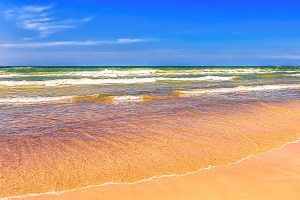 Sometimes when the day awakens with a lengthening line of light along the lake at sunrise, and warm colors cover the shore, each detail beside the beach seems painted into place. Dunes, smoothed by onshore winds throughout the night, appear shaped with brush strokes. Tall leaves of yellow grass bend whenever shifted by soft breezes drifting inland. Daylight’s tints dip into the collar of trees fitted onto ridges of sand hills. Pale hulls of old sailboats brighten once more, now slick with a sheen of sunshine. Even sticks of driftwood resting at the edge of the surf exhibit a greater degree of texture under suddenly rich hues of blue sky. Ring-billed gulls flutter their wings as they play in the breaking waves, while one splinters from the group and rises like a white kite in the air current. A faint series of footsteps stretches across the wet sand like a signature written at the bottom of a finished artwork.
∼ April 26, 2017 ∼ “Trail Nine in Late April”
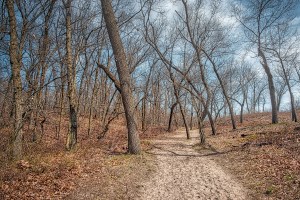 Returning from the Beach House Blowout, Trail Nine curls away from Lake Michigan through a trough between dune hills where the woods are still leafless in late April. Soon this forest will fill with foliage, and its character will change completely. The route moves from sandy beach scenery to the wetlands setting of a large marsh at the center of the Indiana Dunes. State Park maps mark the trail as just short of four miles long, presenting a passage that “provides the best representative view of the dunes.” About halfway along the path, I pass a grove of trees with twisting trunks that appear almost artistic in design and aesthetically pleasing. Their extended network of branches stretches overhead as I walk by, and I stop to watch two hawks glide above, the pair veering to perch in the empty treetop of a black oak. These graceful birds take turns floating fairly low and slow in whatever air current they find, at times rising into the bright daylight, their angled bodies becoming silhouetted by the sun. On this warm spring morning, with its relative calm following swift nighttime winds, a new but weaker weather system has begun to take a temporary hold on the region.
∼ April 25, 2017 ∼ “Pine Tree Trail”
 Although most of the trees remain leafless along this portion of the trail, the marsh displays an early accumulation of lily pads, some already the size of dinner plates, many heart-shaped. Illuminated by late-morning light, their green leaves appear bright in contrast with the mirror of black water, almost the color of coal, where they float. In spring the surface of this flooded pool rises to the level of the wooden walkway I cross, and a few of the loose planks feel wobbly beneath my boots. In the distance, bare branches reach toward weak clouds slowly shifting toward the east. The top of the tallest tree still sways gently in an onshore breeze moving over the nearby dunes, yet the weather has warmed as the end of April approaches. I carry my load of camera gear over a shoulder as I travel Trail Eight. Researching old maps from a century ago and just before these routes received numbers, I discover this path was once named Pine Tree Trail—after this brief traverse of swamp water, it soon leads through a long stretch of thick interdunal woods, including lots of pines when one nears the beach. Maybe I’m old fashioned or merely because I am a writer fond of language, but I prefer descriptive names to ordinal numbers.
∼ April 24, 2017 ∼ “Beach House Blowout”
 Among the most notable landscape features at the Indiana Dunes State Park, blowouts provide hikers extraordinary views of the dunes and Lake Michigan. A number of these openings in the dunes occur along the coast, including the Beach House Blowout reached by following Trail Nine up a steep sandy slope on the lee side of the dunes and across a ridge that rims a large bowl of land formed by windblown erosion. Established by long-term exposure to northern winds arriving from the lake, big blowouts like this one break through the dune hills and can expand into the first interdunal valley. Moving mounds of sand are swept over wooded areas by the onshore gusts, eventually destroying existing trees and creating forest graveyards, while also leveling the terrain, supplying accommodating conditions where grass, small plants, and young pine trees begin to grow. The famous Dunes Pageant, which took place a century ago in June of 1917 and may be credited with initially promoting the Indiana Dunes to a wider audience, was staged in a dune blowout that exhibited the semicircular shape of a natural amphitheater.
∼ April 23, 2017 ∼ “Path to Beach House Blowout Peak”
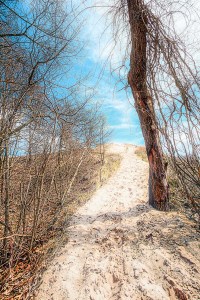 Whenever I hike routes through the dunes, I appreciate that every bend in the trail presents promise of something new, and when I ascend heights over a sharp ridge where the next stretch of scenery remains out of sight, my anticipation grows even greater. As the path rises toward a blue sky broken by white clouds, I look forward to the great lake vista on the other side. I proceed toward the peak up a steep incline, my feet sliding in the soft sand with each step. Traveling Trail Nine as it approaches the Beach House Blowout offers one of the Indiana Dunes’ most dramatic transitions. The passage elevates from a wooded valley between rolling hills until it follows a winding climb to a rim around an extensive hollow carved out of the dunes over time. This landscape in April still continues to display images of empty trees lining the way with expressively bare branches, leading to a peak that I know holds a panoramic view of an impressive setting well worth the effort.
∼ April 22, 2017 ∼ “Windswept Dune”
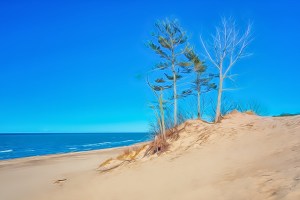 With each wave the surf breaks into whitewater on a stretch of beach speckled by pebbles and shells. Grains of windblown sand glisten in sunlight on this skin of shoreline smoothed by last night’s storm front. The cloudless sky and reflective lake offer complementary hues of blue. The quick winds whine onshore as they sweep through dune trees—some still bare and others beginning to show foliage. Their branches dance in the air and their shadows scrape the tan sand under strengthening sunshine. Even though temperatures have warmed a bit, I pass no one on this short walk along the coast, and this setting seems to remain free of footprints. The long blades of grass—damp and limp much of winter, sometimes weighted by ice or snow—now extend toward the bright sky and merely bend a little in these northern gusts. The scene seems as if it would be appropriate for appearance as impressionist art, perhaps in one of Monet’s beach paintings.
∼ April 21, 2017 ∼ “Pentimento”
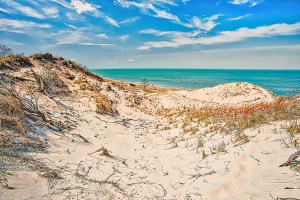 Today, nature’s artistic hand tints Lake Michigan turquoise, and the sky seems painted a deeper shade of pastel blue. A few thin clouds appear to be spaces where pale spots of bare canvas peek through the brushstrokes, or they resemble faded remnants of an earlier image—an example of pentimento, traces from a previous painting bleeding through the layers. The tan beach sand begins to warm in late-morning sunlight. An old man wades into thigh-high water and stands with his stubble face squinting into bright sunshine, waiting for waves to fold over him as his dog, a small border collie, eagerly leaps into each whitening swell of surf. I watch a while and then walk away from the lake into the foredunes to view the bowl of a crater caused by slow erosion from winter’s winds. Tufts of grass decorate the landscape, and dark bits of driftwood still litter the shoreline. I carry my camera tripod much the same way I did when young and resting over my shoulder a rented rod and reel for fishing along the Atlantic coast with my father, a memory from my past that, like a pentimento, also seeps into the present.
∼ April 20, 2017 ∼ “Spring Flooding in Swamp Forest”
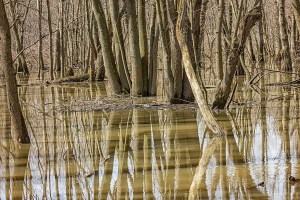 I am amazed by the vacancy witnessed in these swamp woods flooded by seasonal storms. A raft of silence seems to float over swollen waters held still on this windless afternoon. A sense of lethargy inhabits the landscape, though its spirit appears complacent as spring nibbles at winter’s leftovers. I observe an absence of movement in this almost abstract image offering solace with a soothing scene oddly calm yet cluttered. I packed an extra lens jammed into my camera bag to capture this setting with a more compact depth of field. Although most of the year a splinter of waterway winds through this trough between little hills, a sliver of river flowing slowly in its low gradient, when the waters spread during spring rain, thin pillars of trees extend from the expanded floodwaters and are mirrored in the mud-stained surface. Bare branches hacked by wintry winds now lie broken and soaked in shallow pools amid the forest, wetness darkening the bark beneath screeching geese flying overhead. I admire the beauty of nature’s artistry now found in such an unexpected location.
∼ April 19, 2017 ∼ “April Walk Along the Shore”
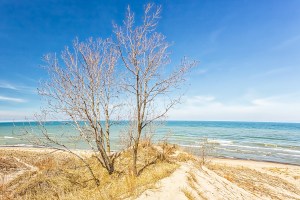 On a day after hard rain, sunlight flickers off the ripples of lake waves as cloud wisps linger on the horizon, though much of the sky has become a brilliant blue. A ring-billed gull bobs on the water like a tiny white buoy, while two others circle overhead. In the distance a dark barge drifts toward the west and a vague skyline of Chicago. Small black shells freckle the edge of the beach, and the few lean trees on a dune hill still exhibit their emptiness. All morning a warm front has been moving over the region, bringing milder weather more normal for spring. Last night’s mighty gusts have died a bit, eased into an onshore breeze waving blades of marram grass now almost golden in noonday sunshine. The slow erosion brought all winter by northern winds has reshaped this lakeside landscape. I follow a sandy path through the smoothed foredunes, leaving a trail of boot prints that mark my way.
∼ April 18, 2017 ∼ “Signs of Spring”
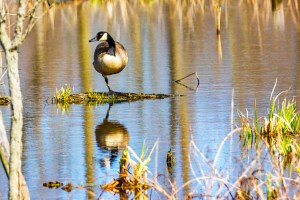 Hints of spring settle into the landscape—green weeds emerging from marsh water, the first flowers slowly opening beneath trees just beginning to bud, migrating birds speckling a blue sky, and sunlight sparkling on the smooth surface of an interdunal pond. Thoreau wrote of this season in his wonderful “Spring” chapter of Walden: “…it was pleasant to compare the first tender signs of the infant year just peeping forth with the stately beauty of the withered vegetation which had withstood the winter—life-everlasting, goldenrods, pinweeds, and graceful wild grasses, more obvious and interesting frequently than in summer even, as if their beauty was not ripe till then; even cotton-grass, cat-tails, mulleins, johnswort, hard-hack, meadow-sweet, and other strong-stemmed plants, those unexhausted granaries which entertain the earliest birds—decent weeds, at least, which widowed Nature wears.” Even as the signals of spring’s arrival abound, anticipation allows me to look forward to its full unveiling in the manner a magician might remove a scarf and display a surprise revelation to an amazed audience.
∼ April 17, 2017 ∼ “Death and Life of the Great Lakes”
 In his recently released book, The Death and Life of the Great Lakes, Pulitzer Prize-finalist Dan Egan describes the Indiana Dunes National Lakeshore as “a 15-mile ribbon of glorious Lake Michigan swimming beach that draws two million visitors annually.” However, walking along the curving shoreline one is always aware of its vulnerability to potential invasive contamination of toxins from production centers for steel or other industries. Indeed, Egan laments the proximity of possible pollution sources in “Gary, Indiana’s industrially ravaged lakefront.” Nevertheless, part of my affection for this landscape arises from concern for its continuation as an attractive environment, as well as an admiration for nature’s ability to survive and thrive despite the onslaught of damaging developments during the past century or more, some that seemingly could have been lethal to its physical state. As portions of the shore were placed off limits this week due to a chemical leak from the nearby U.S. Steel mill into a waterway that leads to the lake, I was reminded of the tenuous relationship between nature and industry in this region. Fortunately, preliminary tests indicate this spill may not have penetrated the waters of Lake Michigan to any significant level, and everyone is patiently awaiting further results. Citizen watchdog group Save the Dunes reports various agencies are conducting oversight of the situation: the Environmental Protection Agency, the National Park Service, the Indiana Department of Environmental Management, the U.S. Fish & Wildlife Service, and others. With spring weather warming and summer swimming season not far away—and though other threats to the lake water exist, as Egan displays in his book—such positive initial signs are reasons to be cautiously hopeful in this instance for the environment’s continuing survival.
∼ April 16, 2017 ∼ “Dune Trees at Easter Weekend”
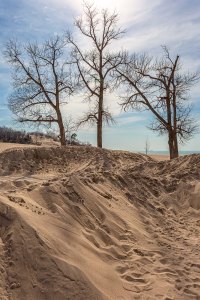 The origins of Easter are related to religion, to nature, and to derivations in language. The obvious theological connection can be summarized as a remembrance of Christ’s resurrection days following His crucifixion. An empty wooden cross between two others has often served as symbol of His death, and bright sunshine frequently appears to represent the light of God emerging from the tomb. However, Easter also has origins in natural mythology. The name perhaps derives linguistically from an Anglo-Saxon goddess of spring, Eostre (as well as the Germanic Ostara or Austro), who could be viewed as the deity of sunrise and an embodiment of the beginning of the season at the Vernal Equinox. Illumination from the appearance of God or from the rising sun also suggests another connotation of “illumination”—enlightenment of the spirit and the mind, a sense of higher understanding suddenly attained. Culturally, Easter is depicted as a time of rebirth and renewal, much like that of the landscape around us, where flowers are starting to bloom, grass has become green again, and the trees begin filling with foliage. This season is sometimes offered as an ideal period for hope and optimism, for fresh relationships and initiations of love, for redemption from past lapses and for faith in the future, for feeling joy and rejoicing in the very emotions Easter evokes. On this day, I pause to celebrate with praise!
∼ April 15, 2017 ∼ “Cowles Bog Beach Before Chemical Spill”
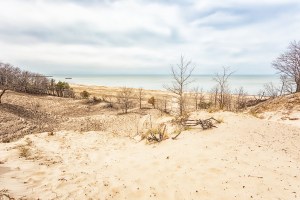 The beach seen in my accompanying photograph taken at the beginning of this week has now been shut down due to conditions that include the possible presence of cancer-causing toxins. As I reported in a previous post, earlier this week a potentially disastrous leak of carcinogenic chemical wastewater contaminated waters feeding Lake Michigan and led to closures along parts of the Indiana Dunes coastline. Coincidentally, I had visited the section of the shoreline impacted by the spill from a U.S. Steel production facility only one day before the event happened. I had hiked the nearly six-mile round trip on the Cowles Bog Trail through parts of a marsh designated a National Natural Landmark in 1965 and over steep dune hills to reach an Indiana Dunes National Lakeshore beach at the end of the path. This stretch of sand is singular in that it is somewhat isolated, inaccessible by automobile. One must walk a distance through a succession of stages in nature’s growth to arrive at the location. Therefore, the expansive foredunes are clean and the surf breaks upon a shoreline untainted by many beachgoers. Nevertheless, one remains aware of industrialization nearby because clouds from a smokestack are always visible above the dune ridge tree line, even on this naturally overcast day. Indeed, the proximity of the steel mill serves as symbol for the sometimes unsettling potential for danger to the environment looming over this natural landscape that continues to be resilient despite its tenuous existence.
∼ April 14, 2017 ∼ “Good Friday”
 I frequently express affection for the Indiana Dunes. Certainly, many of my journal entries have exhibited an attraction to the magnificence of the landscape. However, I must confide a great personal and emotional attachment to this location, since Pam and I spent our first date with a walk along dunes overlooking Lake Michigan on Good Friday years ago. Hiking high above the beach on a clear and warm afternoon, we could look across the water into the distance to see an outline of the Chicago skyline. Actually, that earliest trip to the shore by Pam and me took place on April 20; however, I have always remembered the day simply as being Good Friday, and over time I have emphasized that “good” is an understatement. Easter weekend happened quite late on the calendar that year, and the weather was fairly mild throughout the spring. Unlike this season, flowers already were blooming and trees along the ridges displayed almost full foliage. Nevertheless, the lakefront is inviting any day, but especially when flooded with bright sunlight. A number of sandy trails stretch across the dunes, routes sometimes camouflaged within the woods and underbrush. I am so pleased Pam and I followed one of those paths, stood together to enjoy the scenery, and shared our first kiss those many years ago.
∼ April 13, 2017 ∼ “Chemical Spill in Lake Michigan”
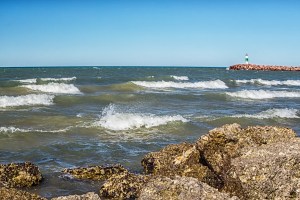 An uneasy relationship between preservation of nature and spread of industrialization stands as a unique characteristic in the history of the Indiana Dunes. By the time the movement to “Save the Dunes” gained momentum in the early twentieth century, sections of Indiana’s shoreline along Lake Michigan had already been damaged irreparably by corporate alterations to the landscape, particularly by factories and plants in the northwest corner of the coast. Dunes were demolished, land was leveled, sand was shipped away, rivers were redirected, and smokestacks’ plumes polluted the sky. Indeed, such extensive commercial contamination of the region served as impetus for ecological concerns and inspired the urgency for conservation. Eventually, due to the dedication of local groups and prominent individuals who passionately believed in protecting the beauty of the environment, compromise and cooperation led to the existence of the Indiana Dunes State Park and the Indiana Dunes National Lakeshore side-by-side with large businesses and active steel mills. Unfortunately, that coexistence sometimes still results in friction, confrontation, or accidental contamination. Tuesday morning carcinogenic chemical wastewater spilled from U.S Steel into the Burns Waterway—one of the ditches built to redirect the Little Calumet River into Lake Michigan—tainted the waters pictured in my accompanying photograph and caused closure of nearby beaches. Unfortunately, this area of Lake Michigan also serves as a source of drinking water for bordering counties.
∼ April 12, 2017 ∼ “Cowles Bog in Early April”
 I shift the weight of my tripod from one shoulder to another as I hike through interdunal wetlands on a warm morning in early April. Once again, a spring setting is reinventing itself, displaying signs of seasonal change. A red-winged blackbird perches in a dead tree, balancing itself in the strong southern wind on a slim limb now weathered as white as ash, and it offers a high-pitched whistle, perhaps warning of my intrusion. I pause a moment on this path to snap a photo of the four-foot long northern water snake slowly sliding past me, its dark skin decorated with yellow bands and blotches. Somewhere unseen a woodpecker taps his coded message against hardwood, and it echoes throughout this swampy landscape. The low croak of a frog drifts loudly through the bog, and I imagine it sounds like a foreign language I’ve not yet learned, something exotic and unintelligible to my ears. The first bright green leaves of plants, bur-reed, and sedge rise above an inky water surface amid reflections of empty trees like reminders of the colorful season about to unveil itself. Today’s hazy overcast sky acts like a photography studio softbox used to diffuse light, lessening the harsh effect of dark shadows developed under direct sunshine, and I capture images of these initial hints at spring.
∼ April 11, 2017 ∼ “Cowles Bog Walkway”
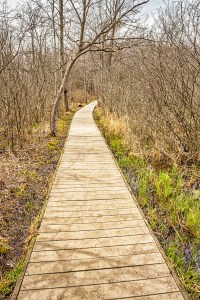 After days of early spring rain, every trail in the Indiana Dunes appears to contain the smell of wet grass or decaying leaves yet remaining on the ground from autumn. Even when the wind strengthens, sweeping between the silhouetted stripes of empty trees, a stale scent spreads then lingers. However, in wetlands paths such conditions seem suitable and contribute to a sense of atmosphere, as when I walked the Cowles Bog Trail one morning this week. In the beginning of April this route still carries the scars of winter: the faded coloring of shrubbery, wind-snapped limbs littering the landscape, the dismal disarray of dead weeds, and the clusters of old cattails folded over onto themselves. However, the verdure of new shoots has started to break through the surface of black water, adding an initial splash of color to the scenery and defining the direction of the wooden walkway as it winds into the distance. Nubs of green buds have also begun to decorate some branches overhanging the pathway, and a growing chorus of birdsong has returned to the region.
∼ April 10, 2017 ∼ “Beach Trees in April: Post Number 100”
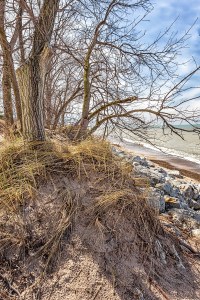 [This post represents the 100th journal note in my Indiana Dunes project, and my writings for this project have now accumulated about 25,000 words. I again invite readers to browse through all the past entries. Moreover, I appreciate all who have viewed and responded to my photographs, and I welcome reactions to my daily commentary as well.] On this warm morning in the beginning of spring, I follow a beach trail along a breakwater and through the smoothed surface of rippling dunes, a path shaped and re-shaped by wind-shifted sands all winter. Today, the lake waves break along the beach, whitening in bright sunlight. An intensifying air current ruffles clusters of long leaves, marram grass sprouting from the foredunes. Leafless trees reach toward the water and lean into the incoming wind. Four gulls—momentarily motionless and in the distance looking like pale stones—settle on wet pebbles at the edge of the shore beneath a blue sky becoming marbled with thin clouds.
∼ April 9, 2017 ∼ “Flooded River”
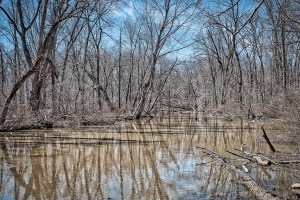 “It is my intention to present—through the medium of photography—intuitive observations of the natural world which may have meaning to the spectators.”—Ansel Adams Following several days of rain this normally narrow, slow-flowing river—shallow and brown with mud much of the summer—now swells well beyond the banks, its width extending into adjacent woods and choking sections of a trail that winds alongside. When the water is at this depth, shadows of trees are more easily seen reflected on the smooth surface, patterns of their thin limbs looking like a page with faded ink prints. After the recent wet weather spell finally broke and blue skies again provided backdrop for this scenery, I quickly visited to witness the changed character of this location. Certain sites like this spot inspire my imagination and, perhaps, evoke emotions in others. I find myself returning to them the way one might call on an old friend for comfort in a time of uncertainty. Therefore, though I am often conscious of the difficulty establishing intimacy in landscape photography, creating a sense of identification with the setting while avoiding sentimentality, I believe as Ansel Adams did that some images I appreciate may also stir significant responses in viewers.
∼ April 8, 2017 ∼ “Dune Path Through Marram Grass in Early April”
 Sunlight whitens sand along the coast as if in defiance after last night’s strong storms that swept through the Indiana Dunes. Rain-swollen streams flood much of the forest just inland, where branches broken by blustery weather lie submerged under a widening swath of water. Except for a few wispy streaks over the horizon, skies clear across the southern edge of Lake Michigan as I head toward the shoreline and walk a narrow path alone among marram grass in the foredunes, still pocked in places with small pools deposited by the surge of wind-driven waves. The thin limbs of empty trees yet seem unsteady in a remaining onshore breeze, a murmur of surf interrupts the silence, and the beach seems speckled with bits of driftwood. The silhouette of one tiny tree twists in the distance, its image similar to a slim dancer solitary on a stage. Lingering hints of winter appear to be drifting away, and the forecast calls for significantly warmer conditions this week as spring begins to inscribe its signature on the landscape.
∼ April 7, 2017 ∼ “Swamp Forest After April Rainfall”
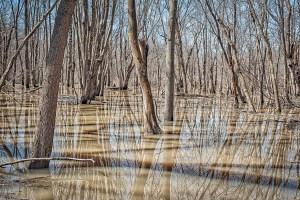 Clots of rain clouds appeared to be locked in place over northern Indiana for days in this beginning of April. Gusts of more than forty miles per hour whipped through the dunes most of Thursday morning. Already, flooded waterways flowed farther over their banks, and the depth of water filling the swamp forest grew to new levels, while also diluting some of its dark brown hue and creating a coffee-and-cream color due to the clarity of fresh rainfall. By the time the stalled weather front edged east and storm activity slackened, the stiff winds at last stilled themselves, and each of the trees seemed anchored in a reflective pool splitting images into two, doubling the details of the scenery displayed by spindly trunks and bare branches. Suddenly, the setting existed as another example of natural artwork, perhaps resembling a pen-and-ink printing on a layer of watercolor wash exhibited in an elegant gallery, the drawn lines of the thin limbs in the design highlighted by return of a brightening blue sky.
∼ April 6, 2017 ∼ “Changing Conditions”
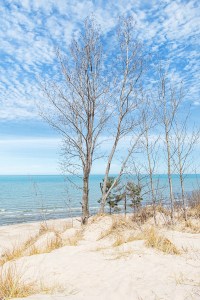 Though only the beginning of April, already a lone sailboat slides across the surface of Lake Michigan, and I watch as a flock of gulls skids overhead in a continuing wind current. So far, spring has staggered through its first weeks, but today with arrival of slightly warmer weather the season seeks to steady itself and secure a firm foothold. Bright sunlight whitens this dry skirt of shoreline while the wet sand at the surf’s edge takes on the rust color of rustic clay brickwork. I pause to peer through my viewfinder at a few dune trees brushed by the onshore breeze. The sky had been completely clear earlier this afternoon, but altocumulus clouds now signal another change in conditions may be on the way. As I snap the shutter to capture this image, behind me some serious cyclists pedal past, moving fast on a paved pathway a bit inland from the beach, each leaning forward over the handlebars and steering toward a steep stretch of dune hillside rising just ahead.
∼ April 5, 2017 ∼ “Pond at Opening of April”
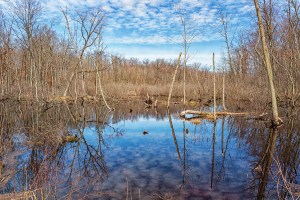 Due to today’s strange change in weather, last night’s overcast of low clouds slowly moving east has mostly faded away. The underbrush softly rustles when I step through to view a glazed pond sometimes wearing its glare like the blinding glint of sunshine on a picture window. With a startled sense of surprise, three geese rise from behind a line of trees to further disturb the silence, flailing at the air with their wings. A lone hawk floats high overhead, quietly lifting and tilting in little shifts of wind, its silhouette almost black and crossing a background of blue. A beaver has gnawed through a tree now felled and lying in the center of the water. I think a day like this deserves its own note of appreciation: how a gauze of late morning haze dissipated above the lake, an onshore breeze sweeping along the beach smoothed the dunes, golden flecks of loose sand blew through the few trees along a ridge, and how now I notice the rigid trunks of trees rise with a seeming show of indifference, bending and extending above a pond surface mirroring their presence.
∼ April 4, 2017 ∼ “Swamp Forest in Early Spring”
 Just inland from Lake Michigan, surrounded by acres of wetlands, I hike between leafless trees of a swamp forest. A red-winged blackbird flies low overhead then moves beyond creaking treetops to my right. The stiffening wind whirs through the empty limbs, ruffles a sparse stubble of marsh weeds, and ripples bleached reed stalks appearing almost a ghostly shade of gray, their tone faded, weakened by months of wintry weather. A morning chill still lingers as onshore gusts gnaw at the sun’s futile attempt to warm these interdunal woods by peeking through slightly porous cloud cover loitering over the whole region, the thick sky tinted with a color similar to chimney smoke. The slow bellow of a bullfrog somewhere in the distance also breaks the silence. Despite the date on my calendar, the shift of seasons remains in transition. Though the great weight of winter has lifted from this landscape, much of the scenery yet exhibits its impression, an influence that will last well into spring, when those first plumes of green growth finally begin to bloom with brilliant flowers yawning open their petals under a shower of bright sunlight.
∼ April 3, 2017 ∼ “Beach After Rain, Beginning of April”
 I heard the throbbing of wind-driven waves reaching a cluster of boulders as breakwater along a brilliantly illuminated beach. All but the dark shadows of driftwood suddenly seemed charged with afternoon sunshine from a sky becoming almost cloudless. The soaking rain that had lingered overnight and into late morning had at last dissipated, and its storm front moved toward the east, as the sand beneath my feet seemed to be warming a bit. A couple of nearby gulls seeking scraps of food in sand at the edge of the lake appeared to quicken their pace as I approached. In the distance a tall man ran along the shoreline, his hands holding tightly to a string ascending toward a brightly colored kite—yellow, green, and red—dragging high above and behind him. Two small children chased after the man and followed his lead, each elated and pointing overhead at the sailing kite with its rectangular frame now lifting or dipping over shallow water by the coast, floating in the slightly rising tide of an onshore breeze where only one month ago at the start of March a wide barrier collar of white shelf ice separated land from lake.
∼ April 2, 2017 ∼ “Spring Flooding”
 After a week of heavy rains, many of the local waterways have been stretched beyond their flood levels. This river—shallow and muddy brown in summer, frozen during much of winter—frequently swells hundreds of yards beyond the tree line that grows from slopes usually defining its banks. The first white settler who built a trading post at this site along the river’s edge nearly two centuries ago found his structure swamped by the same seasonal spread of rainwater overflowing into this flood plain. In April, under spells of heavy rain, the surge sometimes encompasses much of the bordering groves and fields. During those years when a thick snow pack persists until March, the extent of the river’s expansion increases as well, most underbrush and the base of each tree in adjoining woods drowned after downpours from a series of storms. Even the lower branches of trees located in forests far from the normally narrow course of the river often bend and dip into new accumulations of water. Widening pools of runoff might rise higher with every cloudburst, as well as washing away portions of a parallel trail that I often walk on a direction through the dune woods. Various sections of the route submerged, I am frequently required to find a way ahead by climbing heights or opening my own path in the undergrowth.
∼ April 1, 2017 ∼ “Swamp Walkway at Start of April”
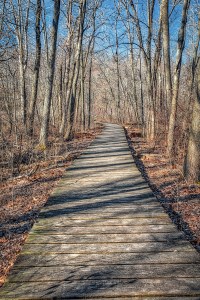 Long dawn shadows veiled much in the heart of this marsh. Later, morning’s thin haze lingered. But the sun soon rubbed against treetops and reclaimed the terrain. As I passed across a wooden footpath only inches above the stagnant wetland, the worn planks appeared weathered a little more by another winter. The trail stretched toward a distant bend like a leading line directing a viewer’s vision farther into the swamp forest, and along sections of the route, the boards seemed almost to float on the surface of the mire. I could smell the sour scent of a damp landscape, the sharp odor of stale water and dark soil covered with decaying leaves. When I paused to snap a photograph, extending my tripod legs with the creak of metal clasps and a distinct clicking sound, I heard the screeching of geese and a brief flailing of wings nearby, then a return to silence. A slight chill still signaled the delay of warmer spring weather. By afternoon, a clear blue sky would cover everything, and I knew I’d find my way between the trees to a shelter at a watershed beside a shallow creek only a few miles ahead.
∼ March 31, 2017 ∼ “Trail Beside Creek at End of March”
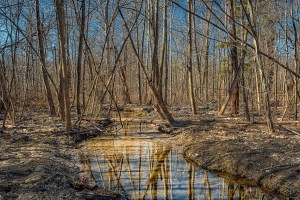 Winter’s silence has slowly given way to the chirping of birds perched among branches still bare in this early spring air. Beneath my feet, a snaking creek-side path speckled with dried leaves—remaining from autumn and now blackened, crackling under every step—seems to reach deep into the distance, the way becoming vague in quickly diminishing daylight. The winding waterway lies still on this windless afternoon, supplying reflected images with a slightly amber tint sketched onto its smooth surface, details as visually inventive as those liberally depicted in an impressionist painting. This easy section of the trail, a short stretch to the lakeshore, offers flat passage for comfortable walking with the shallow slopes of little hills rising on either side. Members of Native American tribes, mostly Potawatomi, once traveled the same place, moving through these woods on trips from their inland villages to Lake Michigan or when transporting furs to the first white settler’s trading post situated just a couple of miles to the west. I consider elements of this history each time I visit the forest trail.
∼ March 30, 2017 ∼ “Inspiration”
 “Nature is my manifestation of God. I go to nature every day for inspiration in the day’s work.”—Frank Lloyd Wright This morning’s sunrise arrived with a flourish, unfolded a sky saturated by golden light like the bold color of Chardonnay wine, and the bluish-green lake water that had been black, overcast with a starless canopy, awakened from its stark spell of nighttime darkness. By the time I hike this beachfront stretch of trail, I find myself moving around some of those sand mounds deposited throughout the foredunes—shapes made during winters by displaced landscape, gifts lifted into place by an unseen hand. I see a sharp horizon line splits the image in front of me, and the shore’s edge is outlined by a repeated pattern, the surf’s spasms of breaking waves. Fluffy clusters of wind-driven clouds define the sky. Once again, this setting serves as inspiration. I work my way east along the coast, where the scenery is framed by a few leafless trees, the shadows of their slim limbs reaching onto the tan sand of a surf-stained beach, and a rocky breakwater of broken stones that appear like rough accents decorating the shorefront. Almost breathless from walking so far, I am reminded that breathless can also refer to emotional excitement, just as inspiration also means the act of drawing breath, the very essence of life.
∼ March 29, 2017 ∼ “View from Mt. Holden in March”
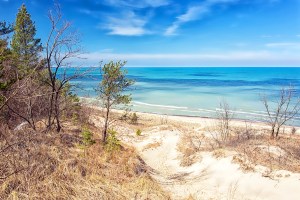 Following a tiring climb up the steep slope of a sand dune, I position my tripod on a ridge cliff overlooking Lake Michigan. Cloud cover has cleared—lifted and drifted away since an early morning drizzle dimpled the beach, dampened the sandy paths, and deposited dew on the patches of marram grass. From this vantage-point the landscape along the lake appears to extend deep into the distance before disappearing beside blue sky and blue water. The spindly limbs of leafless trees still seem to be reaching insistently, as if calling for attention, the way they have persisted all winter. I always frame an image in my camera viewfinder as an attempt to absorb the moment, capture it for a print, and at the same time imprint it in my memory to internalize the energy. I want to preserve this valued scenery I see as sacred in whatever way I am able. One might find nothing subtle about my appreciation for nature, the elation felt in retaining a snapshot of the engaging setting I witness, but much of what I do tries to prove Ansel Adams’ observation about photography: “A great photograph is a full expression of what one feels about what is being photographed in the deepest sense, and is, thereby, a true expression of what one feels about life in its entirety.”
∼ March 28, 2017 ∼ “Evolution of Early Spring”
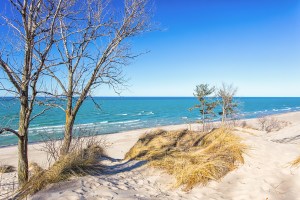 All morning bright sunlight presided over the shoreline, perhaps a signal preceding the inevitability of warmer weather. Year after year, the slow evolution of early spring seems to offer so much hope, gradually gnawing away at remnants of winter imagery. Even though cold onshore breezes will continue to shoulder the coast into April or May, the tight knot of winter loosens each week. Already, returning birds are repopulating treetops in the swamp forest and wading across marsh water. A few more small boats now float along the shore on bright afternoons, hulls swaying in the steady pulse of rippling lake waves. The sandy beach begins to hold daytime heat a little longer. Sunset displays its radiant tints a bit later every day, the tilted rays of light bathing dune hills with rich shades of color shaping the shoreline, embracing the landscape until the cloak of night closes over everything.
∼ March 27, 2017 ∼ “Late Light in Late March”
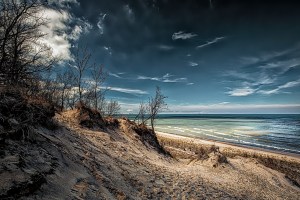 The southern angle of the sun yet sends slanting light at the end of March, casting trees along the dune ridge into silhouette. By sunset they sometimes even seem almost ghostly as the rough bark of trunks and their spindly limbs blacken. The lakeside slopes face north and darken early. Winding deep through the dunes along an old trail late in the day, I feel as if night is arriving already, except for a few final flecks of sunshine still visible among treetops. So, I follow a blowout opening toward the beach, where a half-dozen teenagers have huddled around a tiny campfire for warmth, burning dried sticks of leathery driftwood in a gap between grassy mounds on the foredunes, though I think it is illegal here. The small flames appear like fiery blossoms in full bloom, and a narrow plume of smoke rises into the sky. Enticed by the fire, I slow my stride a bit and then stop to watch, notice a couple of red and gold embers flipped into the air and flickering like exotic butterflies lit by brilliant moonlight.
∼ March 26, 2017 ∼ “Ring-Billed Gulls”
 Some ring-billed gulls browse along the beach while a couple test themselves by wading in strengthening swells of waves or others float overhead in a stiffening onshore breeze. (Today’s bright sunshine hints at spring weather, but a chill still accompanies this northern wind.) In the foredunes a few more forage for food, pecking at whatever they can find, occasionally crying out with a loud and shrill call. Among sand mounds and tufts of marram grass, a small boy offers bits of bread for two of the birds to nibble, tossing morsels of crust to the gulls, causing chaos as their black-and-yellow bills quickly pick at each piece. A woman watches nearby and points toward four more, frequently flapping their black-tipped wings, not much farther away. The child hurls a last slice, the loaf’s heel, toward them. In a frenzy, they clumsily hurry to reach it, challenge one another. Mother and son walk away, turning their attention to collecting colorful shells at the edge of the water. Suddenly, sunlight starts to fade as a lone large cloud passes above the coast, dragging its vague gray shade over everything like a dark theater curtain drawn at the close of an act.
∼ March 25, 2017 ∼ “Mixed Up Month of March”
 Standing between two trees at the tail end to one of my favorite trails, a sandy path that courses through dune woods and forested hills to exit at a ledge on a bluff high above the beach, I view the bluish-green water beyond. Whenever I arrive at this rise beside the lake, a ridge overlooking the shoreline like a natural balcony, I always pause to examine the expanse suddenly on display before me. Overnight clouds have been displaced by a new blue sky spread overhead like a painted canopy, and I listen to the steady rhythm of the surf as it traces slim white lines of waves in the brightening sunlight. Northwest Indiana received a tease of warmer weather as a temporary wedge of southern air current edged over the state and moved into Lake Michigan, chafing away at the lingering layer of winter chill with temperatures in the mid-seventies. Yet, the forecast calls for a storm front that will bring heavy rain as the mixed up month of March remains erratic. However, in this instance, I witness change as I notice the shoreline starting to rearrange itself, and one season seems finally to be fading away while another begins to stake its claim.
∼ March 24, 2017 ∼ “Promontory in Early Spring”
 Once again the landscape is shaped by the changing light of early spring. The screech of ring-billed gulls along the beach greets me. I pass through dunes still sculpted and smoothed by the rush of last season’s gusts. Leafless trees whipped by winds all winter stand as survivors. I watch as today’s waves break against a promontory of jagged rocks, a splash of whitewater rising in the sunshine and leaping over the stones as though holy water, evoking the sacred spray in a Sunday mass. I find my memory searching some church service images from childhood—remembering the blessing bestowed at benediction, the sprinkle of the aspergillum wielded as if it were a magic wand or musical baton, and my fingers dipping into the font upon exit before touching one fingertip to my forehead in beginning the sign of the cross. I also recall a sentence from Eudora Welty’s excellent essay, “Place in Fiction”: “From the dawn of man’s imagination, place has enshrined the spirit; as soon as man stopped wandering and stood still and looked about him, he found a god in that place….”
∼ March 23, 2017 ∼ “Three Weeks into March”
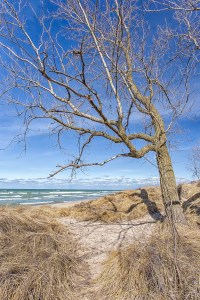 By the time of the high sun near noon, morning’s long shadows have been folded and put away. I hike beneath arching branches of leafless trees, the thinner limbs extending and intersecting like lacework. After last evening’s overcast skies and cold winds coming quickly from the north, a soft southern breeze now cradles the coast and begins to bring warmer weather. Each feature of the entire landscape is tipped with sunshine, though pockets of cooler air linger deep in the ravine or among darker parts of the swamp forest, where sunlight diminishes and the scene almost seems candlelit in those lower levels of dimmer dune woods. Three skeins of geese cross the nearly cloudless sky like wedges sketched onto a blue background, their honking calls audible as they pass not too far away. They appear headed toward a large marsh beyond a nearby dune and just short of the lakeshore. I cannot imagine a more ordinary image for three weeks into March, but nothing could be more comforting.
∼ March 22, 2017 ∼ “Spring Proposal”
 The start of spring is often associated with other beginnings throughout nature and parallels transitions witnessed in the lives of humans. Indeed, literature frequently employs this season as metaphor for spiritual awakening or emotional warmth, especially when reflecting the emergence of new growth in personal relationships. I particularly regard this time of year as important in my life since my wife and I had our first date in spring, involving a visit to Lake Michigan to walk along the Indiana Dunes. As I hiked down from Mt. Holden toward the beach this week, I was reminded of the initiation of my own relationship with Pam when I observed a young couple huddled at the base of the trail while one wrote words in the sand with a broken twig, unaware of my presence a significant distance up the slope. Far from the pair and protecting their privacy, I did not photograph them; however, I could view through my long lens that the man had scrawled “MARRY ME?” The young woman, obviously delighted, responded positively as they kissed and hugged before continuing on their way toward the lake. I did not realize until I returned home and examined my photos that I had accidentally caught the last part of the word “marry” from the proposal etched into the dune in the lower left corner of an image I had composed a bit later when looking from the Mt. Holden trail toward the skyline of Chicago barely discernible on the horizon.
∼ March 21, 2017 ∼ “Beginning of Spring”
 Drawn by the beauty and tranquility of a dune ridge, luminous at noon, I climb a rising path after moving through a stubble of undergrowth and foredunes feathered with patches of marram grass. Bright sunlight shapes the landscape in this start of spring. The slightly swaying limbs of leafless trees seem to breathe with life, bronchial branches inhaling and exhaling in a subtle breeze. This northern air current still exhibits remnants of winter, cooled a bit with its crossing of chilly lake water, and those upper slopes of sand dunes have been smoothed by the gentle hand of last night’s onshore wind; yet, today everything has changed. Each shift to a new season begins with evidence of transition from another but quickly establishes its own identity. As Thoreau observed during a journal note written on March 26 of 1846: “The change from foul weather to fair, from dark, sluggish hours to serene, elastic ones, is a memorable crisis which all things proclaim. The change from foulness to serenity is instantaneous. Suddenly an influx of light, though it was late, filled my room. I looked out and saw that the pond was already calm and full of hope as on a summer evening, though the ice was dissolved but yesterday…. It was no longer the end of a season, but the beginning.”
∼ March 20, 2017 ∼ “Last Day of Winter”
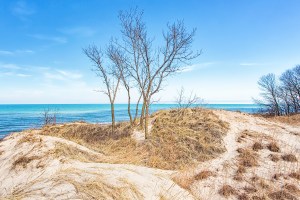 Since yesterday was the last day of winter, I decided to hike the old Cabin Trail at Indiana Dunes. This path is unmarked and not included on state park maps because it exists as a remnant from a different era. During the first half of the twentieth century, when as many as 150 structures—cabins, shacks, and cottages—dotted the beachfront, this route riding a ridge through the dunes helped connect the residents. In fact, a section I traveled starts where the Indiana Governor’s summer house once stood and extends eastward to the site that had held painter Frank V. Dudley’s studio home. When all the private properties were consolidated into parkland, each of the buildings was demolished and materials hauled off. Knowing that the trail snakes around mounds high above the beach, I believed it would serve as an apt metaphor for the transition from winter to spring. Indeed, during my visit I could see the side facing Lake Michigan sloped to the sand and surf, bathed in bright sunshine (though temperatures lingered in the mid-forties), while toward the inland direction a deep ravine, wooded and shaded by its inclines, still displayed pockets of snow not yet melted and remaining among darkest forest recesses.
∼ March 19, 2017 ∼ “Uphill Trail”
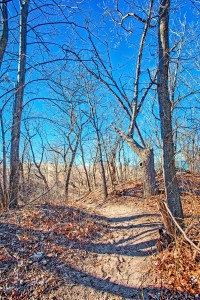 After three days with swift westerly winds, today the landscape appears listless, and this slim trail that reaches to the beach seems framed by a sequence of leafless trees, each bathed in bright sunshine. I’ve decided to climb through the dunes on a path that loops around shifting mounds of sand toward the shore but will be too overgrown in places for passage during summer months. Midday diminishes shadows, and a runoff of sunlight flows almost like liquid soaking the whole scene. Carrying my camera and tripod over my shoulder, I tire as I ascend and approach the coast. By late afternoon, I rest on a ridge, listening to a lone motorboat grind north beyond a narrow sandbar not far offshore, as if attempting to escape this landscape, making a break with the bow now aimed at Lake Michigan’s straight horizon line, light blue above and dark blue below. I watch as the boat’s white wake threads its way through a few buoys, the craft’s swell of water creating little waves that fan from the aft and fade away.
∼ March 18, 2017 ∼ “Dune Ridge Trail”
 The sun seems pinned into position today just above this small hill beside Lake Michigan with only a few thin clouds drifting toward the north to limit its bright cascade of daylight. The dunes, replenished by resettled shoreline shifting inland during last night’s swift winds, appear untroubled now, as if the result of sand slowly sifted through the narrow passage of an hour glass. I often like to climb this sloping path to the top, approaching that place in the landscape where a view of the whole coast will open like an unfolded poster photo promoting a scenic travel destination. Although only a short trail about one quarter mile long, its visitors walk through a wooded valley to approach the incline I find rising in front of me. There, a compact group of empty trees stands alone on the ridge above stubbly tufts of marram grass in March light overlooking the vast expanse of lake on the other side.
∼ March 17, 2017 ∼ “Competing Seasons”
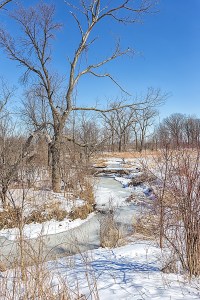 I delay my hike a moment to take in the radiance of a late winter day, the way a slant of sunlight plays on the luminous landscape. Even when yesterday’s snowflakes fell, I sensed the end of a season lurks less than seven days away. The strengthening sunshine of spring seems to be beginning its tenure already, even the northern storms weaken and depart quickly, as last night’s dusting of snow shows. Soon, an uncertainty will settle into the scenery, evidence of two seasons competing with one another will be witnessed. As a photographer, I frequently measure the weather with my observations of light. Though I usually prefer partial overcast to inject texture into an image, in this instance I do not mind the absence of clouds. The crisp air adds clarity to my photograph of this place offering a graceful presence. The branches of a bare tree appear embraced by the blue sky behind it, and the curve of a slender creek, yet glossy with ice, brightens like white frosted glass to offer its elegance. In the weeks ahead this setting will reorganize itself, altering the vista into a distinct image of spring.
∼ March 16, 2017 ∼ “A Moment in the Middle of March”
 I pause on this gray day, the entire sky consumed by cloud cover. Black branches sag under the white weight of new snow, and the rest of the scenery also seems somewhat colorless. Despite the recent spell of milder temperatures, this season lingers—as though a trickle of water still drips into the well of winter, once thought almost dry—with spring only one week away. Middle of March, yet last night’s frost has left a thin skin of translucent ice on the stream’s surface. Images like this intensify my affection for nature. With an absence of wind, stillness fills the forest. Unlike what I will find next month, there are no other visitors on the trail today. A pervasive silence saturates this setting sheltered from the commotions of society. I hear no chirping from birds perched along the path, and I witness not a bit of motion from the passing of deer nearby. In A Walk in the Woods, Bill Bryson’s bestselling book, he writes of another March: “The woods were silent because spring had not yet come…. We trudged through a cold, silent world of bare trees, beneath pewter skies….” I move on, knowing the next time I return so will spring, and the whole landscape will have changed.
∼ March 15, 2017 ∼ “River After Late Winter Snow”
 After almost a month of false warmth and only one week until spring, I was pleased to see winter had nudged itself over northern Indiana once again in mid-March with a day of lake-effect snow, its long string of clouds blown onshore by stiff winds. The thawed Little Calumet River continued to slowly flow, looking like a light green ribbon unrolled between its white banks and the low hills sloping above either side. New blue patches filtered through a mostly overcast sky, showing against the pale clouds like an undercoat of paint emerging into view, and the scenery suddenly brightened, each shaft of sunlight entering as if from a skylight. I followed a narrow trail beside the water, where tips of treetops yet reflected, and a couple of geese nearby trundled hesitantly toward me under overhanging limbs still sleeved with snow, then they quickly turned and walked away. This stretch of the river always seems secluded, especially in winter when it bends and loops through a section of the dune woods ahead. At a time like this, I am delighted by my surroundings, and I’m reminded why I wanted the season to remain a little longer.
∼ March 14, 2017 ∼ “A Perfect Winter Day”
 By the time I arrive at these dune woods, a loose robe of snowfall has spread out and covered everything, smoothing all the irregular angles of the topography, as if an element featured in a Romantic allegory about nature’s innate ability to quickly transform the world around us. A lingering layer of dead leaves yet leftover from autumn and caught among the stubble of undergrowth—visible most of this almost snowless season—has disappeared along the trail. The storm’s insistent winds have stilled, and last night’s low temperatures already have eased a bit; the front’s frigid air has retreated toward the north. Brightening sunlight peeks through the trees to illuminate the landscape, exhibiting elongated shadows of thin trunks on the tide of white surrounding them. In a journal note written during the winter of 1854 (February 12), Henry David Thoreau described “a perfect winter day”: “you must have a clear, sparkling air with a sheen from the snow, sufficient cold, little or no wind; and the warmth must come directly from the sun. It must not be a thawing warmth. The tension of nature must not be relaxed.”
∼ March 13, 2017 ∼ “Northern Winds”
 Strong northern gusts battered an abandoned beach with breaking waves—even the usually ever-present gulls were gone—and continuous gales dragged wind-chill temperatures into the teens Friday afternoon. Though still technically winter, after weeks of warmer weather this unexpectedly abrupt return to a cold sweep of Canadian air spilling onshore seemed especially traitorous. Wisps of quick clouds shifted south, but the bright sunlight already appeared to exhibit an increasing intensity. Additionally, an elevated angle of sunshine suggested spring, only a dozen days away, would soon be here. Yet, my face felt frozen—at times also wet with spray from treacherous rogue waves or blasted by sand in the blustery wind. Repeatedly, my gloved hands fumbled to wipe dry the wide-angle lens with a fiber cloth or to adjust the camera’s shutter settings, as I hoped to photograph this energetic scene normally so calm and serene. Finally, my persistence paid off, and I captured an image that to me made it all worthwhile.
∼ March 12, 2017 ∼ “Stark Forest”
 A gentle breeze whispers through the trees like a murmured prayer offering words of assurance softly spoken to ease the suffering of mourners during a church service. Though my mind creates this fictional grief, I’m more moved due to the true emotions evoked by my surroundings as I walk through woods once charred dark by fire from a lightning strike. Most of the stark forest along this trail had been destroyed decades ago in a single night, stumps of trunks or broken branches burnt black and left a while to stand as if memorial monuments. Nearly half a century later, although almost all have been removed over the years, some of those remnants continue to present evidence of loss. I pause for a moment among the darkening terrain—still sparse despite recent rebirth of new growth—when the scene is stilled, held in a brief lull of wind just before dusk. It is calm and quiet here now, perhaps similar to the hush following a confidential conversation, like a lingering silence at the close of an intimate disclosure.
∼ March 11, 2017 ∼ “Driftwood Shadow”
 Whenever I look at a landscape setting, I am struck by shifting shades of color and elements of luminosity provided by natural light—perhaps the manner in which sloping mounds of sand dunes absorb or reflect winter sunshine, maybe the way the whitewater of waves glistens in bright daylight. I like the elongated lines of shadow and the differing degrees of darkness that sometimes inhabit them. I admire the brilliance of marram grass gently dancing in a brisk onshore breeze under sunlight, as well as the textured brown bark peeling from bone-tinted driftwood. I appreciate the gradual changes in hue influenced by illumination, witnessed in the blues and greens of a clear sky over lake water. Claude Monet once wrote: “For me, a landscape does not exist in its own right, since its appearance changes at every moment; but the surrounding atmosphere brings it to life—the light and the air which vary continually.” Paul Cezanne added an observation: “Shadow is a color as light is, but less brilliant; light and shadow are only the relation of two tones.”
∼ March 10, 2017 ∼ “Midday in Early March”
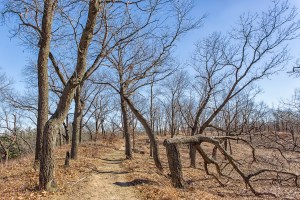 Traveling through a thinning section of woods, I met my first person only moments ago, a birder passing in the opposite direction, and we spoke briefly. However, once again I sense someone else nearby. I guess perhaps a couple at the campgrounds not far past the next bend in this path, as a faint scent of wood smoke drifts between leafless trees accompanied by a distant sound of loud laughter. Despite heavy rainfall earlier, only a slow-flowing stream that last week seemed to be drying up parallels parts of the trail. Normally this is a snow-fed creek throughout winter; but in this year’s snowless season it appears so shallow with a surface so clear, those pale stones on the bottom now show. Morning’s strong storm has moved to the east; a sparse layer of stray clouds has frayed and dissipated as well. In some places along the way, freshly snapped limbs litter the route. Midday sunshine glazes the lake’s swollen waves yet breaking on the beach just beyond a dune hill, and bright daylight tries to reclaim the entire landscape, while the taller skeletal treetops overhead can’t even offer a bit of shade but still sway, seeming to strain in remaining winds, almost as if nodding in assent to this change in conditions.
∼ March 9, 2017 ∼ “Westerly Winds”
 As a photographer seeking to capture a setting with precision, I frequently must weigh the presence of wind in any decision I make. Movement creates an indistinct image, especially in landscape photography that normally uses a smaller aperture (at least f8) and requires more time to allow greater light onto the camera’s sensor. In winter weather, often with weaker light or completely overcast skies, this situation is particularly evident. However, I do have a bit more leeway in freezing a scene without blur because the empty trees are not impacted as much as those full of foliage in other seasons. Strong and steady gales (such as those experienced in the region during the past few days, when westerly gusts grew to more than 50 miles per hour) also negatively influence opportunities to obtain sharp focus due to shaking of the camera, even when secured on a reliable tripod. Nevertheless, noticing the windy conditions this week, I chose to visit Lake Michigan, where motion in the form of waves generated by air currents is always welcomed, since it contributes a sense of energy to a normally placid view.
∼ March 8, 2017 ∼ “Snow Squall”
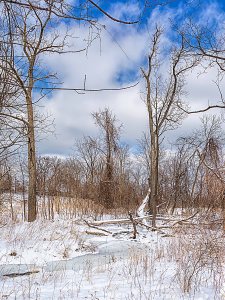 In late February I followed a flat trail through the dune forest and found a location of large leafless trees with dark bark. The bare black branches came alive with movement due to a brisk breeze sweeping inland from Lake Michigan, bringing a squall line onshore. When pale clouds filled the sky and the first flakes fell, drifting down and gently beginning to accumulate, briefly disguising the woods around me, I felt as though a glass snow globe had been flipped over. Shortly after the storm front eased toward the east, a light covering of white settled over everything, blurring sharp lines of the landscape and brightening the scenery in the little remaining daylight. Hiking toward home through slushy footing along the wet path, and with my heavy breathing still visible in the chilled air, I noticed the vivid image of a red-winged blackbird perched in a distant beech tree, too far away to capture with my wide-angle lens, the red edges of its feathers offering the only brushstrokes of color anywhere within sight.
∼ March 7, 2017 ∼ “The Nature Fix”
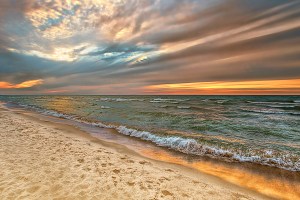 A book published last month, The Nature Fix: Why Nature Makes Us Happier, Healthier, and More Creative by Florence Williams, explores the physical and psychological advantages to engaging with nature. A quote from the text suggests contemporary society and the technological environment of everyday living provide further evidence humans must interact with the natural world on a more regular basis. Williams observes: “We don’t experience natural environments enough to realize how restored they can make us feel, nor are we aware that studies also show they make us healthier, more creative, more empathetic and more apt to engage with the world and with each other. Nature, it turns out, is good for civilization.” Describing the focus of her examination, she adds: “This book explores the science behind what poets and philosophers have known for eons: place matters.” Reading this work, I found myself identifying with some of the emotional and intellectual responses to nature shared by subjects in the chapters, and I associated the author’s conclusions with my opinions on the significance of nature witnessed in the repeated reports about trips to the Indiana Dunes related in this journal.
∼ March 6, 2017 ∼ “Importance of Description”
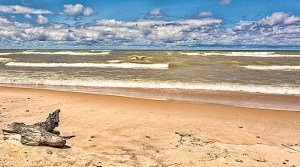 Ring-billed gulls float in southern winds along the lakeshore and rise high in the sky above breaking waves. A few birds land on a narrow sandbar almost golden in midmorning sunshine after an earlier mist has dissipated. Following weeks of unseasonably warm weather, mild temperatures persist. Observing from a trail through the foredunes among marram grass at the start of March, I mark in my memory the dark outline of a cargo ship silhouetted on the horizon, heading west toward Chicago. When I swivel my camera on its tripod head a little, hoping to capture a panoramic view of the scenery, I notice brittle sticks of driftwood lying in the sunshine, the deep brown bark of these broken branches now lightened a bit by the drier air. Reading these words that I’ve written thus far, I realize once more the importance I place on description, how much such details matter to me, as if every bit of information in this setting acts as a mnemonic element, a way to recall forever even the most modestly felt tone of a fleeting moment and any emotion evoked at the time.
∼ March 5, 2017 ∼ “Sun After Storm”
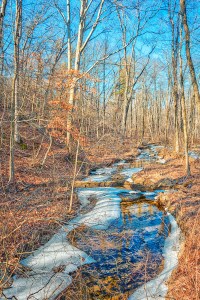 Following a winding route from inland wetlands to the shore of Lake Michigan, my boots sometimes stick in the path’s sludge. By summer much of this thick mud will turn to trail dust. I know overnight snow flurries and frigid winds swept the region, but morning hints of change, as the sky is tinted by an artistic sunrise with warm colors woven overhead. Isolated blotches of ground fog have been washed away by sunshine reclaiming the landscape. I see three deer move through these watery woods, weaving between empty trees and dipping their heads under bottom branches. They slosh the cold marsh water, a thin layer of surface ice cracking like glass or clattering like shards of shattered plates. By the time I make my way to the peak of a dune hill on my hike toward the shore, I observe a scattering of cumulus clouds covering the lake like lengths of knotted white linen cloths, and I can hear the steady pulse of waves breaking on the sandy beach, where lines of whitewater extend like strands of pale twines strung along the coastline.
∼ March 4, 2017 ∼ “River Bend”
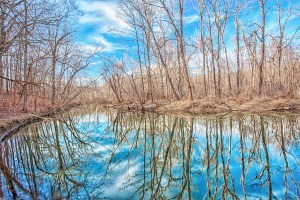 Sometimes it is not enough to know intimately the local characteristics of the landscape—maybe the manner in which gnarled oak, hickory, elm, and ash grow alongside the river or the way the water mirrors their limbs on a calm winter morning when summer’s green leaves are gone and the ice-smooth surface appears as clear as my camera’s glass. In this cold season when even a sighting of the sun offers little warmth, one must remember as always an observation by Ralph Waldo Emerson in Nature that “the whole of nature is a metaphor for the human mind.” Therefore, with each description I present, I am aware of the transition from denotation to connotation, the connection between content and context, and the relationship object has to objective. As a writer and a reader, I’ve witnessed the symbolism natural features frequently assume in literature, and I consciously include consideration of these interpretations in composition of my photographic images as well. In this way, a picture of a river bend can also suggest meanings of transition and change in direction, especially since such a waterway often symbolizes the course of life. Consequently, I always perceive illustration, verbal and visual, as an act also implying intellectual or emotional narrative.
∼ March 3, 2017 ∼ “Trail Beneath Bent Tree”
 On this day after late-night rain, I follow a trail scrawled between leafless trees like an illegible signature. The storm front has shifted to the northeast, yet a sporadic presence of strong winds persists, hinting at further turbulence. These muddy woods I hike through provide a buffer from such gusts. Sandy sections of the path still remain dimpled in spots by last night’s raindrops. Already the weather is changing again, as sunlight weakens once more, filtered at times by increasingly overcast skies threatening with spring-like thunderstorms forecast for this evening. Indeed, the adjusting angle of sunshine and warmer temperatures witnessed lately offer indications of an imminent spring, though this mostly snowless season has not yet allowed a weariness with winter. As I approach a bend near the end of my walk, I notice a tree trunk leaning across the trail, its longest limb listing all the way over the passage ahead of me. When I step past, I feel enveloped by this tilt in an element of the landscape, which in summer will fill further with foliage and resemble a natural tunnel, a symbol of transition.
∼ March 2, 2017 ∼ “Changing Weather”
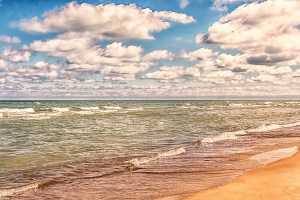 I am walking through the dunes on a weekday afternoon, and the weather changes again. A chaotic cluster of southbound clouds assembles in the distance, each like a weightless white island drifting in winter’s dress blue. Pools of shadow expand across the landscape, and patches of the lake water take on a gray shade. I climb a hillside of sand shaped all season by northern winds, the gold skirt of beach below me, and the shoreline blossoming with bright waves of whitewater. A breeze sighs through empty trees and brushes the long hairs of marram grass along this ridge. The steady surf beneath me sounds a regular rhythm, reliably keeping its beat. A couple of old motorboats loll offshore—engines extinguished, fishing lines seem to be leaning over their sides—both bobbing silently beyond a suddenly submerged sandbar. Soon, they will be returning to port for the evening, but I will wait until well after sunset, hoping to photograph the transition.
∼ March 1, 2017 ∼ “Winding Wooded Trail”
 The crowns of these empty trees sway in strengthening wind gusts, trying my patience as I wait for a lull to snap a photograph and avoid blurring. Sunshine filters through the bare limbs, and their narrow shadows seem to be black brushstrokes dabbed back and forth on the path before me. In some darker parts along the trail, the shade appears more like charred marks branded into the landscape. For a while, I focus on a sole tree—shorter and with burnt-orange leaves still displayed so late in winter—looking out of place among the others. I love the way this route weaves through a crease in the scenery, each section stitched together between steep slopes with a wooden footbridge, though it’s hardly needed since the seasonal stream below has almost gone dry due to lack of snowmelt in this mostly snowless winter. I will follow the curves in this course, descending into the ravine, where I will find less influence of the wind on the images I attempt to capture with my camera.
∼ February 28, 2017 ∼ “Eternal Language of Landscape”
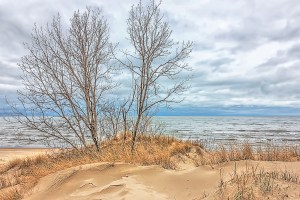 …wander like a breeze / By lakes and sandy shores, beneath the crags / Of ancient mountain, and beneath the clouds, / Which image in their bulk both lakes and shores / And mountain crags: so shalt thou see and hear / The lovely shapes and sounds intelligible / Of that eternal language…. from “Frost at Midnight” by Samuel Taylor Coleridge I listen to the wistful cadence of a soft shifting wind drifting off the lake. Sunlight slips lower, dipping toward the horizon, moving in and out of clouds dragging their shadows across sand dunes smoothed by winter’s hand, a persistent onshore current brought from the north. Tree trunks beside the beach seem to slouch, their black branches nearly bare, only a few final leaves lingering—brown, crisp, and paper thin—yet decorate the stiff limbs. I hike the old Cabin Trail (though there have been no cabins here for a half century) along an eroding slope linking a couple of the highest hills where the breeze murmurs through a cluster of ridge trees as the overcast increases. In every entry to this journal the subject of my writing stays unvaried, though each day a bit of change appears in the scenery through natural alteration, and I offer the same eternal language of the landscape.
∼ February 27, 2017 ∼ “Dunes Creek at End of February”
 The trampled dead leaves of autumn still litter this trail through a dune forest in the end of February. I worry a sense of depth may be lost in my image, flattened by the bright midday light, any details in the photograph bleached by sunshine. At least, that is what I’m thinking as I reach the spot I’d been seeking. A split wind picks its way between the stiff trees, as if sifted in its passing, and I hear the gargle of a clear creek nearby, where a few frogs jump from the bank, one by one, as I hike past them, scuffing my feet on an uneven path. Brush-like tufts at the tops of weeds nod in the slow current, and a yellow sand bed—almost golden—can be seen beneath the shallow water. Spreading overhead, the crosshatched chaos of bare branches, some blackened in silhouette, attests this region remains lodged in winter despite the noticeable ghostly absence of snow and the skein of geese gabbling above. A faint scent of smoke drifts in the breeze, seeps into these deep woods from a campsite in the direction I am heading, not far beyond the next bend.
∼ February 26, 2017 ∼ “River at Bailly Homestead”
 The first white settler in Northwest Indiana, fur trader Joseph Bailly, arrived in 1822 and established a trading post beside the Little Calumet River. This location offered excellent opportunity to transport goods along the river and main east-west Indian trails that crossed nearby, as well as providing proximity to Lake Michigan, just a short distance north and convenient for shipping goods to a commercial hub in Mackinac. This riverside site proved ideal for delivery of animal pelts by canoe, and the local Potawatomi tribe served as favorite trading partners, supplying pelts from various game, including beaver, rabbit, and deer. Bailly’s wife Marie was of Potawatomi heritage in Ottawa on her mother’s side, which must have assisted Bailly in relations with his neighbors. Bailly apparently situated an original structure alongside the river’s northern bank (seen in the accompanying photograph). However, this waterway often overflows with snowmelt in spring, and the width of the river expands quite a bit into the flood plain, as I have documented in past photographs. Consequently, Bailly subsequently constructed his main homestead on a bluff overlooking the river and above any possible floodwaters. That Bailly compound included a main living residence and five other log cabins for storage and warehousing of materials.
∼ February 25, 2017 ∼ “Winter Morning in Swamp Forest”
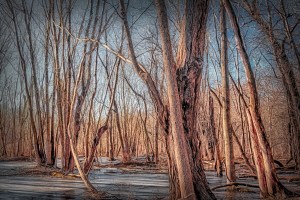 At first, the scenery seemed designed for a dream, smeared with mist before late morning sunlight began to seep through this swamp forest within reach of the river trail. The entire setting shared the silence of a shut room in an abandoned building. I imagined the kind of narrative that could occur in such a scene, the ominous figures a novelist might invent to fit this image. But I was the only one anywhere around, once again alone in nature, watching the gradual awakening of this vague landscape as the last cloud of fog lifted, rose like smoke floating over tamped down ashes in a dampened campfire, and dissipated, unveiling a procession of trees, thin trunks leaning one way or another with bent limbs, their brown bark absorbing the sudden gift of golden sunshine. As clarity revealed details, whorls in the ridges of weathered wood now painted with welcoming hues, I appreciated once more the odd beauty of such a place. However, despite an appearance of warmth, the cold that had collected all night still buried the saturated soil and root balls under frozen water.
∼ February 24, 2017 ∼ “Creek in Late February”
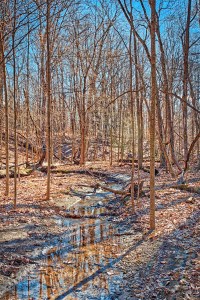 A hawk perches in nature’s attic on an upper limb of the empty tree about fifty feet in front of me. He seems to be observing my movement. Carrying my camera and tripod, I slowly trudge, moving clumsily along a trail, shuffling or stumbling over curling dried leaves and sections of deadwood near the end of February, the crisp chill of winter returned after a brief spell of warm weather. Yesterday, a cold front cleared away the gray skies, and ice again begins to contribute a fine sheen to the water’s surface. Although this season has been mostly snowless, my hope remains for at least one more northern storm that will thoroughly whiten the landscape. For now, the few thin reeds rising along the creek tremble in a gentle wind, and slim black branches bending over the water wobble or flick a bit against a cloudless background of blue decorated with the early afternoon appearance of a waning crescent moon. I pause to watch a small brown and yellow snake, no longer than a woman’s necklace, wriggle across my path; like me, he seems to be in no hurry, taking his time as he heads toward the edge of the creek where a patch of sun shows through an opening in the woods and shines like a tiny spotlight.
∼ February 23, 2017 ∼ “Wooden Walkway over Marsh Water”
 Unusually mild temperatures lasted throughout the weekend, and I followed a route into the Great Marsh, at times tested by the wet conditions, my boots splashing along a path washed out by the flow of snowmelt in places. Elsewhere, the course of my travel offered obstacles to my passing, a narrow trail plastered with damp debris or blackened scraps of cracked branches. A soothing silence was broken only by the croaking of bullfrogs or the sharp honking I heard as a V of geese passed low overhead. Though I carried my camera and tripod balanced on my shoulder like a rifle, I only hunted photos, hoping to capture images of the wetlands on this odd day of warm weather in winter. A couple of garter snakes seemed curious to see me, one even slithering beside my foot as I snapped the shutter with a remote release. By the time I traversed a wooden walkway over the water and finished my hike, I observed a late-day sun hovering just above the horizon with its angled midwinter light tilting in the distance, seemingly caught in a crisscross of bare limbs. Tall leaves of marsh reeds ruffled and twisted like lengths of brown ribbon as afternoon winds that had been timid now picked up, quickly building across the nearby lake. Gusts from the north soon stiffened, signaling an approaching storm front cluttered with clouds appearing like dark smudges over the water.
∼ February 22, 2017 ∼ “River on Sunny February Day”
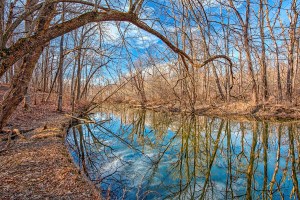 Hiking a narrow trail beneath bare trees beside the sunlit Little Calumet River on another windless day of record-breaking warmth in February, I admire a design of reflections in the stilled current. Settings such as this one remind me why I enjoy landscape photography. The curving bank serves as a leading line drawing the attention of viewers’ eyes through the scenery. I know I often like to stand alone below the overhanging branches at this elbow of the river where it bends toward the north, as I watch the deliberate movement of clouds—sliding high above and floating slowly below on the mirror-like surface of the water. Plus, the blue of the sky and the doubling of limbs appear enriched when seen in a clear river steadily carrying snowmelt downstream. I have frequently captured images of this location in different seasons, and each offers its own reason for appreciation; however, observing the mixture of stark winter woods lingering in this mild premature spring weather seems especially stunning to me.
∼ February 21, 2017 ∼ “Entering Great Marsh Trail”
 Once again skies remain clear, and the sun hangs overhead like a bright light bulb. The softest southern winds—hardly detectable, perhaps like a slow sigh—slightly stir the air and warm this winter day. The smooth untroubled lake surface glistens like window glass wiped clean with a chamois cloth as I pass the shoreline on my way to the Great Marsh just a bit inland. I feel the faint heat of sunshine on my face. All accumulations of snow and ice have faded away. Wisps of weeds rise from the shallow water near the trail where I walk, and a few geese slosh in the distance. Though the afternoon temperature reaches a record high in the sixties, unexpected for February, I find myself alone and about to begin down this path deep into the wetlands, winding among tall reeds and thin trees, their shadows of bare limbs occasionally crossing in front of me like stark black lines reminding that this is a false spring and winter still persists. A couple of narrow clouds appear amid a blue field above stiff stick figures of branches extending toward the sky. A soothing silence has settled in this setting, even bird calls are now few and far between, as I start through a landscape sometimes difficult to travel in other seasons.
∼ February 20, 2017 ∼ “February Snow Melt”
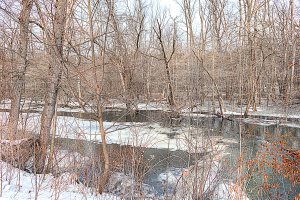 “How important is a constant intercourse with nature and the contemplation of natural phenomena to the preservation of moral and intellectual health!” Henry David Thoreau, Journals: May 6, 1851 Last week after overcast skies in mid-morning created a nearly shadowless landscape, a pond swollen by snow melt showed itself beside the trail in an opening between trees, sections of the water still frozen and snow-covered. Less than a mile into my hike, I shifted the cold metal tripod I carry over my shoulder, extended its legs and set my camera at eye height for a photograph. Even in winter, part of the pond is screened by tall weeds and remnants of undergrowth. The scene seems to evoke in me thoughts about the transition of seasons. Although stilled moments—the progress from past to present to future stalled and preserved as memory in a photo—I like to imagine all of my static images of landscape suggest a narrative continuing in the ongoing measurement of time and reflect an element in the ever-unwinding of life. Each of my pictures merely provides an opportunity for quiet contemplation amid a frequently chaotic world. For me, a photo serves a similar function as a poem, which Robert Frost nicely defined in his essay, “The Figure a Poem Makes,” to be “a momentary stay against confusion.”
∼ February 19, 2017 ∼ “Journal Entry Number Fifty”
 This post represents the 50th journal note in my Indiana Dunes project, and I again invite readers to browse through all the entries. Halfway through February’s four weeks, mild winter weather continues to cover much of the Midwest. As I walk farther along the wetland trail than I might if blocked by this season’s normal snowfall, the damp scent of a thawed swamp forest wakens my senses. I pause to listen to stillness broken only by a high-pitched squawk of a bird heard somewhere in the distance then quickly answered by another. Green and yellow tones of marsh water blend like wet paints mixed with swirling brushstrokes alternating on a canvas, clockwise then counterclockwise. Shadows of bare limbs backlit by late-day sunlight sprawl across the water’s surface as if offering nature’s scrawled signature, language of the landscape gracefully written for all to read. I like swatches of sunshine glistening beneath the empty hardwood trees, each gap between upper branches opening like a skylight. Also, I acknowledge that I delight in describing somewhat poetically the scenery in front of me. Though I am composing prose instead of poetry in this journal, old habits die slowly.
∼ February 18, 2017 ∼ “Snow-Melt Stream Through Dune Forest”
 A slowly moving warm front has at last passed over Indiana and stalled to the north. All the white patches of snow have disappeared along inland routes, and the winter landscape stands bare. Daylight already lasts longer, and the sun seems more persistent, steadily melting the final remnants of frost, even removing ice from the darkest parts of the marsh. Thoreau wrote about such weather in his journals (Jan. 24, 1858): “I do not quite like this warm weather and bare ground at this season. What is a winter without snow and ice at this latitude? The bare earth is unsightly.” As I trudge through muddy paths and step across flooded sections of the trail, I recall those almanac entries that insist frigid temperatures should return before the end of the month; however, local forecasts predict nothing but mild conditions for the next ten days. Therefore, I photograph the emptiness—deadwood and bare branches, dried spikes of weeds in the underbrush—and I note the sudden narrow streams of snow-melt after thawing and recent spells of rainfall, each little tributary appearing like a slim seam stitched into the seemingly fraying fabric of this forest.
∼ February 17, 2017 ∼ “Cold Front”
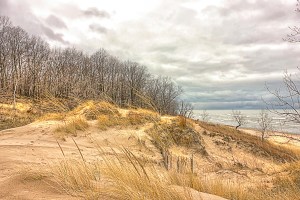 A cluster of dreary clouds crosses Lake Michigan in winter as late sunlight retreats and whitewater waves break against a barren beach, where ring-billed gulls still fidget at the water’s edge and strut on the wind-smoothed sand. A current of colder air arrives about an hour before nightfall and washes ashore, perhaps with a promise of overnight snow, as gusts already ruffle tall leaves of marram grass in the foredunes. Earlier in the afternoon I walked westward along the water in angled sunshine, my shadow following behind me, with the sweep of the surf scrubbing the narrow shoreline and swallowing my footprints. I carried my camera, hoping to capture an opening in the dunes, maybe a new blowout caused by relentless gales of storms rolling over the coast from the north, or a recent example of erosion. Instead, I climbed a dune mound beyond a collection of cottonwood trees to view the lake from above, setting my tripod on a sand cliff at the start of Trail 8, which rises toward Mt. Tom, the highest of the dune hills.
∼ February 16, 2017 ∼ “Dunes Creek in Winter”
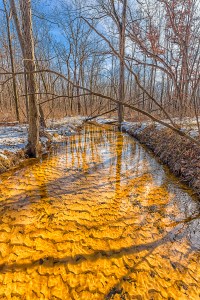 When another mid-winter thaw began last week, I walked along Trail 2 in Sunday sunshine, following the length of Dunes Creek toward the east from Lake Michigan through swamp woods to an inland marsh at the heart of Indiana Dunes State Park. A few cumulus clouds drifted overhead, directed by a slight southern breeze, but much of the time the skies remained fair, a field of rich blue not seen during the previous stretch of overcast days and stormy weather. Patches of old snow yet lining the banks like white bandages had mostly melted, filling the creek with cold and clear water, and the path beneath my feet seemed so soft, as each boot step left a deep imprint in the sandy terrain. By noon, the bright sunlight strengthened even more, shining through the empty air between bare branches, illuminating the lustrous yellow sand bed below a transparent ribbon of water, as the creek almost glowed with a luminous gold.
∼ February 15, 2017 ∼ “Trail Beneath Leaning Tree”
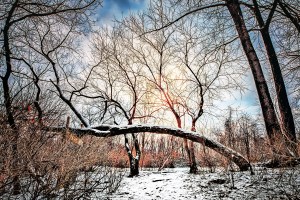 Last week as I was looking for a location to photograph, I followed a path I’d not travelled in the past. Intermittent sunshine through cloud openings after a light overnight snowfall warmed my morning walk. Windless weather also created comfortable conditions for this side trip into the dune woods; still, enough of a chill existed to prevent what little snow had accumulated from melting. When I climbed up one slope and over a narrow ridge along a small hill, the trail continued under a fallen trunk leaning almost parallel to the earth beneath it and serving as an apt contrast to the upright trees all around, their branches bare and interestingly expressive. Moving underneath this odd configuration, noticing its drooping thin upper limbs dragging the ground, I tried to imagine when the tree had been bent into this position and envision the gusts that must have caused such an event. Arched overhead as I stepped through to the other side, it offered the appearance of an entranceway, perhaps a passage into another area of the landscape, somewhere I might find appropriate scenery for the photo I was seeking.
∼ February 14, 2017 ∼ “Swamp Forest in February Thaw”
 All clouds quit the skies on Sunday afternoon, blown away by quickening winds warming the region. On very breezy days filled with the glare of bright sunlight, I like to travel trails deep into the swamp forest where empty trees anchored in waterlogged land are backlit by a blue sky. Despite gusts along the shore, a sense of stillness remains in these woods, their details made more visible by the illumination of unimpeded sunshine through the bare branches. Though only February, the wetlands have thawed, waters of marshes and creeks spreading wide to flood sections of this pathway I take, its soil already transformed into a thick layer of mud. Almost all the snow and ice has melted. Only the deepest recesses of shadows yet display white patches, and the nearly clear water offers fairly accurate reflections of the daylight or the silhouetted trees. Somehow, such scenes seem attractive to me, and I feel calm when walking in this setting. I know I am not alone; some others appreciate similar images in the landscape: “I’ve always loved, as Auden called them, the chinks in the forest / (He had the deer peer through them) / Those little slashes and blades of sunlight cutting streaks / Between the trees…,” Charles Wright states in his lovely book-length poem, Littlefoot.
∼ February 13, 2017 ∼ “Trail Two Through Trees”
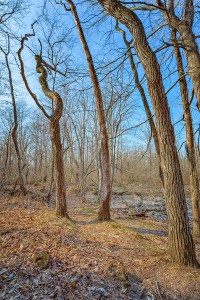 A lessening breeze struggles through thin trees and shuffles dead leaves still littering my path, as well as some sparse undergrowth along the trail ahead. Gnarled limbs twist artfully overhead, and creases mark the darker bark of trunks. Moving through these empty trees among the wetlands during a mid-February thaw, I detect the slightly sour scent of swamp water in winter; yet, I sense a state of well-being and a strengthening of my spirit. I know by the time I reach the beach, where the widening blue sky yet reflects in lazy lake water and a number of ring-billed gulls still soar or circle above the shore, an afternoon sun will gracefully begin its downward drift toward the horizon. But for now, nearly noon under a high sky, this silent stretch of the state park provides isolation with a peaceful setting for walking while wondering about the relationship between nature and self, perhaps what Thoreau meant when he wrote about the importance of all seasons in his journal (August 23, 1853). Addressing the reader, he advised: “live in each season as it passes” and “resign yourself to the influences of each” because “‘nature’ is but another name for health, and the seasons are but different states of health.”
∼ February 12, 2017 ∼ “Broken Wooden Footpath on Bright Winter Day”
 For photography I often would prefer to capture the way morning unfolds at daybreak, offering a new blue horizon, or how evening begins to slip away, colorfully painted skies shifting into nighttime darkness at sunset. However, if I hike along a long trail for any length of time I must accept available light, even as a harsh midday sun hovers directly overhead or when slate gray cloud cover shades the entire landscape, perhaps hiding details in distant hillside shadows and beneath nearby swamp forest trees. For a few hours during a recent Saturday afternoon, I traveled a trail through the center of the Indiana Dunes State Park, including a crease of ground skirting marshland and a broken wooden footpath heaped with winter’s debris that crosses shallow water. Though a couple of small cumulus clouds could be seen on the horizon between bare trees, the day’s bright sky remained mostly clear above, a glare of sunshine illuminating everything with an exposure that displayed an array of washed out colors or exaggerated contrasts in my viewfinder, forcing me to make a compensation in my camera settings that would preserve specific features in the imagery and attempt to present the scene as I experienced it.
∼ February 11, 2017 ∼ “Nineteenth-Century Farm After Snowfall”
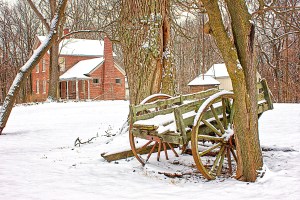 In an entry the other day (2/9/17 “Beach Trees in Winter”), I discussed returning to certain Indiana Dunes locations repeatedly for photographs displaying scenes in different seasons. I have followed a trail that at one point winds past a nineteenth-century farmhouse numerous times in various seasons, and I enjoy viewing the changes in the scenery arising with each shift of weather conditions. Though the farmhouse seems partially hidden by lush foliage and surrounded by deep-green grass in summer, its autumn appearance becomes subsumed in a landscape that has been transformed into something much more colorful and artistic. Even in late fall—as the last leaves linger in surrounding trees and the tawny lawn leading to the front door remains visible, though displaying its evidence of a faded hue—the farmhouse exists almost as a mere complement to that natural setting. However, during the snowy months of winter, when the tree limbs are bare and the reddish bricks of the building attract more attention in contrast with the whiteness above or below, the farmhouse provides a central focus for any photograph, representing a hub of warmth amid the frigid temperatures outside. Additionally, although most of a farm’s activity occurs in other times and it is not designed for much winter work, when its sheds or equipment lie unused under a layer of snow as if dormant, those elements encircling the farmhouse—such as the old cart—often contribute to the subtle beauty of its environs. They supply interesting examples of everyday objects suddenly demanding greater attention, especially when the edges of their lines or the rough textures are emphasized and brought forward in juxtaposition with a smooth pale surface of snowfall.
∼ February 10, 2017 ∼ “Ice Shelf and Island Iceberg”
 Along the beach on a bright afternoon, an ice shelf whitens in winter light and an island iceberg appears at the edge of the lake. Marram grass waves in weakening wind to stir my memory of summer’s warmer weather. A band of damp sand separates the two as if it were a metaphor for the barrier between seasons. Though the air remains frigid, the sunshine is forgiving, and I shrug off the cold. I find myself hiking through the foredunes, then hugging the shoreline as I walk to the west toward a lowering sun, taking my time to consider composition for a photo. Once more, image inspires description and my eye guides what I write. However, I know sometimes language leads landscape, and the composition seen in my camera frame evolves from the gathering of words already forming a literary composition in my mind, sentences beginning to be written and growing into journal notes that owe their existence to an influence from the vigorous visual vocabulary of imagery.
∼ February 9, 2017 ∼ “Beach Trees in Winter”
 In an interesting article on photography by Teju Cole that appeared in the January 31 issue of The New York Times Magazine, he investigates a theme concerning recurring images of a particular object or scene over differing time periods. Cole comments: “The meaning of a photograph changes when it is set next to another to which it is related…. What is different is not the subject but the time it was photographed. Looking at such a series confirms that when you make one photograph and, some time later, make another of the same thing, what is inside the frame changes. With the passage of time, you no longer have ‘the same thing.’” I have frequently suggested an inspiration for my many photos capturing multiple images of locations at the Indiana Dunes connects to a fascination with the variety of moods, tones, growth, or decay displayed when the same setting is seen in different seasons and following changes created by weather conditions or human interaction. This grouping of beach trees near the state park pavilion has been a favorite site for me to focus upon numerous times. The stark character of these empty trees during snow in winter differs greatly from the rich green they exhibit when full in summer months, especially during days when a vibrant sunset aligns just above the horizon of Lake Michigan right behind them.
∼ February 8, 2017 ∼ “Marsh Water Beside Trail Bridge During Winter Thaw”
 What little sunlit snow remains near Lake Michigan seems to sparkle now that the rough weather has abruptly ended. On days like this I like to think each wave that sweeps upon the beach leaves a lasting imprint, though I know the sand always reclaims its shape and obliterates the forceful water’s stain. Like the final few clouds—little white formations that have detached themselves from last night’s squalls and still persist weakly overhead—some early visitors walk along the shore, linger in this sudden sunshine and appreciate a soft southern breeze. A couple of them gather small samples of interesting driftwood debris at the edge of the lake, and another guides his young child to toss pebbles into the surf. But I choose to move inland on a trail toward the inner wetlands, where the landscape has been sheltered from northern winds by dune hills, the setting has already warmed, and the marsh has thawed thoroughly. When I pause on a wooden walkway over the water, I notice patches of weeds and willow thickets that have been evident everywhere, even if thinned a bit in winter. However, I focus my attention and my camera on the calm sky reflected in the swamp’s still surface, nearly clear in this season.
∼ February 7, 2017 ∼ “First Sunday in February”
 After an overnight warm front scraped away the morning haze, the lakeside landscape brightened. The ground around this natural lowland and drainage ditches filled gradually with intricate tracings of maple or oak shadows darkening and sharpening. By noontime, the woods yellowed with sunshine, and I had hiked a few miles through an east-west route, moving from marsh into hardwood forest. But now the afternoon sun has hauled itself across the sky and settled in the southwest behind thin empty trees rising in front of me, their bare branches shifting slightly in a light breeze. The path ahead remains pasted with damp leaves and partially blocked at times by dark blistered bark of dead limbs. A half-frozen creek winds alongside this narrow trail, still two months before spring flooding, where I pause a while to watch a raccoon steadily make his way past me, though he’s hesitant and wary of my presence. Soon this day will fade away with a sunset, displaying tints similar to the discolored skin of a bruise, quickly closing like a loose slip-knot suddenly pulled tight by an unseen hand until it disappears.
∼ February 6, 2017 ∼ “Lake Shore After Light Snow”
 The brisk wind continues, though no more snow, only vague gray clouds (almost colorless at times) come closer; then, as if weighted by their freight, they hover over the slowly rolling waves. I notice silhouettes of stiff limbs trembling a bit in empty trees seemingly standing sentinel on this coast. A few ring-billed gulls fly by, rising high above the dune hills, sliding through the scene like white arrowheads with the pale trail of their flight interrupting the dull overcast. They descend in the distance, almost out of sight, to a thin strip of tan sand and dark brown driftwood showing along the shore, tonal notes of the bird calls clearly drowned out by the breaking surf. Clusters of large snow-covered stones line the lakefront—each grouping gathered in a planned arrangement—forming irregularly banked barriers beside the beach as a breakwater. The sky lightens a little on the western horizon and reveals the faint outline of a factory smokestack at a far-off harbor. I register this moment in my memory, merely knowing I will want to recall a variety of details beyond what can be perceived in any photograph.
∼ February 5, 2017 ∼ “Pausing on a Sun-Warmed Path”
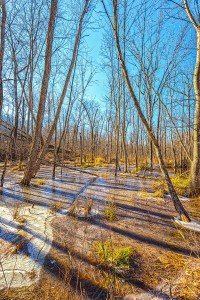 Though the weak snowstorm has passed to the east and now seems no more than an afterthought, cold northern drafts last another day along the lake. Inland, hiking a sandy trail through sun-warmed woods—sheltered between dune hills and beside a marsh with ice sprawling across its surface—I search for something of substance to photograph. Seeking subject matter, I often find myself focusing on the figures of empty trees—perhaps the twisted trunks of birch standing beside me or an array of oaks with bent branches arching overhead and nearly netting the few remnants of clouds drifting toward the horizon. Even the deadwood, bark darkened by rot, sometimes supplies a central interest for an image. Indeed, I have already spoken about my fascination with such scenes (1/17/2017 “Winter Trees”). While walking, I frequently pause to think of daily readings—usually from nature writers and poets I admire—that I had absorbed the night before or during previous evenings. I examined an essay yesterday written by Mary Oliver (“Owls”) in which she speaks eloquently of a similar setting: “And I search in the deeper woods, past fire roads and the bike trail, among the black oaks and the taller pines, in the silent blue afternoons, when the sand is still frozen and the snow falls slowly and aimlessly, and the whole world smells like water in an iron cup.” Wakened from my memory by the distant call of a lone bird somewhere among the upper limbs I had been scanning, a pleasant sound rarely heard breaking the silence in this wintry scenery, I continue on my way.
∼ February 4, 2017 ∼ “Cabin at Bailly Homestead”
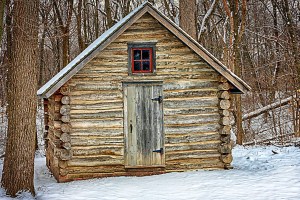 I have photographed the storage log cabin at the Bailly Homestead a number of times after hiking a trail through the neighboring forest in various seasons, but I prefer its appearance in winter during snow. The coloring of the logs appears complementary to the trunks and branches of empty trees in the surrounding woods. The snow and suggested cold create an atmosphere in which the wood of the small cabin presents a warmer and more appealing hue than when conflicting with the green grass of other times in the year or competing with the full foliage often overhanging and filling in its background. Indeed, the spirit of this backdrop with intricate crisscross of branches lends a mood that seems somewhat similar to an abstract expressionist tone. The random pattern established by that stark design of scattered leafless limbs contrasts nicely with the minimalist and orderly parallel lines of the cabin’s logs. In addition, the limited range of colors throughout much of the scenery in the image allows the deep red squares of the window frame to stand out for greater attention. Furthermore, other geometrical shapes—the rectangular door, the circular ends of the logs in the corners of the walls, and the triangular resemblance in the angles of the pitched roof—are emphasized in this restrained setting, as is the plain symmetry contributed by inherent elements of the cabin.
∼ February 3, 2017 ∼ “Landscape and History”
Even in this winter morning as I walk into the woods with the trees empty of leaves, an evident lessening of light and a thin lingering mist among upper limbs diminish visibility. Nevertheless, bare branches appear backlit by a bit of indirect illumination from an opening over frozen swamp water in the distance, their distinct shadows sharpening and lengthening across the slick surface beneath them. Sheltered from lake winds—stilled in this location half-hidden by dune hills—and aware of an obvious absence of chirping birds, I develop an acute sense of silence. With every step I take, I wonder about those who once may have traveled this same trail centuries ago. I like to imagine as far in the past as the first fur trader who settled nearby on a rise beside the Little Calumet River in the early 1800s or before that when local Pottawatomi and Miami tribes would move through parcels of hardwood, along sandy paths, or across marshland on routes around lower Lake Michigan. Alone in nature, I contemplate the narratives of those whose lives could have included visiting this location and whose voices at one time might have floated through this swamp forest. I think about how landscape links us to history.
∼ February 2, 2017 ∼ “Landscape, Language, and Imagination”
 I want to describe the day. As the storm proceeded east, a chaos of dark clouds cleared the coastline and only some pale stragglers remained over the lake. The cold northern wind continued to create a current that would shape small waves and force them to break upon the shore, each approaching the beach like a thin white scroll unrolling in the bright sunlight, as if awaiting words it would wear. Whenever this usually calm surf seems rough, in my imagination I remember my childhood along the Atlantic, my father walking beside me at the edge of the water—slick pebbles and seashells still glistening in sunshine—with fishing gear in his hands the way I now carry my camera on a tripod. In moments like this, the past and present blend, and any vivid image I capture in my viewfinder somehow can recall a memory complete with notes I jot in my journal that often form a brief description, sometimes even including an implied narrative, thus “Photographs & Paragraphs.” In Richard Hugo’s well-known essay on writing poetry, “Triggering Town,” he suggests a process that parallels my use of landscape photos to inspire language and reminiscence: “triggering subjects are those that ignite your need for words…. Your words used your way will generate your meanings. Your obsessions lead you to your vocabulary. Your way of writing locates, even creates, your inner life. The relation of you to your language gains power.” Perhaps this relationship between landscape, language, and imagination helps to explain my fondness for the Indiana Dunes and one reason for my repeated visits.
∼ February 1, 2017 ∼ “Vignette: Dunes Creek”
 A vignette in literature might be defined as a brief description with implied storyline. In photography, a vignette is an image that dwindles and disappears into its edges. Today, I’d like to write a vignette recovered from memory about a dawn when lake waves were ridden by winter winds, cold currents and light snow blowing all morning over beach sand. Soon, the inland woods filled with little drifts, and the shallow water of a creek winding between a couple of dune hills looked like ribbon let loose from its spool. After clouds thinned and sunlight illuminated a landscape unbothered by even a breeze, a sudden stillness existed, and those leaves lingering from fall on nearby limbs failed to flutter much. I recall the clicking of ice slipping from upper branches of bare trees now vulnerable to strengthening sunshine. Later that afternoon, while I walked a trail through this thawing scene, I was sure I smelled a faint scent of fragrant wood-smoke and thought I saw a slender plume of gray rising above a small ridge from a campsite somewhere not far ahead, yet hidden by a line of pines. By the time I reached a compact clearing where I figured the fire had been burning, only a collection of charred twigs and a clutter of blackening embers—some still warm to the touch—remained in a hollow pit. A single set of footprints tracked toward the north in the direction of the shore, but I did not follow. Instead, I returned to the creek, beginning to swell with snow melt, to photograph the scene I wanted to keep as a remembrance that perhaps someday might inspire a bit of writing.
∼ January 31, 2017 ∼ “Trail After Lake-Effect Snow”
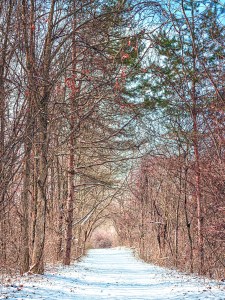 On Sunday morning light lake-effect snow speckled the sky and settled on some of the bare branches overhead. By the time I hiked a few short routes through the woods, glimpses of still-dim sunshine briefly appeared, filtered by a shallow tide of gray clouds streaming onshore. Large snowflakes floated and flitted in a weak breeze like those tiny white plastic particles shaken in a glass snow globe. The accumulation covered thin bristles of plants in the undergrowth, and it powdered brown shrubs all along the way. Some pines huddled near the horizon appeared to add a swatch of green to the scenery. I followed an east-west trail between tall trees with long limbs arching far above me, and I paused just long enough to photograph the narrowing path stretching ahead, displaying the distant place in front of me where the course curves almost at a right angle, turning toward the north. During a brief show of direct sunlight before the afternoon clouds darkened again, I hoped to capture the relaxed atmosphere of my surroundings and the manner in which winter’s whiteness leads the eye, emphasizing a subtle elegance evident in the natural design rising all around.
∼ January 30, 2017 ∼ “Luminous Landscape”
 When I arrive, I notice pale clouds roaming over a dark forest of empty trees, limbs still limp with late-morning frost, as though tired of waiting for daylight. At last, splotches of sunshine seep through fog permeating the woods, and each tree appears to settle into place. Their thin figures fill the frame in my viewfinder, lengthening gracefully above a glaze of frozen swamp water. I listen to the silence and think of Thoreau’s observation in The Maine Woods that “the general stillness is more impressive than any sound.” Even an absolute absence of wind emphasizes the solemn tone in this favorite place I regard almost as a sacred setting, somewhere I revisit often. This serene atmosphere with a sideways illumination infiltrating the scene reminds me of those landscapes painted by Luminists that I love so much, works in which the depth of perspective is created by shaping a place with its available light. The nineteenth-century artists offered images inviting meditation on the spiritual element inherent in our environment, as well as examining the ever-present subconscious influence of nature.
∼ January 29, 2017 ∼ “The Photographer and the Viewer”
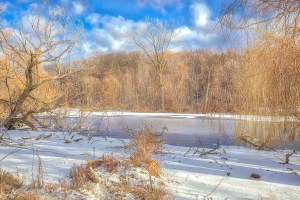 A common comment I receive upon viewers perceiving the images in my photography has to do with the notable absence of people. My landscape photos almost always occur when I am alone in nature, preferably capturing an instant at a particular location that nobody else would have witnessed. In a sense, I like to think I am preserving a moment that otherwise would be lost for all time, sharing an experience and exhibiting a setting no one else had an opportunity to absorb but in a way anyone can appreciate. In fact, however, I might suggest a contrary opinion that each of the pictures I take contains a human presence. I believe in the well-known point of view offered by Ansel Adams: “There are always two people in every picture: the photographer and the viewer.” As is the case for other artists in all forms of art, even if subconsciously, I include an element of myself in each of my works, whether they be poems, prose pieces, or photographs. Selections I make in composition and camera settings determine the character of the scenery one eventually sees, and these choices are influenced by my individual aesthetic approach, as well as the attitude I bring to the task. Likewise, responses to my photography are shaped by the personal background—intellectual, emotional, spiritual—belonging to the viewers.
∼ January 28, 2017 ∼ “Waterway After Snow Melt”
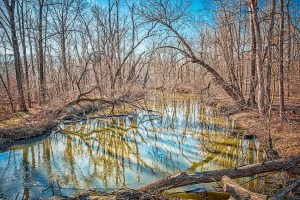 Following days of dark cloud cover and southern thawing winds whipping toward Lake Michigan, morning unveiled a sky of bright sunshine and a river swelled by snow melt. Though still only January—a time when winter yet lurks, preparing its return—a brief spell of mild temperatures invites me to hike a trail sometimes difficult to travel in this season. When slippery with a layer of ice underneath fresh overnight snowfall, the path conceals dangerous holes where a false footstep easily could lead to a broken ankle or fractured leg. This enthralling route through the dunes winds beside a waterway, which now flows slowly beneath the busyness of bare branches bending overhead and mirrored in the surface of the water like fine calligraphy lines or brushed lashes of shadow. Notwithstanding a pale blue sky and brilliant sunlight that fail to offer the kind of illumination with tints or variations in hues I’d prefer for a deeper tone in my photograph, hints of the distinctively quiet character in this landscape seem evident. Presenting a setting of stillness suitable for staring into nature during a moment of reflection, I think of Thoreau’s well-known words from Walden: “Heaven is under our feet as well as over our heads.”
∼ January 27, 2017 ∼ “Repainting the Landscape”
 “Nature has many scenes to exhibit, and constantly draws a curtain over this part or that. She is constantly repainting the landscape and all surfaces….” —Henry David Thoreau, Journals: Nov. 8 1858 The kind of light witnessed in midday during cold winter weather obviously differs from the golden hues of summer sunsets, but I usually find its luminosity correct, compelling, and complementary to seasonal situations. Cloudy skies and snow-covered terrain seem to need the cooler tones or muted colors that come with conditions at this time of year. When I walk the beach following a slight overnight snowfall, the whitecaps of frothy waves brought by northern winds appear to parallel purity of the recent accumulation along the coast, and I appreciate the clean expanse of scenery encountered. At other times, intriguing patterns develop on the dunes due to a mix of drifting sand and snow blown about by the onshore breezes. Even on those completely overcast days when the landscape shows signs of desaturation, or during dense morning fog drifting above an inland marsh, I discover an apparently endless array of ways to take photos that hold my interest. I like to think such a variety of circumstances in the climate throughout the year at the Indiana Dunes—this repeated “repainting of the landscape” displayed in images I capture—adds a sense of freshness to every hike I make.
∼ January 26, 2017 ∼ “Lifting Fog at Dune Marsh”
 Arriving at the Indiana Dunes State Park, I notice sunshine, still low and slanting from above a southern horizon, slips between stiff limbs of winter trees. I feel a bit of wind blowing slowly at the back of my neck like exhaled air released after a held breath as I move through the wetlands. At last, the wash of noon light and a slight breeze from the north seem to lift what little is left of an early-morning fog over this strange landscape of dune marsh. The nearly surreal scene I see on the rear screen of my camera almost catches me off guard. All along the trail, these dreamlike views have become so commonplace I catch myself taking them for granted, and I just about forget to snap a photograph. But then as if merely a gesture of habit or an expression of some need to keep this occasion somewhere other than my untrustworthy memory, I stop to capture the moment. Later, looking at that past of brightening scenery suddenly appearing backlit on my computer screen, as if a gift unwrapped, I again sense the cool current coming onshore from Lake Michigan, and I recall the renewal of blue filling a field of sky above the setting. I witness once more the seemingly tense—or perhaps elated in celebration—spirit evident in the twisted reach of each bare branch elevated toward the heavens. Glimpsing back into the distant gathering of empty trees, and attracted to this swamp forest rising elegantly from the collected water, I am able to appreciate nature’s subtle presence preserved in a continuing present, frozen in time by an image, and I derive an unexpected aesthetic pleasure from this simple picture.
∼ January 25, 2017 ∼ “Marsh Trail Bridge in Winter”
 As I mentioned in my previous post, I find myself fascinated by the way objects may be influenced with changes in the weather, especially during harsh conditions in winter. I also noted that I had traveled along Trail 2 on an extraordinarily warm Saturday in mid-January. The eastern end of this three-mile route, which begins farther west near the entrance to Indiana Dunes State Park, crosses an extensive marsh that stretches through the inner corridor of the dunes. A boardwalk nearly even with the wetland’s surface bridges the marsh for more than a quarter of a mile, normally enabling hikers to cross from south to north toward Trail 10 and dune hills hiding the beach just beyond. However, the state of the wooden walkway has been greatly deteriorated or badly damaged in spots, and currently the path is deemed in a shape too dangerous for passing, so it has been officially closed to pedestrians by park personnel. Alternating periods of freeze and thaw have destroyed portions of the boardwalk. Gaps of differing widths exist in some places where boards have been displaced, and in the rest of its length, sections are uneven, rippling or dipping into a water level raised by snow melt and recent rainfall. In addition, a number of locations are blocked by fallen branches or splintered remnants of toppled tree trunks, seasonal ruin in a transitioning swamp forest.
∼ January 24, 2017 ∼ “Fresh Fallen Tree”
 When a brief mild break in the winter weather occurs, I like to hike familiar trails to examine any alterations in the landscape that have happened due to strong winds, icing and thawing damage, or flooding from melting snow. During my long walk on an unusually warm January afternoon this past Saturday, I discovered a variety of scenes offering evidence of harm to the terrain since previous visits. Broken branches and even newly felled tree trunks commonly occur because of northern gusts sweeping onshore during storms arriving from over the open waters of Lake Michigan, particularly in this season when upper limbs might be weighted by sleeves of frost. Thoreau commented in Walden about his closeness to those trees he regularly passed along paths while walking in winter: “I frequently tramped eight or ten miles through the deepest snow to keep an appointment with a beech-tree, or a yellow birch, or an old acquaintance among the pines…the ice and snow causing their limbs to droop….” As I noted in a recent entry (1/17/2017 “Winter Trees”), I frequently recognize and regard trees seen along routes through the woods “almost as companions.” Consequently, I am sometimes surprised and saddened to witness any destruction to these identifiable elements in the countryside—especially to such substantial and longstanding objects—as much as I realize these situations are typical and in some sense necessary to the routine progression of nature.
∼ January 23, 2017 ∼ “Warm Winter Day”
 Taking advantage of unseasonably warm temperatures in the mid-sixties on Saturday, I decided to hike a couple of trails at the Indiana Dunes State Park. Extending on a loop for 5.5 miles, Trail 10 follows an east-west route that moves along the beach and then returns through an inland area of the dunes shielded from breezes by hills to the north and the south. I kept only to the wooded inner portion of the trail, which is populated by a variety of trees, but predominately white pines and black oaks. The passage also parallels a large marsh at the heart of the park. The day’s mild weather had been brought by strong southern currents with occasional gusts, but the protection for this section of Trail 10 meant conditions weren’t chilled by the wind, and I even removed my jacket at times to remain comfortable. Additionally, I walked a while on Trail 2, which extends for 3 miles, mostly through a stretch thick with an assortment of tall trees in the dunes’ interior on the other side of the marsh. Because I frequently stop to consider locations for possible photographs—seeking objects of interest or examining various angles for composition of pictures—as well as actually capturing images, my progress often can be described as slow yet steady. Indeed, as I mentioned in a previous entry (1/15/2017 “Practiced Patience”), my process for photographing landscape has become more deliberate over time. Nevertheless, since both trails are relatively flat and regarded among the easiest for travelers, I managed to cover quite a bit of distance, and though I regretted the absence of snow and cold normally associated with January in this region, I made the most of the opportunity to bring back some splendid shots representing scenery in the terrain during a mid-winter thaw.
∼ January 22, 2017 ∼ “Winter Winds”
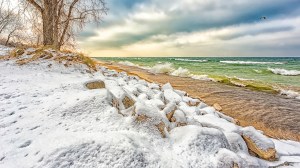 As a photographer waking to a windy day, which occurs often in this region of the Midwest, my first instinct is reluctance to pack my camera and gear for gathering images of the landscape. Movement presents problems for capturing tack sharp photos, especially in summer months when swaying branches and windblown leaves are shifted by strong southern gales. This difficult situation exists even more during periods of stormy weather. The scenery around Lake Michigan frequently appears most interesting at the arrival of ominous cloud formations before a squall or upon viewing the first glimpse of sun rays filtering through the overcast following a rainstorm. Whether indirect or bright, the lighting can include dramatic luminosity and contrast, presenting an aura of depth to the setting sometimes not very different from those glorious golden hours of sunrise and sunset. Additionally, quick currents of air sweeping across the water create waves that lend a dynamic sense to the scene. However, since such conditions are almost always accompanied by gusts rushing onshore, a steady and weighted tripod is needed, as well as a microfiber cloth to constantly clean the lens face and free it of sand or grit. Nevertheless, I find myself more eager to snap pictures of the landscape during winter winds when trees empty of leaves lessen concerns about blurring due to blustery circumstances and an active surf defines the shoreline.
∼ January 21, 2017 ∼ “Dune Tree in Winter Light”
 The effectiveness of photographs often depends upon the kind of light available, and landscape images rely on natural illumination. Traditionally, the optimum times for outdoor pictures are the golden hours around sunrise and sunset. Because of the sun’s position near the horizon, rays move through more of the earth’s atmosphere, which alters the temperature of the light emitted, usually warming the scenery and intensifying saturation. In addition, lighting can add interest when sunshine becomes filtered by a thin overcast or partial cloud cover. Noon normally has been regarded as the least favorable time of day for photography. Nevertheless, with the weaker distant sun and lower angle of the sunlight in winter, photographing in midday may not display those harsh shadows and bleached colors caused by a strong sun on a cloudless summer afternoon. Therefore, I appreciate that images captured at the Indiana Dunes during winter frequently seem softer and subdued, even when taken in the middle of the day under clear skies. Indeed, as John Burroughs observed in his 1875 work, Winter Sunshine: “Sunlight is good any time, but a bright, evenly tempered day is certainly more engrossing to the attention in winter than in summer….”
∼ January 20, 2017 ∼ “Sand & Steel”
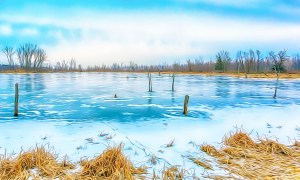 On Sunday I attended the opening of an excellent feature exhibition in the Brauer Museum of Art at Valparaiso University titled Sand & Steel: Visions of Our Indiana Shore, which included more than 60 paintings and photographs depicting images of nature or industry among the Indiana Dunes along the southern shore of Lake Michigan. The paintings ranged from realistic portrayals of mill workers by Morris Topchevsky to impressionist views of the Indiana Dunes—most notably in nearly two dozen works by Frank V. Dudley—to almost pure abstract perspectives on similar scenes by artists such as David Sander and Konrad Juestel. Likewise, photos on display included contemporary documentary pictures by Gary Cialdella and the more pictorialist nature photos of William D. Richardson from the early twentieth century. As I have noted a number of times, I find inspiration in Dudley’s choice of content in his paintings of the Indiana Dunes, including the style evident in his impressionist images, but I also appreciate the ways nature may be represented even more playfully. In fact, as an entertaining exercise, I sometimes create photographs that seem to blend a pictorialist approach with an impressionist influence, as can be seen in my photo titled “Marsh After Frost.”
∼ January 19, 2017 ∼ “Experience and Expertise”
 In my initial proposal defining the ambitions of the project involving this journal, I noted my hope to visit the Indiana Dunes repeatedly and frequently, as I have done in the past, with the intention of knowing the landscape so intimately that elements in the written descriptions would accurately reflect details seen in my photographs. I expressed my goal to view this landscape through words and images in such a way that content in the two media would intersect and complement one another. Convinced only increased familiarity could assist me in achieving results that permitted readers and viewers of my work to witness a blending of the literary with the visual, I committed to sometimes even photographing the same locations—creeks, trees, beaches, bluffs, etc.—over and over again in different seasons and under varied circumstances to more fully display the delight evident in the environment. (For instance, the scene in the accompanying photo is one I have captured on numerous occasions under an array of weather conditions.) I adopted as my model artist Frank V. Dudley, the “Painter of the Dunes.” I wished to emulate to some degree this man who visited, depicted, and then lived in the Indiana Dunes for fifty years, accumulating—through life and art—an experience and an expertise in authentically representing the setting he so deeply appreciated. Additionally, I considered a perception on the importance of local knowledge in nature once offered by Barry Lopez in his 1998 collection of essays, About This Life: “To do this well, to really come to an understanding of a specific American geography, requires not only time but a kind of local expertise, an intimacy with place few of us ever develop. There is no way around the former requirement: if you want to know you must take the time.”
∼ January 18, 2017 ∼ “Berries and Bare Branches”
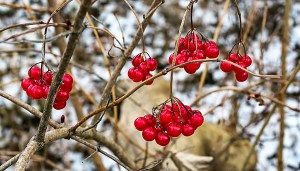 The milder temperatures in this mid-January week have melted almost all snow and ice, and these foggy days have been mostly gray. Therefore, I have been reluctant to capture wide angle photographs of the landscape that may display expansive panoramas of bland scenery. Current weather conditions tend to lend more atmosphere and texture to images exhibiting a greater sense of intimacy. Indeed, cloud cover normally enhances the ability to examine more obscure details in nature clearly, and an overcast sky usually enriches any vibrant hue found in the forest. Consequently, because harsh sunlight often contributes distracting shadows of branches or it blanches nature’s vivid tints, in such situations I will anticipate spending some time focusing on smaller subjects, especially those showing a lingering splash of color within the context of an austere wintry setting. As I walk the dune woods trails, I observe each of the trees or every tuft of underbrush appears bare and mostly monochromatic except perhaps for a few scattered clusters of bold red berries, still slick and glistening with morning moisture, that stand out in contrast with the clutter of a stark thicket of shrubbery and what looks to be a seemingly spiritless backdrop. I seek to preserve the polarity in this moment.
∼ January 17, 2017 ∼ “Winter Trees”
 Reviewing the photographs that I have posted to this journal so far, I notice one element seems to appear repeatedly and garners the central attention. My evident interest in trees becomes visible in image after image, even in instances when I intend to focus elsewhere in a setting. For me, a tree frequently offers itself as the most appealing and aesthetically pleasing object within a scene, often metaphoric of an emotional or spiritual state, no matter which season is being depicted. Budding branches in spring represent beginnings of new life; full green canopies suggest the lush character of summer’s vitality; fall foliage paints nature with its richly vivid colors; and the skeletal structures of gnarled or twisted limbs in winter may be the most expressive and exquisitely artistic. These perceptions present nothing new or surprising to admirers of landscape. However, their existence at all times of the year provides a comfort or reassurance whenever I hike trails in forests with long lateral limbs looming overhead or through swamps when surrounded by branches bending in every direction. When I climb high among dune ridges, I am heartened to find a lone leafy tree on which I can lean. Standing sentinel beside me, it spreads shade and delivers a place to rest a while. Indeed, I might regard these trees almost as companions, and on many trails I measure my progress by presence of a familiar network of branches overarching the path or by recalling the curve of extensive limbs at the edge of a pond, perhaps spanning a narrow stream. Instinctively, I may map my way through the woods on a gray day by following the remembered shadowy figures of trees. I enjoy photographing in each season, displaying the gradual but significant modification that occurs; however, I especially appreciate moments during winter when the dark bark of bare trees stands in contrast as a distinctive silhouette against a cool blue sky, and I think of Thoreau commenting about trees in The Maine Woods, “it is the poet, who loves them as his own shadow in the air.”
∼ January 16, 2017 ∼ “Seasonal Shift”
 When winter winds blow over Lake Michigan from the north, relentless waves break beautifully on the southern shore, and the cold flow of a Canadian air current freezes everything along the beach. Some iconic items linger from summertime, such as old sailboats left on stretches of sand—suddenly separated from the lake by a collar of shelf ice and vulnerable to becoming buried in snow—or lifeguard towers empty since the end of summer yet now disguised by a shiny white glaze. These remnants of warmer weather serve as constant reminders of the dramatic contrasts witnessed in the ongoing seasonal shift at the Indiana Dunes. After a strong snowstorm passes, a calm often settles the lake waves, but a bitter chill continues to contribute to an accumulation of shelf ice encrusted along the water’s edge, and small icebergs speckle the surface as far as the horizon. On the sandbars nearer to land, little irregular islands of ice are also visible. Thus far this winter, the lesser amounts of amassed shelf ice reflect a pattern of mostly milder weather following brief spells of frigid temperatures. Nevertheless, in some years (as can be seen in the accompanying photograph) remnants of shelf ice will persist into March before breaking and melting back into the lake.
∼ January 15, 2017 ∼ “Practiced Patience”
 A couple of days ago, while walking through the woods on a path beside a partly frozen stream for quite a while at the Indiana Dunes State Park as crisp icy leaves crunched underfoot, I realized I hadn’t yet taken any photographs. My process for exploring trails and seeking locations for images has altered over time, partially due to a practiced patience. When I first photographed the Dunes, I would move quickly and snap numerous pictures, knowing I could sort through the results later. However, I discovered myself enjoying my travels less because I believed I wasn’t completely valuing live the landscape captured in my viewfinder and preserved on my memory card. I decided to go forward slowly instead, stopping to click my shutter only when I had thought through the composition within an imagined frame of sight in front of me. In addition, by developing a habit of carrying my camera on a tripod, my pattern for taking pictures became more deliberate. One might consider the new approach as being similar to old school photography when I would have at most only a few rolls of film to use on any given trip. Consequently, when I return home now the image counter on the camera displays only a fraction of what it once did. Nevertheless, each scene depicted seems more complete, a product of careful contemplation rather than of quick impulse. Indeed, my appreciation of the nature around me has increased as well, since I relish the setting and absorb the atmosphere.
∼ January 14, 2017 ∼ “Scenery to Savor”
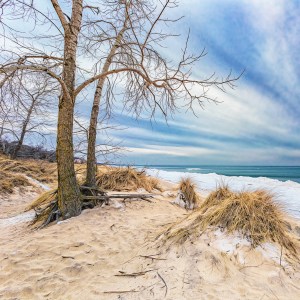 When I walk a trail along the beach in the Indiana Dunes during winter, as in the accompanying photograph, I am reminded of the remarkable changing nature of the landscape and its altered atmosphere between seasons, and I recall why I appreciate each time of year for the characteristics it presents. Traveling the same route in summer I will happen upon many sunbathers with whom I will share the sandy stretch. Couples who enjoy strolling the water’s edge, families with children playing joyfully in the surf, or groups of teens tossing a football to one another are common to encounter. This lively community along the shore seems to exist from sunrise to sunset in summer. Similarly, the coastline vista appears vivid with deep green trees lining the dune ridges as marram grass decorates the foredunes and dances in a light breeze. Patches of underbrush become dappled with colorful wildflowers. However, hiking the length of the beach on a frigid afternoon last week to capture images of the ice shelf, I didn’t come across a single person along the way. Snow covering the sand showed no other footprints. Wind-whipped waves and thick clouds driven by a quick air current displayed the only movement within my sight on that gray day. Nevertheless, I always find myself amazed by the subtle appeal in such a setting, as well as the serenity felt in solitude. Selfishly, as though my senses have been awakened by the cold, I tend to view the landscape more intensely, perhaps regarding it as my own to witness and savor, and the resulting photos I take frequently exhibit a satisfying wintry tone, both austere and aesthetically pleasing. Consequently, I believe, as Ralph Waldo Emerson offers in his “Nature” essay: “Not the sun or summer alone, but every hour and season yields its tribute of delight.”
∼ January 13, 2017 ∼ “Conscious Composition”
 As an author, a poet, and someone who teaches literature for a living, perhaps I perceive symbolism as a way of understanding more readily than others, and I draw upon that tactic when photographing landscapes. In an attempt to add depth when describing a scene, the imagery in my writing usually offers itself for interpretation. Dominant details included are determined by their ability to be viewed as contributing to an underlying meaning. Additionally, elements within the work frequently are selected because of the message implied by the common tone or connotations evoked with each word. Likewise, when choosing subjects to capture with my camera, I consciously create a composition in which objects relate to one another in a way that may cause observers to link the separate sections of a scene contained within the viewfinder’s framing. In fact, sometimes as I snap the shutter, I’m already imagining the indirect impact certain aspects of the picture might exert on an audience. In this photo I deliberately positioned the horizon in the center when aiming my lens, even though most times such a balance between sky and surface would be seen as traditionally less interesting. I wanted to suggest the tension inherent in displaying equal portions. Similarly, I divided the perspective into halves with the nourishing life-giving sun appearing on one side while the other consists of empty trees. I also appreciated that the lake presented itself as emblematic of transition in that its thin ice layer was melting under sunshine. Moreover, the reflection of the sunlight glittering across both water and thawing ice served to emphasize its warming influence on the setting. Yet, one’s eye can also travel from the attention-seeking sun in the upper right hand corner to the cold snow still evident in the lower left. However, I preserved a sense of the sun being an intruder in this wintry sight by adding a few bare limbs above and beneath the sun, nearly surrounding it. I wanted to subtly suggest this contrast between sun and snow, warm and cold, would be a continuing battle, a situation that will be repeated, which explains the title I’ve given to the image: “Sun After First Storm.”
∼ January 12, 2017 ∼ “Memory, Knowledge, and Imagination”
 During an insightful essay about returning to Indiana after a spell away (“Landscape and Imagination,” published by Scott Russell Sanders in his 1991 book titled Secrets of the Universe: Scenes from the Journey Home), the author comments: “It is increasingly rare for any of us to know with passion and subtlety a particular place….” Because of the current restless mobility of Americans and the tendency of individuals, especially younger ones, to be more engaged with sources of technological entertainment in contemporary culture, Sanders suggests fewer folks remain for extended amounts of time in a set location, and only a limited number repeatedly immerse themselves in nature. Interestingly enough, one must note Sanders could not have conceived the exponentially greater addiction to technology existing in today’s society, now more than a quarter century later. However, he further observes that even when engaged by compelling scenery, “It is never a simple matter actually to see what is before your eyes. You notice what memory and knowledge and imagination have prepared you to see.” Perhaps an appreciation for this medley of characteristics—memory, knowledge, and imagination—applied to understanding and interpretation of experience summarizes well what I hope to find, and what I admire most, in my favorite writers who explore reactions of the human spirit in relationship with the natural world. Similarly, I attempt to bring these ingredients into my own observations and reflections on the Indiana Dunes.
∼ January 11, 2017 ∼ “Trail of History”
 Near the entrance to a trail that winds alongside Dunes Creek, seen in this image, stands a sign marking an historic event that took place in 1780. According to the notice posted by Daughters of the American Revolution, a minor battle took place on December 5 of that year between combatants associated with the American forces and a unit under the command of the British. The incident appears to have been the only military conflict in this region during the Revolutionary War. The historical marker indicates that a structure, known as Le Petit Fort, established not far from this position and just hundreds of yards from Lake Michigan, served as center for the hostilities. However, the label of “fort” might be misleading and actually refer merely to a cabin surrounded by a palisade fence enclosing a garden area, perhaps an outpost usually used for accommodating hunters or merchants traveling along the southern tip of Lake Michigan. During the skirmish, the British triumphed, as losses for the Americans included four killed, while two were wounded and seven were captured, held as prisoners. A few others escaped through the woods depicted in the accompanying picture. The British suffered no casualties. On the afternoon I hiked the trail, winds that had blown for a couple of days were suddenly still and an overall silence enveloped everything. Interrupted only occasionally by the soft burble of snowmelt trickling into the creek, the quiet seemed to create a sense of calm and invite contemplation. Although the action that happened here more than two centuries ago might be regarded as minor and insignificant in a comprehensive scheme of things, I thought of additional battle sites from other wars during the long trail of history where casualties occurred on a much larger scale. For instance, I considered the many places opposing armies once met, particularly in the Civil War or World War II, that now have been preserved as memorials, some battlefields existing today as park land boasting serene scenic landscapes belying the horrors once witnessed in those locations.
∼ January 10, 2017 ∼ “Ice Shelf in Early January”
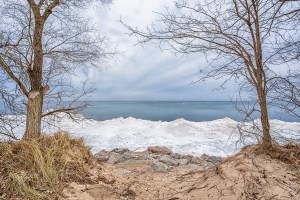 Following a weekend during which temperatures fell to zero or below in some places, I photographed yesterday the forming shoreline ice shelf, as well as icebergs dotting Lake Michigan. Ever since I was young, weather has interested me. I kept a climate tracking chart and examined meteorological maps during high school. My son has displayed a similar interest. He records daily fluctuations of high and low temperatures, as well as precipitation amounts, in a notebook, and he follows reports on television by each of the local meteorologists, whose on-screen personalities he knows well. Mostly, cold weather has always fascinated me. I enjoy hiking in frigid conditions, especially if snow is swirling all around. More than three decades ago, just two weeks after I moved to Indiana in the middle of winter, I had to drive a couple hundred miles across the state on a night the thermometer dipped to -22 degrees (wind chills were -40). An efficient heater kept the interior of my car warm; however, when I stopped at a roadside diner for a bite to eat, I lingered in the parking lot and briefly walked through the small town merely to experience that deep freeze gripping the Midwest. Consequently, I appreciate the arctic-like conditions one often finds during January and February in northwest Indiana. If necessary—with snow pants, heavy boots, an insulated parka, stocking cap, and convertible hunter’s gloves—I can feel comfortable even when the temperature nears zero. Traveling trails in the Indiana Dunes or beaches beside Lake Michigan while carrying my camera and tripod seeking to capture scenic wintry landscape images, I appreciate an absence of others on the paths or stretches of sand I select—the silence only broken by a whistle of wind gust or the crackling of stiffened tree limbs overhead. Stones, bark, and other natural objects can be coated with glistening ice. The surfaces of ponds might appear polished. Each location seems ethereal and inspirational.
∼ January 9, 2017 ∼ “Word and Image”
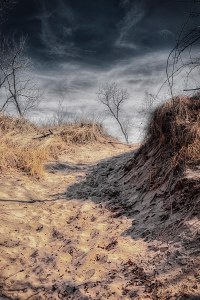 As evidenced by this journal, I frequently combine a couple of elements when relating my experiences in the Indiana Dunes: writing and photography. Using word and image to present and reflect upon the natural landscape, I recognize similarities between the two media. In fact, walking a winding way through winter woods or over a high ridge, I am reminded of some observations Robert Frost once offered in “The Figure a Poem Makes” about his composition of poetry. While I wonder what natural settings might be found along the path beyond the trail twisting ahead, and I wait to be rewarded by surprise, I recall Frost’s well-known comment: “No surprise for the writer, no surprise for the reader.” Frost continues in his essay with additional insight: “I have never started a poem yet whose end I knew. Writing a poem is discovery.” I always mention that one of my main pleasures in composition is precisely the process of discovery involved. Just as I enjoy finding fresh places for photographs when hiking new routes, I always like the arrival at unexpected destinations reached through the journey of writing. Frost further suggests in his essay that coming to an end point through an indirect course can prove more interesting: “Step by step the wonder of unexpected supply keeps growing…. The line will have the more charm for not being mechanically straight. We enjoy the straight crookedness of a good walking stick.” Likewise, I prefer passages curving through the forest undergrowth or disappearing over a dune slope, concealing the scenery before me. For me, images like the one in this photo hint at mystery and unpredictability, as well as the promise of more unanticipated, and possibly even delightful, destinations.
∼ January 8, 2017 ∼ “Fallen Tree”
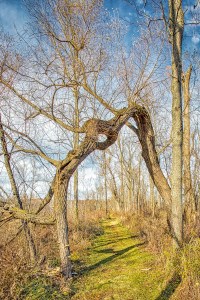 Henry David Thoreau wrote in “The Allegash and East Branch” from The Maine Woods about a time camping with others when he nervously noticed a “branch, rising thirty feet or more, slanted directly over the spot which we had chosen for our bed.” He added: “It is a common accident for men camping in the woods to be killed by a falling tree.” I am not sure about the accuracy of his observation, but I am always fascinated by the limbs of trees looming overhead or those that have toppled to the earth. Indeed, I am often intrigued when I come across a felled tree while hiking. I have taken a number of photos in the past of tree trunks leaning over trails I’ve traveled. Recently, I captured an image of a tree arching over the Great Marsh Trail, appearing almost as if it were an elaborate entranceway inviting hikers to explore the curious and extraordinary landscape beyond it. Though in some way such a scene—a spectacle in which a magnificent object that has stood tall for a long time has been taken down—seems sad, I also admire the beauty of its naturally artistic presence, especially in winter when the exquisite skeletal structure, gnarled and twisted, has been exposed, and its aesthetic elegance yet remains evident for all to see.
∼ January 7, 2017 ∼ “Dynamic Dunes”
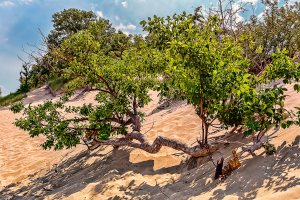 Before this journal advances too far, I should explain why I find the Indiana Dunes so appealing and why the setting never seems to become stale, even after repeated visits. The topography of the Indiana Dunes along Lake Michigan provides both location and inspiration for my photography. Indeed, I am always amazed at the engaging landscape, especially since the scenery constantly alters with the seasonal variations and changing weather conditions. Additionally, the terrain also transforms over time due to onshore winds that shift sands and rearrange the coastline. Though imperceptible, the dunes are always moving, migrating with the assistance of persistent currents. In some years the long and level beach seems to expand to offer a wide buffer before one encounters the first rise of dune mounds. In other years, winter’s storms erode the lakefront so much that little is left of the sandy expanse previously experienced. Strong northern gusts (with the assistance of sharp angling sunlight from the south) also contribute to the natural artistry witnessed in twisted trees limbs along dune slopes or ridges. Eventually, many trees are in danger of becoming buried by dune drifts, as seen in this image. In fact, sections of the Indiana Dunes contain “tree graveyards.” By the end of last winter, the mouth of Dunes Creek, where it empties into Lake Michigan, had completely changed course and been redirected hundreds of yards to the west apparently by months of powerful gales and accumulation of an ice shelf. Consequently, the creek had cut across the state park’s most popular beach for bathers in summer. Part of the park personnel’s tasks in spring involved restoring the normal course of the creek. Nevertheless, this ever-changing and active characteristic provides a dynamic quality in the environment at the Indiana Dunes that season after season keeps surprising and impressing me.
∼ January 6, 2017 ∼ “Deer Crossing”
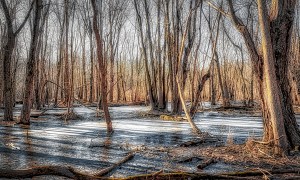 I like to photograph scenes in swamp forests of the Indiana Dunes during winter on mornings after an overnight frost. The floor of the forest has frozen over, the surface of its shallow water forming a thin skin of white ice. Trunks and bare branches twist toward an ash gray canopy of mostly overcast sky, though enough filtered sunshine sometimes enters between trees to brighten patches among the dark woods and provide light for my photos. Deep in such a setting, where any wind is diminished and a quiet complements the stillness in the air, all seems serene. Preparing to preserve this image by positioning my tripod and modifying settings on my camera a couple of days ago, the calm suddenly became chaotic as I heard a thunderous noise from a disturbance somewhere nearby. Looking up from the viewing screen on the back of my camera, I watched as a massive and muscular deer darted from left to right, running and rumbling through the maze of trees, crossing about forty feet in front of me. Hooves clattered and crashed through the hardened top layer of swamp water, shattering the ice into large shards with each leap forward. Unfortunately, my lens and focus adjustments were unprepared to capture this glorious intrusion. The clamor continued about another fifteen seconds until muffled and hushed as the lone deer disappeared into the distance. Then, as I paused for a moment filled with regret that I had missed the chance at a thrilling picture, a peaceful silence returned.
∼ January 5, 2017 ∼ “Dudley and Photography”
 Frank V. Dudley remains well known today as the “Painter of the Dunes,” whose persuasive artworks drew attention to the magnificence of the Indiana Dunes and helped promote the need for preservation of the lake shore in the early twentieth century. I have written in the past about how my photos, like the one seen here, are sometimes impacted by perspectives evident in Dudley’s paintings. His importance as an artist contributing to the cause of protecting the landscape along the southern edge of Lake Michigan had been recognized during his lifetime—even to the point that he was permitted to keep his cottage studio among the dunes, after the State of Indiana assumed ownership, for an annual rental fee of “one large original oil painting”—and his reputation as a crucial figure who championed the Indiana Dunes has grown greater since his death sixty years ago in 1957. However, as a photographer, I’d also like to remind everyone Frank was introduced to the area and encouraged to depict its attributes by his brother, Clarence, who managed the Dudley family’s photography business in Chicago and enthusiastically shared photos of his trips to the Indiana Dunes. Moreover, Frank’s painting process often involved visualizing by framing scenes with photographic equipment or retaining images with camera color slides for later reproduction by brushstroke on his canvas. Therefore, I am pleased to note, in addition to his paintings influencing my photography, to some extent photography influenced Dudley’s choice of subject matter and his working process for paintings.
∼ January 4, 2017 ∼ “Walking in Winter”
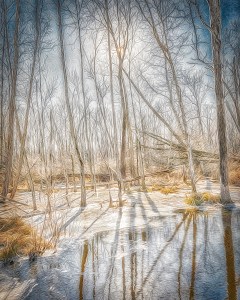 In “A Winter Walk”—one of my favorite Thoreau essays, published early (1843) in his career and more than a decade before Walden—the author exalts about “the wonderful purity of nature” witnessed in winter, especially following a fresh snowfall or when the bare trees are frosted white with ice. His words come closest to expressing the spiritual delight I often experience when hiking through woods or marsh, even on a frigid winter day. Thoreau remarks about a respect for the “sturdy innocence” in wintry scenery. In an excerpt that addresses the atmosphere created during this season, he writes: “All things beside seem to be called in for shelter, and what stays out must be a part of the original frame of the universe, and of such valor as God himself. It is invigorating to breathe the cleansed air. Its greater fineness and purity are visible to the eye, and we would fain stay out long and late, that the gales may sigh through us, too, as through the leafless trees, and fit us for the winter—as if we hoped to borrow some pure and steadfast virtue, which will stead us in all seasons.”
∼ January 3, 2017 ∼ “Peaceful View”
 The Indiana Dunes State Park invites hikers to a New Year’s Day “First Day Hike” each year, and as I was walking along a winding route through the woods between Dunes Creek and Lake Michigan, I could hear voices from some of the hundreds of participants in the distance. Since the weather was unseasonably mild, many had gathered to start 2017 with a casual stroll through nature. The organized event follows a few of the more popular trails to the tops of three dune peaks—Mt. Holden, Mt. Jackson, and Mt. Tom—each just under 200 feet high, and this occasion offers an excellent opportunity for promoting the park. Avoiding the crowd climbing the “Three-Dune Challenge,” since I already have ascended the peaks a number of times on my own, I stayed on a less-traveled path about a half mile east and leading to one of my favorite locations, an opening at a lower dune ridge that nevertheless overlooks the beach, presenting a perfectly peaceful view of the lake.
∼ January 2, 2017 ∼ “New Year’s Reflections”
 “The trees reflected in the river—they are unconscious of a spiritual world so near to them. So are we.” —Nathaniel Hawthorne Even though an imaginary concept, I consider the first image captured in a new year to be illustrative of a state of mind, especially since I view the natural world as representative of intellectual or spiritual concerns. Like the Romantic writers I admire, I find connections between elements defining the outer landscape of our surroundings and those aspects determining the inner landscape of human emotion. Therefore, when I photographed this vista from one of my favorite locations along the Little Calumet River Trail early on New Year’s Day, the characteristics seemed somewhat symbolic and mysterious. Though the morning was unusually mild for the beginning of January, so that all the snow had melted except for a few swatches on one bank, the dominance of leafless trees—on land and reflected in the river—still emphasized an absence associated with winter. In addition, thoughtful reflection suggested the disappearance of the river into a distant horizon signified the unknown future course of the upcoming twelve months.
∼ January 1, 2017 ∼ “Each New Year Is a Surprise”
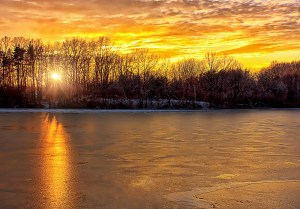 I begin this journal mindful that 2017 marks the 200th anniversary of Henry David Thoreau’s birth year. As I mention in my introduction for this web site, the influence of Thoreau’s comprehensive commentary kept in his journals for decades often will be evident in the entries included here. I regularly return to the collected works of Thoreau and read with great interest his observations on nature or speculations about the human spirit. Just yesterday afternoon, as the last sunset of December lit a distant skyline of bare trees, I browsed some of his writings, and I was reminded of a simple yet reassuring remark noted in an 1858 log: “Each new year is a surprise to us.” Consequently, at this start of a new year I initiate a personal chronicle, which will consist of brief informal musings or reflective evaluations on various events and experiences, with little more than an eagerness to discover what surprise lies ahead.
 Indiana Dunes